
CIV-440 · Lesson 11 of 12 · 22 min
Frost action and cold-region geotechnics
Duluth has long, cold winters, and frost shapes almost every geotechnical decision there: how deep footings and pipes are placed, what backfill is used behind walls, how pavements are built and when excavations can be left open. Frost causes two distinct problems. In winter, water drawn to the freezing front forms lenses of ice that heave the ground, lifting footings, slabs, walls and pipes, and freezing soil grips buried structures and lifts them. In spring, the ice lenses melt from the top down, releasing more water than the soil can hold, and the soil loses much of its strength for a few weeks. Further north, the ground stays frozen all year, and the problems of permafrost are of a different order. This lesson covers all three, and applies them to the Kestrel Bay works.
How frost heave happens
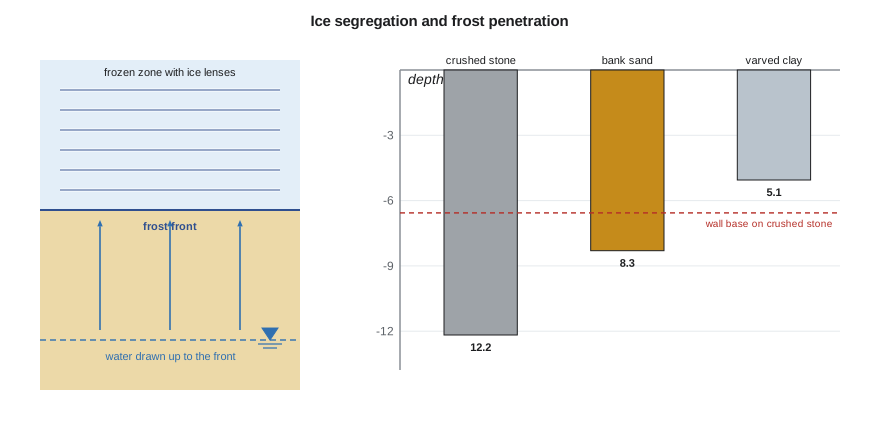
If saturated soil simply froze in place, it would expand by the 9 % volume increase of water turning to ice, a modest heave. Real frost heave is often many times larger, because of ice segregation. Below 0 °C, water in the smallest pores and in films around the particles remains unfrozen, and suction at the freezing front draws water up from the unfrozen soil below. It freezes on growing lenses of clear ice, which push the soil apart. Heave continues as long as water can reach the front and the front stays in the soil long enough. Three conditions are therefore needed: a frost-susceptible soil, freezing temperatures that hold the front in it, and a supply of water.
Frost susceptibility depends on the fine fraction of the soil. Clean gravels and sands, with large pores and little suction, do not form ice lenses. Silts are the worst: fine enough to develop strong suction but permeable enough to deliver water quickly. Clays develop high suction but transmit water slowly, so their heave depends on how long the front stays in them. Casagrande's criterion, still the basis of most practice, regards soils with more than about 3 % of particles finer than 0.02 mm as potentially frost-susceptible. The U.S. Army Corps of Engineers classifies soils into frost groups F1 to F4 by their fines content and type, from gravelly soils with little fines (F1) to silts, fine silty sands and varved clays (F4). The segregation potential, measured in laboratory freezing tests, quantifies the rate of heave per unit temperature gradient.
| Soil at Kestrel Bay | Fines < 0.02 mm | Frost group (Corps) | Behavior |
|---|---|---|---|
| Crushed stone base | under 3 % | non-frost-susceptible | stable |
| Bank sand (SP-SM) | about 3 % | borderline, low | little heave; drains readily |
| Silt lenses in the sand | over 50 % | F4 | high heave and thaw weakening |
| Varved clay (CL) | about 60 % | F4 (varved clays) | heave if water is available; weak on thaw |
How deep frost reaches
The depth of frost penetration depends on the severity of the winter, the surface cover, the thermal properties of the soil and, above all, its water content, because the latent heat of the water must be removed before the soil can freeze. The severity of the winter is measured by the air freezing index, the sum over the winter of the degrees below 0 °C of the daily mean temperature, in degree-days. The surface freezing index is the air index times an n-factor: about 0.9 for a pavement kept clear of snow, and much less under a snow cover, which insulates the ground. A cleared road or sidewalk freezes much deeper than a snow-covered lawn beside it.
Stefan's solution, which ignores the heat stored in the soil and assumes all the heat removed comes from freezing water, gives the depth of frost as
where \(k_f\) is the thermal conductivity of the frozen soil, \(n F\) the surface freezing index in degree-seconds and \(L\) the volumetric latent heat, \(334\ \text{kJ/kg} \times \rho_d w\). It overestimates the depth, because the warm ground below the front also supplies heat. The modified Berggren equation multiplies Stefan's result by a coefficient \(\lambda\), less than 1, that depends on the ratio of the heat capacity to the latent heat and on the mean annual temperature; it is derived from Neumann's exact solution for freezing of a semi-infinite medium, which the script solves directly. The Corps of Engineers and state DOTs use these methods, calibrated against observed frost depths, for pavement design.
Worked problem
Frost penetration under Ridgeway Road
Take a design air freezing index of 2,900 °F·days, an illustrative value for a cold winter at the site, an n-factor of 0.9 for a cleared road and a freezing season of 150 days, with a mean annual ground temperature of 2.5 °C (about 36 °F). Estimate the frost depth in the bank sand (dry density 106 pcf, water content 12 %), the varved clay (dry density 81 pcf, water content 38 %) and crushed stone (dry density 131 pcf, water content 4 %).
Show solution
- Mean surface temperature over the season, working in SI units: 2,900 °F·days is 1,611 °C·days, so \(-0.9(1611)/150 = -9.7\) °C (14.5 °F).
- Latent heat of the sand: \(334 \times 1700 \times 0.12 = 68\) MJ/m³; of the clay, 165 MJ/m³; of the stone, 28 MJ/m³.
- Stefan's estimate for the sand, with \(k_f = 2.2\) W/m·K:
- \[X = \sqrt{\frac{2(2.2)(9.6)(150 \times 86{,}400)}{68 \times 10^6}} = 2.83\ \text{m}\]
- Neumann's solution, which includes the heat from the unfrozen ground, reduces this to 8.3 ft for the sand, 5.1 ft for the clay and 12.2 ft for crushed stone.
Answer: Under a cleared surface in a cold winter, frost could reach about 8 ft in the sand and more in dry granular base. The wet clay freezes much less deeply because of its large latent heat. These are upper estimates for uniform soil; a real pavement structure, with layers and snow at its edges, freezes less deeply, which is why observed frost depths and code values are the primary guide and calculations are used to compare cases.
The script solves Neumann's equation for each soil, then estimates frost heave by the segregation potential method and the adfreeze uplift on a steel pipe foundation.
# Frost penetration (Neumann solution, the basis of the modified Berggren method), frost heave and adfreeze uplift
from math import erf, erfc, exp, sqrt, pi
UNITS = "US"
SI = UNITS == "SI"
F_air = 1600.0 if SI else 2900.0                  # design air freezing index, deg C days | deg F days (illustrative design value)
F_C = F_air if SI else F_air / 1.8
days, nf, T_mean = 150.0, 0.9, 2.5                # freezing season, n-factor for a cleared road surface, mean annual temperature (deg C)
Ts = -nf * F_C / days                             # mean surface temperature in the freezing season, deg C
t = days * 86400.0
SOILS = {  # name: dry density kg/m3, water content, k frozen, k unfrozen (W/m K) -- typical values
    "bank sand (SP-SM)": (1700.0, 0.12, 2.2, 1.6),
    "varved clay (CL)": (1300.0, 0.38, 1.8, 1.2),
    "crushed stone base": (2100.0, 0.04, 2.4, 2.0)}
def depth(rho_d, w, kf, ku, T0=T_mean):
    Lv = 334e3 * rho_d * w                          # volumetric latent heat, J/m3
    cs = 840.0 * rho_d; cwf, cwu = 2090.0 * rho_d * w, 4190.0 * rho_d * w
    Cf, Cu = cs + cwf, cs + cwu                     # volumetric heat capacities, frozen and unfrozen
    af, au = kf / Cf, ku / Cu; r = sqrt(af / au)
    def f(x):  # Neumann's transcendental equation, freezing point 0 deg C
        return (kf * (0 - Ts) * exp(-x * x) / (erf(x) * sqrt(af)) - ku * (T0 - 0) * exp(-x * x * r * r) / (erfc(x * r) * sqrt(au))
                - x * sqrt(pi) * Lv * sqrt(af))
    lo, hi = 1e-4, 3.0
    for _ in range(80):
        m = (lo + hi) / 2
        if f(m) > 0: lo = m
        else: hi = m
    X = 2 * m * sqrt(af * t)
    X_stefan = sqrt(2 * kf * (0 - Ts) * t / Lv)
    return X, X_stefan
lab = lambda x: f"{x:.2f} m" if SI else f"{x*3.281:.1f} ft"
Tshow = f"{Ts:.1f} deg C" if SI else f"{Ts*1.8+32:.1f} deg F"
print(f"Air freezing index {F_air:.0f} {'deg C days' if SI else 'deg F days'}; surface index (n = {nf}) {nf*F_air:.0f}; mean surface temperature {Tshow} over {days:.0f} days")
for name, (rd, w, kf, ku) in SOILS.items():
    X, Xs = depth(rd, w, kf, ku)
    print(f"  {name:20s}: frost depth {lab(X)} (Stefan, ignoring the warm ground below: {lab(Xs)})")
# frost heave by the segregation potential method (illustrative SP values)
grad, tf = 0.02, 60 * 86400.0                     # temperature gradient at the frost front (deg C/mm), time front sits in the soil (s)
for name, SP in (("bank sand", 10e-5), ("varved clay or silt", 100e-5)):
    heave = 1.09 * SP * grad * tf                 # mm
    print(f"Segregation heave, {name}: SP = {SP*1e5:.0f} x 10^-5 mm2/(s.deg C) -> about {heave:.0f} mm" if SI else
          f"Segregation heave, {name}: SP = {SP*1e5:.0f} x 10^-5 mm2/(s.deg C) -> about {heave/25.4:.1f} in.")
# adfreeze uplift on a steel pipe foundation for a sign structure
d, Xf, tau = (0.324, 1.8, 100.0) if SI else (12.75 / 12, 6.0, 2000.0)       # diameter, frozen depth along the pile, adfreeze strength
Up = pi * d * Xf * tau
print(f"Adfreeze uplift on a {d*1000:.0f} mm pipe frozen over {Xf} m: {Up:.0f} kN" if SI else
f"Adfreeze uplift on a {d*12:.2f} in. pipe frozen over {Xf:g} ft: {Up/1000:.1f} kips")Air freezing index 2900 deg F days; surface index (n = 0.9) 2610; mean surface temperature 14.6 deg F over 150 days bank sand (SP-SM) : frost depth 8.3 ft (Stefan, ignoring the warm ground below: 9.3 ft) varved clay (CL) : frost depth 5.1 ft (Stefan, ignoring the warm ground below: 5.4 ft) crushed stone base : frost depth 12.2 ft (Stefan, ignoring the warm ground below: 15.2 ft) Segregation heave, bank sand: SP = 10 x 10^-5 mm2/(s.deg C) -> about 0.4 in. Segregation heave, varved clay or silt: SP = 100 x 10^-5 mm2/(s.deg C) -> about 4.4 in. Adfreeze uplift on a 12.75 in. pipe frozen over 6 ft: 40.1 kips
Designing for frost
Foundations are protected from frost heave by placing them below the frost depth, by founding them on non-frost-susceptible material that extends below it, or by insulating the ground. The Minnesota State Building Code sets a frost depth of 5 ft for footings in northern counties, including St. Louis County, where Duluth is. Water mains and services are buried deeper still, because a frozen water main is a serious failure; in the cities around Lake Superior they are typically placed well below the footing depth, or insulated.
Frost-protected shallow foundations use horizontal insulation, usually extruded polystyrene, around and under the edge of a heated building to keep the ground above freezing with much less embedment; ASCE 32 gives the U.S. design method, and design guides give the insulation needed for each climate. For unheated structures, insulation must be placed under and around the whole foundation. For the Ridgeway Road wall, the base is founded in the sand, which is at most slightly frost-susceptible, on a 12 in. layer of clear crushed stone, with 2 in. of insulation board extending 4 ft in front of the toe beneath the sidewalk to limit frost penetration under the cleared walk.
Behind retaining walls, frost can act against the wall: a frost-susceptible backfill that freezes from the exposed face can push the wall outward and crack it. Free-draining granular backfill, an insulated drain, and drain outlets that do not freeze shut are the remedies. Lesson 2 noted that blocked outlets are a cause of water pressure behind walls; in a cold climate the outlet must be detailed to stay open, by discharging below the frost depth into a drain or by a heat-traced or insulated outlet.
Adfreeze
When soil around a pile, a post or a wall freezes and then heaves, it grips the structure and tries to lift it. The adfreeze bond between frozen soil and steel, timber or concrete can reach values of the order of 2,000 psf in design, and more in short tests. On a sign or light standard founded on a steel pipe, the uplift is
where \(X_f\) is the frozen length of the pipe. For a 12.75 in. pipe frozen over 6 ft, the uplift is about 40 kips, many times the weight of a sign structure. It must be resisted by the shaft resistance of the pile in the unfrozen soil below, or reduced by a bond breaker, such as a greased sleeve or a wrap of plastic sheeting, over the frozen zone. Piles in permafrost are designed the other way round, to use adfreeze for their capacity.
Thaw weakening and pavements
In spring, the frozen ground thaws from the surface down. The thawed layer cannot drain downward through the frozen soil below, and the water released by the ice lenses saturates it, often at water contents above the soil's original value. For a few weeks the subgrade is weak, and heavy trucks can break up pavements that are perfectly adequate the rest of the year. Northern road authorities impose seasonal load restrictions during the thaw for this reason. Pavements in cold regions are designed with non-frost-susceptible granular layers thick enough to limit frost penetration into the subgrade, or to carry loads during thaw, and with drainage to remove the thaw water quickly.
Permafrost
Permafrost is ground that remains at or below 0 °C for at least two consecutive years. It underlies about half of Canada and most of Alaska, continuously in the far north and in discontinuous patches further south, where it is often only a few degrees below freezing and very sensitive to disturbance. Above it lies the active layer, which thaws each summer. Ice-rich permafrost, with segregated ice and ice wedges, settles severely when it thaws, and the removal of vegetation, the heat from a building or a road embankment, or a warming climate can all start that thaw.
Design in permafrost follows one of two approaches. Where the ground is thaw-stable rock or gravel, it can be allowed to thaw. Where it is ice-rich, it is kept frozen: buildings are raised on piles or ventilated pads so that cold air passes beneath them, embankments are built thick or with air convection layers, and thermosyphons, sealed tubes that carry heat out of the ground in winter, are installed under foundations and along pipelines. The design must now consider the warming of permafrost over the life of the structure, which is already causing settlement and damage in northern communities. Kestrel Bay is far south of permafrost; the principles are included because engineers trained in the south are often called north.
Practical points
- Identify frost-susceptible soils from their fines; treat silts and varved clays as highly susceptible.
- Use the code frost depth for foundations, and calculations to compare cleared and covered surfaces.
- Found on, or replace with, non-frost-susceptible material, or insulate.
- Detail wall drains and outlets so they do not freeze, and use bond breakers on posts and piles through frozen ground.
- Protect the base of winter excavations in clay from freezing with insulated blankets or heating.
Common mistakes
MistakeUsing the frost depth under a snow-covered lawn for a cleared sidewalk or pavement.
InsteadCleared surfaces freeze much deeper; use an n-factor near 0.9.
MistakeTreating a sand with a few percent of silt as non-frost-susceptible without checking the fines finer than 0.02 mm.
InsteadAbout 3 % finer than 0.02 mm is the threshold; silt lenses heave strongly.
MistakeIgnoring adfreeze on light structures founded on steel pipes.
InsteadThe uplift can exceed their weight many times; provide a bond breaker or sufficient embedment.
MistakeAllowing the base of an excavation in clay to freeze before concrete is placed.
InsteadFrozen and thawed clay is weakened and heaves; protect it.
Summary and key terms
- Frost heave comes mainly from ice segregation, which needs a frost-susceptible soil, freezing and water.
- Casagrande: soils with more than about 3 % finer than 0.02 mm may be frost-susceptible; silts and varved clays are the worst (F4).
- Frost depth: Stefan \(X = \sqrt{2k_f nF/L}\), reduced by the modified Berggren coefficient; cleared surfaces freeze deepest.
- Protection: found below frost depth, on non-frost-susceptible material, or insulate.
- Adfreeze uplift \(U = \pi d X_f\tau_{ad}\) can lift light foundations; spring thaw weakens subgrades.
- Permafrost is kept frozen with ventilated foundations and thermosyphons, or allowed to thaw where it is thaw-stable.
- Frost heave
- Upward movement of the ground caused by freezing, mainly by the growth of ice lenses.
- Ice segregation
- The formation of lenses of ice in freezing soil from water drawn to the freezing front.
- Frost-susceptible soil
- A soil in which significant ice segregation can occur.
- Freezing index
- The sum of degrees below freezing of the daily mean temperatures over a winter, in degree-days.
- n-factor
- The ratio of the surface freezing index to the air freezing index.
- Adfreeze
- The bond between frozen soil and a structure in contact with it.
- Thaw weakening
- The loss of strength of a soil in spring when ice lenses melt and the soil cannot drain.
- Permafrost
- Ground that remains at or below 0 °C for at least two consecutive years.
Practice problems
Work each problem on paper first, then reveal the answer to check.
Compute the volumetric latent heat of a silt with a dry density of 94 pcf and a water content of 25 %.
Show answer
\(334 \times 1500 \times 0.25 = 125\) MJ/m³.
Using Stefan's equation with \(k_f = 1.8\) W/m·K, a surface freezing index of 1,200 °C·days and \(L = 125\) MJ/m³, estimate the frost depth.
Show answer
\(X = \sqrt{2(1.8)(1200 \times 86{,}400)/(125 \times 10^6)} = 1.73\) m (5.7 ft).
A 12 in. post is frozen over 5 ft with an adfreeze strength of 2,000 psf. Find the uplift.
Show answer
\(U = \pi(1.0)(5)(2{,}000) = 31{,}400\) lb.
Why is a varved clay classed among the most frost-susceptible soils?
Show answer
Its silt partings combine high suction with paths that deliver water to the freezing front, so ice lenses grow readily.
Lesson quiz · 5 questions
Score 60% or more to complete this lesson.
Create a free account to save your progress, take quizzes and earn a certificate.