
CIV-280 · Lesson 12 of 12 · 21 min
Environmental assessment and approvals
The cheapest time to prevent environmental harm is before a project is built. Environmental assessment (EA) is the process of predicting the environmental, social, health and economic effects of a proposed project, comparing alternatives, finding ways to avoid or reduce harm, and giving decision makers and the public the information they need to decide whether and how the project should proceed. Since the United States passed the National Environmental Policy Act in 1970, EA has spread to nearly every country. This lesson describes the general EA process, the federal systems in Canada and the United States and how they changed between 2023 and 2026, the other permits a typical water project needs, methods for predicting and judging impacts, and the role of the public and Indigenous peoples.
Willowbend's largest job this term is the environmental review of a new raw water intake on the Big Sioux River and an off-stream reservoir to store spring runoff for the city's treatment plant (lesson 7). The project would flood about 180 ha (450 acres) of farmland and a small wooded draw, build a pumping station and intake screen in the river, and lay 6 km of pipeline. Martin leads the review; Nadia is responsible for the water quality and air quality chapters and the impact matrix.
The general environmental assessment process
Whatever the jurisdiction, assessments follow similar steps. Screening decides whether a project needs an assessment at all and at what level. Scoping identifies the issues that matter, the valued components to study (such as fish, groundwater, air quality, heritage sites or Indigenous rights) and the boundaries in space and time. Baseline studies describe existing conditions, often over at least a full year to capture seasons. Impact prediction estimates how the project will change each component during construction, operation and closure, using the mass balance, kinetics, water quality and dispersion tools from earlier lessons. Mitigation designs measures to avoid, reduce or offset the effects, and residual effects are those that remain after mitigation. The significance of residual effects is then judged against criteria. Alternatives, including different sites, designs and the option of not proceeding, are compared. The process ends with a decision, conditions and a follow-up program that checks whether predictions were right and mitigation works.
Cumulative effects deserve special mention. A single project may have a small effect, but combined with past, present and reasonably foreseeable future projects in the same watershed or airshed, the total can be large. A river may handle one new outfall but not the fifth. Good assessments set study areas large enough to see these combined effects.
Canada's system and state reviews
Canada's federal Impact Assessment Act of 2019 is a useful comparison. It applies to designated projects such as large mines, pipelines and dams, and in 2023 the Supreme Court of Canada found parts of it beyond federal authority. Parliament amended it in June 2024 to focus on adverse effects within federal jurisdiction, such as fish, migratory birds, federal lands and effects on Indigenous peoples, and to make it easier to rely on provincial assessments.
For a US project, however, the governing law is NEPA, which applies whenever a federal agency proposes, funds or permits an action. A water project that needs a Clean Water Act Section 404 permit from the US Army Corps of Engineers, or federal funding, is a federal action subject to NEPA.
Many states have their own environmental review laws, often called little NEPAs, which apply to state and local actions. California's Environmental Quality Act is the best known. Projects that are both federal actions and subject to a state law usually prepare joint documents to avoid duplication.
NEPA in the United States
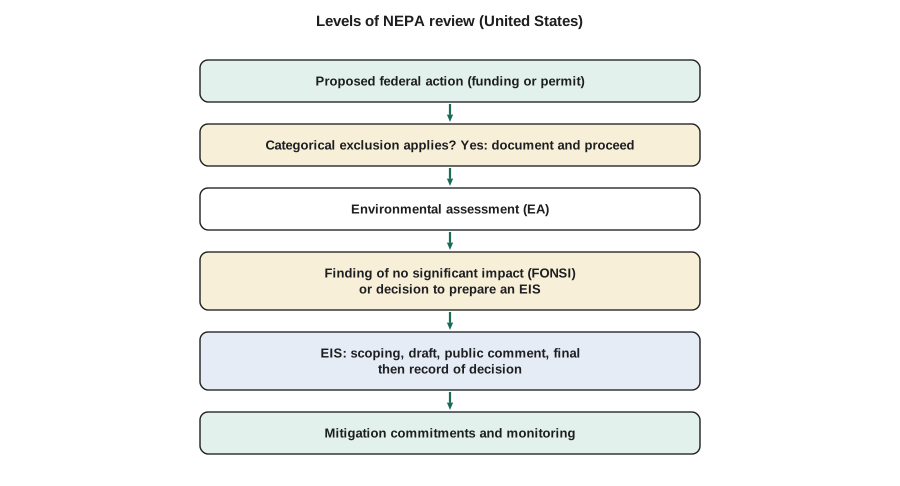
The National Environmental Policy Act requires federal agencies to consider the environmental effects of their proposed actions before deciding. Agencies use three levels of review. A categorical exclusion applies to classes of actions that the agency has found normally have no significant effects. An environmental assessment (EA) is a shorter analysis that ends either in a finding of no significant impact (FONSI), often with mitigation commitments, or in a decision to prepare an environmental impact statement (EIS). An EIS, for actions that may significantly affect the environment, involves scoping, a draft statement open for public comment, a final statement and a record of decision. NEPA is procedural: it requires agencies to take a hard look at effects and reasonable alternatives and to disclose them, but it does not require them to choose the least harmful option.
NEPA changed substantially between 2023 and 2026. The Fiscal Responsibility Act of June 2023 amended the statute itself, adding page limits (generally 150 pages for an EIS and 75 for an EA, longer for complex projects) and deadlines (generally two years for an EIS and one year for an EA), and naming a lead agency to coordinate reviews. In 2025 the Council on Environmental Quality, which had issued binding NEPA regulations since 1978, removed them with an interim final rule effective April 11, 2025, and made the removal final in January 2026; each agency now follows its own NEPA procedures, many of them revised in mid-2025. In May 2025 the Supreme Court, in Seven County Infrastructure Coalition v. Eagle County, held that courts must give agencies substantial deference on the scope and depth of their NEPA analyses and that agencies need not analyze the effects of separate upstream or downstream projects. Practitioners now check the procedures of the specific lead agency at the start of every project.
For Willowbend's reservoir, the lead federal agency would be the Corps of Engineers because of the Section 404 permit needed to place fill in wetlands and the river. Under the Corps' procedures, Martin expects an EA with a FONSI if mitigation for wetland losses is adequate, rather than a full EIS.
Other approvals for a water project
An assessment rarely stands alone. A reservoir and intake typically need several permits, each with its own technical requirements:
| Approval | Authority | Why it applies |
|---|---|---|
| Section 404 permit | US Army Corps of Engineers | Placing fill in wetlands and the river |
| Section 401 water quality certification | State environmental agency | Confirms the federal permit meets state water quality standards |
| Water right permit | State water rights program | Diverting and storing river water |
| Endangered Species Act consultation | US Fish and Wildlife Service | If listed species or critical habitat may be affected |
| National Historic Preservation Act Section 106 | State Historic Preservation Office | Historic and archaeological sites in the flooded area |
| Construction stormwater permit | State NPDES program | Disturbing more than one acre during construction |
| Drinking water source approval | State drinking water program | The new source and treatment plant |
Predicting and judging impacts
Impact prediction uses the quantitative methods of the field: water quality models predict downstream concentrations, dispersion models predict air quality, groundwater models predict drawdown, habitat models predict fish populations, and noise models predict sound levels at homes. Where models are weak, as for many ecological effects, assessments rely on studies of similar projects and expert judgment, and say so. Uncertainty is stated openly, and follow-up monitoring is designed to catch predictions that turn out wrong.
Significance is judged with criteria such as magnitude (how big the change is), geographic extent, duration, frequency, reversibility and the sensitivity or ecological and social context of the receiving environment. Many assessments organize the results in an interaction matrix, an approach that goes back to Luna Leopold's 1971 matrix, with project activities as rows and environmental components as columns. Scoring each interaction makes the reasoning transparent and lets reviewers see which assumptions drive the conclusions.
Worked problem
Scoring residual effects
Nadia scores each residual effect from 1 (low) to 3 (high) for magnitude, extent, duration and reversibility, multiplies the four scores and calls a product of 24 or more potentially significant. Loss of wooded habitat in the flooded area scores magnitude 2, extent 1, duration 3, reversibility 3. Construction dust at nearby farms scores 1, 1, 1, 1. Which is potentially significant?
Show solution
- \[\text{Habitat loss: } 2 \times 1 \times 3 \times 3 = 18\]
- \[\text{Construction dust: } 1 \times 1 \times 1 \times 1 = 1\]
Answer: Neither reaches the threshold of 24 under this scheme, but habitat loss, which is permanent and irreversible, comes close and deserves offsetting habitat elsewhere. Simple scores like these organize the discussion; they do not replace judgment, and changing the threshold or the scoring can change the answer, which is why the method and its sensitivity must be reported.
# Residual effects matrix for the intake and reservoir: product of four 1-3 scores
effects = {   # magnitude, extent, duration, reversibility
    "Wooded habitat flooded":       (2, 1, 3, 3),
    "Fish entrainment at intake":   (2, 2, 3, 2),
    "Downstream low-flow reduction":(2, 2, 2, 1),
    "Reservoir mercury in fish":    (2, 1, 3, 2),
    "Construction dust and noise":  (1, 1, 1, 1),
    "Archaeological sites":         (3, 1, 3, 3),
}
for threshold in (24, 18):
    print(f"Threshold {threshold}:")
    for name, s in sorted(effects.items(), key=lambda kv: -kv[1][0]*kv[1][1]*kv[1][2]*kv[1][3]):
        p = s[0] * s[1] * s[2] * s[3]
print(f" {name:31s} score {p:2d} {'POTENTIALLY SIGNIFICANT' if p >= threshold else ''}")Threshold 24: Archaeological sites score 27 POTENTIALLY SIGNIFICANT Fish entrainment at intake score 24 POTENTIALLY SIGNIFICANT Wooded habitat flooded score 18 Reservoir mercury in fish score 12 Downstream low-flow reduction score 8 Construction dust and noise score 1 Threshold 18: Archaeological sites score 27 POTENTIALLY SIGNIFICANT Fish entrainment at intake score 24 POTENTIALLY SIGNIFICANT Wooded habitat flooded score 18 POTENTIALLY SIGNIFICANT Reservoir mercury in fish score 12 Downstream low-flow reduction score 8 Construction dust and noise score 1
With the threshold at 24, only archaeological sites and fish entrainment are flagged; at 18, habitat loss is flagged too. The results point Nadia's team to the mitigation that matters most: a careful archaeological survey before flooding, an intake screen sized for slow approach velocities so that small fish can swim away, and habitat offsets. The matrix also reminds the team of reservoir mercury: flooding soil and vegetation releases mercury that bacteria convert to methylmercury, which accumulates in fish for years after a reservoir fills, a well-documented effect of reservoirs in Canada and the northern United States.
Public participation and Indigenous peoples
Assessment is a public process. Agencies publish draft documents, hold meetings and respond to comments, and the best reviews change the project in response. Federal agencies must consult with federally recognized Tribes on a government-to-government basis when actions may affect tribal lands, resources or rights, including under Section 106 of the National Historic Preservation Act for sites of religious and cultural significance. For the intake and reservoir, the Corps of Engineers and the city engage the Tribes with historical ties to the Big Sioux River valley.
Engineers contribute to assessment as authors of technical chapters, as designers of mitigation, and as people who explain technical results clearly to non-specialists. A well-run assessment is not an obstacle to good projects; it is how good projects are found and bad ones are improved or stopped before money and trust are spent.
Common mistakes
MistakeTreating the assessment as paperwork done after the design is fixed.
InsteadStart the assessment early so alternatives and mitigation can still change the design.
MistakeIgnoring cumulative effects because the project's own effect is small.
InsteadAssess the project together with other past, present and foreseeable activities in the same area.
MistakeRelying on rules or guidance that have since changed.
InsteadFederal processes in both countries changed between 2023 and 2026; check the current law and the lead agency's procedures at project start.
MistakeReporting a significance conclusion without the criteria behind it.
InsteadState the criteria, thresholds and uncertainty so reviewers can follow the reasoning.
Summary and key terms
- Environmental assessment predicts effects, compares alternatives, designs mitigation and informs decisions before a project is built.
- Steps include screening, scoping, baseline, prediction, mitigation, significance, alternatives, decision and follow-up; cumulative effects must be included.
- NEPA uses categorical exclusions, EAs with FONSIs and EISs; it was amended in 2023, CEQ's regulations were rescinded in 2025–2026, and Seven County (2025) increased deference to agencies.
- Water projects need several other approvals, such as fish habitat, wetland, water rights, species and heritage permits.
- Significance is judged by magnitude, extent, duration, reversibility and context, often with an interaction matrix.
- Public participation and consultation with Indigenous peoples are central to the process.
- Environmental assessment
- A process for predicting and evaluating the effects of a proposed project before decisions are made.
- Scoping
- Identifying the issues, valued components and boundaries an assessment will address.
- Valued component
- An environmental, social or cultural element considered important enough to assess.
- Mitigation
- Measures to avoid, reduce or offset adverse effects.
- Residual effect
- An effect that remains after mitigation.
- Cumulative effects
- Combined effects of a project with other past, present and foreseeable activities.
- Finding of no significant impact
- A NEPA document concluding that an action will not significantly affect the environment.
- Follow-up program
- Monitoring after approval to check predictions and the effectiveness of mitigation.
Practice problems
Work each problem on paper first, then reveal the answer to check.
Why is a no-project alternative included in an assessment?
Show answer
It provides the baseline against which the project's effects and benefits are judged.
Give an example of a cumulative effect for a river.
Show answer
Several outfalls, each acceptable alone, together lowering dissolved oxygen below the objective.
An effect scores magnitude 3, extent 2, duration 2, reversibility 2. Is it potentially significant with a threshold of 24?
Show answer
\(3 \times 2 \times 2 \times 2 = 24\), so yes.
Why does a new reservoir often raise mercury in fish?
Show answer
Flooded soil and vegetation release mercury that bacteria convert to methylmercury, which accumulates in fish.
What is the difference between mitigation and a residual effect?
Show answer
Mitigation reduces an effect; the residual effect is what remains afterward.
Why should engineers check the current law at the start of every assessment?
Show answer
Federal assessment law and procedures in both countries changed substantially between 2023 and 2026 and may change again.
Lesson quiz · 5 questions
Score 60% or more to complete this lesson.
Create a free account to save your progress, take quizzes and earn a certificate.