
CIV-280 · Lesson 11 of 12 · 22 min
Solid and hazardous waste
Everything a city consumes eventually becomes waste: packaging, food scraps, yard trimmings, old furniture, demolition debris, and a smaller but dangerous stream of solvents, batteries, paints and industrial residues. Managing that waste safely and cheaply is a core municipal service and a major engineering task. Done badly, it spreads disease, contaminates groundwater for decades, releases methane that warms the climate and creates sites that cost millions to clean up. Done well, it recovers materials and energy and leaves landfills that are stable and safe after closure. This lesson covers municipal solid waste and the waste management hierarchy, recycling and organics, landfill design, leachate and landfill gas, hazardous waste regulation, and the cleanup of contaminated sites.
Willowbend's landfill job concerns the city's old municipal landfill, which operated from the mid-1970s until 2005 on a site beside a creek. It was built before the federal Subtitle D liner requirements, and monitoring wells downgradient show leachate reaching the shallow groundwater. The state has asked the city to propose an improved cover and a monitoring and leachate management plan. At the same time, the city is planning the next cell at its new engineered landfill.
Municipal solid waste
Municipal solid waste (MSW) is the waste collected from homes, businesses and institutions, as distinct from industrial, construction and agricultural waste. The EPA's estimates put US MSW generation at roughly 2 kg (between 4 and 5 lb) per person per day, or close to 300 million US tons a year, of which about half is landfilled, about a third is recycled or composted and the rest is burned with energy recovery. Food waste, paper and paperboard, plastics and yard trimmings are the largest components.
Engineers measure waste in mass, because that is what scales and contracts use, but landfills and trucks are limited by volume, so density matters. Loose household waste at the curb weighs roughly 100 to 150 kg/m³, a compactor truck packs it to 300 to 450 kg/m³, and a landfill compactor reaches about 700 to 1,000 kg/m³ in place.
The waste management hierarchy
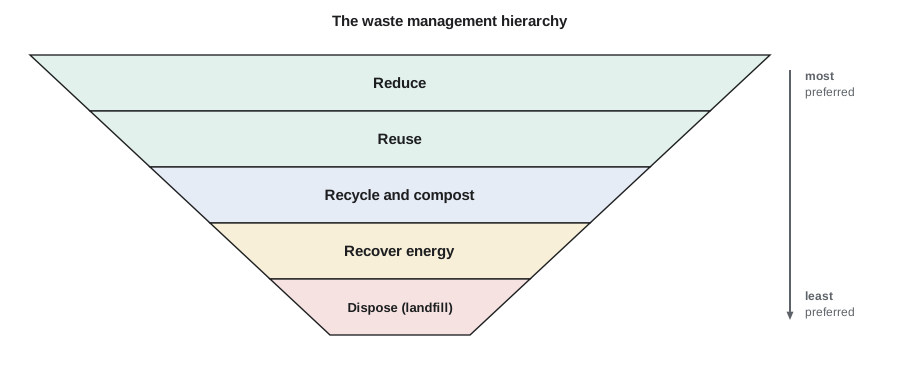
The hierarchy ranks options by environmental benefit: first reduce the amount of waste created, then reuse products, then recycle materials and compost organics, then recover energy from what remains, and only then dispose of the residue in a landfill. The hierarchy is a guide, not a rule, and life-cycle thinking sometimes changes the order for a particular material, for example when shipping a low-value recyclable a long distance uses more energy than it saves.
Extended producer responsibility (EPR) programs make manufacturers responsible for collecting and recycling their products at end of life. They are widespread in Canada, where provinces have EPR programs for packaging and paper, electronics, tires, batteries, paint and used oil, and they are growing in the United States, where several states have passed packaging EPR laws since 2021.
Recycling, composting and energy recovery
Recyclables are collected separately at the curb, either mixed in one bin (single-stream) or sorted by residents, and taken to a materials recovery facility (MRF), where screens, magnets, eddy current separators, optical sorters and workers separate them into bales for sale. Contamination, such as food residue, plastic bags and items that are not recyclable, lowers the value of the bales and has made some materials hard to sell since China restricted imports of mixed recyclables in 2018.
Organic waste can be composted, an aerobic process in which microorganisms turn food and yard waste into a stable soil amendment, or digested anaerobically to produce biogas and digestate. Diverting organics from landfill reduces methane, the main source of landfill greenhouse gas emissions. Energy-from-waste facilities burn residual waste in controlled combustion with steam generation and extensive air pollution control, reducing its volume by about 90 percent and its mass by about 70 to 75 percent; the remaining ash must be tested and landfilled or used in construction.
The engineered sanitary landfill
A modern landfill is not a dump. It is an engineered containment system designed to isolate waste from groundwater, surface water and air for decades after closure. Waste is placed in lined cells, spread in thin layers, compacted and covered daily with soil or alternative cover to control odors, litter, birds and fire. When a cell is full it receives a final cover, and gas and leachate are collected and treated for the life of the site.
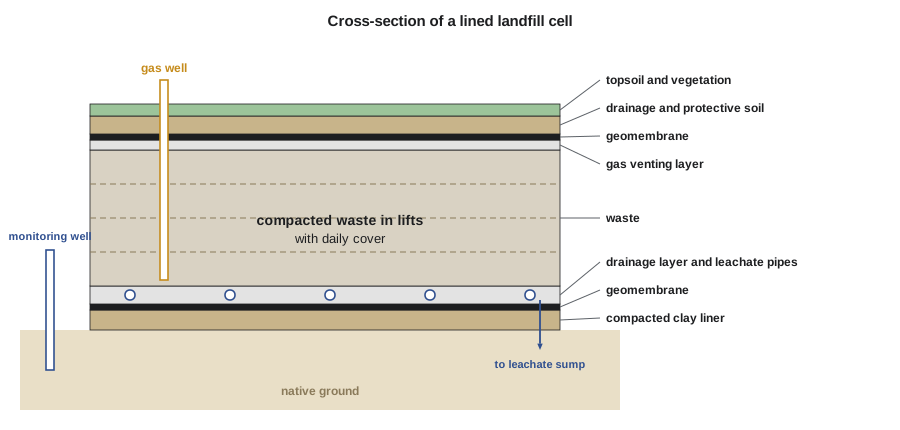
Under Subtitle D of the Resource Conservation and Recovery Act, municipal landfills must meet federal criteria in 40 CFR Part 258, which states implement. The default liner is a composite of a flexible membrane at least 30 mil thick (60 mil if it is high-density polyethylene) over at least 2 ft of compacted soil with a hydraulic conductivity no greater than 1 × 10⁻⁷ cm/s, with a leachate collection system designed to keep less than 30 cm of liquid on the liner. The rules also cover location restrictions, groundwater monitoring, corrective action, closure with a cover that limits infiltration, 30 years of post-closure care and financial assurance.
The composite liner works because the two layers cover each other's weaknesses. A geomembrane is nearly impermeable but inevitably has a few small holes from manufacturing or installation; the clay beneath restricts flow through each hole to a tiny area, while the geomembrane prevents the clay from being exposed to the full leachate head. Together they leak orders of magnitude less than either layer alone.
Leachate
Leachate forms when rain and snowmelt percolate through waste and pick up dissolved and suspended material. Young leachate, from waste in the acid phase of decomposition, is strong, with BOD and COD in the thousands to tens of thousands of mg/L; older leachate has much lower BOD but remains high in ammonia, chloride, dissolved solids and some metals and organic chemicals, including PFAS. Leachate is collected and pumped to a municipal sewer, hauled to a treatment plant or treated on site.
The amount of leachate is estimated with a water balance on the landfill: precipitation minus runoff, evapotranspiration and changes in storage. The single most effective control is the cover. While a cell is open, a large fraction of precipitation infiltrates; a well-built final cover with a geomembrane can cut infiltration to around 1 percent of precipitation or less.
Worked problem
Leachate from the old landfill
The old landfill covers 9.0 ha. Sioux Falls receives about 690 mm of precipitation a year. Under the existing thin soil cover, roughly 15 percent of precipitation infiltrates the waste. A new cover with a geomembrane would reduce infiltration to about 1 percent. Estimate the annual leachate generation before and after.
Show solution
- \[\text{Before: } 0.15 \times 0.690\ \text{m} \times 90\,000\ \text{m}^2 = 9\,315\ \text{m}^3/\text{yr}\]
- \[\text{After: } 0.01 \times 0.690 \times 90\,000 = 621\ \text{m}^3/\text{yr}\]
Answer: The new cover would cut leachate generation by more than 90 percent. Leachate already in the waste will keep draining for years, so the plan also includes collection drains along the toe of the landfill and continued groundwater monitoring.
Landfill gas
Once oxygen is used up, buried organic waste decomposes anaerobically to landfill gas, roughly half methane and half carbon dioxide with traces of other compounds. Methane is explosive between about 5 and 15 percent in air and can migrate through soil into nearby basements, and it is a powerful greenhouse gas, about 28 times as potent as carbon dioxide over 100 years. Landfills are among the largest sources of human-caused methane in both Canada and the United States. Larger landfills collect the gas through wells and pipes under vacuum and either flare it or use it to generate electricity or produce renewable natural gas.
Gas generation is often estimated with a first-order decay model, as in the EPA's LandGEM model: each year's waste generates methane at a rate proportional to the methane potential remaining in it. The decay rate k is lower in dry climates and higher in wet ones; a value of about 0.02 to 0.04 per year is typical of the drier prairies, and the methane generation potential L₀ is often taken as around 100 m³ per metric ton of waste.
# First-order landfill methane model for the closed landfill (LandGEM-style)
import math
k, L0 = 0.04, 100.0               # 1/yr, m3 CH4 per t of waste
placed = {yr: 20000 for yr in range(1976, 2006)}   # t of waste per year, 1976-2005
def methane(year):
    return sum(k * L0 * m * math.exp(-k * (year - y - 0.5)) for y, m in placed.items() if year > y)
for year in (2006, 2016, 2026, 2036, 2046):
    q = methane(year)                              # m3/yr
    print(f"{year}: {q:10,.0f} m3 CH4/yr = {q / 8760:5.1f} m3/h, about {q * 0.717 / 1000:4.0f} t CH4/yr")
# Remaining life of the new landfill's airspace
airspace, waste, density, cover = 1.5e6, 42000, 0.75, 0.15   # m3, t/yr, t/m3, cover fraction
use = waste / density / (1 - cover)
print(f"Airspace used: {use:,.0f} m3/yr -> life {airspace / use:.1f} yr; "
f"with 30% more diversion: {airspace / (use * 0.7):.1f} yr")2006: 1,397,518 m3 CH4/yr = 159.5 m3/h, about 1002 t CH4/yr 2016: 936,785 m3 CH4/yr = 106.9 m3/h, about 672 t CH4/yr 2026: 627,945 m3 CH4/yr = 71.7 m3/h, about 450 t CH4/yr 2036: 420,924 m3 CH4/yr = 48.1 m3/h, about 302 t CH4/yr 2046: 282,154 m3 CH4/yr = 32.2 m3/h, about 202 t CH4/yr Airspace used: 65,882 m3/yr -> life 22.8 yr; with 30% more diversion: 32.5 yr
Two decades after closure, the old landfill still generates about 70 m³ of methane an hour, about 450 metric tons a year, roughly equal in climate effect to the emissions of a few thousand cars, and the rate halves only every 17 years at k = 0.04 per year. A passive vent system is not enough; Nadia proposes active gas collection and a flare. For the new landfill, the program shows that raising diversion by 30 percent would extend its life from about 23 years to about 33, a strong argument for the organics program the city is considering.
Hazardous waste
Hazardous wastes are those that pose a substantial danger to people or the environment if mismanaged. They are usually identified by characteristics, namely ignitability, corrosivity, reactivity and toxicity, and by lists of specific wastes from known industrial processes. Examples include spent solvents, electroplating sludges, waste acids, pesticides and contaminated containers. Households produce small amounts, such as paints, batteries and cleaners, which municipalities collect at depots so they stay out of the garbage.
In the United States, Subtitle C of RCRA creates a cradle-to-grave system for hazardous waste. Generators must identify their waste, obtain an EPA identification number if they generate more than small quantities, and ship it with a manifest that tracks it to a permitted treatment, storage or disposal facility. Those facilities need permits and must meet strict design standards; land disposal of most hazardous wastes is banned unless they are first treated to set standards. The Department of Transportation's hazardous materials regulations govern shipping, and the EPA now runs the manifest system electronically (e-Manifest).
Treatment options include neutralization of acids and bases, chemical oxidation or reduction, stabilization in cement or other binders, recovery of solvents and metals, and high-temperature incineration for organic wastes. Secure landfills for treated hazardous residues have double liners with leak detection between them.
Contaminated sites
Past practices left thousands of contaminated sites: old gas stations, rail yards, wood treatment plants, mine tailings and landfills like the one in Willowbend's job. The Comprehensive Environmental Response, Compensation, and Liability Act of 1980, known as Superfund, lets the EPA clean up the worst sites, listed on the National Priorities List, and makes past and present owners, operators, generators and transporters liable for the costs. States run voluntary cleanup and brownfield programs for the many sites that are not federal priorities. Assessment proceeds from a Phase I environmental site assessment, a historical review, to Phase II sampling and then remedial investigation and feasibility studies.
Remedies range from excavation and off-site disposal to containment with caps and barrier walls, pump-and-treat of groundwater, in-situ methods such as soil vapor extraction, bioremediation and chemical oxidation, and monitored natural attenuation where natural processes can reduce contamination within a reasonable time. Risk-based approaches, which manage exposure pathways rather than removing every molecule, are now common, provided that land-use controls keep the remaining risk acceptable.
Common mistakes
MistakeComparing waste quantities by volume without stating the density.
InsteadDensities range from about 100 kg/m³ loose to 1,000 kg/m³ compacted; always state which.
MistakeAssuming a liner alone controls leachate.
InsteadLeachate generation is controlled mostly by the cover; the liner and collection system contain what is generated.
MistakeTreating a closed landfill as inactive.
InsteadGas and leachate continue for decades after closure and must be managed.
MistakeThrowing household hazardous waste in the garbage.
InsteadPaints, solvents, batteries and pesticides belong at hazardous waste depots.
Summary and key terms
- Municipal solid waste is roughly 2 kg per person per day; organics are a large share.
- The hierarchy ranks reduce, reuse, recycle and compost, recover energy, then landfill.
- Engineered landfills use composite liners, leachate collection, daily and final cover, gas control and monitoring.
- Leachate is estimated by water balance; a good final cover cuts infiltration to about 1 percent of precipitation.
- Landfill gas is about half methane; first-order models estimate generation for decades after closure.
- RCRA Subtitle C tracks hazardous waste from cradle to grave; Superfund assigns liability for cleanup of contaminated sites.
- Municipal solid waste
- Waste collected from homes, businesses and institutions.
- Waste management hierarchy
- A ranking of waste options from reduction to disposal.
- Extended producer responsibility
- A policy making producers responsible for their products at end of life.
- Materials recovery facility
- A plant that sorts recyclables into marketable materials.
- Composite liner
- A landfill liner of a geomembrane placed directly on compacted clay or a geosynthetic clay liner.
- Leachate
- Liquid that has percolated through waste and carries dissolved and suspended contaminants.
- Landfill gas
- Gas from the anaerobic decomposition of waste, mainly methane and carbon dioxide.
- Manifest
- A shipping document that tracks hazardous waste from generator to disposal.
Practice problems
Work each problem on paper first, then reveal the answer to check.
A town of 12,000 people generates 1.9 kg of waste per person per day. How many metric tons a year is that?
Show answer
\(12\,000 \times 1.9 \times 365/1000 = 8\,322\) t/yr.
At an in-place density of 0.8 t/m³ with cover taking 20 percent of the airspace, what airspace does that waste use each year?
Show answer
\(8\,322/0.8/0.8 = 13\,000\) m³/yr.
A 5 ha landfill cell receives 600 mm of precipitation, of which 30 percent infiltrates while it is open. Estimate the leachate generated.
Show answer
\(0.30 \times 0.6 \times 50\,000 = 9\,000\) m³/yr.
With k = 0.03 per year, how long does landfill gas generation from a given year's waste take to halve?
Show answer
\(0.693/0.03 = 23\) years.
Name the four characteristics used to identify hazardous waste.
Show answer
Ignitability, corrosivity, reactivity and toxicity.
Why is a composite liner better than a geomembrane or clay alone?
Show answer
The clay limits flow through the inevitable small holes in the geomembrane, while the geomembrane keeps the full leachate head off the clay.
Lesson quiz · 5 questions
Score 60% or more to complete this lesson.
Create a free account to save your progress, take quizzes and earn a certificate.