
CISSP-114 · Lesson 11 of 12 · 28 min
Identity in the cloud and zero trust
In cloud environments, identity is the primary security control. There is no data center door, no internal network to trust and often no firewall between an attacker on the internet and the cloud provider's management interface: anyone with valid credentials and the right permissions can create, read or destroy resources from anywhere. This lesson covers identity as a service, hybrid identity, the explosion of non-human identities such as cloud roles and API keys, secrets management, cloud entitlement management and how identity anchors zero trust architectures. It builds on the network view of zero trust in CISSP-113 and the authorization architecture in lesson 8.
Identity as a service and hybrid identity
Identity as a service, IDaaS, delivers directory, authentication, single sign-on, multifactor authentication and often governance as a cloud service. Microsoft Entra ID, Okta, Google Cloud Identity, Ping Identity and others operate the identity provider for thousands of customers, giving them modern protocols, global availability and rapid security features without running their own servers. The trade-offs are dependence on the provider's availability and security, the need to understand the shared responsibility split, and data residency questions about where identity data and logs are stored, which matter under Canadian and US privacy and public-sector rules.
Most established organizations run hybrid identity: an on-premises directory, usually Active Directory, remains the source for many systems, and a synchronization service copies identities, and sometimes password hashes, to the cloud identity provider. Authentication can then happen in the cloud using synchronized password hashes, by passing through to on-premises domain controllers or by federating with an on-premises identity provider. Each option has security consequences. Synchronization servers and federation servers hold credentials or signing keys that can impersonate any user, so they are Tier 0. Attackers who compromised on-premises federation servers have forged tokens for cloud services, which is why many organizations now prefer cloud authentication with phishing-resistant MFA and treat the link between on-premises and cloud as a critical trust boundary.
| Hybrid design | How users authenticate | Key risks |
|---|---|---|
| Password hash synchronization | Cloud IdP checks a hash derived from the on-premises hash | Sync server is Tier 0; cloud becomes a second place hashes live |
| Pass-through authentication | Cloud IdP asks on-premises agents to validate the password | Dependency on on-premises availability; agents are Tier 0 |
| Federation with on-premises IdP | Cloud trusts tokens signed by an on-premises federation server | Stolen signing key lets attackers forge tokens for any user |
| Cloud-only identity | Cloud IdP is authoritative; no on-premises dependency | Concentration of trust in one provider; strong admin protection required |
Non-human identities
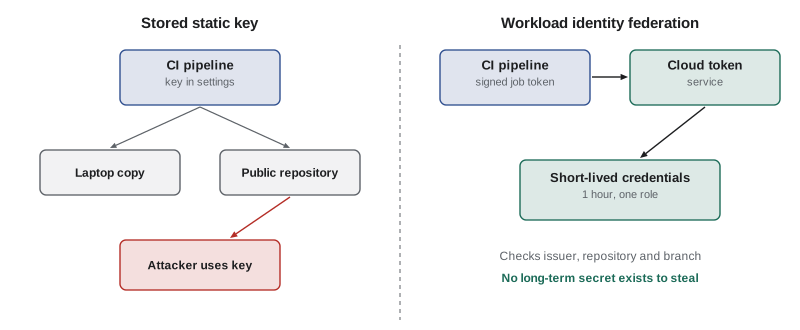
Applications, scripts, containers, virtual machines, CI/CD pipelines and SaaS integrations all authenticate to each other and to cloud services. These non-human or machine identities include cloud IAM roles, service principals, managed identities, API keys, OAuth client credentials, SSH keys and certificates. In most organizations they now outnumber people many times over, and they are often over-privileged, long-lived, poorly inventoried and invisible to the processes built for human joiners and leavers. Leaked access keys committed to public code repositories are found by automated scanners within minutes and used to run cryptocurrency miners or steal data.
The safest secret is one that does not exist. Cloud platforms offer managed or workload identities, where a virtual machine, function or container is given an identity by the platform and receives short-lived credentials automatically, with no long-term key for anyone to copy. Workload identity federation lets workloads outside a cloud, such as a CI/CD pipeline or a Kubernetes cluster, exchange a token from their own platform for short-lived cloud credentials, again without stored keys. Open standards such as SPIFFE give workloads verifiable identities across environments. Where secrets cannot be avoided, they belong in a secrets manager or vault, never in code, configuration files or chat messages, and they should be rotated automatically and scoped narrowly.
from datetime import date
today = date(2026, 10, 19)
keys = [  # (identity, credential type, created, last used, owner)
    ('ci-deploy', 'static access key', date(2023, 2, 1), date(2026, 10, 18), 'platform-team'),
    ('legacy-report', 'static access key', date(2021, 6, 9), date(2024, 1, 15), None),
    ('web-app', 'managed identity', None, date(2026, 10, 19), 'web-team'),
    ('etl-job', 'client secret', date(2026, 5, 2), date(2026, 10, 17), 'data-team'),
    ('old-poc', 'SSH key', date(2022, 11, 30), None, None),
]
for ident, kind, created, used, owner in keys:
    issues = []
    if created and (today - created).days > 365:
        issues.append(f'secret {(today - created).days} days old')
    if used is None or (today - used).days > 90:
        issues.append('unused for 90+ days')
    if owner is None:
        issues.append('no owner')
    if kind == 'managed identity':
        issues = issues or ['no stored secret']
print(f'{ident:13s} {kind:18s} ' + ('; '.join(issues) if issues else 'ok'))ci-deploy static access key secret 1356 days old legacy-report static access key secret 1958 days old; unused for 90+ days; no owner web-app managed identity no stored secret etl-job client secret ok old-poc SSH key secret 1419 days old; unused for 90+ days; no owner
Cloud entitlement management and identity threat detection
Cloud platforms offer thousands of distinct permissions, and roles often accumulate far more than they use. Cloud infrastructure entitlement management, CIEM, tools analyze which identities hold which permissions, compare granted permissions with those actually used, flag risky combinations such as the ability to modify one's own policies, and recommend right-sized policies. Identity threat detection and response, ITDR, focuses on detecting attacks against identity systems themselves: suspicious changes to federation settings, new credentials added to privileged service principals, unusual token issuance, impossible travel and attempts to disable logging. Both depend on comprehensive identity logs being collected and retained.
granted = {  # permissions attached to a role
    'storage:Read', 'storage:Write', 'storage:Delete', 'compute:Start', 'compute:Stop', 'compute:Create',
    'iam:AttachPolicy', 'iam:CreateKey', 'logs:Delete', 'kms:Decrypt',
}
used_90_days = {'storage:Read', 'storage:Write', 'compute:Start', 'compute:Stop', 'kms:Decrypt'}
unused = sorted(granted - used_90_days)
risky = {'iam:AttachPolicy': 'can grant itself more power', 'iam:CreateKey': 'can mint new credentials', 'logs:Delete': 'can erase evidence'}
print(f'Granted {len(granted)}, used {len(used_90_days)}, unused {len(unused)} ({len(unused) / len(granted):.0%})')
for p in unused:
    print(f'  remove {p:18s} {risky.get(p, "")}')
print('Right-sized policy:', sorted(used_90_days))Granted 10, used 5, unused 5 (50%) remove compute:Create remove iam:AttachPolicy can grant itself more power remove iam:CreateKey can mint new credentials remove logs:Delete can erase evidence remove storage:Delete Right-sized policy: ['compute:Start', 'compute:Stop', 'kms:Decrypt', 'storage:Read', 'storage:Write']
Usage-based right-sizing needs care. Some permissions are used rarely but legitimately, such as disaster recovery actions, and removing them can break recovery when it is needed most. Such permissions are better moved to a separate role available through just-in-time elevation than left on everyday roles or removed entirely.
Identity in zero trust architectures
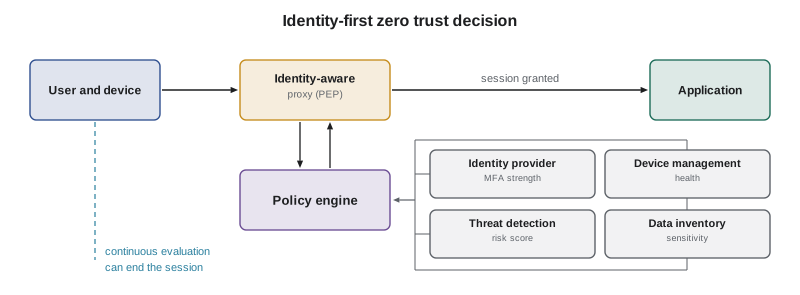
Zero trust, described in NIST SP 800-207, treats every access request as if it came from an untrusted network. Identity is its foundation: each request is authenticated and authorized using the identity of the user or workload, the state of the device, the sensitivity of the resource and contextual signals, and access is granted per session with least privilege. In NIST's terms, a policy engine decides, a policy administrator establishes or tears down the session, and policy enforcement points sit in front of resources, the same pattern as the PDP and PEP in lesson 8. Practical building blocks include a strong identity provider with phishing-resistant MFA, device management that reports health, conditional access policies, identity-aware proxies in front of applications and continuous evaluation of sessions.
Continuous access evaluation closes the gap between a decision and a change in circumstances. Traditionally, an access token remains valid until it expires, even if the user is disabled or the device is found to be compromised a minute after issue. Continuous evaluation lets the identity provider signal relying services in near real time about critical events, such as account disablement, password change or detected risk, so that sessions end promptly. Open standards from the OpenID Foundation, the Shared Signals Framework with its Continuous Access Evaluation Profile, CAEP, and Risk Incident Sharing and Coordination, RISC, standardize these signals between providers and applications.
In the United States, OMB memorandum M-22-09 set a federal zero trust strategy with identity at its core, requiring agencies to use centralized identity systems, phishing-resistant MFA and attribute-based authorization, and CISA's Zero Trust Maturity Model, version 2.0, describes progress across five pillars, the first of which is identity. Federal cloud services used by agencies must be FedRAMP authorized, which includes identity and access controls drawn from NIST SP 800-53. Private-sector organizations widely use the CISA model as a roadmap. Checked October 2026.
Worked problem
Planning an identity-first zero trust program
A 2,500-person engineering company relies on a VPN that, once connected, allows access to the whole internal network. It has an IDaaS provider used for a few SaaS applications, push MFA and 1,800 service accounts and API keys with no inventory. Propose the first year's identity priorities.
Show solution
- Make the IDaaS provider the single front door: federate all SaaS and internal web applications through it, with an identity-aware proxy replacing broad VPN access for web applications.
- Strengthen authentication: phishing-resistant MFA for administrators and remote access first, then everyone; enforce device compliance through conditional access.
- Inventory non-human identities: assign owners, remove unused keys, move workloads to managed identities or workload federation and put remaining secrets in a vault with rotation.
- Reduce privilege: CIEM review of cloud roles, just-in-time administration and collection of identity logs into the SIEM with ITDR detections.
Answer: Zero trust is a journey, and identity is the place to start. Centralizing authentication, hardening it, taming machine identities and reducing privilege deliver most of the early risk reduction.
Thinking like a manager
Cloud identity questions test whether you recognize that permissions are the perimeter. Favor answers that centralize identity, protect the identity provider and its trust links as Tier 0, eliminate long-lived secrets in favor of managed and federated workload identities, right-size permissions using evidence, collect and analyze identity logs and evaluate access continuously. When a zero trust question asks where to begin, identity and strong authentication are almost always the right foundation.
Identity logs as evidence
Every design in this lesson depends on identity logs: sign-ins with their authentication method and device, token issuance, consent grants, changes to roles, policies and federation settings, and the use of privileged and non-human identities. Cloud identity providers keep these logs for limited periods by default, sometimes only 7 to 30 days on lower service tiers, which is shorter than the time many intrusions go undetected. A manager should make sure identity logs are exported to the organization's own SIEM or log archive, retained for at least a year or as long as regulation and investigation needs require, protected from alteration and covered by detections. The most valuable alerts include new credentials added to service principals or applications, changes to federation trust or signing certificates, sign-ins that bypass conditional access, mass consent to a new application, disabling of audit logging and use of break-glass accounts.
Worked problem
Sizing identity log retention
An identity provider generates about 40 million sign-in and audit events a month for a 6,000-person organization, averaging 1.5 KB each. The provider keeps them for 30 days. The security team wants 13 months of searchable history in its own archive. Estimate the storage needed and state why the effort is justified.
Show solution
- Monthly volume: \(40 \times 10^6 \times 1.5\) KB = 60 million KB, about 60 GB.
- Thirteen months: about 780 GB before compression; log compression commonly reduces this several times.
- Industry studies of intrusions often find attackers present for weeks or months before detection, beyond a 30-day window.
- Thirteen months also covers a full annual audit cycle with margin.
Answer: Roughly 0.8 TB uncompressed is modest compared with the cost of an investigation that cannot reconstruct how an attacker obtained and used identities. Retention is a cheap control with a large evidential payoff.
Common mistakes
MistakeStoring cloud access keys in code or pipeline settings.
InsteadUse managed identities or workload identity federation; keep unavoidable secrets in a vault with rotation.
MistakeTreating federation and sync servers as ordinary infrastructure.
InsteadProtect them as Tier 0 because they can impersonate any user.
MistakeGranting broad cloud roles and never reviewing them.
InsteadUse CIEM to compare granted with used permissions and right-size roles.
MistakeAssuming a disabled user's tokens stop working immediately.
InsteadUse short token lifetimes and continuous access evaluation to end sessions promptly.
MistakeManaging only human identities in governance processes.
InsteadGive every non-human identity an owner, a purpose, a review date and least privilege.
Summary and key terms
- IDaaS delivers identity services from the cloud, with shared responsibility and data residency considerations.
- Hybrid identity links on-premises directories and cloud IdPs; sync and federation servers are Tier 0.
- Non-human identities outnumber people and are often over-privileged and long-lived.
- Managed identities and workload identity federation avoid stored secrets; vault and rotate the rest.
- CIEM right-sizes cloud permissions; ITDR detects attacks on identity systems.
- Zero trust decides each session from identity, device, risk and resource signals, re-evaluated continuously.
- Canada's Cyber Center and the US OMB M-22-09 and CISA Zero Trust Maturity Model put identity first.
- IDaaS
- Identity as a service: cloud-delivered directory, authentication and SSO.
- Hybrid identity
- Linking an on-premises directory with a cloud identity provider.
- Non-human identity
- An identity used by software, such as a service principal, role or API key.
- Managed identity
- A platform-issued workload identity with automatic short-lived credentials.
- Workload identity federation
- Exchanging an external workload token for short-lived cloud credentials.
- Secrets manager
- A service that stores, controls access to and rotates secrets.
- CIEM
- Cloud infrastructure entitlement management, which analyses and right-sizes cloud permissions.
- ITDR
- Identity threat detection and response.
- Continuous access evaluation
- Re-evaluating sessions promptly when critical events occur.
- CAEP
- Continuous Access Evaluation Profile of the OpenID Shared Signals Framework.
Practice problems
Work each problem on paper first, then reveal the answer to check.
Why is a federation server a Tier 0 asset?
Show answer
Its signing key can forge tokens for any user.
What is the safest kind of secret?
Show answer
One that does not exist, as with managed or federated workload identities.
What does CIEM compare?
Show answer
Granted permissions with permissions actually used.
Why should rarely used recovery permissions not simply be deleted?
Show answer
They may be needed in an emergency; move them to just-in-time roles instead.
What problem does continuous access evaluation solve?
Show answer
Tokens staying valid after a user is disabled or risk changes.
Name three signals a zero trust policy engine might use.
Show answer
Identity and authentication strength, device health and risk score.
Which CISA model describes zero trust maturity across five pillars?
Show answer
The Zero Trust Maturity Model, version 2.0.
What happens to cloud access keys leaked to public repositories?
Show answer
Automated scanners find and abuse them within minutes.
What does ITDR focus on?
Show answer
Detecting attacks against identity systems themselves.
What data residency question affects IDaaS selection?
Show answer
Where identity data and logs are stored, which some regulators and public bodies restrict.
Lesson quiz · 5 questions
Score 60% or more to complete this lesson.
Create a free account to save your progress, take quizzes and earn a certificate.