
CISSP-114 · Lesson 1 of 12 · 30 min
IAM concepts and the AAA model
Every security control eventually asks the same question: who is this, and what are they allowed to do? Identity and access management, IAM, is the discipline that answers it consistently, for people, devices, services and software, across every system an organization runs. When IAM works, the right subjects reach the right objects for the right reasons, and the organization can prove it afterwards. When it fails, the failures are expensive: an orphaned account used months after an employee left, a contractor with administrator rights nobody remembers granting, a stolen password that opens a hundred applications because single sign-on was built without strong authentication. Breach reports year after year find stolen or misused credentials among the most common ways attackers get in, which is why identity is now often called the new perimeter.
Domain 5 of the CISSP, Identity and Access Management, carries about 13 % of the exam weight under the outline ISC2 has used since 15 April 2024 (checked October 2026; ISC2's outline page announced no replacement, but ISC2 reviews outlines through a job task analysis roughly every three years, so confirm the current outline before you book). It has six sub-domains: 5.1, control physical and logical access to assets; 5.2, design identification and authentication strategy; 5.3, federated identity with a third-party service; 5.4, implement and manage authorization mechanisms; 5.5, manage the identity and access provisioning life cycle; and 5.6, implement authentication systems. This course is independent study material. It is not produced, endorsed or reviewed by ISC2, and none of its questions are taken from any real exam. Every scenario is original and written to train the judgment the exam rewards.
Subjects, objects and access
Access control is described in terms of subjects and objects. A subject is an active entity that requests access: a user, a process running on a user's behalf, a service account, a device or an automated workload. An object is a passive entity that holds information or provides a function: a file, a database table, a printer, an API endpoint, a building or a room. Access is the flow of information or the use of a function between them, and an access control is any mechanism that permits, denies or limits that flow. The roles can change: a program is an object while it sits on disk and a subject when it runs and opens files.
Rights and permissions are the specific operations a subject may perform on an object, such as read, write, execute, delete, approve or change ownership. Privileges are rights that affect the system itself, such as installing software, creating accounts or changing audit settings. Much of IAM consists of deciding which rights each subject needs, granting no more than that, and taking them away as soon as they are no longer needed.
Sub-domain 5.1 reminds you that access control covers physical as well as logical assets. Badge readers, mantraps, visitor management and key control are access controls in exactly the same sense as passwords and permissions. A well-designed program uses the same identity for both: the employee record that drives the directory account also drives the badge, so that one leaver process revokes both. Physical site and facility design is covered in CISSP-112; here we treat physical access as one more object that the identity system must govern.
The access control triple and AAA
Granting access involves a sequence of distinct steps, and the exam expects you to keep them apart. Identification is the claim: a subject asserts an identity, by typing a user name, presenting a badge, or sending a certificate or a client identifier. Authentication is the proof: the subject demonstrates that the claim is true with something it knows, has or is. Authorization is the decision: given an authenticated identity, the system determines what that identity may do with a specific object. Accountability is the record: actions are logged and tied to the identity so that the subject can be held responsible. Many texts call the first three the access control triple and add auditing or accounting to make four. Networking texts use AAA for authentication, authorization and accounting.
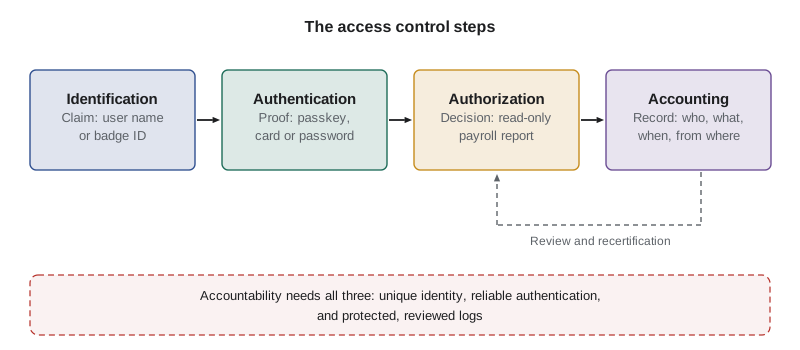
Keeping the steps separate prevents common design errors. A system that authenticates strongly but authorizes loosely, giving every authenticated user access to everything, has not controlled access at all. A system that identifies users with shared accounts can authenticate them but can never hold any individual accountable, because the log shows only the shared name. And a system that logs everything but never reviews the logs has accounting on paper only. Accountability requires unique identification, reliable authentication and protected, reviewed audit trails; remove any of the three and nobody can be held responsible.
| Step | Question answered | Examples | Typical failure |
|---|---|---|---|
| Identification | Who do you claim to be? | User name, employee number, badge ID, certificate subject, client ID | Shared or generic accounts that cannot be traced to a person |
| Authentication | Can you prove it? | Password, passkey, smart card, one-time code, fingerprint | Single weak factor; credentials reused across sites |
| Authorization | What may you do with this object? | File permissions, roles, policies, access control lists | Excess rights, privilege creep, no review |
| Accounting (auditing) | What did you do? | Authentication logs, change logs, database audit, badge logs | Logs not kept, not protected or never reviewed |
Non-repudiation is related to accountability but stronger. It means a subject cannot credibly deny having performed an action, which normally requires that only that subject could have produced the evidence, such as a digital signature made with a private key the subject alone controls. Logs alone rarely provide non-repudiation, because administrators can alter them and passwords can be shared, but signed transactions, hardware-backed keys and tamper-evident log storage move a system closer. Digital signatures are covered in CISSP-112.
Why IAM is central to security
Three trends have moved identity to the center of security architecture. First, users, data and applications have left the corporate network: staff work from home, applications run as cloud services and partners connect directly. The network boundary no longer separates trusted from untrusted, so access decisions must rest on who and what is asking. Second, attackers have shifted from exploiting software to using valid credentials, because phishing and password reuse make that easier and because activity under a valid account blends into normal traffic. Third, the number of non-human identities, such as service accounts, API keys, cloud workload roles and bots, now exceeds the number of human ones in most organizations, and these identities often hold powerful, long-lived privileges with little oversight.
Zero trust, introduced for networks in CISSP-113, makes identity explicit. Under NIST SP 800-207, every request is authenticated and authorized on its own merits using the identity of the subject, the health of the device and the context of the request, and no request is trusted merely because of where it came from. Lesson 11 returns to identity in zero trust architectures.
Logical and physical access in one program
A mature IAM program has a few core components. An authoritative source of identity, usually the human resources system for employees and a vendor management system for contractors, says who should exist. A directory or identity store, such as Active Directory, an LDAP directory or a cloud identity provider, holds accounts, groups and attributes. An identity governance and administration, IGA, system automates provisioning, approvals and access reviews. Authentication services verify credentials and issue sessions or tokens. Authorization is enforced by applications, operating systems, databases and gateways. Privileged access management, PAM, controls administrator accounts. Logging and analytics, often a SIEM, collect evidence.
Worked problem
Tracing an access request
Priya, a payroll analyst at a regional credit union, opens the payroll reporting application from her laptop at 08:40. Trace the identification, authentication, authorization and accounting steps, and name the IAM component responsible for each.
Show solution
- Identification: the browser is redirected to the corporate identity provider, where Priya enters her user name, which maps to the directory account created from her HR record.
- Authentication: the identity provider verifies her passkey, bound to the laptop's platform authenticator, and checks that the laptop is enrolled and compliant.
- Authorization: the identity provider issues a token that includes her group, Payroll-Analysts; the application maps that group to a read-only reporting role and refuses the payroll-approval function, which needs a different role.
- Accounting: the identity provider logs the sign-in with time, device and location; the application logs the report she ran; both feed the SIEM.
Answer: Each step has a different owner: the directory and HR system for identity, the identity provider for authentication, the application and its role mapping for authorization, and logging plus the SIEM for accounting. A weakness in any one undermines the others.
events = [
    ('08:40:02', 'priya.s', 'authn', 'passkey', 'success'),
    ('08:40:05', 'priya.s', 'authz', 'payroll-report:read', 'permit'),
    ('08:41:17', 'priya.s', 'authz', 'payroll-run:approve', 'deny'),
    ('08:52:40', 'svc-backup', 'authn', 'password', 'failure'),
    ('08:52:41', 'svc-backup', 'authn', 'password', 'failure'),
    ('08:52:43', 'svc-backup', 'authn', 'password', 'success'),
]
from collections import Counter
failures = Counter(e[1] for e in events if e[2] == 'authn' and e[4] == 'failure')
denials = [e for e in events if e[2] == 'authz' and e[4] == 'deny']
print('Failed authentications by account:', dict(failures))
for t, who, _, obj, _ in denials:
    print(f'Denied at {t}: {who} tried {obj}')
print('Service accounts using passwords:', sorted({e[1] for e in events if e[1].startswith('svc') and e[3] == 'password'}))Failed authentications by account: {'svc-backup': 2}
Denied at 08:41:17: priya.s tried payroll-run:approve
Service accounts using passwords: ['svc-backup']Centralized and decentralized administration
Access administration can be centralized, with one team and one system managing identities and rights for everyone, or decentralized, with each application owner or business unit managing its own users. Centralized administration gives consistency, easier audits and fast revocation, at the cost of a bottleneck and a single point of failure that must be designed for resilience. Decentralized administration is responsive to local needs but tends to produce inconsistent rules, duplicate accounts and leavers who keep access in systems nobody remembered. Most organizations use a hybrid: a central identity provider and governance process, with application owners responsible for approving access to their own data. The exam usually favors central control of identity and authentication with delegated, documented ownership of authorization decisions.
Remote access authentication protocols illustrate centralized AAA. RADIUS, defined in RFC 2865, authenticates users for network access and VPNs; it runs over UDP, encrypts only the password attribute and combines authentication and authorization in one response. TACACS+, used mainly for administering network devices, runs over TCP, encrypts the whole payload and separates authentication, authorization and accounting so that each command an administrator types can be authorized and logged. Diameter, RADIUS's successor, is used mainly in mobile networks. Network access control with 802.1X, which uses RADIUS behind the scenes, is covered in CISSP-113.
| Feature | RADIUS | TACACS+ |
|---|---|---|
| Transport | UDP (1812, 1813) | TCP (49) |
| Encryption | Password attribute only | Entire payload |
| AAA separation | Authentication and authorization combined | All three separate |
| Typical use | Network access, VPN, Wi-Fi with 802.1X | Device administration with per-command authorization |
| Standard | Open IETF standard | Originally Cisco, now documented in RFC 8907 |
Design principles that run through IAM
Several security principles from Domain 3 shape every IAM decision. Least privilege grants each subject only the access needed for its task, for only as long as needed. Need to know restricts access to information to those whose duties require it, even among people with the same clearance. Separation of duties splits sensitive tasks so that no single person can complete them alone, such as requesting and approving a payment. Defense in depth layers authentication, authorization and monitoring so that one failure does not give full access. Fail secure means that if an access control component fails, it denies rather than permits. Economy of mechanism keeps the access model simple enough to understand and audit, which is why a handful of well-defined roles beats thousands of individual grants.
A manager also weighs usability. Controls that frustrate users get bypassed: passwords written on notes, shared accounts created to avoid waiting for approval, and multifactor prompts approved without thought. Good IAM design reduces the number of times users must authenticate, through single sign-on, while making each authentication stronger, and automates access so that people receive what they need on their first day without informal workarounds.
Worked problem
Spotting the broken step
A warehouse uses one shared account, WAREHOUSE1, on the shipping terminal. Inventory worth $40,000 is shipped to a fraudulent address. The audit log shows WAREHOUSE1 created the order at 02:13. Which access control step failed, and what should replace the shared account?
Show solution
- Identification failed: the account name identifies a terminal, not a person.
- Authentication may have worked, since someone knew the password, but it proves only knowledge of a shared secret.
- Accountability is impossible, because the log cannot show which of the 14 staff who know the password created the order.
- Replace it with individual accounts, a fast sign-in method suited to the floor such as badge tap plus PIN, and a rule that shipments above a threshold need a second person.
Answer: Unique identification is the foundation of accountability. The fix combines individual accounts, practical authentication and separation of duties for high-value actions.
Thinking like a manager
CISSP questions on IAM rarely ask you to configure a protocol. They ask what a security manager should do first, what best reduces risk, or which control addresses the root cause. Start from the access control steps: is the problem that we do not know who someone is, that we cannot prove it, that they have too much access, or that we cannot tell what they did? Prefer answers that fix the process, such as automated deprovisioning tied to HR, over answers that fix one instance, such as disabling one account. Prefer unique identities, strong authentication, least privilege and reviewed logs, in that order of foundation. And remember that people, not just systems, are subjects: policy, training and accountability matter as much as technology.
Common mistakes
MistakeTreating authentication and authorization as the same step.
InsteadAuthenticate to prove identity, then authorize each request against policy for that identity and object.
MistakeAllowing shared or generic accounts for convenience.
InsteadGive every person a unique identity so that actions can be attributed; use break-glass accounts only under strict control.
MistakeCollecting logs without protecting or reviewing them.
InsteadProtect audit trails from alteration and review them, automatically and periodically.
MistakeManaging physical badges and logical accounts in separate, unconnected processes.
InsteadDrive both from the same authoritative identity so that one leaver event revokes both.
MistakeForgetting non-human identities.
InsteadInventory and govern service accounts, API keys and workload identities with owners and review dates.
Summary and key terms
- Subjects request access to objects; rights and privileges define what they may do.
- Identification claims an identity, authentication proves it, authorization decides access and accounting records actions.
- Accountability needs unique identities, reliable authentication and protected, reviewed logs.
- IAM covers physical and logical access and human and non-human identities.
- RADIUS and TACACS+ provide centralized AAA for network access and device administration.
- Least privilege, need to know, separation of duties and fail-secure design shape every IAM decision.
- Domain 5 is about 13 % of the exam under the April 2024 outline; this course is independent of ISC2.
- Subject
- An active entity, such as a user, process or service, that requests access.
- Object
- A passive entity, such as a file, table or device, that is accessed.
- Identification
- Claiming an identity.
- Authentication
- Proving a claimed identity.
- Authorization
- Deciding what an authenticated identity may do.
- Accountability
- Tracing actions to a responsible identity through reliable logs.
- Non-repudiation
- Assurance that a subject cannot credibly deny an action.
- RADIUS
- A UDP-based protocol for centralized authentication and authorization of network access.
- TACACS+
- A TCP-based protocol that separates authentication, authorization and accounting for device administration.
- Identity governance and administration
- Processes and tools for provisioning, approvals and access reviews.
Practice problems
Work each problem on paper first, then reveal the answer to check.
A user types a user name. Which access control step is this?
Show answer
Identification.
Why do shared accounts defeat accountability?
Show answer
Logs cannot attribute actions to an individual.
Name the four steps of access control in order.
Show answer
Identification, authentication, authorization and accounting.
Which protocol encrypts the whole payload and authorizes individual administrator commands?
Show answer
TACACS+.
Is a program a subject or an object?
Show answer
An object while stored; a subject while running and requesting access.
What provides non-repudiation more reliably than logs?
Show answer
Digital signatures made with keys only the subject controls.
What is the usual authoritative source for employee identities?
Show answer
The human resources system.
Which principle splits requesting and approving a payment between two people?
Show answer
Separation of duties.
Why is identity called the new perimeter?
Show answer
Users and services are no longer inside one trusted network, so decisions rest on identity and context.
What does fail secure mean for an access control?
Show answer
If the control fails, it denies access rather than permitting it.
Lesson quiz · 5 questions
Score 60% or more to complete this lesson.
Create a free account to save your progress, take quizzes and earn a certificate.