
CISSP-113 · Lesson 10 of 12 · 30 min
Network attacks and countermeasures
Earlier lessons described attacks as they arose with each protocol and component. This lesson draws them together into the families a security manager must recognize: denial of service, interception and on-path attacks, spoofing, attacks on routing and naming, reconnaissance and attacks that use the network to move and exfiltrate data. For each family it explains how the attack works in principle, what the warning signs are and which countermeasures work. The treatment is conceptual: the aim is to choose and justify defenses, not to carry out attacks, and testing any network without written authorization may be a criminal offense.
Denial of service
A denial of service, DoS, attack aims to make a service unavailable to legitimate users. A distributed denial of service, DDoS, attack uses many sources at once, usually a botnet of compromised computers, routers, cameras and cloud servers. DDoS attacks fall into three broad types. Volumetric attacks flood the target's links with more traffic than they can carry, measured in bits or packets per second; record attacks reported by mitigation providers have exceeded several terabits per second. Protocol attacks exhaust state in servers, firewalls or load balancers, such as SYN floods filling connection tables. Application-layer attacks send seemingly legitimate requests, such as HTTP requests for expensive search pages, at a rate the application cannot handle; they need far less bandwidth and are harder to distinguish from real users. The HTTP/2 Rapid Reset technique disclosed in October 2023 is a recent example of an application-layer method that produced record request rates.
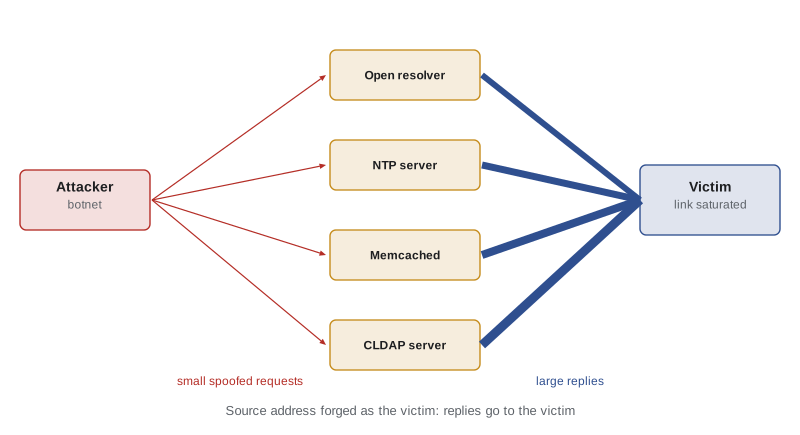
Reflection and amplification attacks combine spoofing with services that reply with more data than they receive. The attacker sends small requests with the victim's address forged as the source to many servers, such as open DNS resolvers, NTP servers, memcached servers or CLDAP servers, and those servers send their larger replies to the victim. The amplification factor is the ratio of response size to request size. Historical attacks used memcached with amplification factors reported in the tens of thousands, which produced a 1.35 Tb/s attack on a code hosting site in 2018.
# Amplification: attacker uplink multiplied by the protocol's amplification factor (illustrative factors)
attacker_mbps = 1_000  # 1 Gb/s of spoofed requests from a botnet
protocols = {'DNS (ANY, open resolver)': 50, 'NTP (monlist, legacy)': 500, 'CLDAP': 60, 'memcached (UDP, exposed)': 10_000}
for name, factor in protocols.items():
    gbps = attacker_mbps * factor / 1_000
    print(f"{name:28s} factor {factor:>6,}  potential attack {gbps:>10,.0f} Gb/s")
print('Real attacks are limited by reflector capacity and the network paths in between.')DNS (ANY, open resolver) factor 50 potential attack 50 Gb/s NTP (monlist, legacy) factor 500 potential attack 500 Gb/s CLDAP factor 60 potential attack 60 Gb/s memcached (UDP, exposed) factor 10,000 potential attack 10,000 Gb/s Real attacks are limited by reflector capacity and the network paths in between.
Countermeasures work at several levels. Upstream, ingress filtering by every network operator under BCP 38 would stop spoofed packets and with them most reflection attacks, but adoption is incomplete. At the organization's edge, DDoS protection comes from upstream scrubbing services, offered by internet providers and specialist firms, that divert traffic during an attack, filter it and return clean traffic; from content delivery networks that absorb load across many locations; and from rate limiting, SYN cookies and connection limits on firewalls and load balancers. In the application, caching, autoscaling, challenge pages for suspicious clients and protecting expensive operations behind authentication reduce the impact of application-layer floods. Organizations should also make sure their own servers cannot be used as reflectors by disabling unneeded UDP services, closing open resolvers and patching NTP and memcached configurations.
DDoS readiness is largely planning. Know which services matter most and what an outage costs; contract mitigation before an attack, because signing up during one is slow; document how to activate scrubbing, who has authority to do so and how to communicate with customers; run exercises; and avoid single points of failure such as one DNS provider. Extortion demands threatening DDoS are common; paying encourages repeat attacks and does not guarantee anything.
Worked problem
Sizing DDoS protection
An online retailer has a 10 Gb/s internet link. Threat intelligence shows attacks on its sector commonly reach 200 Gb/s and occasionally 1 Tb/s. Each hour of outage during peak season costs about $250,000. What does this imply for its design?
Show solution
- A 200 Gb/s attack is 20 times the link capacity; no on-premises device can filter traffic that never fits through the link.
- Protection must therefore be upstream: a scrubbing service or CDN with capacity well above 1 Tb/s.
- An outage of four hours during peak season would cost about $1,000,000.
- Compare that with the annual cost of an always-on CDN and scrubbing contract with documented activation procedures.
Answer: The retailer needs upstream, cloud-scale mitigation, not a bigger firewall. With potential losses of about $1 million per major incident, a mitigation contract costing a fraction of that each year is easy to justify.
Interception and on-path attacks
An on-path attack, traditionally called man-in-the-middle, places the attacker between two parties so they can read, alter or inject traffic. Routes to an on-path position include ARP poisoning and rogue DHCP on local networks, rogue or evil twin access points, DNS spoofing and cache poisoning, BGP hijacking on the internet, compromised routers and malicious proxies, and malware on the endpoint itself. Once in position, attackers can capture credentials sent in clear text, strip or downgrade encryption, for example by preventing a redirect from HTTP to HTTPS, or present forged certificates and hope users click through warnings.
The decisive countermeasure is strong, authenticated encryption end to end: TLS with certificate validation, HTTP Strict Transport Security so browsers refuse to fall back to HTTP, HSTS preloading for important domains, mutual TLS between services, IPsec or WireGuard for network tunnels and SSH with verified host keys for administration. Encryption turns an on-path attacker from someone who can read and change everything into someone who can only observe metadata or disrupt traffic. Supporting controls make on-path positions harder to obtain: dynamic ARP inspection, DHCP snooping, 802.1X with server certificate validation, DNSSEC and secure routing. Users and applications must treat certificate warnings as attacks, not inconveniences.
| Route to an on-path position | Where | Countermeasure |
|---|---|---|
| ARP poisoning | Local segment | Dynamic ARP inspection, segmentation |
| Rogue DHCP or IPv6 router advertisements | Local segment | DHCP snooping, RA Guard |
| Evil twin access point | Wireless | EAP-TLS or server certificate validation, WIPS |
| DNS cache poisoning | Resolver | DNSSEC validation, source port randomization |
| BGP hijack | Internet routing | RPKI route origin validation, prefix filtering, monitoring |
| TLS stripping | Any on-path position | HSTS and preloading, HTTPS-only applications |
| Rogue certificate | Any on-path position | Certificate validation, CAA records, certificate transparency monitoring |
Spoofing
Spoofing means forging an identifier to impersonate something trusted. IP address spoofing forges the source of packets; it is easy for one-way traffic such as UDP floods and reflection, but much harder for full TCP sessions because the attacker does not see the replies unless on-path. MAC spoofing defeats MAC filtering and MAC-based authentication. Email spoofing forges the sender address, countered by SPF, DKIM and DMARC as lesson 7 described. Caller ID spoofing is addressed by STIR/SHAKEN. DNS spoofing returns forged answers. GPS spoofing, increasingly reported near conflict zones, forges satellite navigation signals and can affect the timing that some networks rely on, which is one reason critical networks use multiple time sources. The general countermeasure is to authenticate identities cryptographically rather than trust identifiers that anyone can forge.
Attacks on routing and naming
BGP has no built-in way to verify that an autonomous system is entitled to announce a prefix, so a mistaken or malicious announcement can redirect traffic for large parts of the internet. Well-known incidents include the 2008 event in which a Pakistani operator's announcement, intended to block a video site domestically, leaked globally and made the site unreachable worldwide for hours, and a 2018 hijack of address space belonging to a major cloud DNS service, used to redirect users of a cryptocurrency wallet site to a fraudulent server and steal funds. Route leaks, where a network wrongly propagates routes it learned from one provider to another, cause similar disruption by accident.
Worked problem
A BGP hijack scenario
A Canadian payment processor owns 203.0.113.0/24 and announces it from its own autonomous system. One morning, monitoring shows that 203.0.113.0/25 and 203.0.113.128/25 are being announced from an unfamiliar autonomous system in another country, and customers report certificate warnings on the payment site. What is happening and what should the processor do?
Show solution
- The two /25 announcements are more specific than the /24, so routers that accept them send traffic to the hijacker by longest prefix match.
- Certificate warnings suggest the hijacker is presenting a fraudulent server; valid TLS is protecting users who heed the warnings.
- Immediate actions: activate the incident response plan, announce the two /25s itself to compete for traffic, contact upstream providers and the hijacker's upstreams to filter the bogus routes, and notify customers.
- Longer term: publish RPKI route origin authorizations with an appropriate maximum length so that networks performing route origin validation drop the bogus announcements, subscribe to BGP monitoring and keep CAA records and certificate transparency monitoring in place.
Answer: It is a BGP hijack using more specific prefixes. Respond by competing announcements and upstream filtering, and prevent recurrence with RPKI, monitoring and strict TLS, which is what limited the damage this time.
RPKI lets address holders publish signed route origin authorizations stating which autonomous systems may originate their prefixes and with what maximum prefix length; networks that perform route origin validation reject invalid announcements. Adoption has grown substantially, and by 2025 roughly half of announced IPv4 routes were covered by route origin authorizations, according to public RPKI monitoring services. RPKI does not validate the whole path; work on path validation continues, with ASPA, autonomous system provider authorization, being standardized. Organizations should create authorizations for their own prefixes, ask their providers whether they validate routes, and monitor announcements of their address space. The Mutually Agreed Norms for Routing Security, MANRS, initiative promotes filtering, anti-spoofing, coordination and validation among network operators.
Naming attacks target DNS and domain registration. Besides cache poisoning, attackers take over domains through compromised registrar accounts, change records at DNS hosting providers, register look-alike domains and exploit dangling DNS records that still point to cloud resources the organization has deleted, letting an attacker claim the resource and serve content on the organization's subdomain. Controls include registrar lock and multifactor authentication on registrar and DNS accounts, DNSSEC, monitoring for look-alike registrations and certificate issuance through certificate transparency logs, removing DNS records when resources are retired and CAA records that restrict which certificate authorities may issue certificates for the domain.
Reconnaissance, lateral movement and exfiltration
Attacks unfold in stages, and network controls can interrupt several of them. Reconnaissance gathers information: passive methods use public sources such as DNS records, certificate transparency logs, search engines and leaked data; active methods scan ports, probe services and map networks. Defenders reduce their exposed surface, monitor for scanning and use the same techniques on themselves through attack surface management. After initial access, attackers move laterally, using stolen credentials and remote administration protocols such as SMB, RDP, WinRM and SSH. Segmentation, restricting administrative protocols to management hosts, and detecting unusual internal connections stop or reveal lateral movement. Command and control, C2, channels let attackers direct compromised hosts, often over HTTPS, DNS or legitimate cloud services to blend in. Exfiltration sends stolen data out, sometimes in bulk, sometimes slowly to avoid detection.
Network detection and response tools analyze traffic metadata and flows to spot these patterns: a workstation suddenly connecting to hundreds of internal hosts, beaconing at regular intervals to a new domain, unusual DNS volumes, or large outbound transfers at night. Egress filtering, allowing outbound traffic only through proxies and only to necessary destinations, makes C2 and exfiltration harder. Data loss prevention can inspect outbound content for sensitive data. None of these controls is perfect alone; together they raise the attacker's cost and the chance of detection.
Choosing countermeasures by risk
Countermeasures cost money and effort, so managers weigh them against risk. The quantitative approach from Domain 1 applies: the annualized loss expectancy, ALE, is the single loss expectancy multiplied by the annualized rate of occurrence, and a control is justified if the reduction in ALE exceeds its annual cost.
# Value of a network control using annualized loss expectancy (illustrative figures)
scenarios = {
    'DDoS outage of online store': dict(sle=600_000, aro_before=0.8, aro_after=0.1, cost=120_000),
    'Lateral movement to file servers': dict(sle=1_500_000, aro_before=0.3, aro_after=0.1, cost=180_000),
    'Evil twin credential theft': dict(sle=80_000, aro_before=0.5, aro_after=0.05, cost=60_000),
}
for name, s in scenarios.items():
    before = s['sle'] * s['aro_before']
    after = s['sle'] * s['aro_after']
    value = before - after - s['cost']
print(f"{name:34s} ALE before ${before:>9,.0f} after ${after:>8,.0f} control ${s['cost']:>8,.0f} net value ${value:>9,.0f}")DDoS outage of online store ALE before $ 480,000 after $ 60,000 control $ 120,000 net value $ 300,000 Lateral movement to file servers ALE before $ 450,000 after $ 150,000 control $ 180,000 net value $ 120,000 Evil twin credential theft ALE before $ 40,000 after $ 4,000 control $ 60,000 net value $ -24,000
The numbers are estimates, and qualitative factors matter too: legal obligations, safety, reputation and the effect on customers. A control with a slightly negative net value may still be required by regulation or contract, and a cheap control that removes a catastrophic but unlikely risk may be worth more than its ALE suggests. The point of the calculation is to make reasoning explicit and comparable, not to replace judgment.
Thinking like a manager
For DDoS, the manager's answer is planning and upstream capacity. For on-path attacks, it is authenticated encryption plus controls that make on-path positions hard to obtain. For spoofing, it is cryptographic authentication of identities. For routing and naming attacks, it is RPKI, registrar security, DNSSEC and monitoring. For lateral movement and exfiltration, it is segmentation, egress control and detection. And for every choice, it is a risk-based justification that leadership can understand.
Common mistakes
MistakeBuying a bigger on-premises firewall to stop volumetric DDoS.
InsteadVolumetric attacks exceed link capacity; use upstream scrubbing or a CDN.
MistakeTreating certificate warnings as a nuisance to click through.
InsteadTreat them as possible on-path attacks; use HSTS and certificate validation.
MistakeNot publishing RPKI authorizations for the organization's own prefixes.
InsteadCreate route origin authorizations with suitable maximum lengths and monitor announcements.
MistakeLeaving DNS records pointing to deleted cloud resources.
InsteadRemove records when resources are retired to prevent subdomain takeover.
MistakeAllowing all outbound traffic because inbound is filtered.
InsteadApply egress filtering to hinder command and control and exfiltration.
Summary and key terms
- DDoS attacks are volumetric, protocol or application-layer; reflection uses spoofing and amplifying services.
- Volumetric DDoS needs upstream mitigation, planning and contracts before an attack.
- On-path attacks are neutralized mainly by authenticated end-to-end encryption, supported by local and routing controls.
- Spoofing is countered by cryptographic authentication rather than trust in forgeable identifiers.
- BGP hijacks exploit longest prefix match; RPKI route origin validation and monitoring reduce the risk.
- Segmentation, egress filtering and network detection interrupt lateral movement, command and control and exfiltration.
- Annualized loss expectancy helps compare and justify network countermeasures.
- DDoS
- Distributed denial of service, an availability attack from many sources.
- Amplification factor
- The ratio of response size to request size in a reflection attack.
- Scrubbing service
- An upstream service that filters attack traffic and returns clean traffic.
- On-path attack
- An attack where the adversary sits between communicating parties.
- HSTS
- HTTP Strict Transport Security, which forces browsers to use HTTPS for a site.
- BGP hijack
- Announcing someone else's prefixes to redirect their traffic.
- RPKI
- Resource Public Key Infrastructure, used to sign and validate route origins.
- Subdomain takeover
- Claiming a deleted resource still referenced by an organization's DNS.
- Command and control
- The channel an attacker uses to direct compromised systems.
- ALE
- Annualized loss expectancy, single loss expectancy multiplied by annual rate of occurrence.
Practice problems
Work each problem on paper first, then reveal the answer to check.
Name the three broad types of DDoS attack.
Show answer
Volumetric, protocol and application-layer.
What two ingredients does a reflection attack need?
Show answer
Source address spoofing and servers that reply to the forged source.
A 60-byte request triggers a 3,000-byte response. What is the amplification factor?
Show answer
50.
Why can an on-premises firewall not stop a 200 Gb/s flood on a 10 Gb/s link?
Show answer
The link is saturated before traffic reaches the firewall.
What is the decisive countermeasure to on-path attacks?
Show answer
Strong, authenticated end-to-end encryption.
Which mechanism stops browsers falling back to HTTP?
Show answer
HSTS, ideally with preloading.
Why do hijackers announce more specific prefixes?
Show answer
Routers prefer the longest prefix match.
What does an RPKI route origin authorization state?
Show answer
Which autonomous system may originate a prefix and up to what length.
Give one sign of command and control traffic.
Show answer
Regular beaconing to a new or unusual domain.
What is the ALE if SLE is $200,000 and ARO is 0.25?
Show answer
$50,000.
Lesson quiz · 5 questions
Score 60% or more to complete this lesson.
Create a free account to save your progress, take quizzes and earn a certificate.