
CISSP-110 · Lesson 1 of 12 · 27 min
Security concepts: the five pillars and core principles
Domain 1 of the CISSP, Security and Risk Management, is the largest domain on the exam and the one that frames all the others. It asks you to think like a security leader: someone who understands what the organization is trying to achieve, what could stop it, and which protections are worth their cost. This course works through the whole domain in twelve lessons. This first lesson sets out the vocabulary that every later lesson, and every other CISSP domain, relies on: the five pillars of information security, the principles that guide control design, and the idea that security exists to serve the mission rather than the other way round.
CISSP is a registered mark of ISC2. This course is an independent study aid based on the publicly available exam outline. The quiz and exam questions are original practice items written for this course; they are not real exam questions and are not taken from any exam.
Where Domain 1 sits
The CISSP exam outline in force since 15 April 2024 weights Domain 1 at about 16 percent of the exam, the highest of the eight domains. ISC2 reviews its outlines every few years through a job task analysis, so check the ISC2 website before you sit the exam to confirm which outline applies. The 2024 outline divides Domain 1 into twelve sub-domains: professional ethics; security concepts; governance principles; legal, regulatory and compliance issues; investigation types; policies, standards, procedures and guidelines; business continuity requirements; personnel security; risk management; threat modeling; supply chain risk management; and security awareness, education and training. This course follows that order closely, grouping a few sub-domains together.
| Sub-domain | Topic | Lesson |
|---|---|---|
| 1.1 | Professional ethics | 7 |
| 1.2 | Security concepts | 1 |
| 1.3 | Governance principles and frameworks | 2 and 3 |
| 1.4 | Legal, regulatory and compliance issues | 4, 5 and 6 |
| 1.5 | Investigation types | 6 |
| 1.6 | Policies, standards, procedures and guidelines | 8 |
| 1.7 | Business continuity requirements | 9 |
| 1.8 | Personnel security | 10 |
| 1.9 | Risk management concepts | 11 |
| 1.10 | Threat modeling | 12 |
| 1.11 | Supply chain risk management | 10 |
| 1.12 | Awareness, education and training | 12 |
The five pillars
The 2024 outline names five security concepts together: confidentiality, integrity, availability, authenticity and nonrepudiation. The first three form the classic CIA triad; authenticity and nonrepudiation complete what ISC2 calls the five pillars. Every control you will study across the eight domains protects one or more of them.
Confidentiality means that information is disclosed only to people, processes and systems that are authorized to see it. Encryption, access control, data classification, clean-desk rules and non-disclosure agreements all protect confidentiality. Threats include eavesdropping, theft of devices, social engineering, misconfigured cloud storage and insiders who look at records they have no business reason to see. A related idea is sensitivity: how much harm unauthorized disclosure would cause. Confidentiality is not the same as privacy. Privacy concerns the rights of individuals over information about them; confidentiality is one of the tools used to honor those rights.
Integrity means that information and systems are accurate, complete and protected from unauthorized or accidental change. Hashing, digital signatures, input validation, change management, segregation of duties and version control protect integrity. Integrity failures are often subtle: a payroll rate changed by one decimal place, a tampered software update, a medical record edited without an audit trail. Integrity has two sides: preventing improper changes, and detecting them when they happen.
Availability means that authorized users can get timely and reliable access to information and systems when they need them. Redundancy, backups, capacity planning, patching, denial-of-service protection and business continuity planning protect availability. Availability is the pillar most directly tied to business operations: an hour of outage for an online retailer or a hospital's clinical systems has an immediate and measurable cost.
Authenticity means that a person, system or piece of data is genuine: that it is what it claims to be and comes from where it claims to come from. Authentication of users, mutual authentication of systems, certificates and message authentication codes protect authenticity. Nonrepudiation means that a party cannot credibly deny having performed an action, such as sending a message or approving a payment. Nonrepudiation usually depends on digital signatures backed by a trusted public key infrastructure, combined with reliable logs and time stamps. A shared password cannot provide nonrepudiation, because anyone who knew it could have acted.
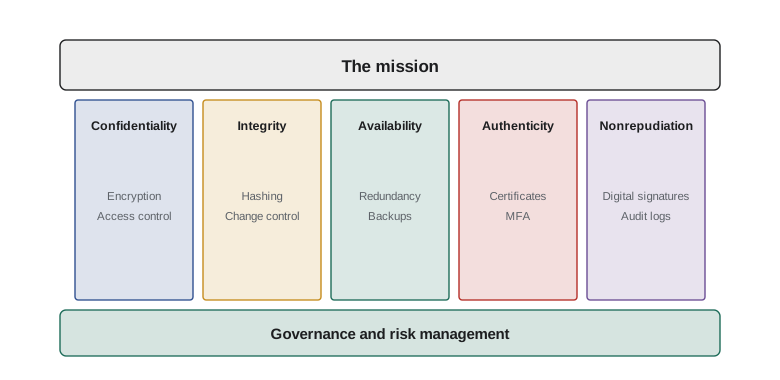
The pillars can pull against each other. Strong encryption with tightly held keys protects confidentiality but can threaten availability if the keys are lost. Locking every record against change protects integrity but makes legitimate corrections harder. A security leader's job is not to maximize one pillar but to find the balance the business needs. A public website prioritizes integrity and availability; its content is meant to be seen. A merger negotiation file prioritizes confidentiality. An industrial control system often puts availability and integrity ahead of confidentiality, because a stopped or misbehaving process can hurt people.
Worked problem
Which pillar is at risk?
Classify the main pillar affected in each incident: (a) a laptop holding unencrypted client files is stolen from a car; (b) a ransomware attack encrypts the file server; (c) an attacker changes the bank account number on a supplier invoice; (d) an employee denies sending an email that authorized a refund, and the email system has no signing or reliable logs; (e) a fake website imitates the company login page.
Show solution
- (a) Unauthorized disclosure is possible: confidentiality.
- (b) Authorized users cannot reach their files: availability. Many ransomware groups also steal data first, adding a confidentiality breach.
- (c) Data has been altered without authorization: integrity.
- (d) The organization cannot prove who acted: nonrepudiation.
- (e) The site is not genuine: authenticity.
Answer: Confidentiality, availability (and often confidentiality), integrity, nonrepudiation and authenticity. Real incidents frequently affect more than one pillar.
Related concepts you will meet often
Several further terms appear throughout the CISSP and are worth fixing now. Identification is claiming an identity, such as typing a user name. Authentication is proving that claim, with something you know, have or are. Authorization is deciding what an authenticated identity may do. Accountability is the ability to trace actions to an identity, which depends on the first three and on auditing. Together these are sometimes called IAAA. Note that accountability requires unique identities: if three administrators share one account, no log can tell you which of them made a change.
Data has states as well as values. Data at rest sits in storage; data in transit moves across networks; data in use is being processed in memory. Each state needs its own protections, and a design that encrypts data at rest and in transit can still leak it in use. Data also has an owner, a custodian and users, roles you will see again in Domain 2.
Principles that guide control design
A small set of design principles recurs across the domains. They are worth memorizing because exam scenarios often test whether you can recognize one at work.
- Least privilege: give each person and process only the access needed for their task, and no more.
- Need to know: even with the right clearance, access a specific item of information only when your work requires it.
- Separation (or segregation) of duties: split critical tasks so that no single person can complete and conceal a harmful act, for example by separating the person who creates a supplier from the person who approves payments.
- Defense in depth: layer administrative, technical and physical controls so that one failure does not expose the asset.
- Fail securely: when a control fails, it should fail into a safe state that protects the asset, while life-safety systems such as fire exits fail open to protect people.
- Keep it simple, and secure by default and by design: complexity hides weaknesses, and secure settings should be the starting point rather than an option.
- Zero trust: do not grant trust because of network location; verify every request explicitly, based on identity, device and context.
- Trust but verify, and privacy by design: monitor that controls work as intended, and build privacy protections into systems from the start.
These principles are not absolute rules. Least privilege can slow urgent work if access requests take days; separation of duties is hard in a team of three. Part of thinking like a manager is choosing compensating controls, such as after-the-fact review of logs, when a principle cannot be applied fully.
Security serves the mission
The most important idea in Domain 1 is that security exists to enable the organization to achieve its mission safely, not to eliminate all risk. A hospital's mission is patient care; a security control that delays clinicians reaching records in an emergency may harm the mission it was meant to protect. A bank's mission includes moving money quickly and correctly; controls must protect integrity without stopping legitimate payments.
This is why the CISSP is often described as a manager's exam. Many scenario questions offer a technically clever option and a business-aligned option. The better answer usually starts from understanding requirements and risk, involves the right stakeholders, follows policy and law, and protects people first. When you see answer choices such as 'immediately reconfigure the firewall' and 'first determine the business impact and consult the system owner', ask which one a responsible senior leader would choose.
In the United States, this business-first view appears in federal guidance. The NIST Cybersecurity Framework 2.0, published in February 2024, added a Govern function so that cybersecurity strategy, roles and risk tolerance are set at the top of the organization, and NIST SP 800-37 builds its risk management framework around categorizing systems by mission impact before selecting controls. Many sector regulators, such as the federal banking agencies and the SEC, expect boards to oversee cyber risk.
As you work through the remaining lessons, keep returning to three questions. What is the organization trying to achieve? What could prevent it, and how likely and harmful would that be? Which response gives the best balance of protection, cost and usability? Those questions sit underneath governance, law, continuity, personnel security and risk management alike.
Worked problem
Balancing the pillars
A clinic proposes locking patient records so that only the treating physician can open them. Emergency staff object that they sometimes need records at 3 a.m. when the treating physician is unreachable. Which approach best balances the pillars?
Show solution
- Identify the pillars in tension: confidentiality (limit access) against availability (urgent access for care).
- Recall the mission: patient care comes first, but privacy law and ethics require protecting records.
- Look for a design that serves both: a break-glass procedure that lets authorized emergency staff open a record after stating a reason.
- Add accountability: log every break-glass access and review it promptly, with consequences for misuse.
Answer: Use a controlled break-glass process with logging and review. It preserves availability for care while keeping confidentiality enforceable through accountability, a compensating control.
Common mistakes
MistakeTreating the CIA triad as the whole of security in the 2024 outline.
InsteadThe outline names five pillars, adding authenticity and nonrepudiation.
MistakeAssuming a shared account can support nonrepudiation.
InsteadNonrepudiation needs unique identities, digital signatures and reliable logs.
MistakeEquating confidentiality with privacy.
InsteadPrivacy is about individual rights; confidentiality is one tool for honoring them.
MistakeMaximizing one pillar regardless of business needs.
InsteadBalance the pillars according to the mission and risk.
MistakeChoosing the most technical answer on scenario questions.
InsteadPrefer answers that start from business requirements, policy, law and safety.
Summary and key terms
- Domain 1 is about 16 percent of the 2024 CISSP outline and has twelve sub-domains.
- The five pillars are confidentiality, integrity, availability, authenticity and nonrepudiation.
- Pillars can conflict; the right balance depends on the mission and the asset.
- Identification, authentication, authorization and accountability work together; accountability needs unique identities.
- Data must be protected at rest, in transit and in use.
- Least privilege, need to know, separation of duties, defense in depth, fail securely and zero trust guide control design.
- Security exists to enable the mission; the best exam answers usually reflect business-aligned, risk-based judgment.
- Confidentiality
- Disclosure only to authorized people, processes and systems.
- Integrity
- Accuracy and completeness, protected from unauthorized or accidental change.
- Availability
- Timely, reliable access for authorized users.
- Authenticity
- Assurance that a person, system or data is genuine.
- Nonrepudiation
- Assurance that a party cannot credibly deny an action.
- Accountability
- The ability to trace actions to a unique identity.
- Least privilege
- Granting only the access needed for a task.
- Separation of duties
- Splitting critical tasks so no one person can complete and conceal misuse.
- Defense in depth
- Layered controls so one failure does not expose an asset.
- Zero trust
- Verifying every request explicitly rather than trusting network location.
Practice problems
Work each problem on paper first, then reveal the answer to check.
Name the five pillars in the 2024 Domain 1 outline.
Show answer
Confidentiality, integrity, availability, authenticity and nonrepudiation.
Which pillar does a digital signature on an approval mainly support?
Show answer
Nonrepudiation, along with integrity and authenticity.
A website defaced by an attacker has suffered a failure of which pillar?
Show answer
Integrity.
Why can a shared administrator account undermine accountability?
Show answer
Logs cannot show which person acted.
What are the three states of data?
Show answer
At rest, in transit and in use.
Give an example of separation of duties in finance.
Show answer
One person sets up suppliers and another approves payments.
Should a fire exit door fail open or closed?
Show answer
Open, because life safety comes first.
What does zero trust stop relying on?
Show answer
Network location as a basis for trust.
What is a compensating control?
Show answer
An alternative control used when the preferred control cannot be applied fully.
Which pillar does an industrial control system often prioritize?
Show answer
Availability and integrity, because failures can cause physical harm.
Lesson quiz · 5 questions
Score 60% or more to complete this lesson.
Create a free account to save your progress, take quizzes and earn a certificate.