
CINE-410 · Lesson 8 of 12 · 29 min
Cable cams, wire rigs, cranes and telescopic arms
Some of the most memorable moving shots in sport and film come from cameras suspended on cables or carried on long arms: a camera racing above a football field, following a skier down a slope, flying across a stadium, rising from a close-up to a vast wide shot. These systems sit between drones and dollies. They can carry heavier cameras than most drones, run for hours on mains power, repeat moves precisely and fly over crowds where drones are restricted, but they need engineering, rigging and space. This lesson introduces cable cams and wire rigs, cranes and telescopic arms, the physics of cable tension and motion profiles, and how DPs work with the specialist crews who operate them.
Types of suspended and extended camera systems
| System | How it works | Typical uses | Key constraints |
|---|---|---|---|
| Point-to-point cable cam | A camera carriage runs along one or two cables strung between two anchor points | Following action along a line: skiers, runners, river shots, valley crossings | Straight-line path, large anchors, sag, wind |
| Multi-point cable system | Four or more motorized winches move a camera over an area in three dimensions | Stadiums, concerts, large sets, sports broadcasting | Engineered installation, long rigging time, exclusion zones |
| Wire rigs for actors | Cables and winches lift or fly performers | Flying, falls, stunts | Stunt rigging specialists, separate from camera systems |
| Camera crane (jib) | A counterbalanced arm on a base raises and swings the camera | Rising and descending shots, sweeping moves | Fixed arm length, counterweights, ground support |
| Telescopic crane | A motorized arm that extends and retracts during the shot | Moves that change reach while rising and swinging | Operators, weight, ground pressure, space |
| Robotic arm | An industrial robot carrying the camera, often with motion control | Precise, repeatable, fast moves (see Course CINE-330) | Limited reach, strict safety zones |
Most of these systems are rented with a specialist crew who rig, operate and maintain them.
Cable cams in practice
A point-to-point cable cam is the simplest suspended system: one or two cables tensioned between anchors, a carriage running along them and a stabilized head carrying the camera. The carriage may be pulled by a separate drive line from a winch or driven by an onboard motor. Operators control the carriage speed and the camera head remotely, often while a separate operator controls focus.
- Anchors: trees, towers, buildings, rock bolts or engineered ground anchors, all assessed by the rigging crew for the forces involved.
- Spans: a few tens of meters to several hundred, depending on the system.
- Height: clearance above the action must allow for cable sag under the carriage weight.
- Stabilization: a gyro-stabilized head removes most of the swing and vibration, but wind and fast acceleration can still affect the image.
- Power and communication: battery or mains power for the carriage and camera, with wireless links for control and video.
Cable sag and tension
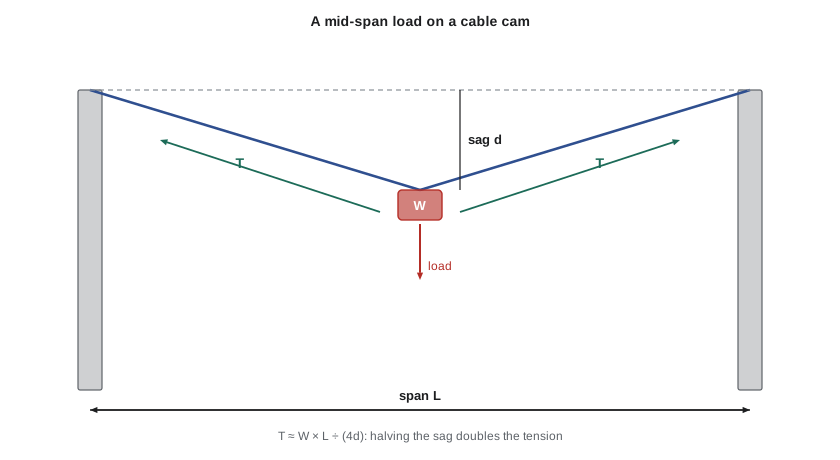
A cable under load sags. For a cable supporting a load at its middle, the relationship between tension, load, span and sag is a basic statics problem. A useful approximation for a point load W at mid-span on a cable of span L with sag d, ignoring the cable's own weight, is:
Here T is the horizontal tension in the cable. Halving the sag doubles the tension, which is why "pulling the cable tighter" quickly reaches the limits of the cable and the anchors.
Worked problem
Tension in a cable cam span
A cable cam carriage with camera and head weighs 25 kg. The span is 150 m, and the rigger plans a sag of 3 m at mid-span with the carriage there. Ignoring the cable's own weight, estimate the horizontal tension. If the rigger wanted only 1.5 m of sag, what would the tension become?
Show solution
- Load: W = 25 × 9.81 ≈ 245 N.
- Tension at 3 m sag: T ≈ 245 × 150 ÷ (4 × 3) = 36,750 ÷ 12 ≈ 3,060 N, about 3.1 kN.
- Tension at 1.5 m sag: 36,750 ÷ 6 ≈ 6,130 N, about 6.1 kN.
Answer: About 3.1 kN with 3 m of sag, rising to about 6.1 kN if the sag is halved. Real rigs also carry the cable's own weight, dynamic loads from acceleration and wind, and safety factors, so riggers use engineered calculations and certified hardware rated well above these figures.
Motion profiles and timing
Cable cams and cranes rarely move at constant speed from start to finish. They accelerate, cruise and decelerate. A trapezoidal motion profile helps plan the timing.
Worked problem
How long does a cable cam pass take?
A cable cam must travel 200 m to follow a skier. It can reach 15 m/s (54 km/h) and accelerate and decelerate at 2 m/s². How long does the pass take, and how much of the span is spent accelerating and braking?
Show solution
- Time to reach 15 m/s: 15 ÷ 2 = 7.5 s.
- Distance while accelerating: 15² ÷ (2 × 2) = 225 ÷ 4 = 56.25 m; the same distance is needed for braking.
- Distance at cruise: 200 − 2 × 56.25 = 87.5 m, which takes 87.5 ÷ 15 ≈ 5.8 s.
- Total: 7.5 + 5.8 + 7.5 ≈ 20.8 s.
Answer: About 21 seconds, with more than half the span (about 112 m) used for acceleration and braking. If the skier is faster than 15 m/s or the span is shorter, the camera may not keep up, so the action and camera speeds must be matched in rehearsal.
Cranes and telescopic arms
Camera cranes lift the camera on a counterbalanced arm. On a traditional crane, the arm length is fixed and counterweights at the back balance the camera, head and any operator at the front. Telescopic cranes add a motor that extends and retracts the arm during the shot, letting the camera move in and out as well as up, down and around. Many telescopic cranes carry a remote head instead of an operator, reducing the counterweight needed and letting the camera reach places where a person could not ride safely.
- Reach: arms range from a few meters to well over 20 m.
- Base: dollies, track, vehicles or fixed bases; long arms need stable, level ground and careful ground-pressure checks.
- Counterweights and balance: changes to the camera package must be rebalanced.
- Wind: long arms act like sails and have strict wind limits.
- Operators: a crane grip or technician swings the arm, a remote head operator frames the shot, and a focus puller works remotely.
Worked problem
Reach and height of a crane move
A telescopic crane arm pivots 1.5 m above the ground. With the arm at 12 m and raised to 30° above horizontal, how high is the camera above the ground and how far forward is it from the pivot? What changes if the arm extends to 15 m?
Show solution
- At 12 m: height above pivot 12 × sin 30° = 6 m; forward reach 12 × cos 30° ≈ 10.4 m.
- Camera height above ground: 1.5 + 6 = 7.5 m.
- At 15 m: height above pivot 15 × 0.5 = 7.5 m; ground height 9 m; forward reach 15 × 0.866 ≈ 13 m.
Answer: At 12 m the camera is about 7.5 m high and 10.4 m forward; at 15 m it rises to about 9 m and reaches about 13 m forward. A telescopic move can therefore rise and push in at the same time without moving the base.
Safety around suspended and extended systems
These systems combine heavy loads, height and motion over people, so failures can be catastrophic.
- Engineering and certification: cable systems and anchors are designed and checked by qualified riggers, often with engineering sign-off, using certified hardware with documented load ratings and safety factors.
- Exclusion zones: no one stands under a cable cam during testing; during filming, only essential and briefed people are allowed under the path, and only if the system and permits allow it.
- Inspections: daily inspections of cables, terminations, pulleys, winches, brakes and controls, with logs.
- Wind and weather limits: agreed in advance and checked with anemometers.
- Emergency stops and recovery: every operator knows how to stop the system and recover a stuck carriage safely.
- Communication: clear radio channels between the system operators, the first AD and the action (for example, a stunt or sports coordinator).
- Electrical safety near power lines and lighting rigs.
Rules and guidance in the US
In the United States, OSHA standards cover slings, rigging and overhead hazards, including 29 CFR 1910.184 for slings, and state OSHA plans may add requirements. The Industry-Wide Labor-Management Safety Committee issues safety bulletins covering camera cranes, camera cars and work near overhead loads, and venues often require their own engineering approvals for cable systems over seating or fields. Drones used for similar shots fall under FAA rules instead (Lesson 7).
Planning a cable cam or crane shot with the DP
The DP works with the specialist company to translate the shot into a buildable plan.
- Define the path: start and end points, height, speed and the action the camera follows.
- Choose the system: point-to-point cable, multi-point system, crane, telescopic arm or robotic arm.
- Survey the site: anchors, ground conditions, power, access, wind exposure and clearances from trees, lines and structures.
- Agree the camera package: weight, lens, filters, focus and wireless systems within the system's payload.
- Plan rigging time: cable systems can take a day or more to rig and test, so they often need a pre-rig day.
- Rehearse at low speed: check framing, focus and clearances before full-speed takes.
Choosing between drones, cables and cranes
Each method has strengths.
| Factor | Drone | Cable cam | Telescopic crane |
|---|---|---|---|
| Path | Free in three dimensions | Along a line or within a rigged volume | Within the arm's reach from the base |
| Duration | Limited by battery, often 10 to 25 minutes | Hours, with mains power | Hours |
| Payload | Limited, especially on lighter drones | Moderate to heavy | Heavy, with counterweights |
| Over people | Restricted by aviation rules | Possible with engineering and approvals | Possible with exclusion zones and approvals |
| Repeatability | Moderate | High | High |
| Set-up time | Short | Long | Moderate |
For repeated moves over a crowd at a live event, a cable system may be the only practical choice. For a single sweeping move over open country, a drone is usually faster and cheaper. For a rising push-in on a set, a telescopic crane is often best.
Common mistakes
MistakeTightening a cable cam to reduce sag without considering tension
InsteadRemember that halving the sag roughly doubles the tension; use engineered calculations and rated hardware
MistakeExpecting a cable cam to reach full speed instantly
InsteadPlan acceleration and braking distances with a trapezoidal profile and match them to the action
MistakeStanding under a cable path during testing
InsteadKeep everyone out of the exclusion zone during tests and allow only essential, briefed people under it during filming
MistakeAdding accessories to a crane camera without rebalancing
InsteadRebalance the arm whenever the camera package changes and stay within the payload rating
MistakeChoosing a cable system with no time for rigging and testing
InsteadSchedule a pre-rig and test day for engineered cable systems
Summary and key terms
- Suspended and extended systems include point-to-point and multi-point cable cams, cranes, telescopic arms and robotic arms.
- For a mid-span load, tension is about W × L ÷ (4d), so reducing sag rapidly increases tension.
- Trapezoidal motion profiles show how much of a path is used for acceleration and braking.
- Telescopic cranes can rise, swing and push in at once without moving the base.
- Safety depends on engineered rigging, certified hardware, inspections, exclusion zones, wind limits and emergency procedures.
- Canadian provincial rules and industry guidelines and US OSHA standards and industry bulletins apply to rigging and overhead loads.
- Choose between drones, cables and cranes by path, duration, payload, people below, repeatability and set-up time.
- Cable cam
- A camera carriage that runs along a suspended cable or cables
- Multi-point cable system
- A system that moves a camera in three dimensions using several motorized winches
- Sag
- The vertical drop of a loaded cable below the straight line between its anchors
- Tension
- The pulling force in a cable
- Anchor
- A secure point to which a cable or rig is attached
- Telescopic crane
- A camera crane whose arm can extend and retract during a shot
- Remote head
- A motorized pan and tilt head controlled from a distance
- Trapezoidal motion profile
- A movement plan with acceleration, constant speed and deceleration phases
- Safety factor
- The ratio between a component's breaking strength and the maximum load it is allowed to carry
- Exclusion zone
- An area kept clear of people because of the risk from a suspended or moving system
Practice problems
Work each problem on paper first, then reveal the answer to check.
A 20 kg carriage hangs at mid-span of a 100 m cable with 2 m sag. Estimate the tension.
Show answer
W ≈ 196 N; T ≈ 196 × 100 ÷ 8 ≈ 2,450 N
If the sag in that example is reduced to 1 m, what happens to the tension?
Show answer
It doubles to about 4,900 N
How far does a camera travel while accelerating to 10 m/s at 2 m/s²?
Show answer
10² ÷ (2 × 2) = 25 m
A crane arm is 10 m long at 45° above horizontal, pivoting 1.5 m above the ground. How high is the camera?
Show answer
1.5 + 10 × sin 45° ≈ 1.5 + 7.1 = 8.6 m
Name two things checked in a daily inspection of a cable system.
Show answer
Any two of cables, terminations, pulleys, winches, brakes and controls
Why do long crane arms have wind limits?
Show answer
They act like sails, and wind can push them off course or overload them
Why might a cable system be better than a drone at a stadium event?
Show answer
It can run for hours, carry a heavier camera and operate over crowds with engineering and approvals where drones are restricted
What does a remote head allow on a telescopic crane?
Show answer
The camera can be framed remotely without an operator riding the arm, reducing counterweight and risk
Why should cable cams be rehearsed at low speed first?
Show answer
To check framing, focus and clearances safely before full-speed takes
Which professionals usually design and check cable systems and anchors?
Show answer
Qualified riggers, often with engineering sign-off
Lesson quiz · 5 questions
Score 60% or more to complete this lesson.
Create a free account to save your progress, take quizzes and earn a certificate.