
CINE-401 · Lesson 8 of 12 · 29 min
Scheduling and prep with the first assistant director
A brilliant visual plan is worthless if it cannot be shot in the time available. The first assistant director (first AD) builds the shooting schedule and runs the set; the DP supplies the information that makes the schedule realistic and then helps keep each day on track. This lesson explains how schedules are built, what the DP contributes, how to budget set-ups and time within a day, how to plan around the sun and other natural light, and how day plans and shot lists keep the crew moving. It also covers the daily rhythm of a shooting day and the decisions a DP and first AD make together when the day starts to slip.
How a schedule is built
The first AD (or a production manager on small shows) breaks down the script into elements: cast, locations, time of day, extras, props, vehicles, stunts, effects and special equipment. Each scene becomes a strip on a stripboard, now usually in scheduling software, and the strips are arranged into shooting days.
- Group scenes by location to minimize moves, and within a location by set and time of day.
- Group by cast availability: actors with short contracts or limited availability are scheduled together.
- Separate day and night work and allow legal turnaround between days (Course CINE-340).
- Place difficult scenes where the crew is fresh and the schedule has slack, not at the end of a long week.
- Produce a day-out-of-days report showing which days each actor works, and a one-line schedule listing scenes by day.
The DP's input matters most at this stage. The first AD needs to know which scenes need more time, which need specific light (sunset, dawn, magic hour), which need pre-rigs, and which combinations of scenes are efficient for camera and lighting.
What the DP brings to scheduling
- Time estimates for each scene, based on shot lists and lighting plans.
- Priority grades (A, B, C) from the breakdown (Lesson 2).
- Natural light needs: scenes that must be shot facing a direction at a time of day, or within a narrow window such as sunset.
- Equipment logistics: days that need cranes, lifts or extra generators, ideally grouped to reduce day-play rentals.
- Pre-rig and wrap-out needs (Lesson 7).
- Efficient sequences: for example, shooting a day interior before a night interior in the same room so the lighting can be converted without moving the camera crew.
Be honest. A DP who promises that a complex scene can be done in three hours, then takes six, damages the whole schedule. Padding every estimate is just as harmful; the first AD learns to discount it.
Budgeting time within a day
A common way to plan a day is to count set-ups and estimate minutes per set-up. The estimate includes lighting, rehearsal, camera and grip work and shooting takes.
Worked problem
Set-ups per day
A 12-hour day includes a 1-hour meal break that is not part of shooting time, a 45-minute company move and a 30-minute block at the start for a blocking rehearsal before lighting. The DP's shot lists contain 22 set-ups. How many minutes are available per set-up, and is the plan realistic?
Show solution
- Total day: 12 hours = 720 minutes. Subtract the meal: 720 − 60 = 660 minutes of work.
- Subtract the move and the opening rehearsal: 660 − 45 − 30 = 585 minutes.
- Minutes per set-up: 585 ÷ 22 ≈ 27 minutes.
- Compare with experience: 25 to 40 minutes per set-up is common for independent drama; simple coverage may be faster and complex set-ups much slower.
Answer: About 27 minutes per set-up. That is achievable only if most set-ups are simple, share lighting directions and avoid turnarounds. The DP should look for set-ups to combine or drop (for example, using two cameras or a developing shot), or ask the first AD to move a scene to another day.
The shape of a shooting day
Most union agreements and good practice set limits on working time, meal breaks and rest. A common pattern is that the crew must be given a meal break no later than about six hours after call, with financial penalties if it is late; check the agreement that applies to each production.
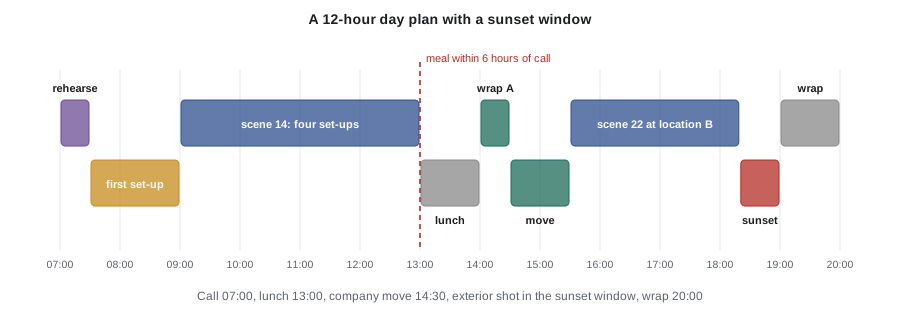
- Call and breakfast: crew arrives; the first rehearsal with actors often happens on set while lighting begins.
- First set-up: usually the longest, because the whole space is being lit for the first time. Getting the first shot early sets the pace of the day.
- Morning work: the bulk of the coverage for the first scene.
- Meal break: about mid-day; the crew returns ready to shoot quickly.
- Afternoon: remaining coverage, company moves, the last scenes.
- Wrap: equipment is struck or prepared for the next day; the DP and first AD review progress and adjust the next day's plan.
Worked problem
Planning a company move
The crew must move from location A to location B, 20 minutes' drive apart. Packing the trucks at A takes 30 minutes, driving 20 minutes, and unloading and setting basic power and distribution at B 40 minutes. A pre-rig crew has already lit the main set at B. How long is the move, and how can the DP reduce its effect?
Show solution
- Move time: 30 + 20 + 40 = 90 minutes.
- With a pre-rig at B, the first set-up there can start soon after unloading; without one, add the full lighting time.
- The DP can ask the first AD to schedule the move across lunch (packing before and unloading after, or a "walking lunch"), shoot a simple insert at A while the trucks pack, or send a second unit ahead.
Answer: About 1.5 hours. Moves are expensive, so productions minimize them by grouping scenes at each location, pre-rigging and scheduling moves around meals.
Sun studies and natural light
Natural light changes all day. For exterior scenes and day interiors that depend on sunlight, the DP plans when and in which direction to shoot.
- Sun position: azimuth (compass direction) and elevation (height above the horizon) change through the day and the year. Apps and websites show the sun's path over a map or through a phone camera at any date.
- Front, side and back light: shooting a face with the sun behind the actor (backlight) gives soft, flattering light on the face from bounce and sky, with a rim on the hair. Side light gives modeling; front sun is often harsh and makes actors squint.
- Golden hour and blue hour: the period after sunrise and before sunset when light is low and warm, and the twilight after sunset when the sky is deep blue. Their length depends on latitude and season (Course PHOT-311 covered how to estimate them).
- Weather: cloud cover softens light but also changes continuity. Scenes that must match across several days need either control (overheads, negative fill) or a consistent sky.
- Seasons: day length varies widely in Canada and the northern US, from very long summer days to short winter days.
Worked problem
Scheduling a sunset scene
A two-page scene on a beach must end with the characters walking away into the sunset. Sunset is at 19:42. Usable warm, low light is judged to start about 45 minutes before sunset and the blue twilight lasts about 25 minutes after it. The scene has 6 set-ups: two wides, two singles, an over and the walk-away. The singles and over can be shot with controlled light (overhead frame and bounce) earlier in the afternoon. When should each part be shot?
Show solution
- The walk-away and one wide need the real sunset: window 18:57 to 19:42, about 45 minutes, plus twilight to about 20:07.
- Plan the walk-away at about 19:25 to 19:45 with two cameras so it can be done in one or two takes.
- Shoot the second wide at about 19:00 to 19:20, facing the sun for backlight.
- Shoot the singles and over from about 16:30 to 18:30, controlling the sun with an overhead and bounce so they match the low, warm feel; place the sun behind the actors.
- Keep a twilight back-up: if a take fails, a version in blue light after sunset may still work.
Answer: Shoot the controllable coverage in the afternoon, the wide just before sunset and the walk-away in the last minutes of sun, with two cameras and the twilight as a back-up.
Day plans and shot lists
Each evening, the DP and first AD review the next day's call sheet. The DP then issues a day plan (sometimes called a shot list for the day) to the camera, electric and grip departments: scenes in order, set-ups in order, lenses, equipment and notes such as "pre-rig ready at 07:30," "two cameras for scene 31" or "sunset window 18:57 to 19:42."
- List set-ups in shooting order, grouped by lighting direction.
- Mark priorities: must, should and could (Lesson 5).
- Note equipment moves: when the dolly track moves, when the crane arrives, when the lift is needed.
- Note special needs: practical effects, VFX references, child performer hours, intimacy coordinator involvement (Lesson 10).
When the day slips
Almost every day falls behind at some point. The DP and first AD have a short list of tools.
- Simplify coverage: combine set-ups into a developing shot, use two cameras, or drop "could" shots.
- Speed up lighting: accept a slightly simpler approach for B and C scenes while protecting A scenes.
- Move work: push a scene to another day, give inserts to a second unit or schedule pickups.
- Never compromise safety to make the day. Rushing rigging, ignoring fatigue or skipping safety meetings causes accidents (Course CINE-340).
The first AD usually tracks progress against the schedule by the hour. When a day is falling behind, the earlier the DP and first AD decide what to change, the more options they have. A decision at 11:00 can protect the afternoon; a decision at 18:00 usually means losing scenes.
Second unit and splinter units
Larger productions use a second unit to shoot inserts, establishing shots, driving plates and action. The second-unit DP must match the main unit's look, so the main DP provides the look book, LUTs, lens notes and reference frames. A splinter unit is a small team working briefly alongside the main unit, often for inserts at the same location. Both can relieve pressure on the main unit's schedule.
| DP input | Example | Scheduling effect |
|---|---|---|
| Time estimate | Night exterior: 9 set-ups, 6 hours after pre-rig | Allocates a full night or splits over two |
| Light window | Dawn scene must face east, 05:40 to 06:30 | Early call; scene shot first |
| Equipment grouping | Crane needed for scenes 12, 30 and 44 | Schedule all three on consecutive days to save day-plays |
| Pre-rig | Stage ceiling rig takes 2 days | Rigging crew starts 2 days before the main unit |
| Priority | Scene 40 is the film's emotional climax | Scheduled early in the week with slack after it |
Common mistakes
MistakeGiving optimistic time estimates to please producers
InsteadGive honest estimates based on shot lists and lighting plans
MistakeIgnoring sun direction when scheduling exteriors
InsteadUse sun studies to place exteriors at the right time and facing
MistakeMaking late decisions when the day slips
InsteadReview progress hourly with the first AD and decide early what to simplify
MistakeScheduling company moves in the middle of a productive block
InsteadSchedule moves across meals and pre-rig the next location
MistakeAssuming a second unit will automatically match
InsteadGive the second-unit DP the look book, LUTs, lens notes and reference frames
Summary and key terms
- The first AD builds the schedule from a script breakdown, grouping scenes by location, cast and time of day.
- The DP contributes time estimates, priorities, light windows, equipment grouping and pre-rig needs.
- Minutes per set-up equals working minutes after meals, moves and rehearsals divided by the number of set-ups.
- Company moves are costly; pre-rigs and scheduling around meals reduce their impact.
- Sun studies place exteriors at the right time and direction; backlight is often the most flattering.
- Daily shot lists in shooting order, with priorities and equipment notes, keep departments ahead.
- When the day slips, decide early what to simplify or move, and never trade safety for time.
- Stripboard
- A schedule layout in which each scene is a strip arranged into shooting days
- Day-out-of-days
- A report showing which days each actor works
- One-line schedule
- A summary schedule listing scenes for each day in one line each
- Call sheet
- The daily document listing call times, scenes, cast, locations and notes
- Company move
- Moving the whole unit from one location to another during a day
- Sun study
- A plan of the sun's position at a location and date to schedule natural light
- Azimuth
- The compass direction of the sun or another object
- Golden hour
- The period of low, warm sunlight after sunrise and before sunset
- Second unit
- A separate crew shooting inserts, plates, establishing shots or action
- Pickup
- A shot or scene filmed later to complete or fix material
Practice problems
Work each problem on paper first, then reveal the answer to check.
A 12-hour day with a 1-hour meal, a 30-minute move and 18 set-ups: minutes per set-up?
Show answer
(660 − 30) ÷ 18 = 35 minutes
Why is the first set-up of a day usually the slowest?
Show answer
The whole space is being lit for the first time
Sunset is at 20:10 and golden light starts 45 minutes before. When does the window start?
Show answer
19:25
Name two ways to reduce the impact of a company move.
Show answer
Schedule it across a meal, pre-rig the next location, shoot inserts while packing, or send a second unit ahead
Why is backlight often preferred for faces in sun?
Show answer
It gives soft light on faces from bounce and sky, a hair rim and no squinting
What does a day-out-of-days report show?
Show answer
Which days each actor works
What should a DP give a second-unit DP?
Show answer
The look book, LUTs, lens notes and reference frames
Why group crane scenes on consecutive days?
Show answer
To reduce day-play rental days and set-up time
What are three tools for catching up a slipping day?
Show answer
Simplify coverage, speed up lighting on lower-priority scenes, move work to another day or unit
Why must the DP's time estimates be honest rather than padded?
Show answer
Optimistic estimates break the schedule; padded ones get discounted and erode trust
Lesson quiz · 5 questions
Score 60% or more to complete this lesson.
Create a free account to save your progress, take quizzes and earn a certificate.