
CINE-330 · Lesson 7 of 12 · 27 min
Music video cinematography: forms and process
A music video is a marriage of sound and image in which the song comes first. The pictures must serve the track, express the artist and catch attention in a crowded feed, often within the first few seconds. For cinematographers, music videos are a playground and a proving ground: budgets are tight, schedules short and ideas big, but the creative freedom is greater than in almost any other form. This lesson explains the main forms of music video, how a video is commissioned and prepared, how the cinematographer works with the artist and director, how performance and narrative are covered, and how to make ambitious images with limited money. Lesson 8 follows with the technical craft of playback, lip sync and off-speed shooting.
The main forms of music video
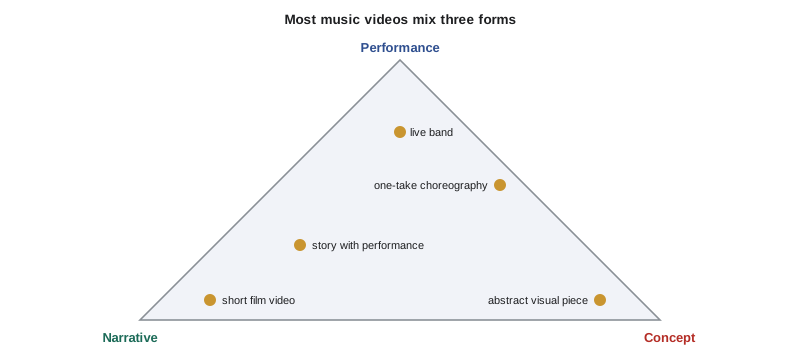
Most music videos combine three basic forms in different proportions.
- Performance videos show the artist singing or the band playing. They may be staged on a set, at a location or in front of an audience. Performance gives the audience a direct connection with the artist and is the easiest form to cut to the music.
- Narrative videos tell a story, sometimes literal, sometimes loosely inspired by the lyrics. The artist may act a role or appear only in performance sections that intercut with the story.
- Concept videos are built around a single visual idea: a one-take choreography, a visual effect, an unusual location, a striking color world or a camera trick. Many famous music videos are concept videos.
Other forms include lyric videos, dance videos built around choreography, animation, live session videos and visualizers, which are short looping images for streaming platforms. Many releases now need a main video plus vertical clips, behind-the-scenes content and loops for social media, all planned together.
How a music video is commissioned
The commissioning process is usually simpler and faster than for commercials.
- The label's video commissioner or the artist's manager sends the track, a brief and a budget range to several directors.
- Directors write treatments, often within a few days, with references and a visual approach. The cinematographer may help with lighting and camera ideas.
- The artist and label choose a treatment. Sometimes there is negotiation about budget, locations or the artist's appearance.
- Pre-production is short, often one or two weeks, sometimes less.
- The shoot usually lasts one or two days.
- The edit is fast, often finished within days, with a color grade and any visual effects.
- The video is released on the artist's channels with social clips.
The cinematographer may be brought in by the director at the treatment stage or after the job is awarded. On low-budget videos, the cinematographer may also bring their own equipment, help find locations and cover roles that a larger production would hire separately.
Working with the artist
The artist is the reason the video exists, and their comfort and confidence on camera matter enormously. Some artists are experienced performers who know their best angles and light; others are uncomfortable on camera or anxious about their appearance. The cinematographer's attitude can make a big difference.
- Understand the artist's image and preferences before the shoot. Ask the director or management about angles, lighting or styling the artist likes or dislikes.
- Light faces flatteringly unless the concept calls for something harsher, and test the look with a stand-in of similar skin tone.
- Keep set-ups quick so the artist does not lose energy waiting.
- Play back takes on a monitor when the artist wants to see them, and listen to their feedback.
- Protect privacy and dignity, especially in intimate or vulnerable scenes, with closed sets and clear communication.
- Respect the artist's time: performance energy fades after many takes, so plan the most important shots early.
Visual language and the song
Music video images are cut to the rhythm and emotion of the song. Before the shoot, the director and cinematographer study the track closely: its tempo, its structure (intro, verse, pre-chorus, chorus, bridge, outro), its peaks and quiet moments. Visual decisions follow from the music.
- Energy: fast, rhythmic songs suit faster cutting, handheld or kinetic moves and strong contrast; slow songs suit long takes, slow moves and softer light.
- Structure: many videos change set, light or camera style at each chorus or the bridge, giving the edit fresh material at key moments.
- Color: a palette can express the song's mood, the artist's brand or an album's visual identity.
- Recurring motifs: an object, gesture or color that returns at intervals can tie the video together.
Worked problem
Mapping a song structure to set-ups
A song lasts 3:30 at 120 beats per minute, with an intro of 16 beats, two verses of 64 beats each, two choruses of 32 beats each, a bridge of 32 beats, a final double chorus of 64 beats and an outro of 16 beats. How long does each section last, and how might the shoot plan reflect the structure?
Show solution
- At 120 bpm, one beat lasts 60 ÷ 120 = 0.5 s.
- Intro: 16 × 0.5 = 8 s. Each verse: 64 × 0.5 = 32 s. Each chorus: 16 s. Bridge: 16 s. Final double chorus: 32 s. Outro: 8 s.
- Sum: 8 + 32 + 16 + 32 + 16 + 16 + 32 + 8 = 160 s, about 2:40; the remaining time is instrumental breaks and repeated phrases in the real track.
- Plan: verses in a narrative location, choruses on a performance set with stronger light and movement, the bridge in a contrasting color world, the final chorus with the biggest camera move.
Answer: Sections range from 8 to 32 seconds. Matching set-ups to sections gives the edit natural changes at the moments the song changes.
Covering a performance
Performance is the backbone of most music videos, and editors need plenty of it. The usual approach is to film the whole song, or large sections of it, many times with different camera positions, lenses and moves, while the artist performs to playback (Lesson 8).
- Wide shots show the space, the band and choreography.
- Medium shots and close-ups capture expression and lip sync.
- Detail shots show hands on instruments, microphones, jewelry or wardrobe.
- Moving shots, such as circling gimbal moves, push-ins and crane moves, add energy.
- Specialty shots, such as high-speed hair flips or long-lens silhouettes, add highlights.
Multi-camera coverage can capture more angles from each performance pass, saving the artist's energy. However, more cameras make lighting harder, because each camera sees different parts of the set. Many cinematographers prefer one or two cameras with carefully lit set-ups, and use additional cameras only for specific passes.
Worked problem
How many passes fit in the day?
A performance set has 6 planned set-ups. Each needs about 25 minutes to light and reset, and the artist performs the 3:30 song 4 times per set-up, with 3 minutes between passes for notes and reset. How long does the performance section of the day take?
Show solution
- Time per set-up for passes: 4 × 3.5 min + 3 × 3 min (gaps between passes) = 14 + 9 = 23 min.
- Total per set-up: 25 + 23 = 48 min.
- Six set-ups: 6 × 48 = 288 min, about 4.8 hours.
Answer: About 4 hours 50 minutes, which leaves room in a 12-hour day for narrative scenes, meals and a company move.
Narrative sections
Narrative sections in music videos are like short films without dialogue. They rely on visual storytelling, performance and editing. Because the song plays over them, there is usually no sync sound, which frees the camera and lighting from many constraints of drama. Narrative scenes may be shot at off-speed frame rates, with unusual lenses or with stylized lighting that would be too much in a feature. The cinematographer still has to provide coverage: establishing shots, mid-shots, close-ups and inserts that let the editor build the story to the music.
Making big ideas on small budgets
Many music videos are made with budgets that would barely cover one day of a commercial. Cinematographers who thrive in music videos are inventive.
- Choose one strong idea rather than many weak ones; a single bold location or lighting concept can carry a video.
- Use practical lights, colored gels, LED tubes and smoke to create looks cheaply.
- Shoot at night or in controlled spaces, where small lights have more impact.
- Borrow or negotiate equipment deals with rental houses, which often support emerging cinematographers.
- Plan carefully: a precise shot list on a small video saves more money than any piece of equipment.
- Keep the crew small but safe, with clear roles and reasonable hours.
- Use the edit: a modest number of strong images, cut rhythmically, often beats many weak ones.
| Form | Typical camera approach | Lighting tendency |
|---|---|---|
| Performance | Multiple passes, varied lenses, moves on choruses | Bold, often stylized |
| Narrative | Coverage like a short film, no sync sound | Motivated, story-driven |
| Concept | Designed around one idea, often one take | Precise, often special |
| Dance | Wide to show choreography, rhythmic moves | Even enough to show bodies |
| Live session | Several cameras, unobtrusive | Natural or concert style |
| Visualizer | Locked or looping, simple | Graphic, high contrast |
Rights and clearances in music videos
Because the label owns or controls the song, music clearance is usually simpler in a music video than in a commercial. Other rights still matter: locations need permission, recognizable artworks or brands may need clearance, and performers and extras need releases. If the video includes other music, samples or film clips, they need licenses.
In the United States, performers in music videos may be engaged under SAG-AFTRA's music video terms when the production is signatory, while dancers and actors on non-union videos still need written agreements. Locations require permits from city or county film offices, and state right of publicity laws, such as those in California and New York, require consent to use a person's likeness commercially.
Choreography and dance coverage
Many music videos feature choreography, either by the artist or by dancers. Dance must be filmed so that the movement reads: full bodies in frame for key moves, camera positions that show formations, and moves that follow the energy of the dance rather than fighting it. The cinematographer should watch rehearsals with the choreographer, note the counts where big moves happen and plan camera moves to land on those counts. Floors matter too: dancers need a safe, non-slip surface, and reflective floors can create beautiful images but may be slippery. Lighting should be broad enough that dancers do not move in and out of pools of light unintentionally, unless the concept calls for it.
When the artist is also the director
Some artists direct or co-direct their own videos. In that case, the cinematographer often becomes the person who translates ideas into practical plans, watches the monitor during performance and gives honest feedback on takes. Agree in advance how decisions will be made on the day, and make sure someone other than the artist is watching continuity, sync and coverage while they perform.
Wrapping a music video day
At the end of a music video day, the cinematographer checks that every section of the song has enough coverage, confirms that data has been backed up, and notes any pick-up shots for the edit.
Common mistakes
MistakeTreating the song as background.
InsteadStudy tempo, structure and mood and let visual choices follow the music.
MistakeExhausting the artist with long set-ups.
InsteadLight efficiently and shoot the most important performance first.
MistakeUsing many cameras without considering lighting.
InsteadAdd cameras only where lighting can support them.
MistakeTrying to film too many ideas on a small budget.
InsteadCommit to one strong idea and execute it well.
MistakeIgnoring releases on non-union videos.
InsteadGet written agreements and releases from every performer and location.
Summary and key terms
- Music videos combine performance, narrative and concept forms, plus social and visualizer content.
- Commissioning is fast: treatment, short prep, one or two shoot days and a quick edit.
- The artist's comfort and image are central; efficient set-ups and flattering light help.
- Visual choices follow the song's tempo, structure, color and recurring motifs.
- Performance is covered in many passes with varied lenses and moves; multi-camera saves energy but complicates lighting.
- Narrative sections are like silent short films, freeing camera and lighting.
- Small budgets reward one strong idea, inventive lighting and careful planning.
- Performance video
- A music video centered on the artist singing or playing.
- Narrative video
- A music video that tells a story.
- Concept video
- A music video built around a single visual idea.
- Visualizer
- A short looping image for a streaming release.
- Video commissioner
- The label staff member who commissions videos.
- Pass
- One complete performance of a song or section for a camera set-up.
- Bridge
- A contrasting section of a song, often before the final chorus.
- Beats per minute
- The tempo of a song.
- Coverage
- The set of shots that lets an editor build a sequence.
- Release
- A signed permission from a person or property owner.
Practice problems
Work each problem on paper first, then reveal the answer to check.
Name the three basic forms of music video.
Show answer
Performance, narrative and concept.
How long is one beat at 100 bpm?
Show answer
0.6 s.
How long is a 32-beat chorus at 128 bpm?
Show answer
15 s.
Why change set-ups at the chorus?
Show answer
To give the edit fresh material when the song changes.
Why might multi-camera performance coverage be harder to light?
Show answer
Each camera sees different parts of the set.
Time for 3 passes of a 4-minute song with 2-minute gaps?
Show answer
12 + 4 = 16 minutes.
What frees narrative music video scenes from drama constraints?
Show answer
There is usually no sync sound.
Name one low-budget lighting tool.
Show answer
LED tubes, practical lights or colored gels.
Who usually controls the song's rights in a music video?
Show answer
The record label.
Why test the look with a stand-in of similar skin tone?
Show answer
To get flattering light ready before the artist arrives.
Lesson quiz · 5 questions
Score 60% or more to complete this lesson.
Create a free account to save your progress, take quizzes and earn a certificate.