
CINE-330 · Lesson 3 of 12 · 27 min
Product and tabletop cinematography
Products are the stars of most commercials. A bottle, a phone, a watch, a burger or a lipstick may appear for only a few seconds, but those seconds are the reason the spot exists. Tabletop cinematography is the specialist art of filming small objects, food and liquids with precise lighting, controlled movement and perfect focus. It shares principles with still product photography, covered in PHOT-310: the family of angles, gradients on reflective surfaces, backlit liquids and dark-field glass. Moving images add new challenges: the camera and the light must work across time, focus must hold through movement, liquids must pour on cue and steam must rise when the camera is rolling. This lesson covers the tabletop stage, lenses including macro and probe lenses, lighting moving products, food and drink, liquids and the craft of the hero packshot.
The tabletop stage
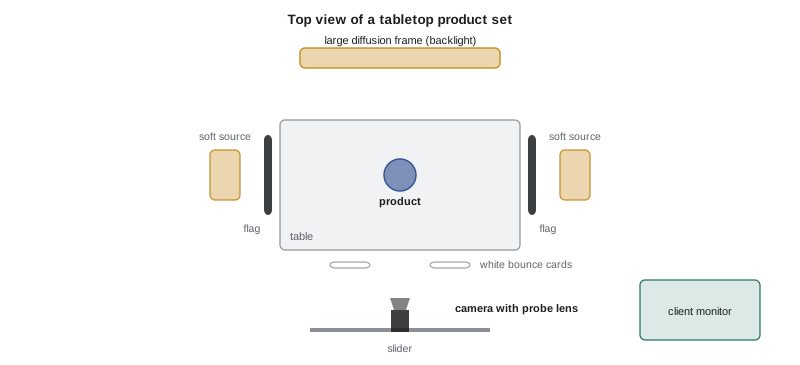
A tabletop shoot usually happens on a stage with a sturdy table, a sweep or background, overhead rigging and enough space around the set for lights, flags and the camera rig. The set is small but the space around it is not; a tabletop stage often looks crowded with stands, diffusion frames and black flags.
- The table must be rigid and level so that products do not shift between takes and the camera can repeat moves.
- Backgrounds may be seamless paper, painted flats, acrylic sheets, textured surfaces or LED screens.
- Overhead rigging lets lights and diffusion hang above the set without stands in frame.
- A product stylist or home economist (for food) prepares hero products, often dozens of identical items so the best one can be chosen and replaced when it wilts or smudges.
- The camera usually sits on a geared head, a slider, a small crane or a motion control rig, because tiny, smooth adjustments matter at close range.
- Monitoring includes a large calibrated monitor for focus and color, with the client and agency watching on a separate display.
Lenses for tabletop work
Small objects need lenses that focus close and render detail. The cinematographer's choice depends on magnification, perspective and the space around the product.
- Macro lenses focus close enough to fill the frame with small objects. A 1:1 magnification means the object is reproduced at life size on the sensor.
- Probe lenses are long, thin lenses with the front element at the end of a tube, sometimes with a periscope angle. They let the camera get inside a scene, glide between products or look up from the table surface. Their apertures are usually slow, so they need a lot of light.
- Macro zooms and close-focus primes give flexibility when products of different sizes appear in the same set.
- Specialty lenses such as split-field diopters, tilt-shift lenses and relay systems create effects like two focal planes or a tilted plane of focus along a row of products.
- Diopters (close-up lenses) screwed or clipped in front of a normal lens reduce the minimum focus distance at low cost, though with some loss of quality at the edges.
Magnification affects depth of field. As magnification increases, depth of field becomes very thin, sometimes only a few millimeters. Commercial cinematographers often stop down to small apertures and use a lot of light to gain depth of field, accepting some loss of sharpness from diffraction.
Here \( N \) is the f-number, \( c \) the circle of confusion and \( m \) the magnification. The formula is a close-up approximation valid when the subject is near the lens.
Worked problem
Depth of field on a close product shot
A lipstick is filmed at a magnification of 0.5 (half life size) on a Super 35 camera, with a circle of confusion of 0.025 mm. What is the approximate depth of field at f/4 and at f/11?
Show solution
- At f/4: DOF ≈ 2 × 4 × 0.025 × (1 + 0.5) ÷ 0.5² = 0.3 ÷ 0.25 = 1.2 mm.
- At f/11: DOF ≈ 2 × 11 × 0.025 × 1.5 ÷ 0.25 = 0.825 ÷ 0.25 = 3.3 mm.
- Stopping down from f/4 to f/11 is three stops, so the set needs about eight times more light to keep the same exposure.
Answer: About 1.2 mm at f/4 and 3.3 mm at f/11. Even at f/11 the depth of field is only a few millimeters, so focus pulling must be precise, or the move designed so the product stays at a fixed distance.
Lighting products that move
Still product photographers light for one frame. Tabletop cinematographers light for a sequence: the product may rotate, the camera may move, liquid may pour. A highlight that looks perfect at the start of a move may slide off the edge of a bottle by the end. The principles of PHOT-310 still apply, but they must hold across time.
- Reflective products show the light sources themselves. Large, carefully shaped soft sources create long, clean gradients; black flags create dark edges that define shape.
- As a product rotates on a turntable, its reflections move. The cinematographer may build a "light tent" or a curved diffusion surface so the reflection stays smooth through the rotation.
- Moving lights can be synchronized with a motion control rig so that a highlight travels across a product in a controlled way.
- Matte and textured products need raking light to reveal texture, and a broad fill to keep shadows from going black.
- Black and white products are hard: a black phone needs strong edge highlights to separate it from shadow, and a white bottle needs careful exposure and gradients to avoid looking flat.
Lighting tabletop is often done with many small soft sources, strips, LED panels and fresnels, all on dimmers controlled from a console. That control lets the gaffer adjust levels quickly when the client asks for "a bit more sparkle" on the label.
Food and drink
Food commercials have their own specialists. A food stylist prepares hero dishes, often making many versions so each shot has a perfect one. The cinematographer's task is to make food look appetizing, fresh and real.
- Backlight and side-backlight make food glisten and reveal steam, texture and translucency.
- Fill keeps detail in shadows without flattening the dish.
- Warm color temperature often feels appetizing, but brand guidelines may set the look.
- Steam is short-lived and often added with steam machines, small hidden sources or in post.
- Ice cream melts quickly under hot lights, so cool LED lighting and fast work matter, or a substitute product is used for set-up and the real product for the take.
- Movement adds life: slow push-ins, gentle rotation, falling ingredients or a sauce drizzle filmed at high speed.
In the United States, food advertising must not mislead consumers. The Federal Trade Commission has acted against deceptive food demonstrations since the 1970 Campbell Soup case, in which marbles at the bottom of a bowl made the soup look thicker. Stylists can make food look its best, but substituting a different product in the hero shot, such as mashed potatoes for ice cream, risks a deception claim. Many agencies keep a written record that the hero product is genuine.
Liquids, pours and splashes
Liquids are one of the hardest subjects in commercial cinematography. A beer pour, a splash of milk, a stream of honey or a drop falling into coffee must be beautiful, repeatable and timed to the camera.
- Transparent liquids glow when backlit through diffusion or a bright card; dark liquids need backlight to show color at the edges.
- Opaque liquids like milk need soft broad light to show smooth shape and highlights.
- Splashes are filmed at high speed (Lesson 4) and often triggered by solenoids, pneumatic rigs or robot arms so that each take repeats.
- Bubbles, condensation and frost on bottles are made with sprays, glycerin and water mixtures, or acrylic ice cubes that do not melt.
- A rig called a "pour rig" holds the bottle and controls the angle and speed of the pour.
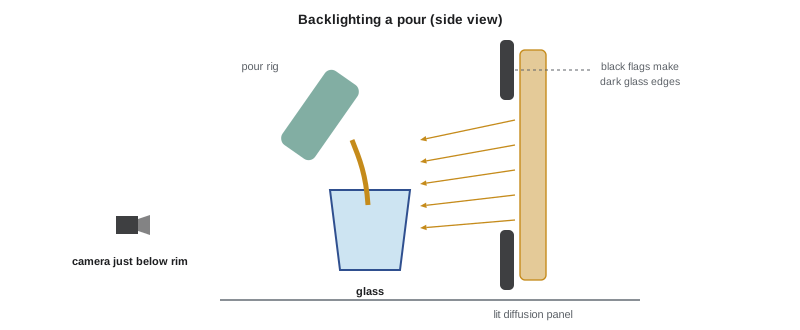
The physics of liquids also affects timing. A drop of water falling 30 cm takes about a quarter of a second; a splash crown forms and collapses in a few hundredths of a second. These short events must be stretched in time by high-speed cameras, which is why tabletop and high-speed work are so often combined.
Worked problem
How long does a drop fall?
A strawberry is dropped from 40 cm above a bowl of cream. Ignoring air resistance, how long does it take to fall, and how fast is it moving at impact?
Show solution
- Time to fall from rest: \( t = \sqrt{2h/g} \) with \( h = 0.40 \) m and \( g = 9.81 \) m/s².
- \( t = \sqrt{0.80/9.81} = \sqrt{0.0815} \approx 0.29 \) s.
- Impact speed \( v = g t \approx 9.81 \times 0.29 \approx 2.8 \) m/s.
Answer: About 0.29 s, arriving at about 2.8 m/s. A real-time shot would be over in a blink, so the drop is filmed at high speed to show the splash.
Focus and motion at close range
At high magnification, small movements become large on screen. A product moving 2 mm toward the lens can go out of focus. Commercial camera teams use several strategies.
- Lock the product and camera distance where possible, moving the product and camera together on a motion control rig.
- Use focus marks and remote follow focus with careful measurement; some teams use laser rangefinders or lidar focus aids.
- Design moves that keep the subject at a constant distance, such as an arc around a turntable rather than a push-in.
- Rehearse moves at slow speed and check focus on a large monitor before shooting.
- Use focus stacking only for still frames in post, since it does not work for moving shots.
The hero packshot
The packshot is the final product shot, often carrying the logo, tagline and price or offer. It must be perfect: label straight, colors accurate, no dust, no reflections of crew or equipment, and room for graphics. Packshots are often shot on a separate tabletop day or at the end of the main shoot.
- Agree the exact frame with the agency; graphics layouts may require precise space around the product.
- Use a product that has been inspected and cleaned with gloves, sometimes a specially prepared "hero" item.
- Light to show brand colors accurately, using color charts and reference images approved by the client.
- Shoot clean plates and passes (with and without reflections, background only, product only) to give post flexibility.
- Plan versions for different aspect ratios (Lesson 11) so the product fits all deliverables.
| Tool | Use | Watch for |
|---|---|---|
| Macro lens | Filling frame with small products | Very thin depth of field |
| Probe lens | Moving among products, low angles | Slow aperture, needs light |
| Turntable | Rotating product smoothly | Moving reflections |
| Pour rig | Repeatable liquid pours | Timing with the camera |
| Large diffusion frame | Long, smooth gradients | Spill onto background |
| Black flags | Defining edges on glass and metal | Reflections of the flags themselves |
| Motion control | Repeatable moves and passes | Cost and set-up time |
Common mistakes
MistakeLighting a reflective product for one frame only.
InsteadCheck reflections through the whole move or rotation.
MistakeShooting macro at wide aperture without a focus plan.
InsteadStop down with enough light, measure carefully or keep subject distance constant.
MistakeSubstituting a different product in a food hero shot.
InsteadUse the genuine product and document it to avoid misleading advertising.
MistakeForgetting that hot lights melt and wilt food.
InsteadUse cool LED sources, substitutes for set-up and fresh hero items for takes.
MistakeFraming the packshot without graphics space.
InsteadAgree layouts with the agency and protect space for logo and tagline.
Summary and key terms
- Tabletop cinematography films small products, food and liquids with precise light, movement and focus.
- Macro, probe and specialty lenses let cameras get close and inside small scenes.
- Depth of field at high magnification is a few millimeters, so focus planning is critical.
- Lighting must work through a move or rotation, especially on reflective products.
- Food must look appetizing while remaining representative, under Canadian and US advertising law.
- Liquids are backlit, rigged for repeatability and often filmed at high speed.
- The hero packshot must be flawless, with space for graphics and passes for post.
- Tabletop
- Filmmaking of small objects, food and liquids on a table set.
- Probe lens
- A long, thin lens with its front element at the end of a tube.
- Macro
- Close-up imaging at high magnification, often near life size.
- Magnification
- The ratio of image size on the sensor to object size.
- Food stylist
- A specialist who prepares food to look its best on camera.
- Pour rig
- A device that holds a container and controls a pour.
- Hero product
- The best prepared example of a product used for key shots.
- Light tent
- A surrounding diffusion that gives smooth reflections on shiny products.
- Clean plate
- A shot of the set without the subject, used in compositing.
- Split-field diopter
- A partial close-up lens that gives two planes of focus.
Practice problems
Work each problem on paper first, then reveal the answer to check.
What does a probe lens let the camera do?
Show answer
Get inside small scenes and move among products.
DOF at m = 1, f/8, c = 0.025 mm?
Show answer
About 2 × 8 × 0.025 × 2 ÷ 1 = 0.8 mm.
How many times more light from f/4 to f/11?
Show answer
About eight times (three stops).
Why are reflections a problem when a product rotates?
Show answer
Highlights move and may slide off or show equipment.
Why use acrylic ice cubes?
Show answer
They do not melt under lights.
How long does an object take to fall 0.2 m?
Show answer
About 0.2 s.
What should be prepared for a packshot?
Show answer
A cleaned hero product, agreed frame and graphics space.
Why backlight food?
Show answer
To make it glisten and reveal steam and texture.
Why might a food shot be illegal?
Show answer
If the product shown is not representative of what consumers buy.
Name one way to keep focus at close range.
Show answer
Keep the product at a constant distance from the lens.
Lesson quiz · 5 questions
Score 60% or more to complete this lesson.
Create a free account to save your progress, take quizzes and earn a certificate.