
CHEM-263 · Lesson 5 of 12 · 26 min
Alcohols: properties, preparation and oxidation
▶ Video coming soon A video version of this lesson is on the way.
An alcohol is a compound with a hydroxyl group, –OH, bonded to an sp³ carbon. The family includes ethanol, the alcohol of beverages and fuel blends; methanol, made from synthesis gas on a scale of more than 100 million metric tons a year; isopropyl alcohol, the rubbing alcohol of first-aid kits; glycerol, the backbone of fats; menthol, cholesterol and the sugars. Alcohols sit at the center of synthetic organic chemistry because they can be made from almost every other functional group and converted into almost every other one. They can be made from alkenes, alkyl halides, carbonyl compounds and epoxides; they can be turned into alkyl halides, alkenes, ethers, esters, aldehydes, ketones and carboxylic acids. This lesson covers their structure and properties, their acidity, the main ways of making them, especially by reducing carbonyl compounds and adding organometallic reagents, and their oxidation.
An –OH group bonded directly to an aromatic ring is a phenol, a different family with its own chemistry because the oxygen lone pair is conjugated with the ring. Phenols appear in this lesson where they contrast with alcohols.
Classification and naming
Alcohols are classified by the carbon that carries the OH. In a primary alcohol it is bonded to one other carbon, as in ethanol, CH₃CH₂OH; in a secondary alcohol, to two, as in propan-2-ol, (CH₃)₂CHOH; in a tertiary alcohol, to three, as in 2-methylpropan-2-ol, (CH₃)₃COH. The classification matters because it controls how alcohols are oxidized and how they react in substitution and elimination. In IUPAC names, the ending -ol replaces the -e of the parent alkane, and the chain is numbered to give the OH the lowest number. Compounds with two OH groups are diols, also called glycols: ethane-1,2-diol is the ethylene glycol of antifreeze.
Physical properties and hydrogen bonding
The O–H bond is strongly polar, and the oxygen has two lone pairs, so alcohols both donate and accept hydrogen bonds. This makes their boiling points much higher than those of hydrocarbons, ethers or alkyl halides of similar size. Ethanol (46 g/mol) boils at 78 °C, while propane (44 g/mol) boils at −42 °C and dimethyl ether (46 g/mol) at −24 °C. Small alcohols dissolve completely in water. As the hydrocarbon part grows, solubility falls: butan-1-ol dissolves to about 7 g per 100 mL of water and hexan-1-ol to less than 1 g. A molecule with one OH group stays water-soluble up to about three or four carbons.
| Compound | Formula | Molar mass (g/mol) | Boiling point (°C) | Solubility in water |
|---|---|---|---|---|
| Propane | CH₃CH₂CH₃ | 44 | −42 | very low |
| Dimethyl ether | CH₃OCH₃ | 46 | −24 | moderate |
| Ethanol | CH₃CH₂OH | 46 | 78 | complete |
| Butan-1-ol | CH₃(CH₂)₃OH | 74 | 118 | about 7 g/100 mL |
| Diethyl ether | (CH₃CH₂)₂O | 74 | 35 | about 7 g/100 mL |
| Ethane-1,2-diol | HOCH₂CH₂OH | 62 | 197 | complete |
| Phenol | C₆H₅OH | 94 | 182 | about 8 g/100 mL |
Acidity and basicity
Alcohols are weak acids, similar in strength to water. Methanol has a pKa of 15.5, ethanol 16 and 2-methylpropan-2-ol about 18. The order reflects solvation, as CHEM-261 lesson 4 explained: the bulky tert-butoxide ion is less well solvated than methoxide, so it is less stabilized in water. Electron-withdrawing groups increase acidity by the inductive effect: 2,2,2-trifluoroethanol has a pKa of 12.4.
Because alcohols are about as acidic as water, hydroxide cannot deprotonate them extensively. To make an alkoxide completely, you use a stronger base, such as sodium hydride (NaH, whose conjugate acid H₂ has a pKa of about 35), or an active metal: sodium metal reacts with ethanol to give sodium ethoxide and hydrogen gas, more gently than with water. Alkoxides are strong bases and good nucleophiles, used in the Williamson ether synthesis of lesson 6 and in E2 eliminations.
Phenols are far more acidic, pKa 10.0 for phenol itself, because the negative charge of the phenoxide ion is delocalized into the aromatic ring by resonance, onto the ortho and para carbons. Electron-withdrawing groups at those positions increase the acidity further: p-nitrophenol has a pKa of 7.2 and 2,4-dinitrophenol a pKa of about 4, as acidic as a carboxylic acid. Because phenols are deprotonated by aqueous sodium hydroxide but not by sodium bicarbonate, a phenol can be separated from a carboxylic acid by extraction, as CHEM-261 lesson 4 described.
Alcohols are also weak bases. Their conjugate acids, oxonium ions such as CH₃OH₂⁺, have pKa values near −2. Protonating the OH converts it into a good leaving group, water, which is why alcohols undergo substitution and elimination in acid. This was the basis of the dehydration and HX reactions in CHEM-261.
Making alcohols: a review of earlier routes
Several routes to alcohols appeared in CHEM-261. Acid-catalyzed hydration of alkenes gives Markovnikov alcohols, through a carbocation that may rearrange; hydroboration–oxidation gives anti-Markovnikov alcohols with syn addition and no rearrangement. SN2 substitution of primary alkyl halides by hydroxide gives primary alcohols, although elimination competes for secondary and tertiary halides. Lesson 6 adds the opening of epoxides. The two most versatile routes, however, start from carbonyl compounds: reduction with hydride reagents and addition of organometallic reagents. Both form a new bond to the carbonyl carbon, and both are previews of the nucleophilic addition reactions of lesson 7.
Reduction of carbonyl compounds
Reduction adds hydrogen across the C=O bond. Aldehydes give primary alcohols and ketones give secondary alcohols. Two hydride reagents dominate the laboratory. Sodium borohydride, NaBH₄, is mild and convenient: it reduces aldehydes and ketones in ethanol or water at room temperature but leaves esters, carboxylic acids and amides untouched. Lithium aluminum hydride, LiAlH₄, is much more reactive; it reduces aldehydes and ketones and also esters and carboxylic acids, both to primary alcohols, but it reacts violently with water and alcohols, so it must be used in dry ether or THF, with a separate aqueous workup.
Both reagents deliver hydride, H⁻, a nucleophile, to the carbonyl carbon. The B–H or Al–H bond is polarized with the hydrogen negative, and the hydride transfers to the electrophilic carbon while the π electrons move onto oxygen, giving an alkoxide. Protonation by the solvent or by the aqueous workup gives the alcohol. Catalytic hydrogenation with H₂ over a metal such as nickel, palladium or ruthenium also reduces carbonyl groups, usually more slowly than C=C bonds, and is used industrially, for example to reduce glucose to sorbitol.
Living cells reduce carbonyl compounds with the coenzyme NADH, which carries a hydride on a dihydropyridine ring and transfers it to the carbonyl carbon in the active site of an enzyme, regenerating the aromatic pyridinium ring of NAD⁺. Because the enzyme holds the substrate in a fixed orientation, the hydride is delivered to one face only and a single enantiomer of the alcohol forms.
Grignard and organolithium reagents
In 1900 Victor Grignard found that alkyl and aryl halides react with magnesium metal in dry diethyl ether to form organomagnesium halides, RMgX, now called Grignard reagents. He received the 1912 Nobel Prize in Chemistry. The carbon–magnesium bond is strongly polarized with carbon negative, so a Grignard reagent behaves like a carbanion, R⁻: it is a strong nucleophile and a very strong base. Organolithium reagents, RLi, made from alkyl halides and lithium metal, behave similarly and are even more reactive.
Grignard reagents add to carbonyl compounds to form new carbon–carbon bonds. The carbon nucleophile attacks the carbonyl carbon, forming a magnesium alkoxide; acidic workup gives the alcohol. The class of alcohol formed depends on the carbonyl compound. Formaldehyde gives a primary alcohol with one more carbon than the Grignard reagent. Other aldehydes give secondary alcohols. Ketones give tertiary alcohols. Esters react twice: the first addition expels the alkoxy group to give a ketone, which immediately adds a second equivalent of the reagent, giving a tertiary alcohol with two identical groups from the Grignard reagent. Epoxides react at the less hindered carbon to give alcohols two carbons longer than the reagent, and carbon dioxide gives carboxylic acids.
| Carbonyl partner | Product after workup | Example |
|---|---|---|
| Formaldehyde, HCHO | Primary alcohol, RCH₂OH | C₆H₅MgBr + HCHO → benzyl alcohol |
| Aldehyde, R′CHO | Secondary alcohol, RR′CHOH | CH₃MgBr + CH₃CHO → propan-2-ol |
| Ketone, R′COR″ | Tertiary alcohol, RR′R″COH | CH₃MgBr + cyclohexanone → 1-methylcyclohexanol |
| Ester, R′CO₂R″ (2 equiv.) | Tertiary alcohol, R₂R′COH | 2 CH₃MgBr + ethyl acetate → 2-methylpropan-2-ol |
| Epoxide (ethylene oxide) | Primary alcohol, RCH₂CH₂OH | C₆H₅MgBr → 2-phenylethanol |
| Carbon dioxide | Carboxylic acid, RCO₂H | C₆H₅MgBr + CO₂ → benzoic acid |
The great limitation of these reagents is their basicity. They are destroyed instantly by any O–H, N–H or S–H group, and even by the acidic C–H of a terminal alkyne. Water, alcohols, carboxylic acids and amines must therefore be absent, both from the solvent and from the molecule carrying the halide. Grignard reactions are run with dry solvent in dry glassware, often under nitrogen. A molecule that contains both a halide and an OH group cannot form a Grignard reagent unless the OH is first protected, a strategy lesson 7 develops.
2-Phenylethanol, the main fragrance compound of rose oil, is made industrially by a Friedel–Crafts reaction of benzene with ethylene oxide, but it is a textbook illustration of the Grignard route from phenylmagnesium bromide and ethylene oxide.
Worked problem
Planning a Grignard synthesis
Show two Grignard routes to 2-phenylbutan-2-ol, C₆H₅C(OH)(CH₃)CH₂CH₃.
Show solution
- The alcohol carbon carries three groups: phenyl, methyl and ethyl. Any one can come from the Grignard reagent, and the other two from a ketone.
- Route 1: phenylmagnesium bromide + butan-2-one (CH₃COCH₂CH₃), then H₃O⁺.
- Route 2: ethylmagnesium bromide + acetophenone (C₆H₅COCH₃), then H₃O⁺.
- A third route, methylmagnesium bromide + propiophenone (C₆H₅COCH₂CH₃), also works.
- The choice depends on the cost and availability of the ketone and halide.
Answer: C₆H₅MgBr + butan-2-one, or CH₃CH₂MgBr + acetophenone, or CH₃MgBr + propiophenone, each followed by aqueous acid.
Oxidation of alcohols
Oxidation removes hydrogen from the carbon bearing the OH and forms a C=O bond. What forms depends on the class of the alcohol, because oxidation requires a hydrogen on that carbon. A primary alcohol is oxidized first to an aldehyde and then, if water is present, further to a carboxylic acid, by way of the aldehyde hydrate. A secondary alcohol is oxidized to a ketone, where oxidation stops because no hydrogen remains on the carbonyl carbon. A tertiary alcohol has no hydrogen on its alcohol carbon and is not oxidized under ordinary conditions.
The classic strong oxidant is chromic acid, made from sodium dichromate or chromium(VI) oxide in aqueous sulfuric acid; the Jones reagent is a solution of CrO₃ in aqueous sulfuric acid and acetone. It oxidizes primary alcohols to carboxylic acids and secondary alcohols to ketones. The orange chromium(VI) is reduced to green chromium(III), a change once used in roadside breath tests for ethanol. To stop at the aldehyde, chemists use reagents that work without water, so that no hydrate can form: pyridinium chlorochromate (PCC) in dichloromethane, introduced by Elias Corey in 1975, or chromium-free methods such as the Swern oxidation (dimethyl sulfoxide activated by oxalyl chloride) and Dess–Martin periodinane. Because chromium(VI) compounds are toxic and carcinogenic, modern practice prefers the chromium-free methods and catalytic ones such as TEMPO with bleach, which uses a stable nitroxyl radical as the catalyst and inexpensive hypochlorite as the final oxidant. Potassium permanganate oxidizes primary alcohols to carboxylic acids.
| Alcohol | Strong oxidant (Jones, KMnO₄) | Anhydrous mild oxidant (PCC, Swern, Dess–Martin) |
|---|---|---|
| Primary, RCH₂OH | Carboxylic acid, RCO₂H | Aldehyde, RCHO |
| Secondary, R₂CHOH | Ketone, R₂C=O | Ketone, R₂C=O |
| Tertiary, R₃COH | No reaction | No reaction |
Mechanistically, most of these oxidations share a pattern: the alcohol oxygen bonds to the oxidant, forming an intermediate such as a chromate ester, and a base removes the hydrogen from the alcohol carbon in an elimination-like step that forms the C=O bond and reduces the oxidant. The step needs a C–H bond on the alcohol carbon, which is why tertiary alcohols resist oxidation.
Your liver oxidizes ethanol in the same two stages. Alcohol dehydrogenase uses NAD⁺ to oxidize ethanol to acetaldehyde, and aldehyde dehydrogenase oxidizes acetaldehyde to acetate, which enters normal metabolism. Acetaldehyde is toxic, and people whose aldehyde dehydrogenase is less active, a common genetic variant in East Asian populations, experience flushing after drinking because acetaldehyde accumulates.
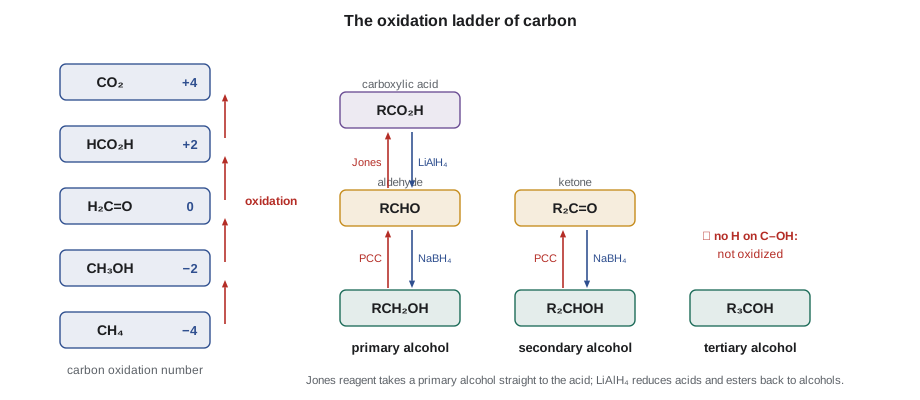
Oxidation states in organic chemistry
Organic chemists usually recognize oxidation and reduction by counting bonds rather than electrons: a carbon is oxidized when it gains bonds to oxygen, nitrogen or halogen or loses bonds to hydrogen, and reduced when the reverse happens. For a more exact count, assign each carbon an oxidation number: start from zero, add one for each bond to a more electronegative atom (O, N, halogen), subtract one for each bond to hydrogen, and ignore bonds to other carbons. In methanol the carbon is −2; in formaldehyde, 0; in formic acid, +2; in carbon dioxide, +4. The program below applies this rule.
def carbon_ox(bonds_to_h, bonds_to_hetero):
    """Oxidation number of a carbon: +1 per bond to O, N or halogen,
    -1 per bond to H, 0 per bond to C (a double bond counts twice)."""
    return bonds_to_hetero - bonds_to_h

species = [
    ('methane CH4', 4, 0),
    ('methanol CH3OH', 3, 1),
    ('formaldehyde H2C=O', 2, 2),
    ('formic acid HCOOH', 1, 3),
    ('carbon dioxide O=C=O', 0, 4),
    ('ethanol, C1 (CH2OH)', 2, 1),
    ('acetaldehyde, C1 (CHO)', 1, 2),
    ('acetic acid, C1 (COOH)', 0, 3),
    ('propan-2-ol, C2', 1, 1),
    ('acetone, C2', 0, 2),
    ('2-methylpropan-2-ol, C2', 0, 1),
]
for name, h, x in species:
    print(f'{name:28s} oxidation number {carbon_ox(h, x):+d}')

def oxidize(alcohol_class, water_present):
    if alcohol_class == 'tertiary':
        return 'no reaction (no H on the alcohol carbon)'
    if alcohol_class == 'secondary':
        return 'ketone'
    return 'carboxylic acid' if water_present else 'aldehyde'

for cls in ('primary', 'secondary', 'tertiary'):
    print(f'{cls:9s}  Jones (aqueous): {oxidize(cls, True):42s} PCC (dry): {oxidize(cls, False)}')

# acid-base: fraction of ethanol present as ethoxide in 0.1 M NaOH (pKa 16, water 15.7)
pka_etoh, pka_h2o = 16.0, 15.7
K = 10 ** (pka_h2o - pka_etoh)
print(f'EtOH + OH- equilibrium constant: {K:.2f}; ethoxide is formed only partly')methane CH4 oxidation number -4 methanol CH3OH oxidation number -2 formaldehyde H2C=O oxidation number +0 formic acid HCOOH oxidation number +2 carbon dioxide O=C=O oxidation number +4 ethanol, C1 (CH2OH) oxidation number -1 acetaldehyde, C1 (CHO) oxidation number +1 acetic acid, C1 (COOH) oxidation number +3 propan-2-ol, C2 oxidation number +0 acetone, C2 oxidation number +2 2-methylpropan-2-ol, C2 oxidation number +1 primary Jones (aqueous): carboxylic acid PCC (dry): aldehyde secondary Jones (aqueous): ketone PCC (dry): ketone tertiary Jones (aqueous): no reaction (no H on the alcohol carbon) PCC (dry): no reaction (no H on the alcohol carbon) EtOH + OH- equilibrium constant: 0.50; ethoxide is formed only partly
Each step up the ladder raises the oxidation number of the carbon by two, matching the two electrons removed by the oxidant. The equilibrium constant for ethanol and hydroxide, about 0.5, shows why hydroxide is not a good base for making ethoxide.
Converting alcohols into other groups
Alcohols are poor substrates for substitution because hydroxide is a poor leaving group. CHEM-261 lesson 9 described three ways round this: protonating the OH with HX, converting it to a sulfonate ester such as a tosylate, or using SOCl₂ or PBr₃ to make the alkyl halide. Acid-catalyzed dehydration gives alkenes by E1 for secondary and tertiary alcohols. Esters, made from alcohols and carboxylic acids or acid chlorides, appear in lesson 10, and ethers in lesson 6. Together these reactions make alcohols the hub of functional group interconversion.
Common mistakes
MistakeTertiary alcohols are oxidized to ketones.
InsteadThey have no hydrogen on the alcohol carbon and are not oxidized under normal conditions.
MistakeJones reagent oxidizes primary alcohols to aldehydes.
InsteadIn aqueous acid the aldehyde forms a hydrate and is oxidized further to the acid; use PCC, Swern or Dess–Martin to stop at the aldehyde.
MistakeNaBH₄ reduces esters to alcohols.
InsteadNaBH₄ reduces aldehydes and ketones only; LiAlH₄ is needed for esters and acids.
MistakeHydroxide fully converts ethanol to ethoxide.
InsteadEthanol and water have similar pKa values; use NaH or Na metal.
MistakeA Grignard reagent can be made from 4-bromobutan-1-ol directly.
InsteadThe OH protonates and destroys the reagent; protect the OH first.
MistakePhenols and alcohols have similar acidity.
InsteadPhenoxide is resonance-stabilized; phenol (pKa 10) is about a million times more acidic than ethanol (pKa 16).
Summary and key terms
- Alcohols carry –OH on an sp³ carbon and are classified as primary, secondary or tertiary.
- Hydrogen bonding gives alcohols high boiling points and water solubility for small members.
- Alcohols are weak acids (pKa 15.5 to 18); phenols are stronger (pKa 10) because phenoxide is delocalized.
- NaBH₄ reduces aldehydes and ketones; LiAlH₄ also reduces esters and acids to primary alcohols.
- Grignard reagents add to formaldehyde, aldehydes, ketones, esters (twice), epoxides and CO₂; they are destroyed by O–H and N–H.
- Oxidation: primary → aldehyde (PCC, Swern) or acid (Jones); secondary → ketone; tertiary → no reaction.
- Carbon oxidation numbers change by two at each rung of the oxidation ladder.
- Primary, secondary, tertiary alcohol
- An alcohol whose OH carbon is bonded to one, two or three other carbons.
- Phenol
- A compound with OH bonded directly to an aromatic ring.
- Alkoxide
- The conjugate base of an alcohol, RO⁻.
- Grignard reagent
- An organomagnesium halide, RMgX, a carbon nucleophile and strong base.
- Hydride reagent
- A reducing agent that delivers H⁻, such as NaBH₄ or LiAlH₄.
- PCC
- Pyridinium chlorochromate, which oxidizes primary alcohols to aldehydes without overoxidation.
- Oxidation number of carbon
- Bonds to heteroatoms minus bonds to hydrogen, ignoring C–C bonds.
Practice problems
Work each problem on paper first, then reveal the answer to check.
Give the product of each reaction: (a) cyclohexanol with Jones reagent; (b) butan-1-ol with PCC; (c) butan-1-ol with KMnO₄; (d) 2-methylbutan-2-ol with Jones reagent.
Show answer
(a) Cyclohexanone; (b) butanal; (c) butanoic acid; (d) no reaction.
Which reducing agent would you use to convert methyl 4-oxopentanoate, CH₃COCH₂CH₂CO₂CH₃, to the hydroxy ester CH₃CH(OH)CH₂CH₂CO₂CH₃?
Show answer
NaBH₄, which reduces the ketone but not the ester.
Design a Grignard synthesis of 3-methylpentan-3-ol from an ester.
Show answer
Ethyl acetate with two equivalents of ethylmagnesium bromide, then aqueous acid: the alcohol carbon gets the methyl from the ester and two ethyls.
Why does p-nitrophenol (pKa 7.2) dissolve in aqueous sodium bicarbonate while phenol does not?
Show answer
Bicarbonate's conjugate acid has pKa 6.4. log K = 6.4 − 7.2 = −0.8 for p-nitrophenol, enough for substantial reaction, while for phenol log K = 6.4 − 10 = −3.6.
Calculate the oxidation number of the carbon in chloromethane and in dichloromethane.
Show answer
CH₃Cl: one bond to Cl, three to H: −2. CH₂Cl₂: 2 − 2 = 0.
Why must a Grignard reaction be run in dry ether?
Show answer
Water protonates the carbanion-like carbon, R–MgX + H₂O → R–H + HOMgX, destroying the reagent.
Lesson quiz · 5 questions
Score 60% or more to complete this lesson.
Create a free account to save your progress, take quizzes and earn a certificate.