
CHEM-263 · Lesson 12 of 12 · 26 min
Capstone: multistep synthesis and retrosynthetic planning
▶ Video coming soon A video version of this lesson is on the way.
Over two terms you have met well over a hundred reactions. Each is useful on its own, but the real power of organic chemistry appears when reactions are combined into sequences that turn simple, inexpensive starting materials into a target molecule with a defined structure. Planning such a sequence is synthesis design, and its central tool is retrosynthetic analysis, introduced in CHEM-261 lesson 12 and formalized by Elias James Corey, who received the 1990 Nobel Prize in Chemistry for developing the theory and methodology of organic synthesis. This capstone lesson gathers the reactions of CHEM-263, sets out the principles of retrosynthesis and strategy, and works through the planning of four targets from the worlds of flavor, fragrance and polymers: a fruit ester, the ketone that gives raspberries their smell, an insect pheromone and the monomers of nylon-6,6.
Thinking backward
Retrosynthetic analysis starts from the target and works backward. At each step the chemist asks which bond could have been made last, by a known reaction, from simpler precursors. That imaginary bond-breaking step is a disconnection, drawn with a hollow arrow, ⇒, pointing from the target to the precursors. The fragments produced by a disconnection are synthons, idealized charged pieces, and each synthon must correspond to a real reagent, its synthetic equivalent. Disconnecting the C–C bond between the carbonyl carbon and the α-carbon of a β-hydroxy ketone, for example, gives an enolate synthon and a carbonyl synthon, and the real reaction is an aldol. The analysis continues until the precursors are commercially available or easily made.
Good disconnections follow a few rules of thumb. Disconnect at or next to functional groups, because that is where the reactions are. Prefer disconnections that break the molecule into two pieces of similar size near its middle, because that leads to convergent routes. Prefer C–C disconnections that correspond to reliable bond-forming reactions: Grignard and organolithium additions, enolate alkylations, aldol and Claisen condensations, Michael additions, Diels–Alder reactions and Wittig reactions. Disconnect C–heteroatom bonds, such as those of esters, amides and ethers, early in the analysis, because they are easy to make in the forward direction. And recognize patterns: a 1,3-relationship between two oxygen functions points to an aldol or Claisen, a 1,5-relationship to a Michael addition, and a cyclohexene to a Diels–Alder reaction.
| Pattern in the target | Likely disconnection | Forward reaction (lesson) |
|---|---|---|
| Ester or amide | C(O)–O or C(O)–N bond | acid chloride, anhydride or Fischer (10) |
| Ether | one C–O bond | Williamson (6) |
| Alcohol with new C–C bond | C–C bond to the carbinol carbon | Grignard addition (5) |
| β-Hydroxy carbonyl or enone | α–β C–C bond | aldol (9) |
| β-Keto ester or 1,3-diketone | α–C(O) bond | Claisen (9) |
| 1,5-Dicarbonyl | β-carbon to α-carbon bond | Michael addition (9) |
| Cyclohexene | two ring σ bonds | Diels–Alder (2) |
| Alkene in a defined position | the C=C | Wittig (7) |
| α-Alkyl ketone or acid | α–alkyl bond | enolate, acetoacetic or malonic alkylation (8) |
| Substituted benzene | ring–substituent bond | EAS in the right order (4), diazonium (11) |
| Amine | C–N bond | reductive amination, amide or nitrile reduction (11) |
Strategy: order, protection and selectivity
Planning a synthesis means more than finding reactions. Three issues recur.
Order of steps. Reactions affect each other. Directing effects decide the order of aromatic substitutions, as lesson 4 showed. A reducing agent must be added after any step that needs a carbonyl group, and a Grignard reagent cannot be made in the presence of an alcohol. Sometimes a functional group is introduced in one form and converted later, a functional group interconversion: a nitro group is installed for its directing effect and then reduced to an amine; an alkyne is built by alkylation and then reduced to a Z-alkene.
Protecting groups. When a molecule has two groups that would both react with a reagent, one must be protected. Ketones and aldehydes are protected as acetals (lesson 7), alcohols as silyl ethers or benzyl ethers, amines as amides or carbamates, and carboxylic acids as esters. Each protecting group adds two steps, one on and one off, so the best synthesis avoids them where it can. A useful idea, which green chemists emphasize, is that a protecting group is a sign that a more selective reagent has not yet been found.
Chemoselectivity, regioselectivity and stereoselectivity. Many reagents can tell functional groups apart: NaBH₄ reduces ketones but not esters, a hindered base deprotonates the less hindered α-carbon, and the Diels–Alder reaction sets relative stereochemistry. Choosing such selective reagents is the art of synthesis.
Yield, length and convergence
Every step loses material. If each step of a linear synthesis gives 80 per hundred, a ten-step sequence gives 0.8¹⁰ ≈ 0.11 overall, about one ninth. The overall yield of a linear route is the product of the step yields, so short routes win, and improving the worst step helps most. A convergent synthesis makes two or more fragments separately and joins them late. The longest linear sequence, the number of steps from any starting material to the target, is shorter, and expensive material is carried through fewer steps, so the overall yield is higher. The program at the end of this lesson compares linear and convergent plans.
Yield is not the only measure. Atom economy, the share of reactant atoms that end up in the product, measures the waste a reaction produces by its stoichiometry; additions and rearrangements score 100, substitutions and eliminations less. The E-factor, kilograms of waste per kilogram of product, includes solvents and reagents and is often 25 to 100 in pharmaceutical manufacture but below 1 in bulk chemical production. Green chemistry favors catalytic reactions, renewable feedstocks and fewer steps.
Target 1: isoamyl acetate, a banana ester
Isoamyl acetate, 3-methylbutyl ethanoate, is the main odor compound of bananas. Disconnecting the ester C–O bond gives acetic acid and 3-methylbutan-1-ol, both inexpensive; 3-methylbutan-1-ol is the main component of fusel oil, a by-product of fermentation. In the forward direction, the Fischer esterification of lesson 10, with sulfuric acid as catalyst and an excess of acetic acid, gives the ester; the equilibrium is pushed further by removing water. For a smaller laboratory preparation, acetic anhydride reacts faster and irreversibly. The route is one step, and the only by-product of the Fischer route is water.
Target 2: raspberry ketone
Raspberry ketone, 4-(4-hydroxyphenyl)butan-2-one, gives raspberries their characteristic smell and is used in flavors and cosmetics. Natural raspberries contain only a few milligrams per kilogram, so almost all of it is made by synthesis or by fermentation.
Retrosynthesis. The target is a methyl ketone with a CH₂CH₂ link to a phenol ring. Two disconnections suggest themselves. In the first, recognize that the saturated CH₂–CH₂ could come from a C=C by hydrogenation; the resulting enone, 4-(4-hydroxyphenyl)but-3-en-2-one, has the β-aryl enone pattern of an aldol condensation. Disconnecting its C=C gives 4-hydroxybenzaldehyde and acetone. In the second, disconnect the bond between the α-carbon of the ketone and the benzylic CH₂: an acetone enolate equivalent and a 4-hydroxybenzyl electrophile, which points to an acetoacetic ester synthesis (lesson 8).
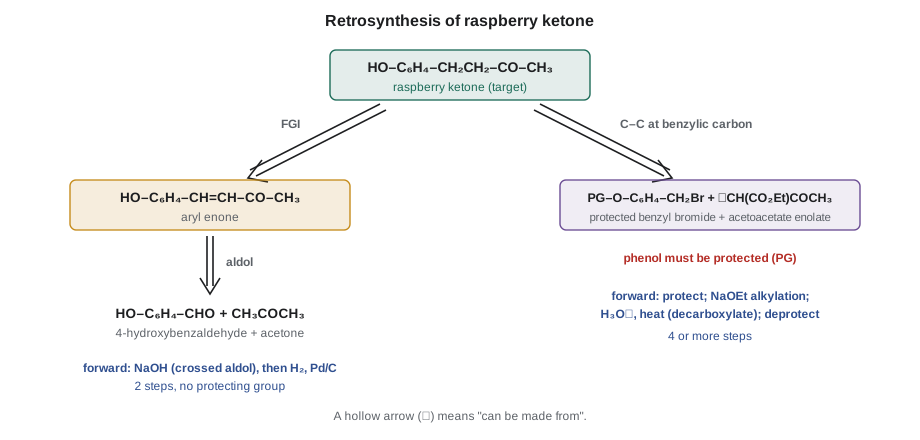
Choosing a route. The aldol route has two steps. 4-Hydroxybenzaldehyde has no α-hydrogens, so its crossed aldol condensation with excess acetone in aqueous base is clean, a Claisen–Schmidt condensation of lesson 9; the phenol is deprotonated under the conditions, which slows the reaction but does no harm. Catalytic hydrogenation over palladium then reduces the conjugated C=C selectively, leaving the ketone and the aromatic ring. The acetoacetic ester route needs a benzylic halide, which cannot carry a free phenol (the phenoxide would alkylate itself), so the OH must be protected, for example as a methyl ether, and deprotected at the end: at least four steps. The aldol route is shorter, uses cheaper materials, needs no protecting group and has better atom economy, losing only water. It is essentially the industrial route.
Worked problem
Overall yield of two routes to raspberry ketone
The aldol route has two steps with yields of 85 and 95 per hundred. The acetoacetic route has four steps (protect, alkylate, hydrolyze and decarboxylate, deprotect) with yields of 95, 75, 85 and 90. Compare overall yields.
Show solution
- Aldol route: 0.85 × 0.95 = 0.81.
- Acetoacetic route: 0.95 × 0.75 × 0.85 × 0.90 = 0.55.
- The shorter route wins by about a third, before counting the extra reagents and waste of protection and deprotection.
Answer: About 81 against 55 per hundred; the aldol–hydrogenation route is preferred.
Target 3: an insect pheromone
(Z)-Tricos-9-ene, also called muscalure, is the sex pheromone of the female housefly, used in fly traps to attract males. It is a C₂₃ hydrocarbon with a single cis double bond between C9 and C10. The challenge is to place the double bond exactly and with Z geometry, because the E isomer is much less active.
Two strategies from the course meet the challenge. The Wittig reaction of lesson 7 forms a C=C exactly where a C=O was, and unstabilized ylides, with only alkyl groups on the carbanion carbon, give mainly Z-alkenes. Disconnecting the C=C gives nonanal, C₈H₁₇CHO, and the ylide from 1-bromotetradecane and triphenylphosphine. In the forward direction, the phosphonium salt is deprotonated with a strong base such as butyllithium and treated with nonanal, giving mainly the Z-alkene. The alternative uses alkyne chemistry from CHEM-261 lesson 12: alkylate the acetylide of dec-1-yne with 1-bromotridecane by SN2 to build tricos-9-yne, then reduce it with hydrogen over a Lindlar catalyst, which gives the Z-alkene by syn addition. The alkyne route usually gives higher Z selectivity, while the Wittig route makes the double bond in one bond-forming step. Both use only primary alkyl halides in SN2 steps, as the rules require.
Target 4: the monomers of nylon-6,6
Nylon-6,6 is made from hexanedioic acid (adipic acid) and hexane-1,6-diamine (lesson 10). Both are made on a scale of millions of metric tons a year, and their manufacture shows synthesis planning under the constraints of cost, scale and environmental impact.
Adipic acid. Disconnecting both C(O)–C bonds back is not helpful; instead, recognize that a six-carbon diacid comes from cleaving a six-membered ring. Oxidizing cyclohexanol or cyclohexanone opens the ring between the carbonyl carbon and its neighbor and gives adipic acid. Industry makes a mixture of cyclohexanol and cyclohexanone, called KA oil, by air oxidation of cyclohexane, which comes from hydrogenating benzene, and oxidizes the mixture with nitric acid. The nitric acid step releases nitrous oxide, N₂O, a powerful greenhouse gas and ozone-depleting substance; adipic acid plants were once among the largest single sources of N₂O, and abatement systems that decompose it catalytically are now standard in most plants. Routes from renewable sugars, by fermentation to glucaric or muconic acid followed by hydrogenation, are being developed.
Hexane-1,6-diamine. The two amino groups at the ends of a six-carbon chain suggest reduction of the dinitrile adiponitrile, NC(CH₂)₄CN, which adds no carbons (lesson 10). Adiponitrile is made industrially by adding hydrogen cyanide twice to buta-1,3-diene with a nickel catalyst, or by the electrochemical coupling of acrylonitrile, two molecules joining tail to tail at the cathode. Catalytic hydrogenation of adiponitrile gives the diamine. Toxic HCN is handled only in closed industrial systems, which is part of what makes the routes viable at scale.
Nylon-6, the other major nylon, comes from caprolactam, which is made from cyclohexanone by forming its oxime with hydroxylamine and rearranging the oxime in strong acid, the Beckmann rearrangement, which inserts the nitrogen into the ring. Ring-opening polymerization of caprolactam gives the polymer.
Putting the course together
The four targets used the Fischer esterification, the crossed aldol condensation, selective catalytic hydrogenation, the Wittig reaction, alkyne alkylation and Lindlar reduction, oxidative ring cleavage, nitrile reduction and amide formation, and the decisions turned on the same few ideas: which carbonyl compounds can form enolates, which partner is the better electrophile, which reagents are selective, how many steps a route needs, and how much waste it makes. The table of disconnections at the start of this lesson doubles as a compact summary of the functional group interconversions of the course.
A program: searching for routes and comparing yields
import heapq, math

# a small reaction network: (start, product, reagents, typical yield)
REACTIONS = [
    ('4-hydroxybenzaldehyde + acetone', 'aryl enone', 'NaOH (crossed aldol condensation)', 0.85),
    ('aryl enone', 'raspberry ketone', 'H2, Pd/C (reduce C=C only)', 0.95),
    ('4-hydroxybenzyl alcohol', 'protected benzyl alcohol', 'protect phenol as methyl ether', 0.95),
    ('protected benzyl alcohol', 'protected benzyl bromide', 'PBr3', 0.85),
    ('protected benzyl bromide', 'alkylated acetoacetate', 'ethyl acetoacetate, NaOEt', 0.75),
    ('alkylated acetoacetate', 'protected raspberry ketone', 'H3O+, heat (decarboxylate)', 0.85),
    ('protected raspberry ketone', 'raspberry ketone', 'remove methyl ether', 0.90),
    ('benzene', 'cyclohexane', 'H2, Ni', 0.99),
    ('cyclohexane', 'KA oil', 'O2, Co catalyst', 0.80),
    ('KA oil', 'adipic acid', 'HNO3 (oxidative ring opening)', 0.93),
    ('butadiene', 'adiponitrile', 'HCN, Ni catalyst (twice)', 0.90),
    ('adiponitrile', 'hexane-1,6-diamine', 'H2, catalyst', 0.98),
]

def best_route(start, target):
    """Dijkstra on -log(yield): the highest-yield path through the network."""
    graph = {}
    for a, b, r, y in REACTIONS:
        graph.setdefault(a, []).append((b, r, y))
    queue, seen = [(0.0, start, [])], set()
    while queue:
        cost, node, path = heapq.heappop(queue)
        if node == target:
            return math.exp(-cost), path
        if node in seen:
            continue
        seen.add(node)
        for nxt, reagents, y in graph.get(node, []):
            heapq.heappush(queue, (cost - math.log(y), nxt, path + [(node, reagents, nxt)]))
    return None, []

for start, target in (('4-hydroxybenzaldehyde + acetone', 'raspberry ketone'),
                      ('4-hydroxybenzyl alcohol', 'raspberry ketone'),
                      ('benzene', 'adipic acid'), ('butadiene', 'hexane-1,6-diamine')):
    y, path = best_route(start, target)
    print(f'{start} -> {target}: {len(path)} steps, overall yield {y:.2f}')
    for a, r, b in path:
        print(f'     {r}')

# linear versus convergent: eight steps at 85 per hundred each
step = 0.85
linear = step ** 8
convergent = step ** 4          # two 3-step fragments in parallel, then 1 coupling = 4 in the longest line
print(f'linear 8 steps: {linear:.2f}; convergent (longest linear sequence 4): {convergent:.2f}')

def atom_economy(product_mass, reactant_masses):
    return 100 * product_mass / sum(reactant_masses)

# isoamyl acetate by Fischer esterification: C5H12O (88.15) + C2H4O2 (60.05) -> C7H14O2 (130.19) + H2O
print(f'Fischer, isoamyl acetate: atom economy {atom_economy(130.19, [88.15, 60.05]):.1f} per hundred')
# with acetic anhydride (102.09): product + acetic acid by-product
print(f'anhydride, isoamyl acetate: atom economy {atom_economy(130.19, [88.15, 102.09]):.1f} per hundred')4-hydroxybenzaldehyde + acetone -> raspberry ketone: 2 steps, overall yield 0.81
NaOH (crossed aldol condensation)
H2, Pd/C (reduce C=C only)
4-hydroxybenzyl alcohol -> raspberry ketone: 5 steps, overall yield 0.46
protect phenol as methyl ether
PBr3
ethyl acetoacetate, NaOEt
H3O+, heat (decarboxylate)
remove methyl ether
benzene -> adipic acid: 3 steps, overall yield 0.74
H2, Ni
O2, Co catalyst
HNO3 (oxidative ring opening)
butadiene -> hexane-1,6-diamine: 2 steps, overall yield 0.88
HCN, Ni catalyst (twice)
H2, catalyst
linear 8 steps: 0.27; convergent (longest linear sequence 4): 0.52
Fischer, isoamyl acetate: atom economy 87.8 per hundred
anhydride, isoamyl acetate: atom economy 68.4 per hundredThe route search finds the two-step aldol route to raspberry ketone with an overall yield of about 0.81, against about 0.46 for the five-step benzyl route through a protected bromide. The industrial nylon intermediates come out at about 0.74 for adipic acid from benzene and 0.88 for the diamine from butadiene. The linear-versus-convergent comparison shows why convergence matters: eight linear steps at 85 per hundred give 0.27, while a convergent plan whose longest linear sequence is four steps gives about 0.52. The atom economy of the Fischer esterification, 88 per hundred, beats that of the anhydride route, 68, because the anhydride wastes a molecule of acetic acid, which is why industry uses the Fischer route when water can be removed.
Where organic chemistry goes next
With CHEM-261 and CHEM-263 complete, you have the foundation for the rest of the chemistry program. CHEM-282 shows how infrared, NMR and mass spectrometry identify the products of these reactions. CHEM-361 develops advanced synthesis: carbon–carbon bond-forming reactions catalyzed by transition metals, such as the Suzuki and Heck couplings recognized by the 2010 Nobel Prize, asymmetric catalysis and the total synthesis of complex natural products. CHEM-363 explores mechanism in depth, CHEM-401 covers polymers, and the biochemistry courses apply the same mechanisms to the reactions of living cells. The habits you have built, reading structures, pushing arrows, weighing kinetic and thermodynamic control, and planning backward from a target, will serve you in all of them.
Common mistakes
MistakeA synthesis should be planned forward from the cheapest starting material.
InsteadPlan backward from the target by retrosynthesis, then check the forward route.
MistakeMore steps mean a more impressive synthesis.
InsteadOverall yield multiplies, so shorter and convergent routes are better.
MistakeProtecting groups cost nothing.
InsteadEach adds two steps, reagents and waste; avoid them where a selective reagent exists.
MistakeAny Wittig reaction gives the E-alkene.
InsteadUnstabilized ylides give mainly Z-alkenes; stabilized ylides give mainly E.
MistakeA benzylic bromide with a free phenol can be used in an enolate alkylation.
InsteadThe phenoxide would compete as a nucleophile; protect the OH first.
MistakeYield is the only measure of a good synthesis.
InsteadAtom economy, E-factor, safety, cost and step count matter too.
Summary and key terms
- Retrosynthetic analysis works backward from the target through disconnections to synthons and their real reagents.
- Disconnect at functional groups, near the middle of the molecule, using reliable C–C bond-forming reactions; recognize 1,3-, 1,5- and cyclohexene patterns.
- Order of steps, protecting groups and selective reagents decide whether a plan works.
- Overall yield of a linear route is the product of step yields; convergent routes and fewer steps give more product; atom economy and E-factor measure waste.
- Isoamyl acetate (Fischer esterification), raspberry ketone (crossed aldol then hydrogenation), muscalure (Z-selective Wittig or alkyne–Lindlar) and the nylon-6,6 monomers illustrate the course reactions in real routes.
- Retrosynthetic analysis
- Planning a synthesis by working backward from the target.
- Disconnection
- An imagined bond-breaking step that corresponds to a known forward reaction.
- Synthon
- An idealized fragment from a disconnection, represented by a real reagent, its synthetic equivalent.
- Functional group interconversion
- A step that converts one functional group into another without changing the skeleton.
- Convergent synthesis
- A route that joins separately prepared fragments late in the sequence.
- Atom economy
- The fraction of reactant mass that ends up in the desired product.
- E-factor
- Mass of waste produced per mass of product.
Practice problems
Work each problem on paper first, then reveal the answer to check.
Propose a synthesis of 4-phenylbutan-2-one (benzylacetone, a fragrance compound) by an acetoacetic ester route.
Show answer
Ethyl acetoacetate, NaOEt, benzyl bromide; then H₃O⁺ and heat to hydrolyze and decarboxylate.
Show a two-step route to 4-phenylbutan-2-one from benzaldehyde and acetone, and compare it with the acetoacetic route.
Show answer
Crossed aldol condensation to benzalacetone, then H₂ over Pd to reduce the C=C. Both are short; the aldol route uses cheaper materials and loses only water.
Plan a synthesis of 2-methylhexan-2-ol from esters or ketones with Grignard reagents.
Show answer
Butylmagnesium bromide + acetone, or two equivalents of methylmagnesium bromide + ethyl pentanoate, then H₃O⁺.
Disconnect ethyl 2-benzyl-3-oxobutanoate and give the forward reaction.
Show answer
Disconnect the α-carbon to benzyl bond: ethyl acetoacetate enolate (NaOEt) + benzyl bromide by SN2.
A route has six steps of 90 per hundred each. What is its overall yield, and what would it be if one step were improved to 99?
Show answer
0.9⁶ = 0.53; with one step at 0.99: 0.9⁵ × 0.99 = 0.58.
Why does the Z geometry of muscalure matter for the choice of reactions?
Show answer
The pheromone activity depends on the cis isomer, so the route must use Z-selective reactions: an unstabilized Wittig ylide or Lindlar reduction of an internal alkyne.
Lesson quiz · 5 questions
Score 60% or more to complete this lesson.
Create a free account to save your progress, take quizzes and earn a certificate.