
CHE-480 · Lesson 8 of 12 · 22 min
Water reuse and zero liquid discharge
The Cedar Rapids plant buys its water from the city, which draws it from the Cedar River. It takes an Iowa DNR water use permit for its backup well. When the corn market was tight two summers ago and the region had a dry spell, the city asked its large users to cut consumption, and the plant found that it could not do so without cutting production. The expansion will increase water use further. Malik wants to know whether the plant can grow without taking more water, and an investor on the board has asked, in writing, whether the plant could achieve zero liquid discharge. Wren gives the question to Theo with a warning: zero liquid discharge sounds like an environmental goal, but it is an energy and waste project, and its costs are easy to underestimate.
The water balance
Every water study starts with a balance. Water enters the plant as city water, as moisture in the corn (about 15 %) and as water formed by combustion. It leaves as evaporation from the cooling tower, as vapor in the dryer exhaust, as moisture in the DDGS (about 10 %), in the ethanol (very little), and as wastewater to the sewer. Inside the plant it circulates: the cooling tower recirculates thousands of cubic meters per hour, and the process recycles backset and condensate. The balance must close to within the accuracy of the meters, usually a few percent. Closing it at Cedar Rapids took Theo two weeks and found an uninstrumented hose station that was using more water than the boilers.
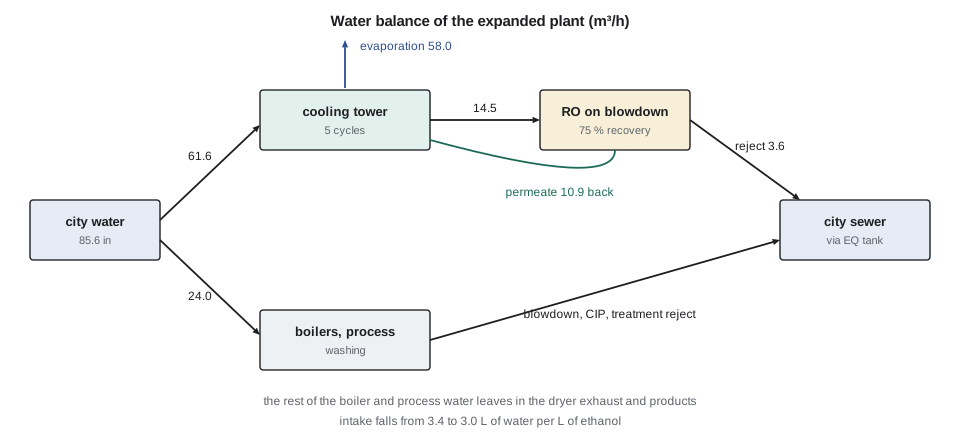
The industry measures water use in liters of water per liter of ethanol. Modern dry-grind plants use roughly 2.5 to 3.5 L/L, down from more than twice that in the early 2000s, mostly by recycling process water and improving cooling towers. The Cedar Rapids plant is at about 3.4 L/L today. The cooling tower dominates: it evaporates about 58 m³/h at the expanded plant's heat load, and evaporation is the price of rejecting heat with water.
Cooling tower cycles of concentration
A cooling tower loses water in three ways: evaporation, drift (droplets carried out with the air) and blowdown. Evaporation leaves the dissolved salts behind, so they concentrate in the circulating water. To keep them below the point where scale forms or corrosion accelerates, part of the water is purged as blowdown. The ratio of the concentration in the circulating water to that in the makeup is the number of cycles of concentration, \(N\). A salt balance gives:
where \(M\) is makeup, \(E\) evaporation, \(B\) blowdown and \(D\) drift. The evaporation is fixed by the heat load. Raising the cycles reduces blowdown and makeup, with diminishing returns: going from 3 to 5 cycles halves the blowdown, but going from 5 to 8 saves less. What limits the cycles is water chemistry: calcium carbonate, calcium sulfate and silica scale. Better chemical treatment, acid feed to control alkalinity, and softening or side-stream filtration of the makeup all allow higher cycles.
# Plant water balance: cooling tower cycles, RO on blowdown, and the cost of zero liquid discharge
E, drift = 58.0, 0.03                # evaporation m3/h (expanded plant), drift m3/h
other = 24.0                         # boiler makeup, process and washing water, m3/h
ethanol_m3h = 240e3 / 8400           # expanded plant, m3 ethanol per hour
for cyc in (3, 5, 8):
    B = E / (cyc - 1) - drift        # blowdown so that makeup = E + B + drift = cyc x (B + drift)
    M = E + B + drift
    print(f"{cyc} cycles: makeup {M:5.1f} m3/h, blowdown {B:5.1f} m3/h, intake {(M+other)/ethanol_m3h:.2f} L/L")
# RO on the 5-cycle blowdown, permeate back to the tower
B5 = E / 4 - drift; rec = 0.75
perm, rej = B5 * rec, B5 * (1 - rec)
M5 = E + B5 + drift
print(f"RO at {rec:.0%}: permeate {perm:.1f} m3/h back, reject {rej:.1f} m3/h; intake {(M5-perm+other)/ethanol_m3h:.2f} L/L")
# ZLD: brine concentrator (MVR) to 95 % recovery, crystallizer on the rest
feed = rej + 6.0                      # RO reject plus the water treatment reject, m3/h
bc_kwh, cr_kwh = 25.0, 60.0           # kWh per m3 of feed
bc = feed * bc_kwh                    # brine concentrator, kW
cr = feed * 0.05 * cr_kwh             # crystallizer takes the last 5 % of the feed, kW
salt = feed * 4.5                     # kg/h of salts at 4,500 mg/L TDS in the feed
print(f"ZLD on {feed:.1f} m3/h: {bc+cr:.0f} kW, {(bc+cr)*8400/1e6:.2f} GWh/yr, salt {salt*8400/1000:.0f} t/yr to landfill")3 cycles: makeup 87.0 m3/h, blowdown 29.0 m3/h, intake 3.88 L/L 5 cycles: makeup 72.5 m3/h, blowdown 14.5 m3/h, intake 3.38 L/L 8 cycles: makeup 66.3 m3/h, blowdown 8.3 m3/h, intake 3.16 L/L RO at 75%: permeate 10.9 m3/h back, reject 3.6 m3/h; intake 3.00 L/L ZLD on 9.6 m3/h: 269 kW, 2.26 GWh/yr, salt 364 t/yr to landfill
Reuse within the plant
The best water to reuse is water the plant already has. Theo's survey lists four sources. Evaporator and still condensate is nearly free of salts but contains organic acids and ethanol; the plant already reuses most of it in the cook, and the expansion's larger cook will take more. Boiler blowdown is hot, soft and low in organics, and can go to the cooling tower makeup. Cooling tower blowdown is high in salts and treatment chemicals, and needs membrane treatment before reuse. And the treated effluent from the anaerobic reactor of Lesson 7, if polished by a membrane bioreactor, could be a source of makeup water too. Each source is matched to a use by quality: the cook tolerates organics but not high chloride; the boilers need very pure water; the cooling tower tolerates moderate salts but not phosphorus or ammonia, which feed biological growth.
Reverse osmosis
Reverse osmosis (RO) pushes water through a dense polymer membrane under a pressure greater than the osmotic pressure of the feed, leaving the salts behind. A typical brackish-water RO system recovers 70 to 85 % of its feed as permeate with more than 97 % of the salts removed. The remaining concentrate, or reject, carries all the salts in a smaller volume. Recovery is limited by scaling of the least soluble salts at the concentrate end, and by the osmotic pressure, which rises as the concentrate gets stronger. Pretreatment matters as much as the membranes: cooling tower blowdown contains suspended solids, biological growth and treatment chemicals that foul RO membranes, so it is usually filtered, softened or treated with antiscalant, and the RO is cleaned regularly.
Putting an RO unit on the cooling tower blowdown, at 75 % recovery, sends about 11 m³/h of permeate back to the tower and leaves about 3.6 m³/h of reject. The plant's intake falls to about 3.0 L/L, and the city water needed by the expanded plant is about the same as the existing plant uses today. That answers Malik's first question: the plant can grow without taking more water.
Zero liquid discharge
Zero liquid discharge (ZLD) means that no liquid leaves the plant: every stream is reused, and the dissolved salts leave as a solid. The usual ZLD train has three stages. Membranes concentrate the water as far as they economically can. A brine concentrator, usually a falling-film evaporator driven by mechanical vapor recompression (MVR), takes the brine to near saturation and recovers most of the remaining water as distillate. A crystallizer, or a small evaporation pond in dry climates, takes the last brine to dry salt. Brine concentrators use about 20 to 30 kWh per cubic meter of feed; crystallizers several times more per cubic meter they treat.
The code shows what ZLD would mean for the expanded plant. Treating the RO reject and the water treatment reject, about 9.6 m³/h, would take about 270 kW, about 2.3 GWh of electricity a year, and produce roughly 360 t a year of mixed salt containing calcium, magnesium, sodium, chloride, sulfate, silica and the residues of every treatment chemical in the plant. That salt is not a product. It would go to a landfill that accepts it, and depending on its composition and leaching behavior it might need to be tested and managed as a special waste. The ZLD system itself would cost several million dollars and need skilled operators; scaling and corrosion in brine concentrators and crystallizers are notorious.
Worked problem
Cycles of concentration
A cooling tower evaporates 40 m³/h with negligible drift. How much makeup does it need at 4 cycles, and how much does going to 6 cycles save?
Show solution
- At 4 cycles, \(B = 40/3 = 13.3\) m³/h, so \(M = 40 + 13.3 = 53.3\) m³/h.
- At 6 cycles, \(B = 40/5 = 8.0\) m³/h, so \(M = 48.0\) m³/h.
- The saving is \(5.3\) m³/h, about 10 % of the makeup.
Answer: 53.3 m³/h at 4 cycles; going to 6 cycles saves about 5.3 m³/h.
When ZLD makes sense
ZLD is common in places where discharge is impossible or very costly: inland plants in arid regions, sites with no sewer or receiving water, and sites where the receiving water is already stressed by salt. Some ethanol plants in water-scarce regions run close to ZLD for process water. At Cedar Rapids, the plant has a sewer and a city treatment plant that can accept its salt load, which is small compared with the city's own; water is not physically scarce, though it is sometimes restricted. Wren's analysis frames the question in terms of the hierarchy. ZLD would eliminate a discharge that is legal and harmless to the city plant, at the cost of electricity, which has its own emissions, and a solid waste stream that would occupy a landfill. The board's investor wants a plant that uses less water and harms the river less. RO reuse and condensate return deliver most of that. ZLD delivers the last few cubic meters per hour at a high price.
| Option | City water (L/L) | Discharge (m³/h) | Extra power | Solid waste |
|---|---|---|---|---|
| Expanded plant, 5 cycles | 3.4 | about 45 | none | none |
| 8 cycles with better chemistry | 3.2 | about 40 | none | none |
| 5 cycles + RO on blowdown | 3.0 | about 35 | about 30 kW | none |
| RO + ZLD on all brines | about 2.7 | about 25 (CIP, condensate) | about 300 kW | about 360 t/yr salt |
Stormwater
One more water stream is easy to forget because it falls from the sky. Rain on the plant's roofs, roads and loading areas picks up grain dust, DDGS, oil drips and anything spilled, and runs to ditches that lead toward the Cedar River. Stormwater from industrial sites is regulated in its own right, and the plant keeps a stormwater plan: good housekeeping around the grain and DDGS areas, covered loading, spill kits, curbed containment for tanks, inspections after storms and periodic sampling of the outfalls. The expansion adds paved area, so the plan adds a detention pond with an oil and grit separator, sized for the design storm, which also gives the plant a place to hold firefighting water if a fire ever occurs. Clean stormwater is also a possible makeup source for the cooling tower, though at Cedar Rapids the volumes and timing make it a small one.
Water risk and stewardship
Water is also a business risk. A drought or a restriction can stop production; a change in the city's charges can change the cost of every liter; and lenders and customers increasingly ask about water use in sustainability questionnaires. Wren recommends that the plant set a water intensity target, about 3.0 L/L by the end of the expansion, report it alongside carbon intensity, and keep ZLD on the shelf as a contingency study, with a design basis ready if conditions change. She also recommends one cheap measure that is easy to forget: submetering. A plant cannot manage what it does not measure, and the hose station Theo found had been running unmetered for years.
The board's investor receives a two-page answer: the plant will grow by a fifth without increasing its water intake, by raising cooling tower cycles, adding RO on the blowdown and returning more condensate to the cook. Zero liquid discharge was studied and set aside for now, because at Cedar Rapids it would trade a small, harmless discharge for electricity and a landfilled salt. Malik signs it and adds a line: if the city's water ever becomes scarce, the study is ready.
Common mistakes
MistakeStarting a reuse study without a closed water balance.
InsteadMeter and close the balance first; hidden users and losses change the answer.
MistakePushing cycles of concentration without water chemistry control.
InsteadScale and corrosion limit cycles; treat and monitor the circulating water.
MistakeTreating RO reject as gone once it leaves the membrane.
InsteadThe reject carries all the salts; it must go somewhere.
MistakeCalling ZLD free of environmental cost.
InsteadZLD uses energy, emits through that energy, and makes a solid waste.
MistakeReusing water without matching quality to use.
InsteadMatch each source to a use that tolerates its organics, salts and nutrients.
Summary and key terms
- A water balance must close before reuse is designed; the cooling tower dominates a dry-grind plant's use.
- Blowdown follows from evaporation and cycles of concentration; higher cycles save water with diminishing returns.
- Reuse matches sources (condensate, boiler and tower blowdown, treated effluent) to uses by quality.
- RO recovers 70 to 85 % of brackish feed; its reject carries the salts.
- ZLD adds brine concentration and crystallization; it costs energy and makes solid salt.
- Water intensity in L/L is a useful target alongside carbon intensity.
- Cycles of concentration
- The ratio of dissolved solids in circulating cooling water to those in makeup.
- Blowdown
- Water purged from a cooling tower or boiler to limit dissolved solids.
- Drift
- Water droplets carried out of a cooling tower with the air.
- Reverse osmosis (RO)
- Membrane separation that forces water through a dense membrane against osmotic pressure.
- Zero liquid discharge (ZLD)
- A system design in which no liquid leaves the plant and salts leave as solids.
- Mechanical vapor recompression (MVR)
- Compressing evaporated vapor to use it as the heating medium in an evaporator.
Practice problems
Work each problem on paper first, then reveal the answer to check.
A tower evaporates 30 m³/h at 5 cycles with no drift. What is the blowdown?
Show answer
\(30/4 = 7.5\) m³/h.
Why do higher cycles give diminishing water savings?
Show answer
Blowdown varies as \(E/(N-1)\), which flattens as N grows.
An RO unit at 80 % recovery treats 20 m³/h. What are the permeate and reject flows?
Show answer
16 m³/h permeate and 4 m³/h reject.
Name two limits on RO recovery.
Show answer
Scaling of sparingly soluble salts and rising osmotic pressure.
Why might ZLD be the wrong choice at a plant with a sewer?
Show answer
It costs energy and makes landfilled salt to remove a legal, harmless discharge.
What simple measure did Theo's balance show the plant needed?
Show answer
Submetering of water users.
Lesson quiz · 5 questions
Score 60% or more to complete this lesson.
Create a free account to save your progress, take quizzes and earn a certificate.