
CHE-480 · Lesson 3 of 12 · 23 min
Particulate control: the DDGS dryers
The DDGS dryers are the noisiest, hottest and dustiest part of the Cedar Rapids plant, and the one Wren worries about most. Two rotary drum dryers, each fired by a natural gas burner, take wet cake and syrup at about 65 % moisture and turn them into DDGS at about 10 %. The exhaust from each drum, about 40 m³/s at 120 °C, carries water vapor, the volatile organics driven off the hot solids, combustion products, and dust: fine fragments of the product picked up by the gas. The expansion adds a third dryer section and pushes the exhaust train harder, so Wren and Theo start the technical work here. Their first question is how much particulate leaves today and where it goes.
What particulate matter is
Particulate matter is any solid or liquid matter suspended in a gas. Its effects and its control both depend on size. Particles larger than about 10 µm settle quickly and are caught in the nose and throat; particles below 2.5 µm reach deep into the lungs and stay airborne for days. Size also decides which control device works: large particles can be thrown out by inertia, while fine ones must be caught by filtration or electrostatic forces. Particle size is usually given as an aerodynamic diameter, the diameter of a sphere of density 1,000 kg/m³ that settles at the same velocity, because settling and inertia are what matter for both breathing and collection.
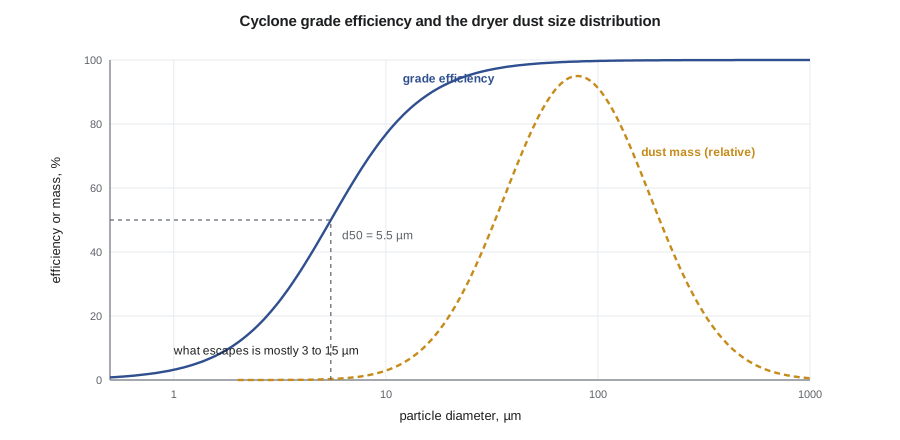
A dust sample contains a range of sizes. Industrial dusts are usually close to lognormal: the logarithm of diameter is normally distributed. Two numbers describe the distribution: the mass median diameter, below which half the mass lies, and the geometric standard deviation \(\sigma_g\), the ratio of the 84th percentile diameter to the median. The dryer dust at Cedar Rapids, measured by Dev's laboratory from samples taken upstream of the cyclones, has a mass median diameter of about 80 µm and \(\sigma_g\) of about 2.2. Most of its mass is in coarse product fines, but the tail of the distribution extends below 10 µm.
Filterable and condensable particulate
Stack test methods split particulate into two parts. Filterable particulate is what a heated filter in the sampling train catches at stack conditions. Condensable particulate is material that is a vapor at stack temperature but condenses into particles as the plume cools in the air: in a dryer exhaust these are mostly organic compounds driven off the solids, with some sulfuric acid and salts. Condensable particulate is almost all smaller than 1 µm and so counts as PM2.5. In the exhaust of a drying operation it is often larger than the filterable part. Any plan to reduce PM2.5 from the dryers must address it, and no cyclone or filter will catch it while it is still a vapor.
Settling chambers and cyclones
The simplest particulate collectors rely on inertia. A settling chamber slows the gas so particles fall out under gravity; it is useful only for particles larger than about 50 µm. A cyclone makes the gas spin: it enters tangentially near the top of a cylinder, swirls downward in an outer vortex, reverses and leaves up the center through an outlet tube. The centrifugal force on a particle in the vortex can be hundreds of times its weight, so particles migrate to the wall, slide down and leave through the bottom. Cyclones are cheap, rugged, tolerate high temperature and need no moving parts, which makes them the standard first stage on dryers. In the ethanol industry they also serve as product recovery equipment: what they catch is DDGS and goes back to the product.
The classic design method is due to Lapple. It assumes the gas makes a number \(N_e\) of effective turns in the outer vortex, at the inlet velocity \(V_i\). A particle is collected if it can cross the inlet width \(W\) in the time available. The diameter collected with 50 % efficiency, the cut size, is:
and the efficiency for a particle of diameter \(d\) is approximated by \(\eta = 1/[1 + (d_{50}/d)^2]\). The overall efficiency is the grade efficiency averaged over the mass distribution. Smaller cyclones with narrow inlets, higher inlet velocities and more turns have smaller cut sizes and higher efficiency, but higher pressure drop. Banks of small cyclones in parallel, called multicyclones, give the efficiency of a small cyclone at the gas flow of a large one.
# DDGS dryer exhaust: Lapple cyclone efficiency over a lognormal dust size distribution,
# then a wet electrostatic precipitator sized with the Deutsch-Anderson equation
import math
mu, rho_p = 2.2e-5, 1200.0          # gas viscosity at 120 C (Pa s), particle density (kg/m3)
W, Vi, Ne = 0.20, 22.0, 8           # cyclone inlet width m, inlet velocity m/s, effective turns
d50 = math.sqrt(9 * mu * W / (2 * math.pi * Ne * Vi * rho_p))   # Lapple cut size, m
eta = lambda d: 1 / (1 + (d50 / d) ** 2)
MMD, sg = 80e-6, 2.2                # mass median diameter and geometric standard deviation
def frac_below(d):                  # mass fraction finer than d (lognormal)
    return 0.5 * (1 + math.erf(math.log(d / MMD) / (math.sqrt(2) * math.log(sg))))
edges = [10 ** (k / 40) * 1e-7 for k in range(0, 161)]   # 0.1 um to 1 mm
cin = 2.0                          # g/m3 dust carried out of the dryers
Qgas = 80.0                        # m3/s actual, both dryers
out = out10 = out25 = 0.0
for a, b in zip(edges, edges[1:]):
    m = frac_below(b) - frac_below(a); dm = math.sqrt(a * b); p = m * (1 - eta(dm))
    out += p; out10 += p if dm < 10e-6 else 0; out25 += p if dm < 2.5e-6 else 0
print(f"Lapple cut size d50 = {d50*1e6:.1f} um")
print(f"overall cyclone efficiency = {100*(1-out):.2f} %")
kgh = lambda f: cin * f * Qgas * 3.6         # g/m3 x m3/s -> kg/h
print(f"cyclone outlet: total {kgh(out):.1f} kg/h, PM10 {kgh(out10):.2f}, PM2.5 {kgh(out25):.3f}")
print(f"PM10 share of what escapes: {100*out10/out:.0f} %")
w = 0.06                           # effective migration velocity in a wet ESP, m/s
for target in (0.80, 0.90, 0.95):
    A = -Qgas / w * math.log(1 - target)
    print(f"wet ESP for {target:.0%}: collecting area {A:,.0f} m2, SCA {A/Qgas:.0f} s/m")
# pulse-jet fabric filter for the DDGS loadout hood: 12 m3/s at an air-to-cloth ratio of 1.5 m/min
Qbag, ac = 12.0, 1.5
area = Qbag * 60 / ac
bag = math.pi * 0.15 * 3.0            # one bag, 150 mm x 3 m
print(f"loadout fabric filter: cloth {area:.0f} m2, about {math.ceil(area / bag)} bags")Lapple cut size d50 = 5.5 um overall cyclone efficiency = 98.56 % cyclone outlet: total 8.3 kg/h, PM10 0.80, PM2.5 0.003 PM10 share of what escapes: 10 % wet ESP for 80%: collecting area 2,146 m2, SCA 27 s/m wet ESP for 90%: collecting area 3,070 m2, SCA 38 s/m wet ESP for 95%: collecting area 3,994 m2, SCA 50 s/m loadout fabric filter: cloth 480 m2, about 340 bags
The high-efficiency cyclones on the dryers have a cut size of about 5.5 µm and remove about 98.6 % of the dust carried out of the drums. That still leaves about 8 kg/h of filterable particulate going on to the oxidizer, of which about a tenth is PM10. Most of the escaping mass is in the size range just around the cut size, from about 3 to 15 µm.
What happens downstream: the RTO
At Cedar Rapids the cyclone exhaust goes to the regenerative thermal oxidizer, which burns the VOC at about 815 °C (Lesson 4). The oxidizer also affects particulate. Organic fines and condensable organics burn, which removes most of the condensable particulate; the ash of the dust and any salts pass through. But particulate is also a problem for the oxidizer: dust deposits in the ceramic heat recovery beds, and the salts in syrup-derived dust can react with the ceramic and plug it. RTOs on dryers are washed out or baked out regularly, and a high particulate load shortens the life of the media. Good cyclone performance protects the RTO as much as it protects the air.
Stack tests on the existing RTO stack give about 3.2 kg/h of PM10 and 2.6 kg/h of PM2.5 for the expanded dryer train, counting filterable and condensable together. The PM2.5 is mostly condensable material that survives the oxidizer as fine salts and sulfate, plus some new particles formed from sulfur dioxide. That is why the PM2.5 at the stack is not much smaller than the PM10, even though the cyclones let through so little fine dust.
Fabric filters
Where the gas is dry and not too hot, fabric filters, or baghouses, are the most efficient general particulate collectors, routinely removing more than 99.9 % of the mass including fine particles. The gas passes through felted or woven bags, and the dust builds a cake on the surface; the cake itself becomes the filter. Bags are cleaned by shaking, by reverse air or, most commonly in modern units, by short pulses of compressed air blown down the inside of each bag. The key design variable is the air-to-cloth ratio: the gas flow divided by the cloth area, which is the superficial velocity through the fabric. Pulse-jet filters on dry agricultural dusts run at about 1 to 2 m/min.
At Cedar Rapids the grain receiving pits, the hammer mills and the DDGS loadout all use pulse-jet baghouses. The new loadout hood for the expansion draws 12 m³/s; at 1.5 m/min it needs about 480 m² of cloth, or about 340 bags of 150 mm diameter and 3 m length. Fabric filters are not used on the dryer exhaust because it is near saturation with water vapor: as soon as it cooled below its dew point, the sticky, wet dust would blind the bags. Temperature and moisture often decide which device can be used before efficiency does.
Worked problem
Sizing a pulse-jet baghouse
A new grain receiving pit hood draws 8 m³/s. At an air-to-cloth ratio of 1.8 m/min, how much cloth is needed, and how many 150 mm by 3 m bags?
Show solution
- Cloth area \(= Q / (\text{air-to-cloth ratio}) = 8 \times 60 / 1.8 = 267\) m².
- One bag has \(\pi \times 0.15 \times 3 = 1.41\) m².
- Number of bags \(= 267 / 1.41 = 189\); add spares for compartments taken off line for maintenance.
Answer: About 267 m² of cloth, roughly 190 bags plus a spare compartment.
Electrostatic precipitators
An electrostatic precipitator (ESP) charges particles with a corona discharge from high-voltage electrodes and collects them on grounded plates. It treats large gas flows with low pressure drop and high efficiency for fine particles. Dry ESPs are used in power plants and cement kilns; wet ESPs, which wash the plates with water, can handle saturated gas and sticky or condensed aerosols and are used after quenches and scrubbers. The classic sizing relation is the Deutsch-Anderson equation:
where \(A\) is the collecting area, \(Q\) the gas flow and \(w\) an effective migration velocity found from experience with similar dusts. The ratio \(A/Q\), the specific collection area, is the design number. The code shows that a wet ESP after the RTO, taking a migration velocity of 0.06 m/s, would need about 3,000 m² of plate for 90 % removal. That is a large and expensive unit, and Wren's view is that the fine particulate from the dryers should be attacked earlier.
Wet scrubbers
Venturi scrubbers accelerate the gas through a throat where water is injected; the high relative velocity between gas and droplets lets droplets capture particles by impaction. Efficiency rises with pressure drop: a venturi at 5 to 10 kPa can catch most particles above 1 µm, at the cost of a large fan. Scrubbers also absorb soluble gases and can handle hot, wet, sticky gas. Their drawback is that they turn an air problem into a water problem: the scrubber liquor must be treated or, at an ethanol plant, returned to the process. Some ethanol plants use wet scrubbers on dryers for exactly that reason, since the liquor can go back to the evaporators.
| Device | Typical efficiency | Handles wet gas? | Pressure drop | Use at the plant |
|---|---|---|---|---|
| Cyclone | 80 to 99 % (coarse) | Yes | 1 to 2 kPa | Dryer product recovery |
| Fabric filter | 99 to 99.9 % | No | 1 to 2 kPa | Grain and DDGS handling |
| Dry ESP | 99 % + | No | Low | Not used |
| Wet ESP | 90 to 99 % (fine) | Yes | Low | Option after the RTO |
| Venturi scrubber | 90 to 99 % above 1 µm | Yes | 5 to 10 kPa | Option before the RTO |
Prevention first
Before choosing a device, Wren asks whether the particulate can be prevented. Three changes help. The first is the dryer's outlet temperature: running hotter dries faster but drives off more organics and scorches more fines, raising condensable particulate, VOC and odor. Running the expanded train with three dryer sections instead of two lets each run cooler. The second is the syrup ratio: adding more syrup to the wet cake raises the sticky, salty fraction of the dust. Some plants now recover more corn oil and protein from the syrup before drying, which changes the dust. The third is cyclone maintenance: worn inlet vanes and leaking dust valves at the cyclone bottoms can halve efficiency without anyone noticing, so Wren's monitoring plan adds a differential pressure alarm on each cyclone.
The design team's conclusion for the expansion is that the new dryer section gets the same high-efficiency cyclones and shares the RTO, which will be enlarged; that the three sections will run at a lower outlet temperature; and that the permit will be written for PM10 and PM2.5 including condensables, with a stack test at start-up. A wet ESP is kept as an option if the test shows the PM2.5 estimate was optimistic.
Common mistakes
MistakeMeasuring only filterable particulate from a dryer.
InsteadCondensable particulate is often the larger part of dryer PM2.5; include it in tests and estimates.
MistakePutting a fabric filter on a near-saturated exhaust.
InsteadWet, sticky dust blinds the bags; use cyclones, scrubbers or a wet ESP.
MistakeQuoting a single cyclone efficiency for any dust.
InsteadEfficiency depends on the size distribution; integrate the grade efficiency over it.
MistakeAssuming a smaller cyclone is always better.
InsteadHigher efficiency comes with higher pressure drop and fan power, and small inlets plug with sticky dust.
MistakeIgnoring cyclone wear and air leaks.
InsteadWorn vanes and leaking discharge valves can cut efficiency sharply; monitor pressure drop.
Summary and key terms
- Particle size controls health effects and the choice of collector; industrial dusts are often lognormal.
- Condensable particulate forms when organic vapors and acid gases cool; it is almost all PM2.5.
- Cyclones catch coarse dust cheaply; Lapple's cut size grows with inlet width and falls with inlet velocity and turns.
- Fabric filters are the most efficient general collectors but need dry gas; size them by air-to-cloth ratio.
- ESPs follow the Deutsch-Anderson equation; wet ESPs handle saturated gas and fine aerosols.
- Lower dryer temperatures and good maintenance prevent particulate before any collector sees it.
- Aerodynamic diameter
- The diameter of a unit-density sphere with the same settling velocity as the particle.
- Mass median diameter
- The diameter below which half the particle mass lies.
- Cut size
- The particle diameter collected with 50 % efficiency.
- Condensable particulate
- Material that is a vapor in the stack and forms particles as the plume cools.
- Air-to-cloth ratio
- Gas flow divided by filter cloth area; the face velocity through the fabric.
- Specific collection area
- Precipitator plate area divided by gas flow.
Practice problems
Work each problem on paper first, then reveal the answer to check.
How does the Lapple cut size change if the inlet velocity is quadrupled?
Show answer
It halves, since it varies with the inverse square root of inlet velocity.
What is the grade efficiency of a cyclone with d50 = 5 µm for a 10 µm particle?
Show answer
\(1/(1 + 0.25) = 80\) %.
Why is condensable particulate not caught by the cyclones?
Show answer
It is still a vapor at cyclone temperature.
A baghouse treats 5 m³/s at 1.2 m/min. What cloth area is needed?
Show answer
\(5 \times 60 / 1.2 = 250\) m².
In the Deutsch-Anderson equation, what happens to penetration if the plate area doubles?
Show answer
It is squared: for example 10 % becomes 1 %.
Name one way to cut dryer particulate without a new collector.
Show answer
Run the dryers cooler, adjust the syrup ratio, or repair worn cyclones.
Lesson quiz · 5 questions
Score 60% or more to complete this lesson.
Create a free account to save your progress, take quizzes and earn a certificate.