
CHE-480 · Lesson 11 of 12 · 21 min
Carbon management: accounting, capture and carbon pricing
Every hour the Cedar Rapids fermenters release about 18 t of carbon dioxide, almost exactly as much as the ethanol they make. After the expansion that will be more than 21 t/h, or about 180 kt a year: pure, wet carbon dioxide at atmospheric pressure, already separated from everything else by the biology. In most industries capturing carbon dioxide means separating it from a dilute flue gas, which is expensive. At an ethanol plant the separation is free, and only drying, compression and somewhere to put it are needed. That is why ethanol plants have been among the first industrial sources of carbon dioxide for capture and storage. Malik asks Wren to put the plant's carbon accounts on one page and to tell the board what capture would mean for the plant.
Greenhouse gas accounting
Corporate greenhouse gas accounting follows the Greenhouse Gas Protocol, which divides emissions into three scopes. Scope 1 is direct emissions from sources the company owns or controls: at the plant, combustion of natural gas in the boilers, dryers and RTO, plus small amounts from vehicles, refrigerants and the flare. Scope 2 is indirect emissions from purchased electricity, steam and heat. Scope 3 is everything else in the value chain: purchased goods such as corn, fertilizer and chemicals, transport, the use of the products and their end of life. The scopes prevent double counting within one company's inventory: the power plant's scope 1 is its customers' scope 2.
Facility reporting to governments is narrower and more prescriptive than corporate accounting. Each program has its own rules for which sources count, which emission factors and calculation methods to use, and what to do about biogenic carbon. The plant reports to EPA's Greenhouse Gas Reporting Program, which has applied to facilities emitting 25,000 t CO₂e or more a year; EPA proposed in 2025 to end the program for most source categories, and the plant keeps its records either way. In facility reporting, carbon dioxide from burning or fermenting biomass is usually reported separately as biogenic and is not counted toward the facility's total, because it does not add carbon to the atmosphere over the crop cycle.
# Carbon accounts for the expanded plant (63.4 million gal/yr) and the value of capturing fermentation CO2
L = 240e6; LHV = 21.2; GRID = 400.0                 # L/yr, MJ/L, g CO2e/kWh (illustrative)
gal = L / 3.78541
scope1 = 7.5 * L * 56.0 / 1e9                        # kt CO2 from natural gas combustion
scope2 = 0.20 * L * GRID / 1e9                       # kt
scope3 = L / 393.0 * 291 / 1e6                       # kt, corn farming only
ferm = L * 0.789 / 1000 * 0.957 / 1000               # kt biogenic CO2
print(f"scope 1 {scope1:.0f} kt, scope 2 {scope2:.1f} kt, scope 3 (corn) {scope3:.0f} kt")
print(f"biogenic fermentation CO2 {ferm:.0f} kt (reported separately)")
cap = 0.95 * ferm; comp_kwh = cap * 1000 * 110
energy_MJ = L * LHV
dci = (cap * 1e9 - comp_kwh * GRID) / energy_MJ - 1.5
print(f"captured {cap:.0f} kt/yr; compression {comp_kwh/1e6:.1f} GWh/yr; CI falls by {dci:.1f} g/MJ")
# Option 1: section 45Q at 85 per metric ton stored in a saline formation
q45 = cap * 85 / 1000
# Option 2: section 45Z, 1.00 per gallon x (50 - CI in kg/MMBtu)/50, CI without land-use change
for name, ci in (('no capture', 51.8), ('with capture', 51.8 - dci)):
    f = max(0.0, (50 - ci * 1.055) / 50)
    print(f"45Z {name}: CI {ci:.1f} g/MJ = {ci*1.055:.1f} kg/MMBtu, factor {f:.3f}, {f*gal/1e6:.1f} million per year")
print(f"45Q on {cap:.0f} kt: {q45:.1f} million per year (cannot be claimed with 45Z in the same year)")scope 1 101 kt, scope 2 19.2 kt, scope 3 (corn) 178 kt biogenic fermentation CO2 181 kt (reported separately) captured 172 kt/yr; compression 18.9 GWh/yr; CI falls by 30.8 g/MJ 45Z no capture: CI 51.8 g/MJ = 54.6 kg/MMBtu, factor 0.000, 0.0 million per year 45Z with capture: CI 21.0 g/MJ = 22.1 kg/MMBtu, factor 0.558, 35.4 million per year 45Q on 172 kt: 14.6 million per year (cannot be claimed with 45Z in the same year)
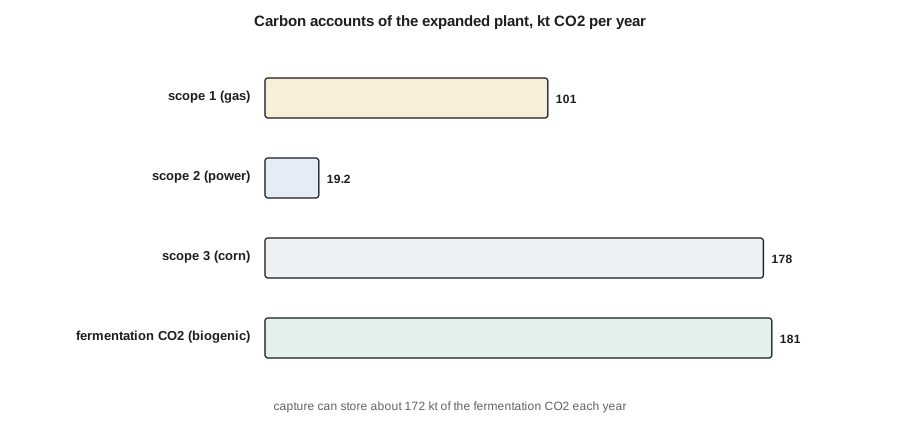
The page Wren gives Malik has four numbers. Scope 1 is about 100 kt of fossil carbon dioxide a year, almost all from natural gas. Scope 2 depends on the grid. Scope 3 from corn farming alone is about 180 kt, the largest of the fossil numbers and the hardest to change. And the biogenic fermentation carbon dioxide is about 180 kt, not counted in any scope total, but the largest single stream the plant could do something about.
Why capturing biogenic carbon counts
If the plant releases its fermentation carbon dioxide, the carbon simply returns to the air it came from, and the life-cycle assessment counts it as zero. If the plant captures it and stores it permanently underground, that carbon has been removed from the atmosphere: the corn took it out, and it does not go back. In the life-cycle accounting of Lesson 10, the stored carbon dioxide is credited against the ethanol. Capturing 95 % of the fermentation carbon dioxide lowers the carbon intensity of the plant's ethanol by about 30 g/MJ, after charging for the electricity to compress it and the energy to transport and inject it. That is more than all the other options combined, and it takes the plant's ethanol from about 36 % below gasoline to about 70 % below.
The capture train
The fermentation gas leaves the scrubber nearly pure carbon dioxide, saturated with water at about 30 °C and slightly above atmospheric pressure. The capture train compresses it in stages with intercooling, removing the condensed water after each stage, dehydrates it further with a glycol contactor or a solid desiccant so that no liquid water can form in the pipeline, removes traces of oxygen if the pipeline specification requires, and compresses it to a dense phase above about 7.4 MPa and 31 °C, its critical point, for transport. The compression takes about 100 to 120 kWh per metric ton, which the code charges to the carbon intensity. The equipment is well proven: it is the same as the equipment that has supplied food-grade carbon dioxide from ethanol plants for decades, except for the final pressure.
Nadia's process safety review starts here. Dense-phase carbon dioxide is not flammable but is an asphyxiant at high concentrations, heavier than air, and released from a pipeline or compressor it forms a cold, dense cloud that can flow into low ground and buildings. A release from a large pipeline is a major hazard, and the routing, valve spacing, leak detection and emergency planning of carbon dioxide pipelines have become a matter of public concern since a pipeline rupture in Mississippi in 2020 sent dozens of people to hospital. Priya adds fixed carbon dioxide detection in the compressor building.
Storage
Captured carbon dioxide can be used, for example in beverages, greenhouses, dry ice or chemical synthesis, or stored. Most uses return the carbon dioxide to the air within days or months and so do not count as permanent removal. Permanent storage means injection into deep geological formations, usually saline aquifers at depths of more than about 800 m, where the carbon dioxide is dense, sealed beneath impermeable cap rock, and trapped over time by dissolution and mineralization. Storage sites are characterized, permitted, monitored during injection and for years after, and closed under regulatory oversight.
For Cedar Rapids, storage has been tied for years to the Summit Carbon Solutions pipeline, which in 2026 was rerouted to carry carbon dioxide from Iowa ethanol plants through Nebraska to storage in Wyoming. The project's original plan to store in North Dakota was blocked by legal and permitting challenges, and South Dakota banned eminent domain for carbon dioxide pipelines in 2025. In 2026 Summit cut about 200 miles from its Iowa route and more than 400 landowners, kept a core group of Iowa ethanol plants, and shifted storage to Wyoming by way of Nebraska. Kingfisher's capture project would depend on a lateral connection to that system, or to another storage option, reaching service; on its own the plant is too small to develop a storage site.
Carbon pricing and credits
In Iowa, the plant faces no carbon price; instead, federal tax credits reward low carbon intensity (the section 45Z clean fuel production credit) and stored carbon dioxide (section 45Q). These are not taxes on emissions but rewards for reductions, and they are claimed by filing tax returns, not by trading permits.
Section 45Q pays a credit for each metric ton of carbon dioxide captured and stored in secure geological storage. Since the 2025 tax law it is 85 dollars per metric ton for industrial capture with geological storage when wage and apprenticeship requirements are met, and the same rate now applies to carbon dioxide used for enhanced oil recovery or utilization. Section 45Z pays a clean fuel production credit per gallon, scaled by how far the fuel's emissions rate is below 50 kg CO₂e per million Btu: the factor is (50 − CI)/50, and the full rate is 1.00 dollar per gallon when wage and apprenticeship requirements are met. The 2025 law extended 45Z through 2029. Under the guidance available in 2026, one plant cannot claim both credits for the same year, so the plant must choose.
The code makes the choice concrete. Without capture, the plant's ethanol is at about 55 kg/MMBtu, above the 50 kg/MMBtu threshold, and earns nothing under 45Z. With capture, it falls to about 22 kg/MMBtu, and the 45Z credit would be about 0.56 dollars per gallon, worth about 35 million dollars a year on 63 million gallons. The 45Q alternative, about 14.6 million dollars a year, is less than half as much per year but lasts 12 years from the start of operation, while 45Z ends after 2029. A capture project that starts up in 2029 would get one year of 45Z at most. The choice between the two credits depends on timing more than on the rates.
Worked problem
Carbon intensity reduction from capture
A plant making 100 million liters of ethanol a year (21.2 MJ/L) captures and stores 76 kt of fermentation CO₂. Compression and transport add the equivalent of 3 kt. How much does its carbon intensity fall?
Show solution
- Net stored \(= 76 - 3 = 73\) kt \(= 7.3 \times 10^{10}\) g.
- Fuel energy \(= 100 \times 10^6 \times 21.2 = 2.12 \times 10^9\) MJ.
- Reduction \(= 7.3 \times 10^{10} / 2.12 \times 10^9 = 34\) g/MJ.
Answer: About 34 g CO₂e/MJ.
Other levers
Capture is the largest lever but not the only one, and the others are cheaper per metric ton. The plant's scope 1 can be cut by heat integration and vapor recompression on the evaporators and stills, which replace steam with electricity, by restoring the RTO's thermal efficiency, by burning biogas from the anaerobic reactor, and in the longer term by electrifying steam with heat pumps or electric boilers, which makes sense only where the grid is low-carbon. Scope 2 depends on the grid: in Iowa it is about 400 g/kWh, which decides whether electrification lowers or raises emissions. Scope 3 can be cut by buying corn grown with lower-emission practices, such as reduced tillage, cover crops and precise nitrogen use, which both fuel programs have been working to recognize in carbon intensity scores.
| Lever | What it changes | Approximate effect on CI |
|---|---|---|
| Capture and storage of fermentation CO2 | Stores biogenic carbon | About −30 g/MJ |
| MVR and heat integration | Cuts natural gas, adds power | About −2 to −3 g/MJ |
| RTO heat recovery to 97 % | Cuts natural gas | About −1 g/MJ |
| Biogas to boilers | Replaces natural gas | Less than −0.1 g/MJ |
| Low-carbon corn | Farm N2O and energy | Several g/MJ, if verified |
Risks and integrity
Carbon management has its own risks. Credit values depend on policy that can change with an election. Storage depends on infrastructure the plant does not control. Claims about low-carbon products must be backed by data that survives verification; carbon intensity filings are audited, and overstated reductions can lead to the loss of credits and to penalties. Wren's rule for the plan is that every reduction must be measurable at the plant, with a meter or a mass balance, and every number in the board paper must trace to a source. Theo adds one of his own, learned at the refinery: plan for the version of the policy that exists, not the one the industry is lobbying for.
Common mistakes
MistakeAdding biogenic fermentation CO2 to scope 1.
InsteadReport it separately as biogenic; storing it is a removal credited in the LCA.
MistakeCounting CO2 sold for beverages as permanent storage.
InsteadMost utilization returns the CO2 to the air quickly; only secure geological storage is permanent.
MistakeValuing a capture project at today's credit price for its whole life.
InsteadCredit prices and policies change; test the project across a range.
MistakeIgnoring the electricity for compression.
InsteadAbout 100 to 120 kWh/t; its emissions depend on the grid and are charged to the CI.
MistakeTreating dense-phase CO2 as harmless because it is not flammable.
InsteadIt is an asphyxiant that forms cold, dense clouds; pipelines need hazard analysis.
Summary and key terms
- Scope 1 covers direct emissions, scope 2 purchased energy and scope 3 the value chain; biogenic CO2 is reported separately.
- Fermentation CO2 is nearly pure, so capture needs only drying, compression and storage.
- Storing biogenic CO2 permanently removes it from the atmosphere and lowers ethanol CI by about 30 g/MJ.
- Storage requires deep saline formations, permits, monitoring and shared infrastructure.
- Carbon pricing and fuel credit programs turn CI reductions into money, with policy risk.
- Every reduction claimed must be measurable and traceable.
- Scope 1
- Direct emissions from sources a company owns or controls.
- Scope 2
- Indirect emissions from purchased electricity, steam and heat.
- Scope 3
- Other indirect emissions in a company's value chain.
- Biogenic CO2
- Carbon dioxide from biomass carbon recently taken from the atmosphere.
- Dense phase
- Carbon dioxide above its critical pressure, with liquid-like density.
- Geological storage
- Permanent injection of CO2 into deep formations beneath a sealing cap rock.
Practice problems
Work each problem on paper first, then reveal the answer to check.
Which scope is the plant's natural gas combustion?
Show answer
Scope 1.
Why is capture cheaper at an ethanol plant than at a boiler stack?
Show answer
The fermentation gas is already nearly pure CO2.
Roughly how much electricity does CO2 compression take?
Show answer
About 100 to 120 kWh per metric ton.
Why does storing biogenic CO2 count as removal?
Show answer
The carbon came from the air via the corn and does not return.
What are the critical pressure and temperature of CO2?
Show answer
About 7.4 MPa and 31 °C.
Name a scope 3 lever for the plant.
Show answer
Buying corn grown with lower-emission practices.
Lesson quiz · 5 questions
Score 60% or more to complete this lesson.
Create a free account to save your progress, take quizzes and earn a certificate.