
CHE-470 · Lesson 9 of 12 · 22 min
Bitumen upgrading
Much of the crude the Des Plaines refinery runs began as bitumen in the oil sands of northern Alberta. Bitumen is too heavy and viscous to flow at ordinary temperatures, and it carries sulfur, metals and asphaltenes in quantities few refineries could handle directly. It reaches refineries in two forms: as synthetic crude oil, made by upgraders that crack and hydrotreat the bitumen near where it is produced, and as diluted bitumen, mixed with light hydrocarbons so it can flow through a pipeline. Roz arranges for Theo to spend a few days on a video link with an upgrader engineer, Lena Whitehorse, because the planners want to understand how synthetic crude quality might change if the upgraders alter their operations.
What bitumen is
Bitumen is an extra-heavy oil with an API gravity of about 8, so it is slightly denser than water. Its viscosity at reservoir temperature is in the hundreds of thousands to millions of centipoise, so it does not flow until heated. A typical Athabasca bitumen contains about 4.5 to 5 wt % sulfur, 0.4 wt % nitrogen, and a few hundred ppm of nickel and vanadium. More than half of it boils above 524 °C, the usual vacuum residue cut point, and it contains 15 to 20 % asphaltenes. Its hydrogen-to-carbon ratio is about 1.5. Upgrading it to a light, sweet crude means rejecting carbon or adding hydrogen on a very large scale, the same two routes met in lesson 6.
Bitumen is recovered in two ways. About half is mined from shallow deposits and separated from the sand with hot water, producing a froth that is cleaned with a paraffinic or naphthenic solvent. The rest lies too deep to mine and is produced in place, mostly by steam-assisted gravity drainage, in which steam injected through one horizontal well heats the bitumen so that it drains to a second well beneath. The upstream engineering of these methods is covered in the petroleum engineering courses; this lesson starts where the bitumen arrives at an upgrader.
The upgrader
An upgrader is a refinery without the finishing units. It takes bitumen, separates it in atmospheric and vacuum distillation, converts the vacuum residue, hydrotreats the resulting naphtha, distillate and gas oil, and blends them into a light synthetic crude. It sells no gasoline or diesel directly; its single main product is synthetic crude oil, often called SCO, shipped by pipeline to refineries. Large upgraders also make sulfur, coke or pitch, and fuel gas used on site.
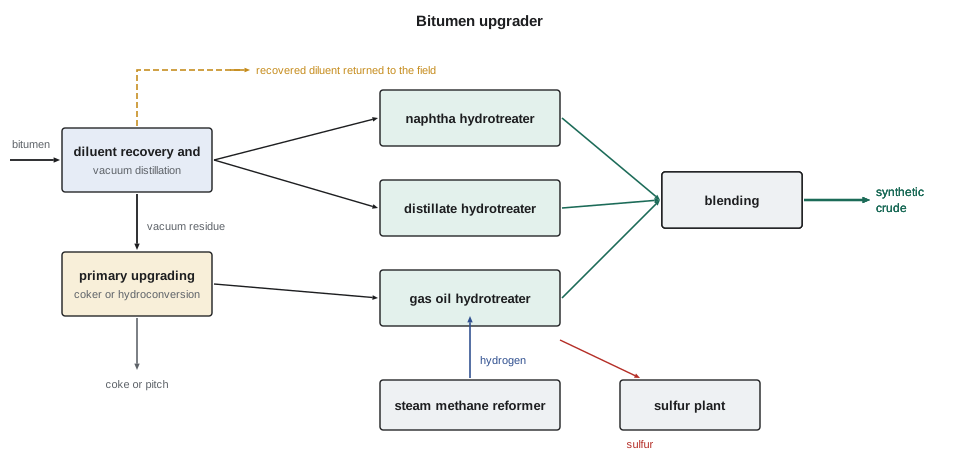
Primary upgrading converts the residue. The oldest oil sands upgraders, dating from the 1960s and 1970s, chose coking. One uses delayed coking and the other fluid coking, in which the residue cracks on a fluidized bed of hot coke particles. Both reject carbon as coke, much of which has been stockpiled on site because there is little market for high-sulfur coke so far from customers. A later upgrader near Edmonton chose ebullated-bed hydroconversion, which adds hydrogen and converts more of the residue to liquid, leaving a smaller amount of unconverted pitch.
Secondary upgrading is hydrotreating. The coker or hydroconverter liquids are unstable, high in sulfur and nitrogen, and olefinic. Naphtha, distillate and gas oil hydrotreaters, operating at high pressure, saturate the olefins and some aromatics and remove most of the sulfur and nitrogen. The hydrogen comes from steam methane reformers fed with natural gas, which makes upgraders very large users of natural gas and very large emitters of carbon dioxide.
# Bitumen upgrading: coking versus hydroconversion yields of synthetic crude per barrel of bitumen
bitumen_bpd = 100000
routes = {  # name: (synthetic crude bbl per bbl bitumen, coke or pitch t per 1000 bbl, hydrogen scf/bbl)
    "delayed coking + hydrotreating": (0.86, 32.0, 1300),
    "fluid coking + hydrotreating": (0.88, 26.0, 1300),
    "ebullated-bed hydroconversion": (1.00, 12.0, 2300),
}
for n, (y, coke, h2) in routes.items():
    print(f"{n:32s} SCO {y*bitumen_bpd:8.0f} b/d  coke/pitch {coke*bitumen_bpd/1000:6.0f} t/d  H2 {h2*bitumen_bpd/1e6:5.0f} MMscf/d")
# Diluent: dilbit is roughly 70 % bitumen and 30 % condensate by volume for pipeline viscosity
dil = 0.30
print(f"to ship {bitumen_bpd} b/d of bitumen as dilbit needs {bitumen_bpd*dil/(1-dil):.0f} b/d of diluent")
# Partial upgrading: reduce diluent need by lowering viscosity in the field
for cut in (0.0, 0.5, 1.0):
print(f"partial upgrading removing {cut*100:.0f} % of the diluent need saves {cut*bitumen_bpd*dil/(1-dil):.0f} b/d of pipeline space")delayed coking + hydrotreating SCO 86000 b/d coke/pitch 3200 t/d H2 130 MMscf/d fluid coking + hydrotreating SCO 88000 b/d coke/pitch 2600 t/d H2 130 MMscf/d ebullated-bed hydroconversion SCO 100000 b/d coke/pitch 1200 t/d H2 230 MMscf/d to ship 100000 b/d of bitumen as dilbit needs 42857 b/d of diluent partial upgrading removing 0 % of the diluent need saves 0 b/d of pipeline space partial upgrading removing 50 % of the diluent need saves 21429 b/d of pipeline space partial upgrading removing 100 % of the diluent need saves 42857 b/d of pipeline space
The code compares three routes for 100,000 b/d of bitumen. Delayed coking yields about 86,000 b/d of synthetic crude and about 3,200 t/d of coke. Fluid coking yields slightly more liquid. Ebullated-bed hydroconversion yields about 100,000 b/d, with a volume gain that offsets the residue it leaves unconverted, but uses nearly twice as much hydrogen. The extra liquid has a cost: more natural gas, more carbon dioxide from hydrogen manufacture, and higher capital cost.
Synthetic crude quality
Synthetic crude is light, typically 31 to 34 °API, and very low in sulfur, around 0.1 to 0.2 wt %. It contains almost no vacuum residue, because the upgrader has already converted it. Refiners like it for those reasons, but it has drawbacks. Its distillates are high in aromatics and naphthenes, because they came from cracked bitumen, so its diesel has low cetane and its jet fuel may struggle with the smoke point limit. Its gas oil is aromatic and makes a poor FCC feed unless hydrotreated further. A refinery cannot run on synthetic crude alone; its residue-free composition leaves the coker idle, and its middle distillates overload the hydrotreaters. That is why the Des Plaines refinery blends synthetic crude with conventional light crude and dilbit, as seen in lesson 2.
| Property | Bitumen | Dilbit | Synthetic crude | Light sweet crude |
|---|---|---|---|---|
| API gravity | about 8 | 20 to 22 | 31 to 34 | 38 to 42 |
| Sulfur, wt % | 4.5 to 5 | 3.5 to 4 | 0.1 to 0.2 | under 0.5 |
| Vacuum residue, vol % | over 50 | 45 to 50 | near zero | 10 to 20 |
| Ni + V, ppm | about 300 | about 250 | under 1 | under 10 |
| Pipeline-ready? | No | Yes | Yes | Yes |
Diluted bitumen
Since the early 2000s, most growth in oil sands production has shipped as dilbit rather than synthetic crude, because building an upgrader costs far more than adding diluent. A typical dilbit is about 70 % bitumen and 30 % diluent by volume, the diluent usually being natural gas condensate. Some blends, called synbit, use synthetic crude as diluent, in a ratio closer to 50:50. The diluent travels to the refinery with the bitumen and is recovered there in the crude unit as light naphtha. Shipping diluent both ways, or buying it locally, is a cost: the code shows that 100,000 b/d of bitumen needs about 43,000 b/d of diluent, which also takes up pipeline capacity that could otherwise carry oil.
Dilbit poses challenges for the refinery. Its TBP curve, seen in lesson 2, has a gap: light diluent at the front, little middle distillate, and a large residue. Its high asphaltene content raises the risk of incompatibility when blended with paraffinic crudes. Its metals and sulfur load the coker and the sulfur plant. And its diluent fraction adds light naphtha, which has low octane and can saturate the isomerization unit. Refineries that run a lot of dilbit, such as the Des Plaines refinery, need coking capacity, large sulfur plants and careful crude scheduling.
Pipeline specifications
The amount of diluent is set by pipeline specifications rather than by the refinery. Heavy crude pipelines out of Alberta accept crude only below a maximum density, roughly 940 kg/m³, and a maximum viscosity of a few hundred centistokes at the pipeline's reference temperature. Bitumen at about 1,010 kg/m³ and a viscosity in the hundreds of thousands of centistokes is far outside both. Because viscosity falls steeply as diluent is added, the first few percent of diluent do most of the work, but meeting the density limit needs the full 25 to 35 %. In winter, when the pipeline runs colder, more diluent is needed to meet the viscosity limit, so dilbit quality at the refinery changes with the season as well as with the producer.
Pipelines also limit basic sediment and water, usually to half a percent, and set limits on olefins, which must be essentially absent because they can form gums and indicate that cracked material has been blended in. That last rule matters for partial upgrading, since mild thermal cracking makes olefins that must be saturated or removed before the product can enter a common pipeline. Shippers who deliver off-specification crude pay penalties, and the pipeline operators monitor every batch at their terminals.
Partial upgrading
Between full upgrading and dilbit lies partial upgrading: processing bitumen just enough to meet pipeline specifications for density and viscosity, reducing or eliminating the need for diluent. Approaches include mild thermal cracking, solvent deasphalting to remove part of the asphaltenes, and combinations of the two. The product does not have the quality of synthetic crude but can flow with little or no diluent. The code shows that halving the diluent needed for 100,000 b/d of bitumen frees about 21,000 b/d of pipeline space. Alberta has supported partial upgrading projects for this reason, and several have reached demonstration or early commercial stages, though large-scale deployment depends on economics that vary with the price differential between heavy and light crude.
Emissions and carbon capture
Upgrading is energy-intensive. Natural gas fuels the furnaces, makes steam and, above all, makes hydrogen, and producing a barrel of synthetic crude from mined bitumen emits more carbon dioxide than producing a barrel of conventional light crude. The carbon intensity of oil sands crude, from extraction through upgrading, has been reduced over the past two decades by cogeneration, process heat integration and, for in-situ projects, lower steam-to-oil ratios, but it remains above the average for conventional crude.
The steam methane reformers at upgraders produce a concentrated stream of carbon dioxide, which makes capture relatively cheap. The Quest project at the Scotford upgrader near Edmonton has captured carbon dioxide from the upgrader's hydrogen units since 2015 and stored it in a deep saline aquifer, about a million metric tons a year. The oil sands producers have proposed a much larger capture network linking many sites to a storage hub. In the US, these emissions fall under no federal carbon price; the refinery reports its greenhouse gas emissions to EPA each year, and Illinois has no carbon price for refineries, and the carbon intensity of fuels made from oil sands crude also matters for the federal Renewable Fuel Standard, under which refiners meet annual blending obligations with tradable credits called RINs, and the low carbon fuel standards that some western states run.
What the refinery takes from all this
Lena's message to Theo is that synthetic crude quality is not fixed. When an upgrader's coker or hydroconverter is down for maintenance, the upgrader may sell unhydrotreated or partially treated streams, or a heavier blend, and refineries that buy its crude see the change. When the upgrader changes its hydrotreater severity, the aromatics in the distillates shift. When natural gas prices rise, the upgrader may reduce hydrogen use. the Des Plaines refinery tracks synthetic crude quality cargo by cargo, and the planners, as Sanjay points out, adjust the crude slate to keep the hydrotreaters and the coker within their limits.
Theo puts the comparison into a single page for Roz. Bitumen can be upgraded at the source, making a premium crude but carrying high capital cost and emissions at the upgrader, or diluted and shipped, moving the upgrading to refineries with coking capacity downstream. Either way, the carbon in the bitumen must be rejected or matched with hydrogen somewhere. The two routes move that work, and its emissions, between Alberta and the refineries of the Midwest and Ontario, but do not remove it.
Worked problem
Diluent for dilbit
An in-situ project produces 50,000 b/d of bitumen to be shipped as dilbit at 30 vol % diluent. How much diluent is needed, and what is the total pipeline volume?
Show solution
- If bitumen is 70 % of dilbit, dilbit volume is \(50\,000/0.70 = 71\,400\) b/d.
- Diluent: \(71\,400 - 50\,000 = 21\,400\) b/d.
Answer: About 21,400 b/d of diluent and 71,400 b/d of dilbit.
Common mistakes
MistakeAssuming synthetic crude is interchangeable with light sweet crude.
InsteadIt has no residue and aromatic distillates; blend it with other crudes.
MistakeTreating dilbit diluent as free.
InsteadIt must be bought, shipped and recovered, and it takes pipeline space.
MistakeChoosing the highest liquid yield route without counting hydrogen.
InsteadHydroconversion yields more liquid but uses much more hydrogen and natural gas.
MistakeIgnoring changes at the upgrader.
InsteadSynthetic crude quality varies with upgrader operations; track it by cargo.
Summary and key terms
- Bitumen is an extra-heavy, high-sulfur, high-metals oil that cannot flow without heat or dilution.
- Upgraders convert it by coking or hydroconversion, then hydrotreat the liquids into synthetic crude.
- Synthetic crude is light and sweet but has no residue and aromatic distillates.
- Dilbit carries diluent to the refinery and moves the upgrading downstream.
- Partial upgrading and carbon capture aim to cut diluent use and emissions.
- Bitumen
- An extra-heavy, very viscous petroleum with API gravity below 10.
- Synthetic crude oil
- A light, sweet crude made by upgrading bitumen.
- Dilbit
- Bitumen blended with light diluent, usually condensate, for pipeline transport.
- Synbit
- Bitumen blended with synthetic crude as diluent.
- Primary upgrading
- Conversion of residue by coking or hydroconversion.
- Partial upgrading
- Processing bitumen just enough to meet pipeline specifications with less diluent.
Practice problems
Work each problem on paper first, then reveal the answer to check.
Why is bitumen denser than water?
Show answer
Its API gravity is below 10.
What are the two primary upgrading routes?
Show answer
Coking (carbon rejection) and hydroconversion (hydrogen addition).
Why can't a refinery run only on synthetic crude?
Show answer
It has no residue for the coker and its distillates overload the hydrotreaters.
What is synbit?
Show answer
Bitumen diluted with synthetic crude.
What is the aim of partial upgrading?
Show answer
To meet pipeline specifications with less or no diluent.
Why is carbon capture relatively cheap at upgraders?
Show answer
Hydrogen plants produce concentrated carbon dioxide.
Lesson quiz · 5 questions
Score 60% or more to complete this lesson.
Create a free account to save your progress, take quizzes and earn a certificate.