
CHE-470 · Lesson 3 of 12 · 22 min
Atmospheric and vacuum distillation
Every barrel that enters the Des Plaines refinery passes first through the crude unit. Bea Laforge, the operations superintendent for the crude and vacuum units, takes Theo up the crude column on his second week. From the top platform, sixty meters up, she points down the line of equipment: the desalters, the preheat train of more than twenty heat exchangers, the crude furnace, the atmospheric column with its side strippers, and beyond them the vacuum unit with its huge-diameter column. Separation by distillation, she says, is the oldest process in the refinery and still the one that sets the rate of everything else.
Desalting
Crude arrives with dissolved salt, water and sediment. Left in the crude, chloride salts hydrolyze in the hot furnace to form hydrogen chloride, which condenses with water at the top of the crude column and corrodes the overhead system. Salt and solids also foul exchangers and poison catalysts downstream. The desalter mixes the crude with wash water, typically 4 to 8 % by volume, at about 120 to 150 °C, then separates the water in a large vessel with an electric field that helps the water droplets coalesce. A target of a few pounds of salt per thousand barrels of crude is common. The brine from the desalter carries oil and dissolved hydrocarbons and goes to wastewater treatment.
The preheat train and furnace
Crude is heated in two stages. First, it passes through a long train of heat exchangers that recover heat from the hot product streams and pumparounds leaving the column; a good preheat train brings the crude to 260 to 300 °C before the furnace. Then a fired furnace heats it to about 350 to 370 °C, enough to vaporize everything that will leave the column above the residue. Hotter than that and the heaviest molecules begin to crack thermally, forming coke in the furnace tubes and gas in the column. The furnace is one of the largest energy users in the refinery, and every degree of extra preheat saves fuel.
# Crude unit: cut yields to products and a simple column heat balance with a pumparound
crude = 120000  # b/d
yields = {"off-gas and LPG": 0.02, "naphtha": 0.19, "kerosene": 0.09, "diesel": 0.20, "atmospheric residue": 0.50}
for k, y in yields.items():
    print(f"{k:22s} {y*100:5.1f} %  {y*crude:8.0f} b/d")
# Heat balance (per hour). 1 b = 0.159 m3. Densities in kg/m3, heat capacities in kJ/kg K
bbl = 0.159
m_crude = crude / 24 * bbl * 870          # kg/h
cp = 2.4
T_preheat, T_furnace = 285.0, 365.0
Q_furnace = m_crude * cp * (T_furnace - T_preheat) / 3.6e6 * 1.12   # MW, factor 1.12 adds vaporization
print(f"crude mass flow {m_crude/1000:.0f} t/h; furnace duty about {Q_furnace:.0f} MW")
# A pumparound removes heat at higher temperature than the overhead condenser
pa_flow = 900.0  # m3/h circulated
dT = 55.0
Q_pa = pa_flow * 800 * 2.6 * dT / 3.6e6
print(f"diesel pumparound duty {Q_pa:.1f} MW returned to crude preheat at about 250 C")
# Overflash: extra vapor above the bottoms draw to keep the wash section wet
overflash = 0.03 * crude
print(f"overflash at 3 % of crude = {overflash:.0f} b/d of liquid washing the flash zone trays")
# Vacuum unit: atmospheric residue split at a 560 C cut point (true boiling basis)
ar = yields["atmospheric residue"] * crude
vgo_frac = 0.56
print(f"vacuum unit feed {ar:.0f} b/d -> VGO {ar*vgo_frac:.0f} b/d, vacuum residue {ar*(1-vgo_frac):.0f} b/d")off-gas and LPG 2.0 % 2400 b/d naphtha 19.0 % 22800 b/d kerosene 9.0 % 10800 b/d diesel 20.0 % 24000 b/d atmospheric residue 50.0 % 60000 b/d crude mass flow 692 t/h; furnace duty about 41 MW diesel pumparound duty 28.6 MW returned to crude preheat at about 250 C overflash at 3 % of crude = 3600 b/d of liquid washing the flash zone trays vacuum unit feed 60000 b/d -> VGO 33600 b/d, vacuum residue 26400 b/d
For the Des Plaines refinery, the code estimates a crude mass flow of about 690 t/h and a furnace duty of about 41 MW from the preheat temperature to the furnace outlet. That duty would be much larger without the preheat train. The furnace burns refinery fuel gas, and its stack is one of the refinery's largest single sources of carbon dioxide.
The atmospheric column
The heated crude enters the flash zone near the bottom of the atmospheric column, operating just above atmospheric pressure. The vapor rises through 30 to 50 trays and is condensed progressively by reflux; the unvaporized liquid falls to the bottom as atmospheric residue. Stripping steam injected at the bottom lowers the hydrocarbon partial pressure so more light material vaporizes from the residue. Side draws take off kerosene and diesel, and the overhead gives naphtha and light gases. Each side draw goes to a small side stripper, a column of a few trays where steam strips out light material that would otherwise lower the product's flash point.
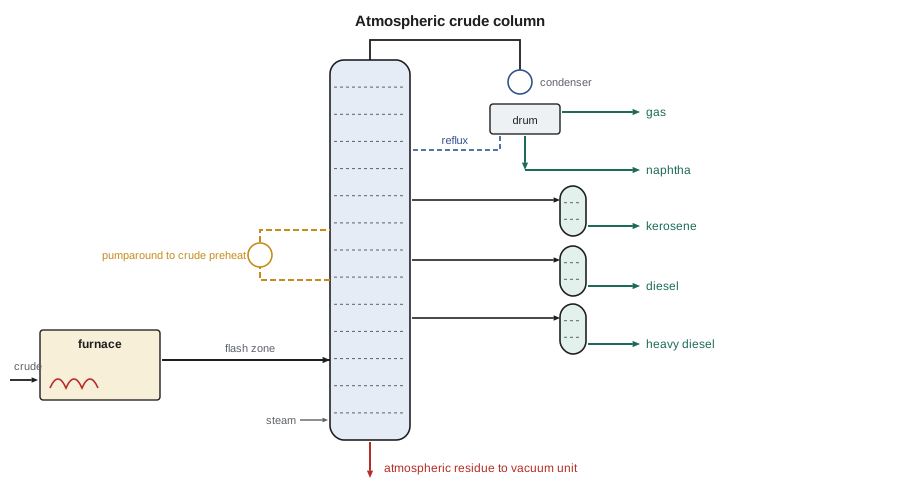
Unlike a simple binary column, a crude column makes several products of overlapping boiling ranges. Each product is defined not by purity but by its distillation range and the properties that follow: flash point, freezing point, end point. The engineer sets cut points, the temperatures on the TBP curve at which one product ends and the next begins. A gap or overlap between adjacent products, measured on their laboratory distillation curves, shows how sharp the separation is.
Pumparounds
If all the heat removed from the column left through the overhead condenser, it would be removed at the coldest point, near 100 °C, where it is worth little. Pumparounds solve this. A liquid stream is drawn from a tray, pumped through exchangers that heat the incoming crude, and returned a few trays higher. The heat is removed at 200 to 300 °C, where it can preheat crude. Pumparounds also reduce the vapor and liquid traffic in the upper column, so the column can be smaller. The code estimates that a diesel pumparound at the Des Plaines refinery returns about 29 MW to the crude.
Overflash
The trays just above the flash zone are washed by a small liquid stream called overflash: material vaporized beyond what the products need, which condenses and falls back. It keeps the wash trays wet, so that heavy residue droplets carried up with the vapor are washed back down instead of contaminating the heavy diesel. Too little overflash and the bottom side product darkens with metals and carbon; too much and energy is wasted reheating material that ends up in the residue. Typical overflash is 2 to 5 % of crude.
The vacuum unit
The atmospheric residue still contains a large amount of gas oil that boils too high to vaporize at atmospheric pressure without cracking. The vacuum unit reheats it in another furnace to about 390 to 420 °C and flashes it into a column held at very low pressure, typically 25 to 100 mm Hg absolute at the flash zone, created by steam ejectors or vacuum pumps. Lower pressure lowers boiling points, so the gas oil vaporizes without cracking. Products are light and heavy vacuum gas oil, sent to the fluid catalytic cracker or hydrocracker, and vacuum residue, sent to the coker, an asphalt plant or fuel oil.
Vacuum columns are short and very wide because the vapor at low pressure has a huge volume. They use structured packing or grids rather than trays to keep the pressure drop low. The cut point between gas oil and residue is critical: pushing it higher makes more valuable gas oil but carries more metals and carbon into the cracker feed. The code shows that at the Des Plaines refinery about 56 % of the atmospheric residue leaves as vacuum gas oil and the rest as vacuum residue for the coker.
| Product | Typical TBP range, °C | Main destination |
|---|---|---|
| Light naphtha | 30 to 85 | Isomerization, gasoline blending |
| Heavy naphtha | 85 to 175 | Naphtha hydrotreater and reformer |
| Kerosene | 175 to 235 | Jet fuel after treating |
| Diesel | 235 to 345 | Diesel hydrotreater |
| Vacuum gas oil | 345 to 560 | Catalytic cracker or hydrocracker |
| Vacuum residue | above 560 | Coker, asphalt or fuel oil |
Corrosion and reliability
Crude units suffer several kinds of corrosion. In the overhead, hydrogen chloride and water attack carbon steel, which is why refineries add neutralizers and filming amines and wash the overhead with water. In the hot sections, sulfur compounds and naphthenic acids cause high-temperature corrosion, which is managed by alloy selection, often 5 % or 9 % chromium steel or 317 stainless steel, and by limiting the acid number of the crude blend. Fouling of the preheat train by asphaltene deposition is another chronic problem, especially when incompatible crudes are blended; a heavy crude mixed with a very paraffinic one can precipitate asphaltenes. The crude unit sets the refinery's run length, often four to six years between major turnarounds, so its reliability matters to every other unit.
Running the column: what the operator watches
Bea's board operators manage the crude unit through a few key temperatures and flows. The furnace outlet temperature and the stripping steam rate set how much of the crude vaporizes in the flash zone, called the lift. The temperature at each side draw tray sets that product's end point, and the draw rate is adjusted to hold it: draw more diesel and heavier material is pulled down into the diesel, raising its end point; draw less and the material drops into the residue. The overhead temperature controls the naphtha end point, and the reflux and pumparound rates balance the heat removal so that each section of the column has enough liquid to separate the products.
Laboratory results arrive a few hours after sampling, so many refineries use online analyzers and inferential models that estimate product distillation points from tray temperatures, pressure and flows. At the Des Plaines refinery the advanced control system adjusts the draws every minute to hold product qualities at their limits, which recovers barrels that would otherwise be given away. A diesel that is a few degrees too light, for example, means valuable diesel-range material has been left in the residue and sent to the coker, where it is worth less.
Energy and pinch analysis
A crude unit and vacuum unit together can account for a third or more of a refinery's fuel use, so their heat integration is studied closely. Pinch analysis, which compares the hot streams that must be cooled with the cold streams that must be heated, shows the minimum furnace duty possible for a given temperature approach in the exchangers. Most crude preheat trains are designed with an approach of 20 to 40 °C; a tighter approach saves fuel but needs more exchanger area. Fouling erodes the benefit over time: as deposits build up, the preheat temperature falls, the furnace fires harder, and its emissions rise. Refineries track the furnace inlet temperature as a key performance indicator and clean exchangers on a schedule chosen to balance cleaning cost against fuel savings.
The heat removed in the vacuum unit is equally valuable. Its pumparounds return heat at 250 to 300 °C, and the hot vacuum residue leaving the bottom, at nearly 400 °C, is one of the best heat sources on the site. At the Des Plaines refinery, the residue heats crude in the last exchangers before the furnace and then raises steam before it goes to the coker. Theo's first small project is to check whether a cleaned exchanger pair has returned the furnace inlet temperature to its design value, using the crude flow, the heat capacity of the crude and the measured temperatures, the same calculation as the code above.
Steam is the other energy input. Stripping steam, at a few kilograms per barrel of product stripped, ends up condensed in the overhead accumulator as sour water, which is sent to the sour water stripper and then reused as desalter wash water. The vacuum ejectors also consume steam, and their condensate is sour. Reducing steam use cuts both energy and wastewater, but too little stripping steam leaves light ends in the products and lowers their flash points below specification.
Worked problem
Vacuum gas oil from a residue
A crude unit produces 50,000 b/d of atmospheric residue. The TBP curve shows that 55 % of it boils below the 560 °C vacuum cut point. How much vacuum gas oil and vacuum residue does the vacuum unit make?
Show solution
- VGO: \(0.55 \times 50\,000 = 27\,500\) b/d.
- Residue: \(50\,000 - 27\,500 = 22\,500\) b/d, ignoring small losses and gas.
Answer: About 27,500 b/d of gas oil and 22,500 b/d of vacuum residue.
Common mistakes
MistakeRaising furnace outlet temperature to increase lift.
InsteadAbove about 370 °C in the crude furnace, cracking and coking begin; use stripping steam or the vacuum unit instead.
MistakeRemoving all heat at the overhead condenser.
InsteadPumparounds recover heat at high temperature and shrink the upper column.
MistakeSetting overflash to zero to save energy.
InsteadDry wash trays let residue into the heavy side product.
MistakeBlending crudes without checking compatibility.
InsteadIncompatible crudes can precipitate asphaltenes and foul the preheat train.
Summary and key terms
- The desalter removes salt, water and solids that would corrode and foul the crude unit.
- A preheat train and furnace heat crude to about 360 °C; hotter would crack it.
- The atmospheric column makes naphtha, kerosene, diesel and residue, with side strippers and pumparounds.
- Overflash keeps the wash trays wet; cut points define each product.
- The vacuum unit separates gas oil from vacuum residue at low pressure without cracking.
- Desalter
- A vessel that washes crude with water and separates it electrostatically to remove salt.
- Cut point
- The TBP temperature dividing two adjacent products.
- Side stripper
- A small steam-stripped column that removes light ends from a side product.
- Pumparound
- A circulating liquid loop that removes heat from a column at high temperature.
- Overflash
- Extra vaporization that condenses on the wash trays above the flash zone.
- Vacuum gas oil
- Heavy distillate recovered under vacuum and fed to cracking units.
Practice problems
Work each problem on paper first, then reveal the answer to check.
Why is crude desalted?
Show answer
To remove salt that forms hydrogen chloride and corrodes the overhead, and solids that foul and poison.
What limits the crude furnace outlet temperature?
Show answer
Thermal cracking and coking above about 370 °C.
What does a side stripper do?
Show answer
Removes light ends from a side product with steam, raising its flash point.
Give two benefits of a pumparound.
Show answer
Heat recovered at high temperature for crude preheat; lower vapor traffic in the upper column.
Why are vacuum columns wide?
Show answer
Vapor at low pressure has a very large volume.
What is the risk of raising the vacuum cut point too far?
Show answer
More metals and carbon in the gas oil, which harm the cracker catalyst.
Lesson quiz · 5 questions
Score 60% or more to complete this lesson.
Create a free account to save your progress, take quizzes and earn a certificate.