
CHE-470 · Lesson 8 of 12 · 21 min
Alkylation and gasoline blending
Gasoline is not made in any single unit. It is blended, in tanks or in-line, from half a dozen components that come from the cracker, the reformer, the isomerization unit, the alkylation unit, the crude unit and outside suppliers of butane and ethanol. Every batch must meet a long list of specifications at once: octane, vapor pressure, distillation, sulfur, benzene, aromatics, olefins, oxygen content and more. Bea's colleague in the blending and shipping group, a senior technologist named Pauline Roy, explains to Theo that blending is where the refinery's work turns into money. A barrel of gasoline given away at one octane number above the specification is value lost, and a batch that fails a specification can cost far more.
Alkylation
Alkylation combines light olefins from the FCC, mainly butylenes and some propylene, with isobutane to make alkylate, a mixture of branched paraffins in the gasoline range dominated by trimethylpentanes, the isomers of isooctane. The overall reaction for butylene is:
Alkylate is a premium blendstock. It has a high RON of about 94 to 97, and unusually its MON is nearly as high, so its sensitivity is low. It contains no aromatics, no olefins, no benzene and almost no sulfur, and its vapor pressure is low. As limits on aromatics, olefins and sulfur have tightened, alkylate has become one of the most valuable components of the pool.
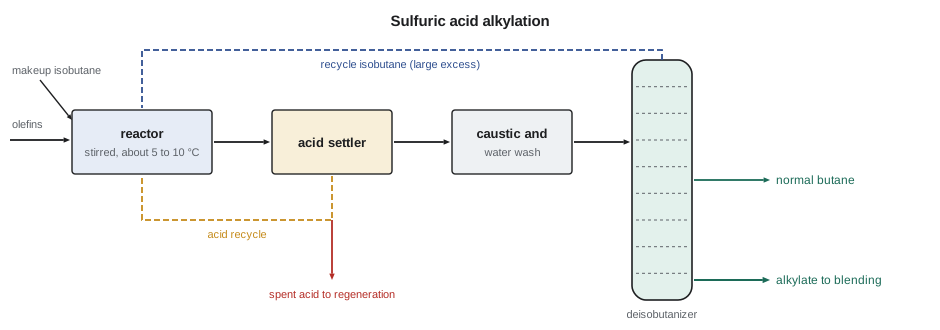
The reaction runs through carbocations, like FCC cracking, but in a liquid strong acid at low temperature. A proton from the acid adds to the olefin to form a carbocation, which reacts with another olefin or with isobutane. Isobutane transfers a hydride to the cation, releasing the alkylate product and forming a tertiary butyl cation that continues the chain. Side reactions, especially olefin polymerization, make heavier, lower-octane products and consume acid. They are suppressed by keeping a large excess of isobutane in the reactor, typically an external isobutane-to-olefin ratio of 5 to 15, and by intense mixing. That excess isobutane must be recovered and recycled in a large distillation column, the deisobutanizer, which is a big part of the unit's energy use.
Sulfuric acid and hydrofluoric acid
Two liquid acids are used commercially. Sulfuric acid units operate at about 5 to 10 °C with refrigeration, often provided by evaporating part of the hydrocarbon in the reactor. They consume acid: the acid is slowly diluted with water and contaminated with acid-soluble oils, and spent acid must be regenerated by burning it to sulfur dioxide and remaking sulfuric acid, either on site or at a contractor's plant. Hydrofluoric acid units operate at 30 to 40 °C with cooling water and regenerate their acid in the unit, so acid consumption is very low. But hydrogen fluoride is highly toxic and, if released, can form a dense, drifting vapor cloud. HF alkylation units have extensive mitigation: water spray curtains, rapid acid transfer systems, detection and, in recent designs, additives that reduce the volatility of the acid.
# Gasoline blending: octane and vapor pressure of a blend, with and without ethanol
comps = {  # name: (volume fraction, RON, MON, RVP kPa)
    "FCC gasoline": (0.36, 92.0, 80.5, 55.0),
    "reformate": (0.30, 98.0, 87.0, 35.0),
    "alkylate": (0.12, 96.0, 93.0, 31.0),
    "isomerate": (0.10, 87.0, 85.0, 90.0),
    "butane": (0.02, 94.0, 90.0, 360.0),
    "light straight-run": (0.10, 68.0, 66.0, 80.0),
}
def blend(c):
    ron = sum(v[0] * v[1] for v in c.values()); mon = sum(v[0] * v[2] for v in c.values())
    rvp = sum(v[0] * v[3] ** 1.25 for v in c.values()) ** (1 / 1.25)   # RVP blending index method
    return ron, mon, rvp
r, m, p = blend(comps)
print(f"BOB (before ethanol): RON {r:.1f}  MON {m:.1f}  AKI {(r+m)/2:.1f}  RVP {p:.0f} kPa ({p*0.145:.1f} psi)")
# Add 10 % ethanol: blending values are higher than ethanol's own octane in a hydrocarbon base
eth = (0.10, 129.0, 102.0, 0.0)
c2 = {k: (v[0] * 0.90,) + v[1:] for k, v in comps.items()}
r2 = sum(v[0] * v[1] for v in c2.values()) + eth[0] * eth[1]
m2 = sum(v[0] * v[2] for v in c2.values()) + eth[0] * eth[2]
p2 = p + 6.9   # about a 1 psi (6.9 kPa) vapor pressure bump at 10 % ethanol
print(f"E10: RON {r2:.1f}  MON {m2:.1f}  AKI {(r2+m2)/2:.1f}  RVP {p2:.0f} kPa")
# Alkylation acid: sulfuric acid consumption per barrel of alkylate (typical range)
alk = 9000
for acid in (0.3, 0.5):  # lb acid per gallon of alkylate
print(f"sulfuric acid unit at {acid} lb/gal: {alk*42*acid/2204.6:.0f} t/d acid regenerated or replaced")BOB (before ethanol): RON 91.4 MON 83.1 AKI 87.3 RVP 61 kPa (8.9 psi) E10: RON 95.2 MON 85.0 AKI 90.1 RVP 68 kPa sulfuric acid unit at 0.3 lb/gal: 51 t/d acid regenerated or replaced sulfuric acid unit at 0.5 lb/gal: 86 t/d acid regenerated or replaced
The code shows that a 9,000 b/d sulfuric acid unit at the Des Plaines refinery, consuming 0.3 to 0.5 lb of acid per gallon of alkylate, must have 50 to 90 t/d of acid regenerated or replaced. the Des Plaines refinery sends its spent acid by pipeline to a regeneration plant on a neighboring site and receives fresh acid in return, a common arrangement in industrial clusters such as the Chicago area, where refineries along the Des Plaines and Calumet rivers supply much of the Midwest. Newer alternatives include solid acid catalysts and ionic liquid alkylation, which has been commercialized at a small number of refineries.
The choice between the two acids has become a question of process safety as much as economics. Several refinery incidents involving HF units have prompted regulators and communities to press for alternatives, and some refiners have converted HF units to sulfuric acid or to newer catalysts. The principles of inherently safer design from CHE-380 apply directly: replacing a hazardous material, or reducing its inventory and volatility, removes risk at its source rather than relying on layers of protection.
The gasoline pool
At the Des Plaines refinery, the gasoline pool is blended from these components:
| Component | Share of pool, vol % | RON | MON | RVP, kPa | Notes |
|---|---|---|---|---|---|
| FCC gasoline (desulfurized) | 36 | 92 | 80.5 | 55 | Olefins, some sulfur |
| Reformate | 30 | 98 | 87 | 35 | Aromatics, benzene |
| Alkylate | 12 | 96 | 93 | 31 | Clean, low sensitivity |
| Isomerate | 10 | 87 | 85 | 90 | Clean, volatile |
| Light straight-run naphtha | 10 | 68 | 66 | 80 | Low octane |
| Butane | 2 | 94 | 90 | 360 | Cheap octane, very volatile |
This blend, before ethanol, is called the blendstock for oxygenate blending, or BOB. Most gasoline in North America is finished at the terminal by splash blending 10 % ethanol into a BOB. The refinery therefore makes BOBs that will meet all specifications only after the ethanol is added, and the octane and vapor pressure targets for the BOB allow for the ethanol's effect.
Blending octane
Octane blends roughly linearly by volume, but not exactly. Each component has a blending octane number, which can differ from its pure-component octane because of interactions in the mixture. Ethanol is the classic example: pure ethanol has a RON of about 108 to 109, but its blending RON in a typical hydrocarbon base at 10 % is about 125 to 130. Refineries use blending octane numbers fitted to their own components, or interaction models fitted to laboratory data on blends.
The code uses linear blending with these values. The BOB at the Des Plaines refinery comes to about RON 91.4 and MON 83.1, an antiknock index of about 87.3. Adding 10 % ethanol raises it to about 90.1, enough to sell as a regular or mid-grade with room to blend in more low-octane naphtha, which is how ethanol lets refiners make cheaper BOBs. In practice the refinery blends a sub-octane BOB for regular gasoline that reaches 87 only after ethanol, and a premium BOB for 91 or higher.
Vapor pressure
Vapor pressure controls how easily gasoline evaporates. Too low and the engine is hard to start in cold weather; too high and the fuel boils in the fuel system in hot weather and evaporates from tanks and vehicles, contributing to smog. Gasoline vapor pressure is measured as Reid vapor pressure (RVP) or an equivalent dry vapor pressure, and its limits change with season and region: higher in winter, lower in summer. Summer limits in many urban areas are around 50 to 62 kPa (7 to 9 psi), and winter limits can exceed 90 kPa.
Vapor pressure does not blend linearly. A common approximation uses a blending index, raising each component's RVP to the power 1.25 before averaging by volume and converting back, as the code does. The BOB comes to about 61 kPa. Ethanol, despite its own low vapor pressure, raises the vapor pressure of gasoline by about 7 kPa (1 psi) at 10 % because it forms non-ideal mixtures with hydrocarbons. The refinery must therefore make a summer BOB with about 7 kPa lower vapor pressure than the finished gasoline is allowed, unless a regulatory waiver for ethanol blends applies.
Butane is the swing component. It is cheap and has good octane, but its vapor pressure of about 360 kPa means that every percent of butane raises pool RVP noticeably. In winter, refineries blend as much butane as the vapor pressure limit allows; in summer, they must remove it, store it or sell it. The changeover between seasons is a carefully planned operation, because tanks at terminals must be turned over to the new grade by fixed dates.
Ethanol and renewable content
Ethanol blending is shaped by policy. In the US, the Renewable Fuel Standard, which makes ethanol blending the cheapest way for most refiners to meet their obligation. In the US, E10 is the usual blend; EPA approved year-round sales of E15 in several Midwest states, including Illinois and Iowa, starting in 2025. Ethanol supplies octane and renewable content but lowers energy content by about 3 % at E10, raises vapor pressure and cannot be shipped in most refinery and product pipelines because it absorbs water, which is why it is added at the terminal. Kingfisher's interest in all this is direct: Nadia's group is evaluating whether Kingfisher's ethanol could be sold under long-term contract to the terminals that the Des Plaines refinery supplies.
Other specifications
Octane and vapor pressure are only two of many limits. Distillation is controlled at several points, the temperature at which 10 %, 50 % and 90 % evaporates and the end point, along with a driveability index that combines them. Sulfur is limited by EPA's Tier 3 standard, which has held gasoline to an annual average of 10 ppm sulfur since 2017, with small refineries given until 2020. Benzene is limited by EPA's gasoline benzene rule, which limits the annual average to 0.62 % by volume. Aromatics and olefins may be limited by regional or seasonal rules. Gasoline must also pass tests for oxidation stability, gum, corrosion of copper and appearance, and must carry a deposit control additive. Each test is run on every batch before it is released.
How blending is optimized
With six or more components and a dozen specifications, finding the cheapest blend that meets every limit is a linear programming problem, the method of lesson 12. A blend optimizer takes the volumes available in each component tank, their measured qualities and their values, and finds the recipe that maximizes margin while meeting every specification with a small safety margin. Online analyzers on the blend header measure octane by near-infrared spectroscopy, vapor pressure and distillation in real time, and the in-line blender adjusts the component flows to stay on target as the batch is made. Pauline says that the best blends at the Des Plaines refinery come within 0.1 of the octane specification; every tenth of an octane number given away across a year's production would be worth several million US dollars.
Worked problem
Octane of a two-component blend
A refiner blends 70 % reformate at RON 98 with 30 % light straight-run naphtha at RON 68. Estimate the RON of the blend by linear blending, then the volume of alkylate at RON 96 that must replace naphtha to reach RON 92.
Show solution
- Blend: \(0.7 \times 98 + 0.3 \times 68 = 89.0\).
- Replacing a fraction \(x\) of the blend's naphtha with alkylate raises RON by \(x (96 - 68) = 28x\).
- Need \(28x = 3\), so \(x = 0.107\): about 11 % alkylate, leaving 19 % naphtha.
Answer: RON 89; replacing about 11 % of the blend's naphtha with alkylate reaches RON 92.
Common mistakes
MistakeBlending vapor pressure linearly.
InsteadUse a blending index such as RVP to the power 1.25.
MistakeUsing pure ethanol octane for blending.
InsteadEthanol's blending octane in gasoline is much higher than its pure value.
MistakeForgetting the ethanol vapor pressure bump.
InsteadSummer BOBs need about 7 kPa lower vapor pressure unless a waiver applies.
MistakeRunning a low isobutane-to-olefin ratio to save energy.
InsteadPolymerization rises, octane falls and acid consumption increases.
Summary and key terms
- Alkylation combines isobutane with light olefins in strong acid to make high-octane, clean alkylate.
- Sulfuric acid units consume acid; HF units regenerate it but carry a toxic release hazard.
- Gasoline is blended from FCC gasoline, reformate, alkylate, isomerate, naphtha, butane and ethanol.
- Octane blends nearly linearly with blending values; vapor pressure needs a blending index.
- Blend optimizers and online analyzers minimize octane and vapor pressure giveaway.
- Alkylate
- Branched C7 to C9 paraffins made from isobutane and light olefins.
- BOB
- Blendstock for oxygenate blending, the refinery gasoline before ethanol is added at the terminal.
- Blending octane number
- The effective octane of a component in a blend, which can differ from its pure value.
- Reid vapor pressure
- A standard measure of gasoline volatility at 37.8 °C.
- Isobutane-to-olefin ratio
- The excess of isobutane fed to an alkylation reactor to suppress side reactions.
- Octane giveaway
- Octane quality in excess of the specification, which is value lost.
Practice problems
Work each problem on paper first, then reveal the answer to check.
Why is alkylate valued in modern gasoline?
Show answer
High octane with low sensitivity, no aromatics, olefins or benzene, and low vapor pressure.
Why is excess isobutane fed to an alkylation reactor?
Show answer
To favor alkylation over olefin polymerization.
What is a BOB?
Show answer
Refinery gasoline blendstock made to meet specifications after ethanol is added at the terminal.
Why can't vapor pressure be blended linearly?
Show answer
Mixtures are non-ideal; a blending index is used.
Why is butane removed from gasoline in summer?
Show answer
Its high vapor pressure would exceed summer limits.
Why is ethanol blended at the terminal rather than the refinery?
Show answer
It absorbs water and cannot be shipped in most product pipelines.
Lesson quiz · 5 questions
Score 60% or more to complete this lesson.
Create a free account to save your progress, take quizzes and earn a certificate.