
CHE-470 · Lesson 5 of 12 · 22 min
Fluid catalytic cracking
The fluid catalytic cracker is the largest and most complex unit at the Des Plaines refinery, and for many refineries it is the main gasoline maker. Roz calls it the heart of the refinery: if the cracker is down, the refinery loses most of its gasoline and much of its propylene and butylene, and the planners scramble to sell gas oil instead. Theo spends a week with the cracker team, led by a process engineer named Jun Tanaka, who has worked on the unit for fifteen years and still calls it the most interesting piece of equipment he has met.
What the cracker does
The fluid catalytic cracker, or FCC, converts heavy vacuum gas oil, and sometimes some residue, into lighter, more valuable products: gasoline, liquefied petroleum gas rich in propylene and butylenes, and light cycle oil in the diesel range. It does so by contacting the hot oil with a fine, hot, powdered catalyst for a few seconds. The large molecules crack on the acid sites of the catalyst into smaller ones. A by-product of the cracking is coke, a carbon-rich deposit that covers the catalyst and deactivates it. The FCC burns that coke off in a regenerator and uses the heat of combustion to drive the cracking.
The catalyst
FCC catalyst is a powder of particles about 70 micrometers in diameter, which flows like a liquid when aerated. Each particle contains a zeolite, usually a rare-earth exchanged or ultra-stable form of zeolite Y, held in a matrix of clay, alumina and silica. The zeolite's strong acid sites crack molecules into the gasoline range and promote hydrogen transfer reactions; the matrix pre-cracks large molecules too big to enter the zeolite pores and traps metals. Additives are often blended in: ZSM-5 to crack gasoline-range olefins into propylene, metal traps for vanadium, and combustion promoters for the regenerator.
Cracking on an acid site proceeds through carbocations. A molecule loses a hydride or gains a proton to form a positively charged carbon ion, which breaks at the bond beta to the charged carbon, a reaction called beta-scission. The products are an olefin and a smaller carbocation, which can crack again, isomerize or pick up a hydride from another molecule. This is why FCC gasoline is rich in branched olefins and aromatics and has a high octane, and why the cracker makes so much propylene and butylene.
Riser, reactor and regenerator
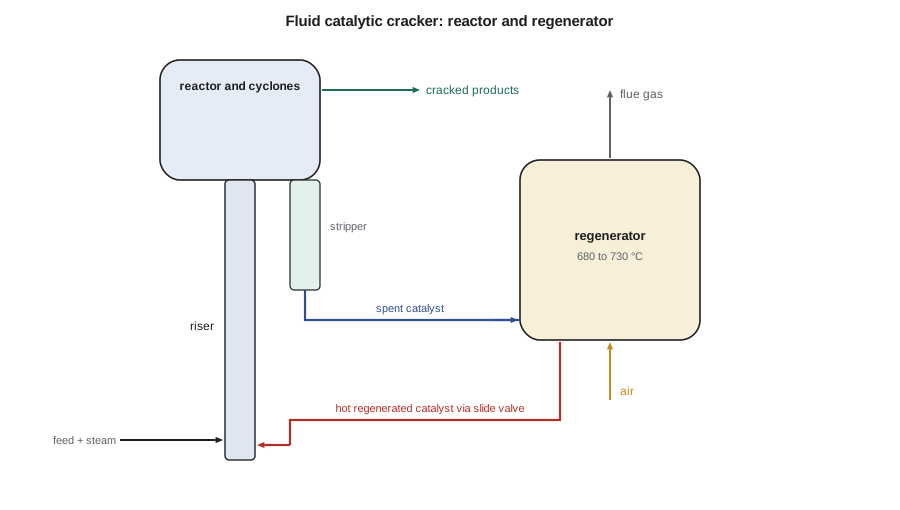
Hot regenerated catalyst, at about 700 °C, flows down a standpipe to the base of the riser, a vertical pipe 30 to 40 meters tall. There it meets the preheated feed, sprayed in through atomizing nozzles with steam. The oil vaporizes, and the expanding vapor carries the catalyst up the riser in two to four seconds while the cracking takes place. At the top, cyclones separate the catalyst from the product vapor. The spent catalyst falls into a stripper, where steam removes hydrocarbons trapped between the particles, and then flows to the regenerator.
In the regenerator, air fluidizes the catalyst and burns the coke at 680 to 730 °C. The flue gas leaves through cyclones and then an expander or waste heat boiler, and often an electrostatic precipitator or wet scrubber to remove catalyst fines and sulfur oxides. The hot regenerated catalyst returns to the riser, carrying the heat of combustion with it.
The heat balance
The FCC is a heat-balanced unit. The heat from burning coke in the regenerator must equal the heat needed to vaporize and heat the feed, supply the endothermic heat of cracking, and cover losses. Because the catalyst circulation carries the heat, the unit adjusts itself: if the feed becomes heavier and makes more coke, the regenerator gets hotter, the hotter catalyst needs less circulation to hold the riser outlet temperature, and less circulation means less coke is burned per metric ton of feed until a new balance is found. Operators control the riser outlet temperature with the regenerated catalyst slide valve, and the catalyst-to-oil ratio follows from the heat balance.
# FCC heat balance: coke burned in the regenerator supplies the reactor heat
feed = 38000            # b/d gas oil
m = feed * 0.159 * 910 / 24 / 3600    # kg/s
coke_frac = 0.050       # wt fraction of feed burned as coke
h_coke = 32.0e6         # J/kg heat of combustion to CO2 (full burn, illustrative)
Q_regen = m * coke_frac * h_coke
# Reactor needs: feed preheat to reaction temperature, vaporization and endothermic cracking
cp_feed = 2.8e3; T_feed, T_rx = 230.0, 530.0
dH_vap = 2.6e5; dH_crack = 4.5e5   # J/kg of feed
Q_need = m * (cp_feed * (T_rx - T_feed) + dH_vap + dH_crack)
print(f"feed {m:.0f} kg/s; heat from coke {Q_regen/1e6:.0f} MW; reactor needs {Q_need/1e6:.0f} MW")
# Catalyst to oil ratio needed to carry that heat from regenerator to riser
cp_cat = 1.1e3; T_reg = 700.0
cat = Q_need / (cp_cat * (T_reg - T_rx))
print(f"catalyst circulation {cat:.0f} kg/s; catalyst-to-oil ratio {cat/m:.1f}")
# Yield estimate at 75 % conversion (illustrative correlation shape)
conv = 0.75
gasoline = 0.62 * conv - 0.05 * max(0, conv - 0.72) * 10
yields = {"dry gas": 0.035, "LPG": 0.17, "gasoline": gasoline, "light cycle oil": 0.16, "slurry oil": 1 - conv - 0.16, "coke": coke_frac}
yields["gasoline"] = 1 - sum(v for k, v in yields.items() if k != "gasoline")
for k, v in yields.items(): print(f"{k:16s} {v*100:5.1f} wt %")feed 64 kg/s; heat from coke 102 MW; reactor needs 99 MW catalyst circulation 527 kg/s; catalyst-to-oil ratio 8.3 dry gas 3.5 wt % LPG 17.0 wt % gasoline 49.5 wt % light cycle oil 16.0 wt % slurry oil 9.0 wt % coke 5.0 wt %
The code estimates that at the Des Plaines refinery, burning about 5 % of the feed as coke gives roughly 100 MW, enough for the reactor's needs, and the catalyst circulation of about 530 kg/s gives a catalyst-to-oil ratio of about 8. Those numbers are typical. The catalyst circulates through the unit dozens of times per hour, and the inventory of catalyst in a large unit is a few hundred metric tons. Fresh catalyst is added every day, at a few metric tons, to replace the fines lost through the cyclones and to hold activity as metals accumulate; an equal amount of equilibrium catalyst is withdrawn.
Coke make is the key constraint. A heavier feed with more Conradson carbon makes more coke, the regenerator gets hotter, and above about 730 to 760 °C the catalyst begins to lose its zeolite structure. Units built to process residue use catalyst coolers, which remove heat from the regenerator by raising steam, or two-stage regenerators. Some units run in partial combustion, burning coke to a mixture of carbon monoxide and carbon dioxide and then burning the carbon monoxide in a separate boiler; this lowers the regenerator temperature.
The main fractionator and gas plant
The cracked vapor leaving the reactor is quenched and separated in the main fractionator into wet gas, unstabilized gasoline, light cycle oil, heavy cycle oil and a slurry oil from the bottom that carries catalyst fines. The wet gas is compressed and goes with the gasoline to the gas plant, a train of absorbers and distillation columns that recovers propane and propylene, butanes and butylenes, and stabilized gasoline, leaving dry gas for the refinery fuel system. The propylene can be split off to sell as chemical-grade or polymer-grade propylene; the butylenes and isobutane go to the alkylation unit, the subject of lesson 8.
| Product | Typical yield, wt % | Destination |
|---|---|---|
| Dry gas (hydrogen, methane, ethane, ethylene) | 3 to 4 | Refinery fuel gas |
| LPG (propane, propylene, butanes, butylenes) | 15 to 20 | Alkylation, propylene sales, LPG |
| Gasoline | 45 to 52 | Gasoline blending after sulfur removal |
| Light cycle oil | 14 to 18 | Diesel hydrotreater or fuel oil |
| Slurry oil | 6 to 10 | Fuel oil, carbon black feed |
| Coke | 4.5 to 6 | Burned in regenerator |
Conversion and severity
FCC conversion is defined as the percentage of feed converted to gasoline and lighter products, including coke. A typical unit runs at 70 to 80 % conversion. Raising the riser outlet temperature or the catalyst-to-oil ratio increases conversion, but beyond a point gasoline itself begins to overcrack into LPG and dry gas. Refineries shift the cracker between modes: a gasoline mode in summer, a distillate mode with lower conversion to make more light cycle oil when diesel is in demand, and a propylene mode with ZSM-5 additive when propylene prices are high. The yield pattern in the code is for a typical gasoline mode.
Feed quality drives everything. Hydrotreating the cracker feed removes sulfur, nitrogen and metals and saturates some aromatics, which raises conversion, cuts coke and gives a lower-sulfur gasoline. Many refineries built FCC feed hydrotreaters for the gasoline sulfur rules. Others treat the cracked gasoline instead, in a selective hydrotreater that removes sulfur while saturating as few of the high-octane olefins as possible.
Emissions and reliability
The FCC regenerator is one of the refinery's largest emission sources. Its flue gas carries carbon dioxide from burning coke, sulfur oxides from sulfur in the coke, nitrogen oxides, carbon monoxide and catalyst fines. Additives in the catalyst can capture sulfur oxides in the regenerator and release them as hydrogen sulfide in the riser, where it is recovered with the rest of the refinery's sulfur. Wet gas scrubbers and electrostatic precipitators capture particulates. Under a Title V operating permit from the Illinois Environmental Protection Agency, which carries the federal refinery air rules for benzene at the fence line and sulfur dioxide among its limits, refineries report and limit these emissions.
Erosion is the chronic reliability issue: catalyst moving at high velocity wears away cyclones, standpipes, slide valves and the riser. Most of the unit is lined with erosion-resistant refractory. Jun shows Theo the record of the last turnaround, when the reactor cyclones were replaced after five years of service. The unit is expected to run that long again, which is why the operators watch catalyst losses and the pressure balance between reactor and regenerator so carefully. A reversal of that pressure balance, which could send air into the reactor or hydrocarbons into the regenerator, is one of the hazards the unit's safeguards are designed to prevent.
A shift on the cracker console
Jun lets Theo sit beside the board operator for a night shift. The operator's screens show three groups of numbers that must be watched together. The first is the heat balance: riser outlet temperature, regenerator dense bed and dilute phase temperatures, and the slide valve positions. A rising difference between the dilute phase above the bed and the dense bed itself signals afterburn, where carbon monoxide burns above the catalyst bed with no catalyst to absorb the heat, which can damage the cyclones. The second is the pressure balance: reactor pressure, regenerator pressure and the pressure drops across each slide valve, which must stay positive so catalyst flows the right way. The third is the product side: wet gas compressor load, main fractionator bottoms temperature and the gas plant recoveries.
At about two in the morning the feed changes as a new tank of gas oil, with more coker gas oil in it, comes on line. Over the next hour the regenerator temperature climbs by about 8 °C, the regenerated catalyst slide valve closes slightly, and the catalyst-to-oil ratio falls, exactly as the heat balance predicts. The operator trims the feed preheat to bring the circulation back up and keep conversion where the planners want it. Theo sees in practice what the code shows on paper: the unit finds its own balance, and the operator's job is to steer where that balance lands.
The cracker and the rest of the refinery
Because the FCC makes most of the refinery's gasoline-range olefins, it ties together many other units. Its gasoline goes to a selective hydrotreater for sulfur removal. Its propylene goes to sale or to a polymer-grade splitter, its butylenes and isobutane to alkylation, and its light cycle oil to the diesel hydrotreater, where its high aromatic content consumes a lot of hydrogen and limits the cetane of the diesel pool. Its slurry oil, after the fines settle out, is sold as a feed for carbon black or needle coke, or blended into fuel oil. A cracker outage therefore ripples through the gasoline pool, the alkylation unit, the hydrogen balance and the fuel gas system all at once.
Worked problem
Coke burn and heat
An FCC processes 230 t/h of feed and makes 5.0 wt % coke. Taking the heat of coke combustion as about 32 MJ/kg, how much heat does the regenerator release?
Show solution
- Coke: \(0.05 \times 230 = 11.5\) t/h \(= 3.19\) kg/s.
- Heat: \(3.19 \times 32 = 102\) MW.
Answer: About 100 MW, consistent with the code.
Common mistakes
MistakeTreating coke as a waste product.
InsteadCoke burned in the regenerator supplies the heat that drives the cracking.
MistakeRaising riser temperature indefinitely to increase conversion.
InsteadGasoline overcracks to LPG and dry gas, and coke rises.
MistakeFeeding residue without heat removal.
InsteadThe regenerator overheats and destroys the zeolite; use catalyst coolers or two-stage regeneration.
MistakeIgnoring the reactor-regenerator pressure balance.
InsteadA reversal can mix air and hydrocarbons; safeguards must protect against it.
Summary and key terms
- The FCC cracks vacuum gas oil over a zeolite catalyst into gasoline, LPG and light cycle oil.
- Cracking proceeds through carbocations and beta-scission, giving olefinic, high-octane gasoline.
- Coke from cracking is burned in the regenerator, and the heat returns with the catalyst.
- The heat balance sets the catalyst-to-oil ratio; feed quality sets coke make.
- The gas plant recovers propylene and butylenes for sale and alkylation.
- Riser
- The vertical pipe where feed and catalyst react for a few seconds.
- Regenerator
- The vessel where coke is burned off the catalyst with air.
- Zeolite Y
- The crystalline aluminosilicate that provides the main acid cracking sites.
- Catalyst-to-oil ratio
- The mass flow of catalyst divided by the mass flow of feed.
- Beta-scission
- The breaking of a carbon-carbon bond beta to the charged carbon of a carbocation.
- Light cycle oil
- The FCC product in the diesel boiling range, rich in aromatics.
Practice problems
Work each problem on paper first, then reveal the answer to check.
Why does the FCC need no furnace for the reaction heat?
Show answer
Burning coke in the regenerator supplies it, carried by the catalyst.
What does ZSM-5 additive do?
Show answer
Cracks gasoline-range olefins into propylene and butylenes.
What happens to the heat balance if feed coke make rises?
Show answer
The regenerator gets hotter and catalyst circulation falls.
Why is cracker feed often hydrotreated?
Show answer
To raise conversion, cut coke, and lower gasoline sulfur.
What limits regenerator temperature?
Show answer
Loss of zeolite structure above about 730 to 760 °C.
Where do FCC butylenes usually go?
Show answer
To the alkylation unit.
Lesson quiz · 5 questions
Score 60% or more to complete this lesson.
Create a free account to save your progress, take quizzes and earn a certificate.