
CHE-470 · Lesson 10 of 12 · 21 min
Steam cracking, olefins and aromatics
A refinery is surrounded by chemistry. Its off-gases, its propylene, its reformate and its naphtha are the raw materials of the petrochemical industry, which turns them into plastics, fibers, rubbers, solvents and thousands of intermediates. the Des Plaines refinery sells propylene and off-gas to a steam cracker on the Gulf Coast that buys the refinery propylene stream by rail, and its planners watch petrochemical prices as closely as fuel prices, because a molecule sold to a chemical plant can be worth more than the same molecule blended into gasoline. Nadia, who is studying Kingfisher's options for bio-based chemicals, asks Theo to explain how the olefins business works. He arranges a visit to a steam cracker with a process engineer from the refinery's chemicals marketing team, Omar Haddad.
Olefins and why they matter
Ethylene and propylene are the two largest-volume organic chemicals in the world. Ethylene, with world production well over 150 million metric tons a year, goes mainly into polyethylene, and also into ethylene oxide and glycols, vinyl chloride for PVC, and styrene. Propylene goes into polypropylene, acrylonitrile, propylene oxide and cumene. Butadiene, a smaller co-product, is the base of synthetic rubber. Because these molecules are reactive gases that are costly to store and ship, crackers and polymer plants usually sit together in clusters, connected by pipelines, as they do in the Chicago area, where refineries along the Des Plaines and Calumet rivers supply much of the Midwest.
The steam cracker
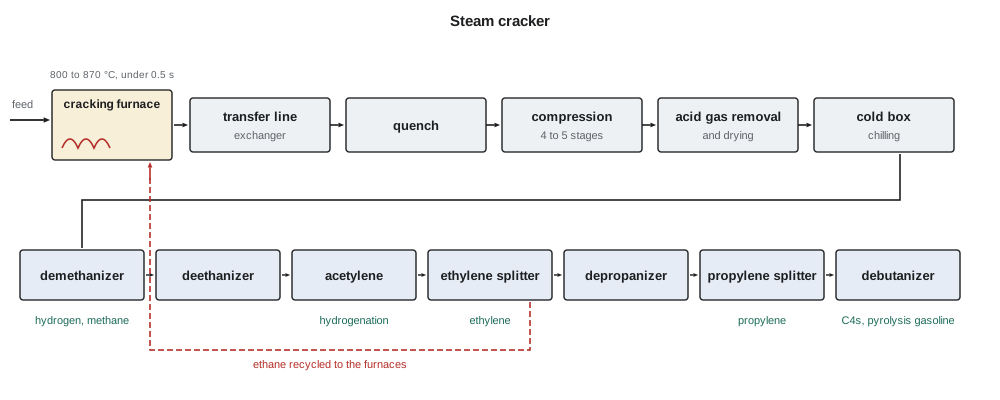
A steam cracker makes olefins by thermally cracking hydrocarbons in the absence of a catalyst. The feed, ethane, propane, butane or naphtha, is mixed with steam and heated very quickly to 800 to 870 °C in long tubes in the radiant section of a furnace, then cooled within a fraction of a second. At those temperatures, carbon-carbon and carbon-hydrogen bonds break homolytically to form free radicals, which propagate a chain of reactions that produce ethylene, propylene and hydrogen. For ethane, the overall reaction is simple:
It is strongly endothermic, about 137 kJ per mole, which is why cracking furnaces are among the largest fired heaters in industry. The steam lowers the hydrocarbon partial pressure, which favors the olefin-forming reactions, and reduces coke formation. Short residence time, typically 0.1 to 0.5 seconds, limits secondary reactions in which the olefins themselves react to form heavier products and coke.
Feed choice
Feed choice decides almost everything about a cracker. Ethane gives the highest ethylene yield, about 80 % at ultimate conversion with recycle of unconverted ethane, and few co-products. Naphtha gives only about 30 % ethylene but much more propylene, butadiene and aromatic pyrolysis gasoline. The code shows the consequences: to make a million metric tons of ethylene a year takes about 1.25 Mt of ethane or about 3.3 Mt of naphtha, and the naphtha cracker also makes about half a million metric tons of propylene and over 700,000 metric tons of pyrolysis gasoline.
# Steam cracker: ethylene yield from ethane vs naphtha, and furnace run length as coke builds
feeds = {  # wt % yields at typical severity (illustrative, rounded)
    "ethane": {"ethylene": 80, "propylene": 1.5, "butadiene": 1.5, "hydrogen and methane": 13, "pyrolysis gasoline": 2, "other": 2},
    "naphtha": {"ethylene": 30, "propylene": 15, "butadiene": 4.5, "hydrogen and methane": 16, "pyrolysis gasoline": 22, "other": 12.5},
}
target = 1_000_000  # t/yr ethylene
for f, y in feeds.items():
    need = target / (y["ethylene"] / 100)
    print(f"{f:8s}: {need/1e6:.2f} Mt/yr feed for 1 Mt ethylene; co-products propylene {need*y['propylene']/1e8:.2f} Mt, pygas {need*y['pyrolysis gasoline']/1e8:.2f} Mt")
# Ethane conversion and selectivity at different coil outlet temperatures (illustrative)
for cot, conv, sel in ((820, 0.55, 0.84), (840, 0.65, 0.81), (860, 0.72, 0.78)):
    print(f"COT {cot} C: conversion {conv*100:.0f} %, ethylene per pass {conv*sel*100:.0f} wt % of feed")
# Coke builds on the radiant tubes: tube metal temperature rises until a decoke is needed
tmt, limit, rise = 1010.0, 1100.0, 1.6   # C, C, C per day
print(f"run length about {(limit - tmt)/rise:.0f} days before decoking")
# Aromatics: BTX from reformate
ref = 22000 * 0.159 * 0.80 * 365 / 1000   # kt/yr
for comp, w in (("benzene", 0.06), ("toluene", 0.18), ("xylenes", 0.20)):
print(f"{comp:8s} in reformate: about {ref*w:.0f} kt/yr")ethane : 1.25 Mt/yr feed for 1 Mt ethylene; co-products propylene 0.02 Mt, pygas 0.03 Mt naphtha : 3.33 Mt/yr feed for 1 Mt ethylene; co-products propylene 0.50 Mt, pygas 0.73 Mt COT 820 C: conversion 55 %, ethylene per pass 46 wt % of feed COT 840 C: conversion 65 %, ethylene per pass 53 wt % of feed COT 860 C: conversion 72 %, ethylene per pass 56 wt % of feed run length about 56 days before decoking benzene in reformate: about 61 kt/yr toluene in reformate: about 184 kt/yr xylenes in reformate: about 204 kt/yr
North American crackers have shifted heavily toward ethane since shale gas production expanded the supply of natural gas liquids. Ethane crackers are cheaper to run when ethane is cheap, but they make little propylene. That has raised the value of propylene from refinery FCC units and led to on-purpose propylene plants, such as propane dehydrogenation units. Crackers in Europe and Asia rely more on naphtha. the Des Plaines refinery's propylene, recovered from the FCC gas plant, competes in this market.
Severity and run length
The coil outlet temperature, or COT, is the main severity variable. Raising it increases conversion of the feed but lowers selectivity to ethylene, as more of the product cracks further to methane and hydrogen or condenses to heavier molecules. The code shows that for an ethane furnace, raising the COT from 820 to 860 °C lifts conversion from 55 to 72 % but cuts the selectivity to ethylene. Operators choose the COT to balance yield, energy use and furnace run length.
Coke deposits on the inside of the radiant tubes, insulating them so that the tube metal temperature must rise to keep the same heat input. When the tube metal temperature reaches the limit of the alloy, around 1,100 °C for modern high-nickel, high-chromium tubes, the furnace is taken off line and decoked with a mixture of steam and air for a day or two. The code estimates a run length of about 56 days for an ethane furnace whose tube temperature rises by 1.6 °C per day. A cracker has many furnaces, typically ten or more, so one is usually being decoked while the others run.
Quench, compression and separation
The cracked gas leaves the furnace at over 800 °C and must be cooled in milliseconds to stop the reactions. Transfer line exchangers do this, raising high-pressure steam that drives the cracker's compressors. Further cooling in a quench tower with water or oil condenses heavy products and dilution steam. The cracked gas is then compressed in four or five stages to about 35 bar, with caustic washing to remove carbon dioxide and hydrogen sulfide and drying to remove water before the cold section.
The cold section is a cryogenic distillation train. A demethanizer at about minus 100 °C separates hydrogen and methane, which become fuel or are purified into hydrogen product. A deethanizer separates C2s from heavier products. Acetylene, a minor product that would poison polyethylene catalysts, is selectively hydrogenated to ethylene. The ethylene splitter, a very tall column with more than 100 trays, separates ethylene from ethane, which is recycled to the furnaces. Similar columns separate propylene from propane and the C4s from pyrolysis gasoline. Polymer-grade ethylene and propylene must be extremely pure, typically 99.9 % or more, with impurities such as carbon monoxide, acetylene and sulfur at the ppm level or below.
The refrigeration needed for the cold section is supplied by ethylene and propylene refrigeration cycles driven by large steam-turbine compressors, which together with the cracked gas compressor make the cracker one of the largest users of mechanical power in industry. Energy accounts for most of the cash cost of an ethane cracker, which is why cracker designs integrate furnaces, steam and compressors so tightly.
| Product | Main uses |
|---|---|
| Ethylene | Polyethylene, ethylene oxide and glycol, vinyl chloride, styrene |
| Propylene | Polypropylene, acrylonitrile, propylene oxide, cumene |
| Butadiene | Synthetic rubbers, ABS plastic |
| Benzene | Styrene (via ethylbenzene), cumene and phenol, cyclohexane for nylon |
| Toluene | Solvents, conversion to benzene and xylenes, gasoline octane |
| Para-xylene | Terephthalic acid for polyester fiber and PET bottles |
Aromatics from the refinery
The other major family of petrochemicals is the aromatics: benzene, toluene and the xylenes, together called BTX. Most come not from steam crackers but from catalytic reformers like the one in lesson 7, run at high severity on a naphtha cut chosen to maximize aromatics. Pyrolysis gasoline from naphtha crackers is the second source. The code estimates that a 22,000 b/d reformer at the Des Plaines refinery produces reformate containing roughly 60,000 t/yr of benzene, 180,000 t/yr of toluene and 200,000 t/yr of xylenes, enough to supply a medium-sized aromatics plant.
Aromatics are separated from reformate by liquid-liquid extraction or extractive distillation with a polar solvent such as sulfolane, which dissolves aromatics but not paraffins. The extract is distilled into benzene, toluene and mixed xylenes. Because demand for para-xylene, the raw material for polyester, far exceeds the amount present in reformate, aromatics complexes also convert toluene and other xylenes into para-xylene, by transalkylation, disproportionation and xylene isomerization, and separate it from its isomers by adsorption in simulated moving bed units or by crystallization. Selling benzene to a chemical plant also helps a refinery meet the gasoline benzene limit in the US.
The refinery as a chemical feedstock supplier
Omar walks Theo through the streams the Des Plaines refinery can send to petrochemical customers. Propylene from the FCC, after splitting from propane, is sold as refinery-grade or upgraded to polymer grade. Off-gases from the FCC and coker contain ethylene and ethane that can be recovered and sent to a cracker. Light naphtha and hydrocracker unconverted oil can be sold as cracker feed. Reformate can be sold to an aromatics plant or have benzene extracted. Each of these takes a molecule out of the fuel pool and puts it into chemicals, and the planning model decides each month whether the chemicals price justifies it.
The integration can run deeper. Some refineries are built alongside a cracker and an aromatics complex on the same site, sharing utilities, hydrogen, fuel gas and feedstocks. These integrated sites can shift molecules between fuels and chemicals as markets change. As fuel demand plateaus in some regions, refiners have studied converting more of each barrel to chemicals, through high-severity FCC units designed for propylene, crude-to-chemicals complexes that crack whole crude fractions, or by sending more naphtha to crackers. Such schemes are being built mainly in Asia and the Middle East.
Safety in olefin plants
Ethylene and propylene are highly flammable gases, stored and processed at high pressure and very low temperature. Leaks can form flammable vapor clouds, and brittle fracture is a risk if carbon steel is cooled below its design temperature, for example during a depressuring. Cracking furnaces carry the hazards of any large fired heater, including tube rupture and firebox explosions on light-off. Acetylene in concentrated form is unstable. Butadiene can form explosive peroxides and polymer. The process hazard analysis methods and safeguards from CHE-380 are applied throughout, with particular attention to low-temperature embrittlement, furnace safeguarding and relief system design.
Back to Kingfisher
Nadia's question was whether Kingfisher's ethanol could become a petrochemical feed. Theo reports that ethanol can be dehydrated to ethylene over an alumina or zeolite catalyst, a route already used commercially in Brazil to make bio-based polyethylene. The economics depend on the price of ethanol relative to fossil ethylene and on whether buyers will pay a premium for renewable plastic. Omar adds a practical point: the product must meet the same polymer-grade purity specification as ethylene from a cracker, so the dehydration plant needs its own purification train. Theo notes the idea for the capstone in lesson 12.
Worked problem
Feed for an ethane cracker
A cracker will make 1.5 Mt/yr of ethylene from ethane at an overall yield of 80 wt %. How much ethane is needed, and how much hydrogen and methane will it make at 13 wt %?
Show solution
- Ethane: \(1.5/0.80 = 1.875\) Mt/yr.
- Hydrogen and methane: \(0.13 \times 1.875 = 0.24\) Mt/yr.
Answer: About 1.9 Mt/yr of ethane and 0.24 Mt/yr of hydrogen and methane, used mostly as furnace fuel.
Common mistakes
MistakeAssuming a higher coil outlet temperature always means more ethylene.
InsteadConversion rises but selectivity falls, and run length shortens.
MistakeTreating ethane and naphtha crackers as interchangeable.
InsteadNaphtha crackers make far more propylene, butadiene and aromatics.
MistakeOverlooking acetylene in cracked gas.
InsteadIt poisons polymerization catalysts and must be hydrogenated out.
MistakeIgnoring low-temperature embrittlement.
InsteadCarbon steel can fracture if cooled below its design temperature.
Summary and key terms
- Steam cracking makes ethylene and propylene by free radical thermal cracking with steam at 800 to 870 °C.
- Ethane gives high ethylene yield; naphtha gives more propylene, butadiene and pyrolysis gasoline.
- Coil outlet temperature trades conversion against selectivity and run length.
- Cracked gas is quenched, compressed and separated cryogenically to polymer-grade purity.
- BTX aromatics come mainly from reformate, separated by solvent extraction.
- Steam cracker
- A plant that thermally cracks hydrocarbons with steam to make light olefins.
- Coil outlet temperature
- The temperature of the cracked gas leaving the radiant coil, the main severity variable.
- Transfer line exchanger
- A heat exchanger that quenches cracked gas and raises high-pressure steam.
- Pyrolysis gasoline
- An aromatic liquid co-product of naphtha cracking.
- BTX
- Benzene, toluene and xylenes.
- Polymer grade
- Olefin purity sufficient for polymerization catalysts, typically 99.9 % or more.
Practice problems
Work each problem on paper first, then reveal the answer to check.
Why is steam added to cracker feed?
Show answer
To lower hydrocarbon partial pressure, favoring olefins, and reduce coke.
Why is residence time kept very short?
Show answer
To limit secondary reactions of the olefins to heavier products and coke.
What sets the run length of a cracking furnace?
Show answer
Coke buildup raising the tube metal temperature to its limit.
Why must acetylene be removed from ethylene?
Show answer
It poisons polymerization catalysts.
Where do most BTX aromatics come from?
Show answer
Catalytic reformers, with pyrolysis gasoline second.
Name one way a refinery sells molecules into chemicals.
Show answer
FCC propylene, off-gas olefins, cracker naphtha, or reformate aromatics.
Lesson quiz · 5 questions
Score 60% or more to complete this lesson.
Create a free account to save your progress, take quizzes and earn a certificate.