
CHE-390 · Lesson 9 of 12 · 21 min
Sterilization and contamination control
Every fermenter is a warm, wet, sugar-rich environment that any passing microorganism would like to share. In a pharmaceutical or enzyme fermentation, a single foreign organism can ruin a batch, so the medium and equipment are sterilized and the culture is protected from the outside world. A fuel ethanol plant cannot afford full sterility at its scale, and it does not need it: yeast in a hot, acidic, increasingly alcoholic mash outcompetes most intruders. But bacteria, especially lactic acid bacteria, do grow in ethanol plants, and they cost yield every day. This lesson covers both ends: the kinetics of killing microorganisms by heat, and the practical control of contamination in a plant that is clean but not sterile.
Why contamination matters
Contaminating bacteria consume glucose that would have become ethanol, and make lactic and acetic acids that stress the yeast. Rosa's laboratory measures lactic acid in every fermenter at drop; a level above about 0.3 % by weight usually means trouble. The code converts lactic acid into lost ethanol: each 0.1 % of lactic acid represents about 0.5 g/L of ethanol not made, and at 1 % lactic acid the plant loses about 3 to 4 % of its output, before counting the slowdown of stressed yeast. Severe infections can stop a fermentation altogether. At Kingfisher Bioenergy's scale a single percentage point of yield is worth about two million liters a year, so contamination control is a constant activity rather than an occasional emergency.
Killing microorganisms with heat
Moist heat kills microorganisms by denaturing their proteins and damaging their membranes and nucleic acids. Under constant conditions, the number of viable organisms falls by first-order kinetics, just like enzyme deactivation in lesson 4:
The decimal reduction time, \(D\), is the time for a tenfold reduction at a given temperature, \(D = \ln 10 / k_d\). Vegetative cells such as yeast and lactobacilli are killed in seconds at 70 to 80 °C. Bacterial spores, the dormant forms made by Bacillus and Clostridium species, are far more resistant; resistant spores have \(D\) values of a few minutes at 121 °C. Sterilization design is therefore based on spores. The temperature dependence follows the Arrhenius equation with a high activation energy, roughly 250 to 350 kJ/mol for spores, so a modest rise in temperature shortens the required time dramatically.
The Del factor
The design criterion for sterilization is the Del factor, \(\nabla = \ln(N_0/N)\), the natural logarithm of the reduction in viable numbers. It is chosen so that the probability of a single survivor in a batch is acceptably low, often one in a thousand. For a 150 m³ batch of medium with \(10^6\) spores per liter, \(N_0 = 1.5 \times 10^{11}\) and the target \(N = 10^{-3}\), so \(\nabla = \ln(1.5 \times 10^{14}) = 32.6\). During a real batch sterilization, temperature rises, holds and falls, and the Del factor accumulates over all three phases:
Heating and cooling large batch vessels take an hour or more each, so much of the kill, and much of the damage to the medium, happens during those ramps.
import math
# Thermal death kinetics and the Del factor for sterilizing a medium (illustrative constants)
R = 8.314
D121 = 3.0                        # min, decimal reduction time of a resistant spore former at 121 C
k121 = math.log(10)/D121          # 1/min
E = 290e3                         # J/mol activation energy for spore death
def k(T): return k121*math.exp(-E/R*(1/(T+273.15) - 1/(121+273.15)))
N0 = 1e6 * 150e3                  # spores per L x liters in a 150 m3 batch of medium
target = 1e-3                     # probability of one survivor per batch
Del = math.log(N0/target)
print(f"required Del factor {Del:.1f}")
for T in (121, 130, 140, 150):
    print(f"{T} C: k {k(T):7.2f} 1/min, holding time {Del/k(T)*60:7.1f} s")
# Damage to a heat-sensitive nutrient (vitamin, E about 90 kJ/mol): batch at 121 C vs continuous at 140 C
kv121 = 0.01; Ev = 90e3
def kv(T): return kv121*math.exp(-Ev/R*(1/(T+273.15) - 1/(121+273.15)))
tb = Del/k(121); tc = Del/k(140)
print(f"nutrient left: batch 121 C hold {tb:.1f} min -> {100*math.exp(-kv(121)*tb):.0f} %, continuous 140 C {tc*60:.0f} s -> {100*math.exp(-kv(140)*tc):.1f} %")
# Ethanol lost to lactic acid bacteria contamination in the fermenters
for lactic in (0.3, 0.6, 1.0):     # % w/v lactic acid at drop
    glucose_lost = lactic*10/0.9 * 0.9   # g/L glucose, homofermentative 1 g glucose -> ~1 g lactic (90 % basis)
    etoh_lost = glucose_lost*0.47
print(f"lactic acid {lactic:.1f} % w/v -> about {etoh_lost:.1f} g/L ethanol lost ({100*etoh_lost/130:.1f} % of a 130 g/L titer)")required Del factor 32.6 121 C: k 0.77 1/min, holding time 2551.7 s 130 C: k 5.53 1/min, holding time 353.9 s 140 C: k 44.93 1/min, holding time 43.6 s 150 C: k 330.44 1/min, holding time 5.9 s nutrient left: batch 121 C hold 42.5 min -> 65 %, continuous 140 C 44 s -> 97.5 % lactic acid 0.3 % w/v -> about 1.4 g/L ethanol lost (1.1 % of a 130 g/L titer) lactic acid 0.6 % w/v -> about 2.8 g/L ethanol lost (2.2 % of a 130 g/L titer) lactic acid 1.0 % w/v -> about 4.7 g/L ethanol lost (3.6 % of a 130 g/L titer)
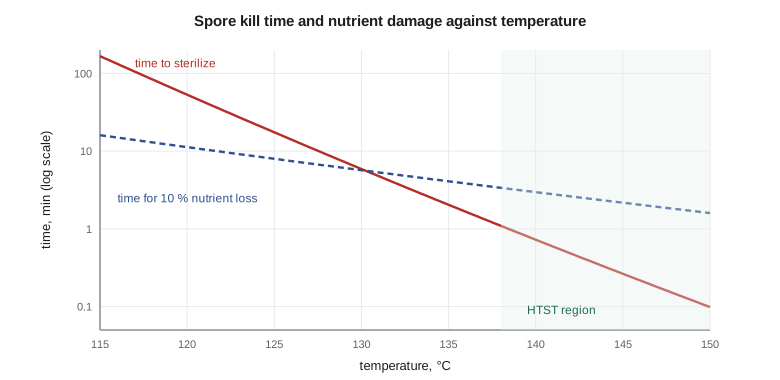
With the code's illustrative constants, the medium needs about 43 minutes at 121 °C but only about 44 seconds at 140 °C. Because the activation energy for spore death is much higher than that for destroying nutrients, high-temperature, short-time treatment kills spores while sparing the medium: the code shows a heat-sensitive vitamin retaining about 98 % in the continuous process against about 65 % in the batch. This is the principle behind continuous sterilizers, which heat the medium rapidly by steam injection or plate exchangers, hold it in a pipe for under a minute or two, and cool it quickly, often recovering heat by exchanging the hot sterile medium with the cold incoming medium. The holding tube must give every element of fluid enough time; because flow in a pipe has a velocity distribution, the design uses the fastest element, not the average, and turbulent flow is preferred because it narrows the distribution.
Worked problem
Holding time
A sterilizer must give \(\nabla = 32.6\). At 140 °C, \(k_d = 45\) min⁻¹. What holding time is needed?
Show solution
- \(t = \nabla/k_d = 32.6/45 = 0.72\) min.
- About 44 s; the tube is sized for the fastest-moving fluid.
Answer: About 44 seconds.
Sterilizing air, equipment and additions
Aerobic fermenters take in large volumes of air, which must be filtered. Depth filters of fibrous media and membrane cartridge filters with pore ratings around 0.2 µm remove microorganisms by interception and diffusion; the filters are themselves steam-sterilized and tested for integrity. Equipment is sterilized with steam at about 121 °C or above, with attention to dead legs, valves and instrument fittings where steam cannot reach and condensate collects. Feeds, nutrients and antifoams added during fermentation must be sterile too. Aseptic design avoids crevices, uses steam barriers on valves and keeps the vessel under slight positive pressure, so that leaks blow outward.
Contamination control in the ethanol plant
A dry-grind plant uses a different strategy. The jet cooker and liquefaction at about 85 °C reduce the bacteria in the mash greatly but do not sterilize it, and the mash is cooled through heat exchangers, transferred through long pipes and held in fermenters that are open to some ingress. The plant relies on a set of hurdles that together keep bacteria in check. The mash pH, around 4.5 to 5, favors yeast. A large, healthy yeast population pitched at high numbers takes the sugar before bacteria can. Ethanol, as it accumulates, inhibits bacteria too. And sanitation keeps the bacterial load low. Plants with problems almost always have a gap in one of these hurdles.
Sanitation is the most important. Every fermenter, the mash coolers, the propagation tank and the transfer lines are cleaned in place between uses: a rinse, a hot caustic wash to remove soil and biofilm, a rinse, sometimes an acid wash for scale, and a sanitizer such as chlorine dioxide or peracetic acid. Biofilms, layers of bacteria embedded in a slime they produce, grow in heat exchangers and dead legs and protect the bacteria from sanitizers; they are the usual source of chronic contamination. Rosa's laboratory takes swabs of exchanger plates and plates them on selective media to find where the bacteria live. Carla knows from experience that the mash coolers are the plant's weak point, and the plant now opens and cleans them on a fixed schedule.
Antimicrobials and the feed question
When sanitation and the other hurdles are not enough, plants add antimicrobials to the fermenters. For many years, antibiotics such as virginiamycin and penicillin were widely used at low doses. Because the residues can carry into distillers grains, which are fed to livestock, antibiotic use is now scrutinized by the FDA, which regulates animal feed ingredients, together with state feed laws and by feed buyers concerned about antibiotic resistance, and many plants market antibiotic-free grains. Alternatives include hop acids, extracts of the hop plant used in brewing that inhibit many gram-positive bacteria including lactobacilli; chlorine dioxide and other oxidizers added to mash; and stabilized forms of sodium chlorite. Kingfisher Bioenergy uses hop acids as its routine treatment and sanitation to prevent the need for more.
| Hurdle | How it helps | Plant practice |
|---|---|---|
| Heat in cook | Reduces bacteria in mash | Liquefaction at about 85 °C |
| Low pH | Favors yeast over bacteria | Mash at pH 4.5–5 |
| High pitch | Yeast takes sugar first | About 10⁷ cells/mL at fill |
| Ethanol | Inhibits bacteria as it rises | Fast early fermentation |
| Sanitation | Removes bacteria and biofilm | Clean-in-place every cycle |
| Antimicrobials | Kill or suppress bacteria | Hop acids; antibiotics avoided |
Biosafety in the laboratory
The organisms handled at Kingfisher Bioenergy are of low hazard: industrial yeast, the enzyme producers' strains in the products, and the lactic acid bacteria that are found in food. Rosa's laboratory nevertheless follows good microbiological practice, as described for low-risk organisms in Biosafety in Microbiological and Biomedical Laboratories (BMBL, sixth edition) published by the CDC and NIH: hand washing, no eating or drinking in the laboratory, disinfection of benches, safe handling of sharps, autoclaving of cultures before disposal, and training. The aim is to keep cultures pure and protect staff from the ordinary hazards of laboratory work, not to contain a dangerous organism. Theo notes that the plant's larger biological hazards are physical ones: carbon dioxide in fermenters and the confined-space entry rules that come with them.
Investigating an infection
In March, lactic acid at drop rises from 0.2 to 0.7 % in three fermenters in a row. Rosa and Theo follow the plant's investigation routine. They sample along the process: mash leaving liquefaction, mash leaving each cooler, the propagator and the fermenters at several hours after fill, and plate each sample on a medium selective for lactic acid bacteria. Liquefaction samples are nearly clean, as expected after the hot hold, but the mash leaving cooler 2 carries far more bacteria than that leaving cooler 1. When cooler 2 is opened, the plates in its cold end are coated with biofilm. The cooler is cleaned with hot caustic and an oxidizing sanitizer, the cleaning frequency is increased, and lactic acid returns to normal within a week. The episode cost about 1.5 % of the plant's output for a fortnight.
The investigation shows why plants watch trends rather than single results. One high lactic acid value might be a sampling error; three in a row in fermenters filled through the same equipment points to a source. Rosa's dashboard plots lactic and acetic acid for every fermenter with the cooler that filled it, so a pattern appears within a few days.
Theo's notes from the lesson end with a list he keeps on his desk: design sterilization on spores and the fastest fluid element; count the heat-up and cool-down; trust trends in lactic acid, not single results; look for biofilm in the cold end of exchangers and in dead legs; and prefer sanitation to chemicals. The last point is also the cheapest.
Common mistakes
MistakeDesigning sterilization for vegetative cells.
InsteadSpores are far more resistant; design on spore kill.
MistakeIgnoring heat-up and cool-down in batch sterilization.
InsteadThey contribute much of the Del factor and much of the medium damage.
MistakeSizing a holding tube on average velocity.
InsteadUse the fastest fluid element.
MistakeRelying on antimicrobials instead of sanitation.
InsteadBiofilms in exchangers and dead legs must be cleaned out.
Summary and key terms
- Heat kills microorganisms by first-order kinetics; spores set the design.
- The Del factor \(\ln(N_0/N)\) is the sterilization criterion; high activation energy makes HTST effective.
- Continuous sterilizers at about 140 °C for under a minute spare nutrients far better than batch.
- Ethanol plants control contamination with hurdles: heat, low pH, high pitch, ethanol, sanitation and antimicrobials.
- Lactic acid at drop measures lost yield; biofilms in mash coolers are a common source.
- Sterilization
- Destruction or removal of all viable microorganisms.
- Decimal reduction time
- Time for a tenfold reduction in viable numbers.
- Del factor
- The natural logarithm of the reduction in viable organisms.
- Spore
- A dormant, highly resistant form of some bacteria.
- Biofilm
- A layer of microorganisms embedded in a slime they produce.
- Clean-in-place
- Cleaning equipment by circulating solutions without dismantling it.
Practice problems
Work each problem on paper first, then reveal the answer to check.
A spore has \(D = 3\) min at 121 °C. What is \(k_d\)?
Show answer
\(2.303/3 = 0.77\) min⁻¹.
Why does HTST spare nutrients?
Show answer
Spore death has a higher activation energy than nutrient damage.
Lactic acid at drop is 0.6 %. Estimate ethanol lost.
Show answer
About 2.8 g/L, roughly 2 % of output.
Name three hurdles against contamination.
Show answer
Low pH, high yeast pitch, sanitation (also heat, ethanol, antimicrobials).
Why are antibiotics in ethanol fermentation scrutinized?
Show answer
Residues can reach livestock feed and raise resistance concerns.
Why are dead legs a problem?
Show answer
Steam and cleaning solutions do not reach them, and biofilms grow.
Lesson quiz · 5 questions
Score 60% or more to complete this lesson.
Create a free account to save your progress, take quizzes and earn a certificate.