
CHE-390 · Lesson 2 of 12 · 21 min
Cells, biomolecules and metabolism for engineers
Rosa begins Theo's training with a microscope rather than a flowsheet. Under it, a drop of fermenting mash shows thousands of oval yeast cells, each about 5 to 10 micrometers long, many with small buds where daughter cells are forming. Each cell is a chemical plant with its own feed preparation, reactors, energy supply and control system. An engineer does not need to be a biologist to design a fermenter, but she does need to know enough about cells to understand where the yields, rates and sensitivities in the design equations come from. This lesson covers that minimum.
Kinds of cells
Living cells come in two broad kinds. Prokaryotes, the bacteria and archaea, are small, typically 1 to 2 micrometers, with no nucleus and few internal compartments. They grow fast: some bacteria double in 20 to 30 minutes in good conditions. Eukaryotes, including yeasts, molds, plants and animals, are larger and have a nucleus and internal organelles such as mitochondria. The yeast used in fuel ethanol, Saccharomyces cerevisiae, is a single-celled eukaryotic fungus that doubles in about one and a half to two hours under good conditions. The same species raises bread and brews beer, and has a long record of safe use; its industrial strains are bred and selected for tolerance to ethanol, temperature and the harsh conditions of a corn mash.
The enzymes the plant buys are made by other industrial microorganisms. Thermostable alpha-amylases are produced by Bacillus species, and glucoamylases by fungi such as Aspergillus niger and Trichoderma reesei, grown in aerobic fermenters by enzyme companies. Lactic acid bacteria, especially Lactobacillus species, are the main contaminants in ethanol fermentation; they are harmless to people, and are used deliberately in making yogurt and sauerkraut, but they compete with yeast for sugar. All of these organisms are of low hazard, and industrial and laboratory work with them follows good microbiological practice.
| Organism | Type | Size | Role at Kingfisher Bioenergy |
|---|---|---|---|
| Saccharomyces cerevisiae | Yeast (eukaryote) | 5–10 µm | Ferments glucose to ethanol |
| Bacillus species | Bacteria | 1–3 µm long | Produce alpha-amylase (off site) |
| Aspergillus or Trichoderma | Filamentous fungi | Hyphae a few µm wide | Produce glucoamylase (off site) |
| Lactobacillus species | Bacteria | 1–5 µm long | Main contaminants; make lactic acid |
The molecules of life
Cells are mostly water, about 70 to 80 % by mass. The dry matter is made of four classes of large molecules. Proteins, about half the dry mass of yeast, are chains of amino acids folded into precise three-dimensional shapes; enzymes are proteins, and their shape is what makes them catalysts. Heat, extreme pH and some solvents unfold proteins, a process called denaturation, which destroys their activity. Nucleic acids, DNA and RNA, carry and express genetic information. Lipids form the cell membrane, a thin oily barrier whose fluidity is affected by temperature and by ethanol, which is one reason ethanol eventually stops yeast growth. Carbohydrates include the cell's energy stores and the starch and sugars it consumes.
Starch is a polymer of glucose. Amylose is a mostly linear chain linked by alpha-1,4 bonds; amylopectin is branched, with alpha-1,6 links at the branch points about every 20 to 25 glucose units. Corn starch is roughly three quarters amylopectin. Alpha-amylase cuts alpha-1,4 bonds at random inside the chains, making dextrins of a few to a few dozen glucose units. Glucoamylase removes glucose units one at a time from the ends of chains and can also cleave the alpha-1,6 branch bonds, more slowly. Together they turn starch into glucose. Each bond hydrolyzed adds a molecule of water, which is why a kilogram of starch gives about 1.11 kg of glucose.
Metabolism: how yeast makes ethanol
Metabolism is the network of enzyme-catalyzed reactions by which cells break down nutrients for energy and build new cell material. Breakdown pathways are catabolic; building pathways are anabolic. The cell's energy currency is adenosine triphosphate, ATP. Catabolic pathways make ATP; anabolic pathways and transport consume it. The cell's reducing power is carried by the cofactor NADH, which must be reoxidized for metabolism to continue.
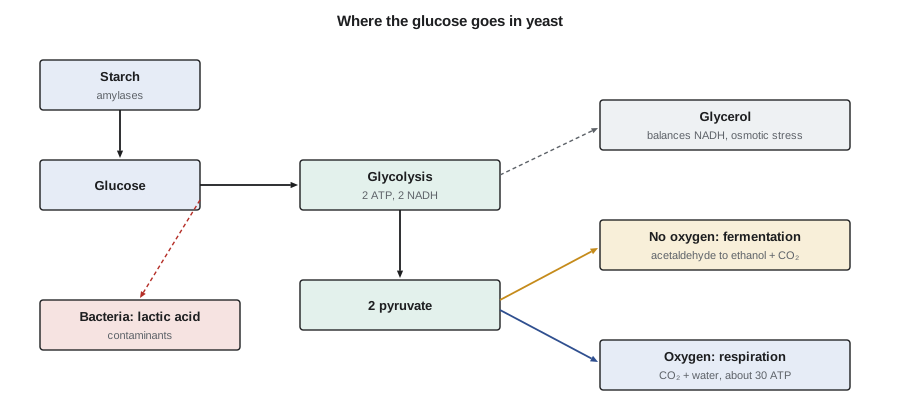
Yeast breaks glucose down by glycolysis, a sequence of ten enzyme reactions that converts one glucose to two pyruvate, with a net gain of two ATP and two NADH. What happens next depends on oxygen. With plenty of oxygen and low sugar, pyruvate enters the mitochondria and is oxidized completely to carbon dioxide in the citric acid cycle, and the NADH is reoxidized by oxygen in respiration, making many more ATP. Without oxygen, the cell reoxidizes NADH by reducing acetaldehyde, made from pyruvate, to ethanol. The overall fermentation is the Gay-Lussac equation:
S. cerevisiae has a further twist: at high sugar concentrations it ferments even when oxygen is present, an effect named after Crabtree. This is helpful in the fermenters, where sugar is high and oxygen is absent anyway, and a nuisance in the propagation tank, where the aim is to make cells. Lesson 8 shows how propagation is run to favor growth.
Yields and where the glucose goes
The Gay-Lussac equation sets the theoretical maximum: 0.511 g of ethanol and 0.489 g of carbon dioxide per gram of glucose. Real fermentations reach about 90 to 93 % of that, because some glucose is used for other purposes. The code accounts for the main uses.
# Where the glucose goes: theoretical and practical ethanol yields in yeast fermentation
M = {"glucose": 180.16, "ethanol": 46.07, "co2": 44.01, "glycerol": 92.09, "biomass": 24.6}  # biomass as CH1.8O0.5N0.2
print(f"Gay-Lussac maximum: {2*M['ethanol']/M['glucose']:.3f} g ethanol per g glucose")
# Practical partition of glucose carbon (illustrative, typical of corn-ethanol fermenters)
share = {"ethanol and CO2": 0.92, "glycerol": 0.045, "yeast biomass": 0.02, "organic acids and other": 0.015}
for k, v in share.items(): print(f"  {k:26s} {100*v:5.1f} % of glucose")
y = share["ethanol and CO2"] * 2 * M["ethanol"] / M["glucose"]
print(f"practical yield {y:.3f} g/g = {100*y/(2*M['ethanol']/M['glucose']):.0f} % of theoretical")
# Energy: free energy captured as ATP
dG_ferm = -235.0     # kJ per mol glucose to ethanol + CO2, approximate standard value
atp = 2; dG_atp = 30.5
print(f"ATP yield 2 per glucose captures {atp*dG_atp:.0f} kJ of {-dG_ferm:.0f} kJ ({100*atp*dG_atp/-dG_ferm:.0f} %)")
print(f"aerobic respiration: about 30 ATP per glucose, so biomass yield is far higher with oxygen")Gay-Lussac maximum: 0.511 g ethanol per g glucose ethanol and CO2 92.0 % of glucose glycerol 4.5 % of glucose yeast biomass 2.0 % of glucose organic acids and other 1.5 % of glucose practical yield 0.471 g/g = 92 % of theoretical ATP yield 2 per glucose captures 61 kJ of 235 kJ (26 %) aerobic respiration: about 30 ATP per glucose, so biomass yield is far higher with oxygen
Glycerol is the largest by-product. Yeast makes it to reoxidize the extra NADH produced when it builds new cell material, and to protect itself against high osmotic pressure, which a mash of 30 % solids certainly provides. Growth of new yeast itself takes a few percent of the glucose, and organic acids, higher alcohols and losses to contaminating bacteria take the rest. Raising the practical yield from 92 to 93 % is worth roughly 4 liters per metric ton of corn, which at Kingfisher Bioenergy's scale is about two million liters a year. Rosa's group spends much of its effort on exactly that kind of gain: yeast strains that make less glycerol, better enzyme dosing and tighter contamination control.
The free energy numbers explain why fermentation is so wasteful as an energy source for the cell and so useful to people. Fermenting a glucose molecule releases roughly 235 kJ per mole of free energy, of which only about a quarter is captured as two ATP. Respiration captures about 30 ATP per glucose. A yeast cell growing aerobically therefore makes far more new cells per gram of sugar, about 0.5 g per gram, than one fermenting, about 0.05 g per gram. Most of the energy in the glucose stays in the ethanol, which is exactly what a fuel plant wants.
Worked problem
Carbon dioxide from a fermenter
A fermenter converts 400 t of glucose to ethanol at 92 % of theoretical, with the rest going to other products. Estimate the ethanol and the carbon dioxide made by the main reaction.
Show solution
- Glucose to ethanol and CO₂: \(400 \times 0.92 = 368\) t.
- Ethanol: \(368 \times 0.511 = 188\) t; CO₂: \(368 \times 0.489 = 180\) t.
Answer: About 188 t of ethanol and 180 t of carbon dioxide.
What cells need to grow
Cells are made mostly of carbon, hydrogen, oxygen and nitrogen, with smaller amounts of phosphorus, sulfur, potassium, magnesium and trace metals. A common empirical formula for yeast dry mass is \(CH_{1.8}O_{0.5}N_{0.2}\), with about 5 to 10 % ash. The medium must supply all of these. In a corn mash, most come from the corn itself, but free amino nitrogen is often limiting early in fermentation, so plants add urea or ammonia as a nitrogen source, and some add protease enzymes that release amino acids from corn protein. Too little nitrogen slows yeast growth and stretches the fermentation; too much feeds contaminants.
Cells also need suitable physical conditions. Each organism has a temperature range: S. cerevisiae ferments best at about 30 to 35 °C and suffers above about 36 to 38 °C, especially as ethanol rises, so fermenter cooling matters. Each organism has a preferred pH: yeast tolerates mild acidity, around pH 4 to 5.5, better than most bacteria, and the low pH of mash is one of the plant's defenses against contamination. Water activity and osmotic pressure matter in concentrated mashes. And all cells are inhibited by their own products at high enough concentration; for yeast, ethanol is the main inhibitor.
The cell as a catalyst
For an engineer, a cell can be pictured as a catalyst particle that grows. It takes in substrate across its membrane, converts it inside through enzyme pathways whose rates depend on the conditions, excretes products and uses part of the substrate to make more catalyst. Its rates per unit mass of cells, called specific rates and written with the letter q, are the biological equivalent of turnover frequencies. Lesson 5 develops the equations that describe how fast the catalyst grows, and lesson 6 the balances that relate substrate consumed to cells and products made.
Regulation inside the cell
Cells do not run every pathway at full speed all the time. They switch genes on and off and adjust enzyme activities in response to their surroundings, so that the same organism behaves differently in different conditions. Glucose repression is the most important example for Theo: when glucose is plentiful, yeast turns down the genes for respiration and for using other sugars, and ferments glucose instead. When glucose runs low, the genes are turned back on, and the cells can switch to respiring the ethanol they made, a shift that brewers call the diauxic shift. In the propagation tank, where oxygen is supplied, this regulation decides whether sugar goes to new cells or to ethanol, and it is why propagation is run with glucose kept low.
Regulation also explains why cells take time to adapt. Yeast moved from a propagation tank rich in oxygen into a fermenter without it, or from a dilute medium into a concentrated mash, must adjust its enzyme content and membrane composition before it grows well. That adjustment is part of the lag phase described in lesson 5. Plants shorten it by keeping propagation conditions close to fermenter conditions near the end of propagation, for example by matching temperature and adding some mash, so the yeast arrives ready to work.
Theo finds it useful to think of metabolism as a set of parallel reactors with shared utilities. Glycolysis is the main reactor; the fermentation, glycerol and respiration branches are product trains; ATP and NADH are the utilities that must balance across the whole plant. Any change that disturbs the utility balance, such as a shortage of nitrogen for building protein or a high osmotic pressure that demands glycerol, shifts carbon from one product train to another. Yield losses are rarely mysterious once the balance is written down, which is the subject of lesson 6.
Common mistakes
MistakeThinking glycerol and other by-products are negligible.
InsteadThey take several percent of the glucose and are a main target for yield improvement.
MistakeTreating yeast and bacteria as interchangeable.
InsteadThey differ in size, growth rate, pH and temperature tolerance and products.
MistakeAssuming oxygen always gives more ethanol.
InsteadOxygen favors respiration and growth; ethanol is made by fermentation.
MistakeForgetting that heat and pH can destroy enzymes.
InsteadProteins denature outside their stable range.
Summary and key terms
- Yeast is a eukaryote that doubles in about two hours; bacteria are smaller and can grow faster.
- Starch is hydrolyzed to glucose by alpha-amylase and glucoamylase, adding water.
- Glycolysis gives two ATP per glucose; without oxygen, yeast reoxidizes NADH by making ethanol.
- Practical yields are about 92 % of the 0.511 g/g maximum; glycerol is the main by-product.
- Cells need carbon, nitrogen, minerals and suitable temperature and pH, and are inhibited by their products.
- Prokaryote
- A cell without a nucleus, such as a bacterium.
- Eukaryote
- A cell with a nucleus and organelles, such as yeast.
- Glycolysis
- The pathway that converts glucose to pyruvate with a net gain of two ATP.
- ATP
- Adenosine triphosphate, the cell's energy carrier.
- Crabtree effect
- Fermentation by yeast at high sugar even when oxygen is present.
- Denaturation
- Loss of a protein's folded shape and activity.
Practice problems
Work each problem on paper first, then reveal the answer to check.
How many grams of glucose are needed for 100 g of ethanol at 92 % of theoretical?
Show answer
\(100/(0.511 \times 0.92) = 213\) g.
Why does yeast make glycerol?
Show answer
To reoxidize surplus NADH from biosynthesis and to protect against osmotic stress.
Why is aerobic growth yield about ten times anaerobic?
Show answer
Respiration makes about 30 ATP per glucose against 2 for fermentation.
What fraction of corn starch is amylopectin?
Show answer
About three quarters.
Why do plants add urea to mash?
Show answer
To supply nitrogen for yeast growth early in fermentation.
Why is mild acidity useful in mash?
Show answer
Yeast tolerates it better than most bacteria.
Lesson quiz · 5 questions
Score 60% or more to complete this lesson.
Create a free account to save your progress, take quizzes and earn a certificate.