
CHE-390 · Lesson 8 of 12 · 21 min
Bioreactor design and oxygen transfer
The fermenters at Kingfisher Bioenergy are anaerobic: once filled, they need no air, and the carbon dioxide the yeast makes keeps them mixed and blanketed. The yeast propagation tank is different. Its job is to grow as many healthy cells as possible, and cells grow ten times more per gram of sugar with oxygen than without. The new propagator for the expansion must deliver enough oxygen to keep the yeast respiring as it multiplies. Oxygen transfer is the central design problem of aerobic bioreactors everywhere, from enzyme fermenters to wastewater aeration basins, and it is the subject of this lesson.
Kinds of bioreactor
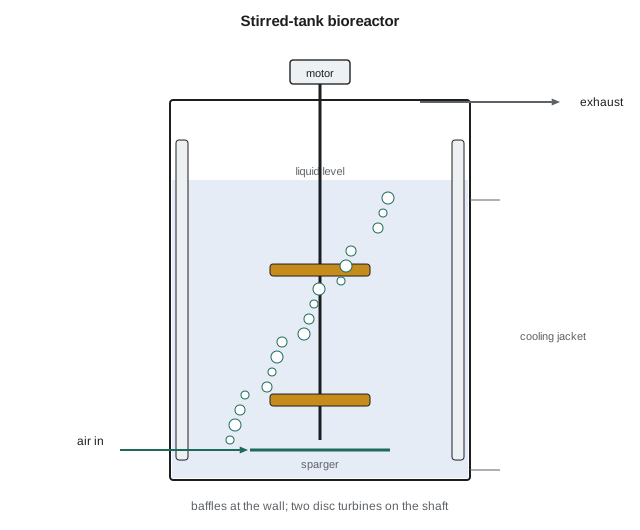
The stirred tank is the workhorse of industrial fermentation: a cylindrical vessel, usually with a height-to-diameter ratio of about 1 to 3, with one or more impellers on a central shaft, baffles at the wall to prevent swirling, a sparger ring below the bottom impeller to introduce air, and jackets or internal coils for cooling. Bubble columns and airlift reactors use the rising gas itself for mixing, with no moving parts; they suit shear-sensitive cells and very large volumes, and are used for some yeast and single-cell protein production. Packed beds hold immobilized enzymes or cells, as in lesson 4. Large anaerobic ethanol fermenters are usually tanks mixed by external pump loops or side-entering agitators, relying on the carbon dioxide they make for much of their mixing.
Why oxygen is hard to supply
Oxygen is poorly soluble in water. At 30 °C and atmospheric pressure, water in equilibrium with air holds only about 7.5 mg/L of oxygen, and fermentation broth slightly less. A yeast culture of 10 g/L growing at 0.25 h⁻¹ consumes several grams of oxygen per liter per hour. The dissolved oxygen in the broth would therefore be used up in seconds if it were not continuously replaced from the gas bubbles. The rate of transfer, not the amount in solution, is what matters.
Oxygen moves from the gas to the cells through a series of resistances: through the gas film inside the bubble, across the interface, through the liquid film around the bubble, through the bulk liquid, and into the cell. For sparingly soluble gases, the liquid film around the bubble is the largest resistance by far. The oxygen transfer rate per unit volume, OTR, is written as
where \(k_L\) is the liquid-film mass transfer coefficient, \(a\) the bubble surface area per unit liquid volume, \(C^*\) the dissolved oxygen concentration in equilibrium with the gas, and \(C_L\) the actual dissolved oxygen. Because \(k_L\) and \(a\) are hard to measure separately, they are lumped as the volumetric mass transfer coefficient, \(k_La\), in reciprocal hours or seconds. This is the same film model Theo used for gas absorption in CHE-314, applied to a bubble instead of a packed column.
Oxygen uptake
The cells' oxygen uptake rate, OUR, is the specific oxygen uptake rate times the cell concentration, \(OUR = q_{O_2} X\). At steady conditions the dissolved oxygen settles where transfer equals uptake. Yeast respire normally as long as dissolved oxygen stays above a critical concentration, typically around 5 to 20 % of air saturation; below it, uptake falls and fermentation begins. Design aims to keep \(C_L\) comfortably above that critical value at the highest expected uptake. In lesson 6 Theo found that aerobic yeast growth needs about 2.2 mol of oxygen per mole of glucose, or roughly one gram of oxygen per gram of cells made; with that yield and the growth rate, the uptake follows directly.
Estimating kLa
\(k_La\) depends on the power put into the liquid, the gas flow, the broth properties and the vessel geometry. For stirred tanks, correlations of the form
are widely used, where \(P_g/V\) is the gassed power per unit volume and \(v_s\) the superficial gas velocity, the gas flow divided by the tank cross-section. For coalescing liquids such as water, van 't Riet's correlation has \(K\) of about 0.026, \(\alpha = 0.4\) and \(\beta = 0.5\) in SI units with \(k_La\) in reciprocal seconds. Fermentation broths differ from water, and salts, antifoams and cells change bubble coalescence, so correlations give estimates within a factor of about two, and measured values are used when available. Power comes from the impellers, \(P = N_p \rho N^3 D^5\), where \(N_p\) is the power number, about 5 for a Rushton disc turbine in the turbulent regime; gassing reduces the power drawn, often to about half, because gas cavities form behind the blades.
import math
# Oxygen transfer in the aerobic yeast propagation tank (illustrative design)
V = 150.0                 # m3 working volume
T_tank = 5.0; H = 7.6     # diameter and liquid height, m
D_imp = T_tank/3; Np = 5.0; rho = 1040.0; N = 1.25   # impellers: 2 Rushton turbines, rev/s
P = 2*Np*rho*N**3*D_imp**5   # ungassed power, W (two impellers)
Pg = 0.5*P                   # gassed power, about half (rule of thumb)
Q = 0.5*V/60                 # air 0.5 vvm, m3/s
vs = Q/(math.pi*T_tank**2/4)
kla = 0.026*(Pg/V)**0.4*vs**0.5   # van't Riet, coalescing broth, 1/s
Cstar = 7.0e-3*1.2   # kg/m3 saturation at the mid-depth pressure, about 7 mg/L at 1 atm in broth
OTRmax = kla*3600*Cstar*1000     # g O2/m3/h with C = 0
print(f"ungassed power {P/1000:.0f} kW, gassed {Pg/1000:.0f} kW, {Pg/V:.0f} W/m3")
print(f"superficial gas velocity {vs*100:.2f} cm/s, kLa {kla*3600:.0f} 1/h")
print(f"maximum OTR {OTRmax:.0f} g/m3/h = {OTRmax/32:.0f} mmol/L/h")
# Oxygen uptake: q_O2 for aerobic yeast growth
mu = 0.25; Yxo = 1.0     # g cells per g O2 (illustrative for respiratory growth)
for X in (2, 5, 10, 20):
    OUR = mu*X/Yxo*1000/32   # mmol/L/h
    ok = "OK" if OUR < 0.8*OTRmax/32 else "oxygen-limited"
print(f"cells {X:2d} g/L: OUR {OUR:5.1f} mmol/L/h -> {ok}")ungassed power 261 kW, gassed 131 kW, 871 W/m3 superficial gas velocity 6.37 cm/s, kLa 354 1/h maximum OTR 2975 g/m3/h = 93 mmol/L/h cells 2 g/L: OUR 15.6 mmol/L/h -> OK cells 5 g/L: OUR 39.1 mmol/L/h -> OK cells 10 g/L: OUR 78.1 mmol/L/h -> oxygen-limited cells 20 g/L: OUR 156.2 mmol/L/h -> oxygen-limited
For the proposed 150 m³ propagator with two Rushton turbines at 75 rpm and air at 0.5 vvm, volumes of air per volume of liquid per minute, the code estimates a gassed power of about 130 kW, a \(k_La\) of about 350 h⁻¹ and a maximum transfer rate of about 90 mmol of oxygen per liter per hour. That is enough for yeast up to about 8 to 9 g/L growing at 0.25 h⁻¹; beyond that the culture becomes oxygen-limited and starts to ferment. Theo concludes that either the target cell concentration must be held below about 9 g/L, the growth rate slowed by limiting the sugar feed, or the oxygen supply raised by more power, more air, back-pressure on the vessel, or oxygen enrichment.
Worked problem
Oxygen balance at steady dissolved oxygen
A culture has \(k_La = 300\) h⁻¹ and \(C^* = 7.0\) mg/L. Its uptake is 1.5 g/L/h. What dissolved oxygen results?
Show solution
- Uptake 1,500 mg/L/h = \(300 \times (7.0 - C_L)\).
- \(7.0 - C_L = 5.0\); \(C_L = 2.0\) mg/L, about 29 % of saturation.
Answer: About 2.0 mg/L, above the critical level for yeast.
Ways to raise oxygen transfer
Each lever has a cost. More agitator power raises \(k_La\) with diminishing returns, as the 0.4 exponent shows, and heats the broth. More air raises \(v_s\) but eventually floods the impeller, when gas overwhelms the blades and power drops. Running the vessel at a modest gauge pressure raises \(C^*\) in proportion to the oxygen partial pressure, and many large fermenters run at 0.5 to 1 bar gauge for that reason, at the cost of a stronger vessel and compressor. Oxygen-enriched air raises \(C^*\) directly, and is used for high-demand fermentations, but brings its own hazards: oxygen-enriched atmospheres make ordinary materials burn far more readily, as Theo learned in CHE-380. The cheapest lever is often the process itself: controlling the sugar feed so the cells grow only as fast as the oxygen supply allows.
Tall vessels help in two ways. The hydrostatic pressure at the bottom raises \(C^*\) where the bubbles enter, and the bubbles' longer path gives more time for transfer. The mean of the top and bottom partial pressures, or their log mean, is used for \(C^*\) in design, and the code includes a factor for it.
Measuring kLa
\(k_La\) is measured in the vessel itself. In the dynamic method, the air is turned off so the cells consume the dissolved oxygen, then turned back on, and the rise in dissolved oxygen is recorded; the slope of the oxygen balance gives both the uptake rate and \(k_La\). In the gassing-out method, used before inoculation, the liquid is first stripped of oxygen with nitrogen and then aerated. In operating plants, the off-gas method is the most reliable: the oxygen and carbon dioxide in the exhaust gas are measured by an analyzer, and a gas balance gives the oxygen uptake rate directly, from which \(k_La\) follows if the dissolved oxygen is known. The same off-gas data give the respiratory quotient, which tells the operators whether the yeast is respiring or fermenting.
Heat and foam
Aerobic growth releases about 460 kJ per mole of oxygen consumed. At the propagator's maximum uptake, that is about 1.8 MW of heat in 150 m³, plus the agitator power, and the cooling jacket or an external heat exchanger must remove it at a broth temperature only a few degrees above the cooling water. Heat removal, not oxygen transfer, limits many large aerobic fermenters. Aerated broths also foam, as proteins stabilize the bubbles; foam that reaches the exhaust can carry broth out, wet the exhaust filter and bring in contaminants. Mechanical foam breakers and controlled antifoam addition are standard, but antifoams lower \(k_La\) and must be used sparingly.
Why propagate at all
Some plants skip propagation and pitch active dry yeast directly into the fermenters. Dry yeast is convenient and consistent, but buying enough to pitch every fermenter at full strength is expensive. Propagation multiplies a smaller amount of dry yeast thirty-fold or more in about half a day, using mash the plant already has, and delivers yeast that is actively growing and adapted to the plant's conditions, which shortens the fermenter lag. The cost is a tank, an air blower and careful operation, since a propagator is the most contamination-sensitive vessel in the plant: it is warm, aerated, rich in sugar and nitrogen, and a bacterial infection there is pitched straight into a fermenter. Kingfisher Bioenergy cleans and sanitizes its propagators every cycle and checks every batch under the microscope before transfer.
The propagation medium is diluted mash, usually with extra nitrogen and some glucoamylase so that sugar is released steadily, and its temperature is held near 32 °C. Air is supplied through a sparger from a dedicated blower with an inlet filter. Theo learns that the propagator's dissolved oxygen is rarely high: most plants run their propagators oxygen-limited near the end, accepting some fermentation, because the cost of more oxygen transfer outweighs the gain in cells. His design keeps the limitation in check by controlling the sugar feed.
Air compression is the propagator's main energy use. Supplying 0.5 vvm to 150 m³ is about 75 m³ of air a minute, compressed to overcome the liquid head of 7.6 m plus pipe and sparger losses, roughly 1 bar gauge. Blower power for this is a few tens of kilowatts, less than the agitator but not trivial. Doubling the air rate would raise \(k_La\) by only about 40 % at the 0.5 exponent, while doubling the blower power, so Theo looks first at feed control.
Theo records his propagator design numbers in a table for the design basis: working volume 150 m³, liquid height 7.6 m, diameter 5.0 m, two Rushton turbines of 1.67 m at 75 rpm, air at 0.5 vvm, gassed power about 130 kW, estimated \(k_La\) about 350 h⁻¹ and maximum oxygen transfer about 90 mmol/L/h. Beside each he notes whether it was calculated, taken from a vendor or measured, so that the reviewers know which numbers to question first.
Common mistakes
MistakeDesigning an aerobic fermenter on dissolved oxygen solubility alone.
InsteadThe transfer rate matters; the dissolved amount is used in seconds.
MistakeUsing ungassed power in a kLa correlation.
InsteadGassing reduces power, often by about half.
MistakeRaising air flow without limit.
InsteadImpellers flood and power falls; there is an optimum.
MistakeUsing oxygen enrichment without reviewing fire hazards.
InsteadEnriched oxygen makes materials burn far more easily.
Summary and key terms
- Oxygen is poorly soluble, so aerobic fermenters must transfer it continuously at a high rate.
- OTR \(= k_La(C^* - C_L)\); the liquid film around bubbles is the main resistance.
- \(k_La\) rises with gassed power and gas velocity; correlations give estimates within about a factor of two.
- The proposed propagator supplies about 90 mmol/L/h, enough for yeast up to about 8 to 9 g/L at 0.25 h⁻¹.
- Heat removal and foam often limit large aerobic fermenters.
- Stirred tank
- A bioreactor mixed by impellers, with baffles, sparger and cooling.
- kLa
- Volumetric oxygen mass transfer coefficient.
- OTR
- Oxygen transfer rate per unit volume.
- OUR
- Oxygen uptake rate of the cells per unit volume.
- vvm
- Volume of gas per volume of liquid per minute.
- Critical oxygen concentration
- Dissolved oxygen below which respiration slows.
Practice problems
Work each problem on paper first, then reveal the answer to check.
A culture uses 2 g/L/h of oxygen with \(C^* = 7\) mg/L and \(C_L = 2\) mg/L. What \(k_La\) is needed?
Show answer
\(2{,}000/5 = 400\) h⁻¹.
Why does vessel back-pressure raise oxygen transfer?
Show answer
It raises the oxygen partial pressure and \(C^*\).
What is impeller flooding?
Show answer
Gas overwhelms the impeller, which stops dispersing it and draws less power.
Estimate the heat from 100 mmol/L/h of oxygen uptake in 150 m³.
Show answer
\(0.1 \times 150{,}000 \times 460/3600 \approx 1.9\) MW.
How does off-gas analysis give the uptake rate?
Show answer
By an oxygen balance between inlet air and exhaust.
Why do antifoams need care?
Show answer
They lower \(k_La\).
Lesson quiz · 5 questions
Score 60% or more to complete this lesson.
Create a free account to save your progress, take quizzes and earn a certificate.