
CHE-390 · Lesson 6 of 12 · 23 min
Stoichiometry of growth and product formation
A chemical engineer would not design a reactor without a balanced equation. For a fermentation, the equation is harder to write, because the cells themselves are a product of uncertain formula, several by-products are made at once and the proportions change with conditions. Yet the elements must still balance. Ingrid asks Theo to write the overall equation for the plant's fermentation from first principles and to check it against what the laboratory measures. The same method will give the oxygen demand of the aerobic propagation tank in lesson 8.
A formula for cells
Elemental analysis of dried yeast gives roughly 47 % carbon, 6.5 % hydrogen, 31 % oxygen and 7.5 % nitrogen by mass, with phosphorus, sulfur and minerals making up the ash. Dividing by atomic masses and normalizing to one carbon gives a formula of about \(CH_{1.8}O_{0.5}N_{0.2}\), with a mass of about 24.6 g per carbon-mole, or C-mol, of cells, close to the formulas reported for many microorganisms. Working in C-mol, one carbon atom's worth of each compound, is convenient because the carbon balance then reads directly as fractions of substrate carbon. Glucose is \(CH_2O\) per C-mol, 30.0 g; ethanol is \(CH_3O_{0.5}\), 23.0 g per C-mol.
The overall equation
For anaerobic growth of yeast on glucose with ammonia as the nitrogen source, making ethanol, carbon dioxide and glycerol, the equation per mole of glucose is
There are six unknowns and four element balances, carbon, hydrogen, oxygen and nitrogen. Two more pieces of information are needed. Theo takes them from measurements: the biomass yield, 0.05 g of cells per gram of glucose, and the glycerol yield, 4.5 % of the glucose. With \(b\) and \(e\) fixed, the nitrogen balance gives \(a\), and the remaining balances give \(c\), \(d\) and \(f\).
Degree of reduction
A tidy way to solve such balances uses the degree of reduction, \(\gamma\), the number of electrons available for transfer to oxygen per C-mol of a compound. It is calculated with valences of 4 for carbon, 1 for hydrogen, −2 for oxygen and −3 for nitrogen when ammonia is the nitrogen source. Carbon dioxide, water and ammonia have \(\gamma = 0\). Glucose has 4, ethanol 6, glycerol 4.67 and biomass about 4.2. An electron balance, which combines the hydrogen and oxygen balances, then says that the electrons in the substrate must appear in the reduced products:
with all yields per C-mol of substrate and the last term for oxygen consumed in aerobic processes. For an anaerobic fermentation, the oxygen term is zero, so the substrate's electrons are shared among cells, ethanol and glycerol. This is why yeast cannot make cells without also making a reduced by-product such as glycerol when it has no oxygen: the electron balance must close.
# Elemental balances for anaerobic yeast growth on glucose with ethanol and glycerol as products
# C6H12O6 + a NH3 -> b CH1.8O0.5N0.2 + c C2H6O + d CO2 + e C3H8O3 + f H2O  (per mol glucose)
b = 0.05 * 180.16 / 24.6       # biomass from Yxs = 0.05 g/g
e = 0.045 * 180.16 / 92.09     # glycerol from 4.5 % of glucose
a = 0.2 * b                    # nitrogen balance
# carbon: 6 = b + 2c + d + 3e ; degree of reduction: 24 = 4.2 b + 12 c + 14 e  (CO2, H2O, NH3 = 0)
c = (24 - 4.2*b - 14*e) / 12
d = 6 - b - 2*c - 3*e
# hydrogen: 12 + 3a = 1.8 b + 6 c + 8 e + 2 f
f = (12 + 3*a - 1.8*b - 6*c - 8*e) / 2
oxy = 6 - (0.5*b + c + 2*d + 3*e + f)
print(f"a {a:.3f} NH3, b {b:.3f} cells, c {c:.3f} ethanol, d {d:.3f} CO2, e {e:.3f} glycerol, f {f:.3f} water")
print(f"oxygen balance residual {oxy:+.4f}")
print(f"ethanol yield {c*46.07/180.16:.3f} g/g, {100*c/2:.1f} % of the 2 mol theoretical")
# Aerobic yeast propagation: oxygen demand from degrees of reduction
Yxs_aer = 0.50; gs, gx = 4.0, 4.2  # per C-mol
yx_cmol = Yxs_aer * 30.03 / 24.6   # C-mol cells per C-mol glucose (glucose 30.03 g per C-mol)
o2 = (gs - yx_cmol*gx) / 4         # mol O2 per C-mol glucose
print(f"aerobic: {yx_cmol:.2f} C-mol cells per C-mol glucose, oxygen {o2:.3f} mol per C-mol glucose, {o2*6:.2f} mol per mol")
# Luedeking-Piret: product formation q_p = alpha mu + beta
alpha, beta = 4.5, 0.10   # g ethanol/g cells, g ethanol/g cells/h (illustrative)
for mu in (0.30, 0.10, 0.02, 0.0):
print(f"mu {mu:4.2f} 1/h -> q_ethanol {alpha*mu+beta:5.2f} g/g/h")a 0.073 NH3, b 0.366 cells, c 1.769 ethanol, d 1.831 CO2, e 0.088 glycerol, f 0.121 water oxygen balance residual +0.0000 ethanol yield 0.452 g/g, 88.5 % of the 2 mol theoretical aerobic: 0.61 C-mol cells per C-mol glucose, oxygen 0.359 mol per C-mol glucose, 2.15 mol per mol mu 0.30 1/h -> q_ethanol 1.45 g/g/h mu 0.10 1/h -> q_ethanol 0.55 g/g/h mu 0.02 1/h -> q_ethanol 0.19 g/g/h mu 0.00 1/h -> q_ethanol 0.10 g/g/h
The balances close exactly. Per mole of glucose, the yeast makes about 1.77 mol of ethanol, 1.83 mol of carbon dioxide, 0.37 C-mol of cells and 0.09 mol of glycerol, taking up 0.07 mol of ammonia. The ethanol yield, 0.452 g/g, is about 88 % of theoretical. That is a little below the plant's 92 %, and Theo traces the difference to the inputs: the laboratory's biomass yield of 0.05 g/g came from a small fermentation with more growth than a plant fermenter, where cells are pitched in large numbers and grow less. With a biomass yield of 0.02 g/g, the balance gives about 91 % of theoretical, close to the plant. The balance has done its job: it shows that every gram of cells and glycerol has a price in ethanol.
Worked problem
Carbon fractions
Using the balance above, what fraction of the glucose carbon ends in ethanol, carbon dioxide, cells and glycerol?
Show solution
- Ethanol: \(2 \times 1.77 = 3.54\) of 6 C, 59 %; CO₂: \(1.83/6 = 31\) %.
- Cells: \(0.37/6 = 6\) %; glycerol: \(3 \times 0.088/6 = 4\) %.
Answer: About 59, 31, 6 and 4 %, summing to 100 %.
Aerobic growth and oxygen demand
In the propagation tank, yeast grows aerobically with a yield of about 0.5 g of cells per gram of glucose and little ethanol. The electron balance gives the oxygen needed. With \(\gamma_S = 4\) for glucose, \(\gamma_X = 4.2\) for cells, and a cell yield of 0.61 C-mol per C-mol of glucose, the oxygen consumed is \((4 - 0.61 \times 4.2)/4 = 0.36\) mol per C-mol of glucose, or about 2.2 mol of oxygen per mole of glucose. That number sets the oxygen transfer the propagator must deliver, and it is the starting point for the aeration design in lesson 8. The respiratory quotient, the moles of carbon dioxide produced per mole of oxygen consumed, is close to 1 for aerobic growth on glucose and rises well above 1 when the yeast starts to ferment. Measuring it in the off-gas tells the operators whether the yeast is respiring or fermenting.
Worked problem
Oxygen for propagation
A propagation consumes 1,500 kg of glucose at an aerobic yield of 0.5 g/g. Estimate the oxygen needed.
Show solution
- Glucose: \(1{,}500/180 = 8.33\) kmol.
- Oxygen: \(8.33 \times 2.15 = 17.9\) kmol, or about 570 kg.
Answer: About 570 kg of oxygen, delivered as roughly 2,700 kg of air at 21 % oxygen if all of it were absorbed; in practice several times more air is supplied.
Growth-associated and non-growth-associated products
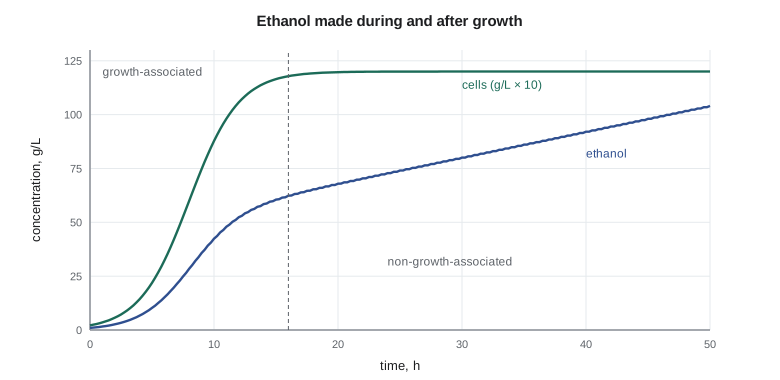
Products can be made in step with growth, independently of it, or both. Ethanol is the clearest example of a mixed case: growing yeast make ethanol as their energy pathway, and non-growing yeast keep making it for maintenance. The Luedeking-Piret model writes the specific product formation rate as
where \(\alpha\) is the growth-associated coefficient and \(\beta\) the non-growth-associated rate. For many secondary metabolites, such as antibiotics, \(\alpha\) is near zero and products appear only after growth slows. For ethanol, both terms matter. The code shows that with illustrative constants, yeast growing at 0.3 h⁻¹ make ethanol at about 1.45 g per gram of cells per hour, while non-growing yeast still make 0.1 g/g/h. In a fermenter with 10 g/L of cells, that non-growth rate alone makes a gram of ethanol per liter per hour, which over the last day of fermentation is a large share of the total.
Yield coefficients in practice
Yield coefficients are not constants of nature. The biomass yield falls when maintenance is a larger share of substrate use, at low growth rates or under stress. It is related to the true yield, \(Y_{X/S}^{max}\), the yield with no maintenance, by
so a plot of \(1/Y_{X/S}\) against \(1/\mu\) from continuous culture data gives both the true yield and the maintenance coefficient. Plants rarely need such detail, but they do need to know that yields shift with conditions, and to measure them on the plant's own mash and yeast. Rosa's laboratory measures ethanol, glycerol, residual sugars and organic acids in every fermenter at drop by liquid chromatography, and Theo builds a monthly carbon balance from those results and the plant's corn and ethanol meters. When the balance does not close, it usually means a meter is wrong, and occasionally that ethanol is being lost somewhere it should not be.
Ingrid shows Theo the balance's most useful single number: the fermentation efficiency, ethanol made as a percentage of the theoretical maximum from the starch fed. It summarizes enzyme, yeast and contamination performance in one figure. Over the last year it has ranged from 90.5 to 92.8 %. The low months match periods of bacterial contamination and of a hot spell in summer; the high months follow a change of yeast strain. A one-point improvement is worth about two million liters of ethanol a year.
Heat of fermentation
The elemental balance also gives the energy balance. Fermenting glucose to ethanol and carbon dioxide is exothermic, releasing roughly 500 to 600 kJ per kilogram of glucose fermented when products are in their normal states, and aerobic growth releases far more, around 15 MJ per kilogram of oxygen consumed. A plant fermenter consuming several metric tons of glucose an hour must therefore remove megawatts of heat to stay at 32 °C. Lesson 10 sizes the coolers. The rule of about 460 kJ of heat per mole of oxygen consumed, which holds for many aerobic processes, lets engineers estimate the cooling load of an aerobic fermenter directly from its oxygen uptake.
Checking measurements with balances
Element balances are also a powerful check on data. If the carbon in the measured products adds up to only 95 % of the carbon in the glucose consumed, either a product is missing from the analysis or a measurement is wrong. In Rosa's laboratory, the commonest culprits are carbon dioxide, which is not measured in the small fermenters but calculated, ethanol lost by evaporation from open flasks, and organic acids that the chromatography method does not separate well. Theo builds a spreadsheet that closes carbon and electron balances for every laboratory fermentation and flags any that miss by more than 3 %. Within a month it has found a miscalibrated ethanol standard and a balance that was weighing flasks without their caps. Both problems would have biased the plant's yield estimates without anyone noticing.
In the plant, the same idea appears at a larger scale. The ethanol made in a fermenter can be estimated three independent ways: from the beer volume and the laboratory ethanol concentration, from the carbon dioxide vented through the scrubber, and from the sugar consumed. When the three estimates agree within a few percent, the plant can trust its yield numbers; when they diverge, one of the meters or samples is at fault.
Theo keeps one rule from this lesson for the rest of the course: before trusting any fermentation result, check that the carbon closes. A balance that closes does not prove the numbers are right, but one that does not close proves that something is wrong, and that is often the quickest way to find a faulty meter, a missing product or a mistaken assumption about the cells.
Common mistakes
MistakeWriting a fermentation equation without cells or by-products.
InsteadInclude biomass and glycerol; their yields set the ethanol yield.
MistakeUsing mass yields when balancing elements.
InsteadConvert to moles or C-mol first.
MistakeTaking laboratory biomass yields for the plant.
InsteadPlant fermenters grow fewer cells per gram of sugar; measure yields at scale.
MistakeIgnoring heat release.
InsteadFermentation releases enough heat to need large coolers.
Summary and key terms
- Yeast dry mass is about \(CH_{1.8}O_{0.5}N_{0.2}\), 24.6 g per C-mol.
- Element balances plus two measured yields fix the overall fermentation equation.
- The degree of reduction balance shows why glycerol accompanies anaerobic growth and gives oxygen demand for aerobic growth.
- Aerobic yeast growth needs about 2.2 mol of oxygen per mole of glucose.
- Luedeking-Piret kinetics capture ethanol made during and after growth.
- C-mol
- The amount of a compound containing one mole of carbon atoms.
- Degree of reduction
- Electrons available per C-mol for transfer to oxygen.
- Respiratory quotient
- Moles of CO₂ produced per mole of O₂ consumed.
- Fermentation efficiency
- Ethanol made as a percentage of the theoretical maximum.
- Growth-associated product
- A product made in proportion to growth.
- True yield
- Biomass yield with maintenance excluded.
Practice problems
Work each problem on paper first, then reveal the answer to check.
What is the degree of reduction of ethanol per C-mol?
Show answer
\((2 \times 4 + 6 - 2)/2 = 6\).
Why must anaerobic yeast make glycerol?
Show answer
To close the electron balance when cells are made.
What does a respiratory quotient of 1.8 in the propagator suggest?
Show answer
The yeast is fermenting as well as respiring.
If \(\beta = 0.1\) g/g/h and cells are 12 g/L, how much ethanol do non-growing cells make in 24 h?
Show answer
\(0.1 \times 12 \times 24 = 29\) g/L.
How is the true yield found?
Show answer
From a plot of \(1/Y\) against \(1/\mu\) in continuous culture.
What does a one-point rise in fermentation efficiency mean at Kingfisher Bioenergy?
Show answer
About two million liters more ethanol a year.
Lesson quiz · 5 questions
Score 60% or more to complete this lesson.
Create a free account to save your progress, take quizzes and earn a certificate.