
CHE-390 · Lesson 4 of 12 · 23 min
Enzyme technology: liquefaction, saccharification and immobilization
Lesson 3 described how fast an enzyme works. This lesson is about using enzymes in a plant: how they are made and sold, how they behave at the temperatures of cooking and fermentation, how long they last, and how they can be fixed to solids and reused. The examples are the two enzymes that turn corn starch into glucose at Kingfisher Bioenergy, and an immobilized enzyme process that Theo meets on a site visit to a corn wet mill.
Industrial enzymes
Most industrial enzymes are made by aerobic fermentation of selected strains of bacteria and fungi, which secrete the enzyme into the broth. After fermentation, the cells are removed by filtration or centrifugation, the enzyme is concentrated by ultrafiltration, and the product is formulated with stabilizers such as glycerol or sorbitol and preservatives, then sold as a liquid in totes or bulk tanks. The enzyme company's process is a complete bioprocess in its own right, with the oxygen transfer and recovery problems covered in lessons 8 and 11. Enzyme suppliers continually improve their products by screening natural enzymes and by protein engineering, so an ethanol plant reviews its enzyme choices every year or two.
Starch processing uses enzymes in large volumes. A dry-grind plant uses an alpha-amylase for liquefaction, a glucoamylase for saccharification, and often a protease to free amino nitrogen, a phytase to release phosphate and reduce phytate in the feed, and cellulases or other carbohydrases to release a little more sugar from fiber. Corn wet mills use similar enzymes to make glucose syrup and then glucose isomerase to make high fructose syrup. Enzymes in detergents, baking, textiles and feed make up the rest of a large global market.
Liquefaction
Raw corn starch is packed in granules that enzymes attack only slowly. Heating a starch slurry above about 65 to 75 °C makes the granules swell and burst, a change called gelatinization, which makes the starch accessible but also makes the slurry extremely viscous. Liquefaction thins it. A thermostable alpha-amylase from Bacillus, active at 85 °C and stable for short times well above that, cuts the gelatinized starch into dextrins, and the viscosity falls by orders of magnitude within minutes. The extent of hydrolysis is often measured as dextrose equivalent, DE, the reducing power of the sugars relative to pure glucose; liquefaction typically reaches about DE 10 to 20.
At Kingfisher Bioenergy the slurry is mixed with alpha-amylase in a slurry tank at about 60 to 80 °C, heated briefly in a jet cooker, and held in liquefaction tanks at about 85 °C and pH 5.5 to 6 for about 90 minutes. Plants differ: some use a cold cook without the jet cooker, relying on more enzyme and longer times. The jet cook helps break up starch granules and reduces bacteria in the mash, and the design depends on how long the enzyme survives at each temperature.
Thermal deactivation
Enzymes lose activity over time, mostly by unfolding, and the loss is faster at higher temperature. For many enzymes the loss follows first-order kinetics:
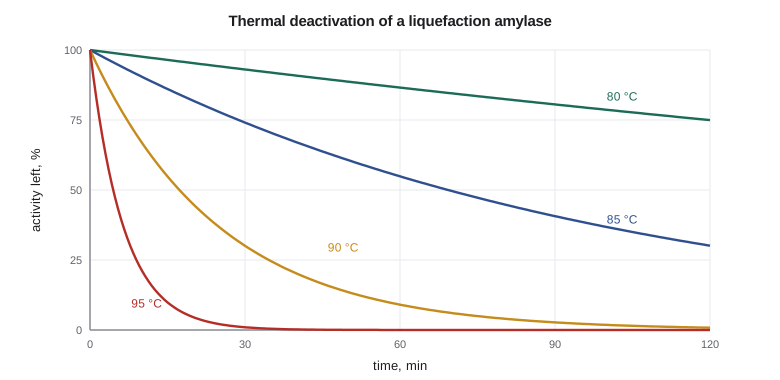
The activation energy for deactivation is typically much larger than that for catalysis, often 200 to 400 kJ/mol, compared with 30 to 80 kJ/mol for the catalyzed reaction. This is why the apparent optimum temperature exists: as temperature rises, catalysis speeds up modestly, but deactivation speeds up sharply. The half-life of the enzyme is \(t_{1/2} = \ln 2 / k_d\). The code uses illustrative constants for a liquefaction alpha-amylase to show how strongly the half-life depends on temperature.
import math
# Thermal deactivation of a liquefaction alpha-amylase: first-order decay with Arrhenius kd
R = 8.314; Ed = 300e3            # J/mol, illustrative deactivation energy
kd85 = 0.010                     # 1/min at 85 C, illustrative
def kd(T): return kd85 * math.exp(-Ed/R*(1/(T+273.15) - 1/(85+273.15)))
for T in (80, 85, 90, 95, 105):
    print(f"{T:3d} C: kd {kd(T):.4f} 1/min, half-life {math.log(2)/kd(T):7.1f} min, activity left after 90 min {100*math.exp(-kd(T)*90):5.1f} %")
# Glucoamylase dose for simultaneous saccharification: dextrin must be converted within the fermentation time
dose_per_t = 0.55    # kg enzyme product per metric ton of corn dry matter (illustrative)
corn_dm_t_h = 61.9 * 0.85
print(f"glucoamylase use {dose_per_t*corn_dm_t_h:.1f} kg/h of product, {dose_per_t*corn_dm_t_h*8400/1000:.0f} t per year")
# Immobilized enzyme pellet: Thiele modulus and effectiveness factor (first-order, sphere)
Rp = 0.5e-3; k1 = 0.8; De = 2e-10   # m, 1/s per particle volume, m2/s
phi = Rp/3*math.sqrt(k1/De)
eta = (1/phi)*(1/math.tanh(3*phi) - 1/(3*phi))
print(f"Thiele modulus {phi:.2f}, effectiveness {eta:.2f}")80 C: kd 0.0024 1/min, half-life 288.6 min, activity left after 90 min 80.6 % 85 C: kd 0.0100 1/min, half-life 69.3 min, activity left after 90 min 40.7 % 90 C: kd 0.0400 1/min, half-life 17.3 min, activity left after 90 min 2.7 % 95 C: kd 0.1544 1/min, half-life 4.5 min, activity left after 90 min 0.0 % 105 C: kd 2.0615 1/min, half-life 0.3 min, activity left after 90 min 0.0 % glucoamylase use 28.9 kg/h of product, 243 t per year Thiele modulus 10.54, effectiveness 0.09
With these constants, the enzyme loses about 60 % of its activity over a 90-minute hold at 85 °C but almost none at 80 °C, and it is destroyed in seconds at 105 °C. That is why the plant adds the enzyme in two doses: a small amount before the jet cooker, much of which is destroyed by the brief high temperature but which helps thin the mash, and the main dose after the cooker, at the liquefaction temperature. Calcium and the substrate itself stabilize many amylases; the starch protects the enzyme it binds to, so the deactivation in mash is slower than in a buffer. Carla tells Theo that when the cook temperature drifts high on night shift, the mash in the liquefaction tanks thickens within the hour, a sign that the enzyme is being destroyed. The plant now has an alarm on that temperature.
Worked problem
Half-life and residual activity
An enzyme has \(k_d = 0.010\) min⁻¹ at 85 °C. What is its half-life, and what fraction of its activity remains after 90 minutes?
Show solution
- \(t_{1/2} = 0.693/0.010 = 69\) min.
- \(E/E_0 = e^{-0.010 \times 90} = 0.41\).
Answer: 69 min; about 41 % remains.
Saccharification
Glucoamylase converts the dextrins to glucose. In a separate saccharification step, used where glucose syrup is the product, the liquefied starch is held at about 60 °C and pH 4.2 to 4.5 for one to three days, reaching about 95 to 96 % glucose. In the ethanol plant, the glucoamylase is added at the fermenter and works at the yeast's temperature for the whole fermentation, with the yeast keeping glucose low. The glucoamylase dose must be enough that the residual dextrins at the end of fermentation are small, but every kilogram costs money. The code estimates the plant's use from a typical dose of about half a kilogram of enzyme product per metric ton of corn dry matter, about 29 kg an hour or about 240 metric tons a year.
Rosa points out a subtlety. Late in fermentation, ethanol and other conditions in the beer reduce glucoamylase activity, and the remaining dextrins are the hardest to hydrolyze, with branch points and short chains. Plants watch residual starch in the dried distillers grains and the residual sugars in the beer as signs that the enzyme dose is too low or the enzyme has lost activity. Some newer products combine glucoamylase with other enzymes, such as an alpha-amylase that works at fermentation temperature on raw starch, so that part of the starch can be converted without cooking at all.
Immobilized enzymes
Free enzymes in an ethanol plant are used once and leave with the distillers grains. For more expensive enzymes, or where the product must be free of enzyme protein, the enzyme can be immobilized: fixed to or inside a solid support so it stays in the reactor while the substrate flows past. Methods include adsorption onto a carrier, covalent attachment, entrapment in a gel and cross-linking of enzyme crystals or aggregates. The largest industrial example is glucose isomerase in corn wet mills, which converts glucose syrup to high fructose syrup in packed beds of immobilized enzyme that run for months.
Immobilization adds a mass transfer step. Substrate must diffuse from the bulk liquid to the particle surface and into its pores before it reaches the enzyme. If the reaction is fast relative to diffusion, the interior of the particle is starved and only the outer shell works. The same Thiele modulus and effectiveness factor that Theo met for porous catalysts in CHE-345 describe this. For a first-order reaction in a sphere of radius \(R\),
The code shows that a millimeter-sized pellet with a fast enzyme can have an effectiveness factor below 0.1: nine tenths of the enzyme is wasted. The fixes are the familiar ones from heterogeneous catalysis: smaller particles, thinner enzyme layers on the outside of the support, or more porous supports. Particle size is limited by pressure drop in the packed bed, so the design is a trade-off. Immobilized enzymes also deactivate, and packed-bed reactors are often run with rising temperature over time to hold conversion as the enzyme decays, the same strategy used for many solid catalysts.
Worked problem
Effectiveness factor
A spherical pellet has \(\phi = 0.3\). Find \(\eta\) and comment.
Show solution
- \(3\phi = 0.9\); \(\tanh 0.9 = 0.716\); \(1/0.716 = 1.397\); \(1/(3\phi) = 1.111\).
- \(\eta = (1.397 - 1.111)/0.3 = 0.95\).
Answer: About 0.95: diffusion barely limits the rate.
Choosing and evaluating enzymes
The plant chooses enzymes by trials, because laboratory constants do not capture everything that happens in a real mash. Rosa runs small fermentations with candidate products at equal cost per metric ton of corn and compares final ethanol, residual starch, glycerol and fermentation time, then confirms the best in one plant fermenter before switching. Theo learns to ask the right questions: what is the activity per liter and its unit, the recommended pH and temperature range, the stability in storage, the price per metric ton of corn treated, and any effect on the distillers grains. Because the enzyme residues end up in a feed product, the supplier must also show that the enzyme and its production organism are acceptable to the FDA, which regulates animal feed ingredients, together with state feed laws.
Storing and dosing enzymes
Liquid enzyme products slowly lose activity in storage, faster when warm. Suppliers state a shelf life, often several months at temperatures below about 25 °C, and recommend avoiding freezing, which can damage some formulations. Kingfisher Bioenergy keeps its enzyme totes in a heated but not hot room in winter and a shaded area in summer, and uses them in the order received. Each delivery comes with a certificate of analysis, and Rosa's laboratory checks the activity of every new lot against a reference sample before it is used.
The enzymes are dosed by metering pumps in proportion to the corn ground, with the dose set in kilograms per metric ton of dry corn. Carla shows Theo the totalizer that the operators check every shift against the tote level, because a pump that loses its prime or a blocked suction line can starve a fermenter of glucoamylase for hours before anyone notices. The plant once lost most of a fermenter's yield this way, and the fix was simple: a flow meter on each enzyme line with a low-flow alarm. Enzyme concentrates are also respiratory sensitizers, so the dosing station has splash guards and the operators wear gloves and eye protection when changing totes, following the product's safety data sheet.
Theo also learns why the plant does not simply run liquefaction cooler to protect the enzyme. Below about 80 °C, gelatinization of corn starch is incomplete, the mash stays thick and some starch passes through fermentation untouched, showing up as residual starch in the distillers grains. The cook temperature is therefore a balance between gelatinization, which needs heat, and enzyme survival, which needs moderation. Newer alpha-amylases with higher stability have moved that balance upward, and Rosa keeps a record of the plant's residual starch each time the enzyme product changes, so the effect of each change can be seen in the plant's own numbers.
Common mistakes
MistakeAdding all the liquefaction enzyme before a hot jet cooker.
InsteadMuch is destroyed; add the main dose after the cooker at the holding temperature.
MistakeAssuming enzyme deactivation is negligible during a long hold.
InsteadCalculate the half-life at the actual temperature.
MistakeUsing large immobilized pellets for a fast enzyme.
InsteadCheck the Thiele modulus; small particles or surface layers may be needed.
MistakeComparing enzymes by dose volume.
InsteadCompare by cost and performance per metric ton of corn in plant trials.
Summary and key terms
- Industrial enzymes are made by aerobic fermentation and sold as stabilized liquids.
- Liquefaction uses thermostable alpha-amylase at about 85 °C to thin gelatinized starch to dextrins.
- Enzymes deactivate by first-order kinetics with high activation energies, so half-life falls steeply with temperature.
- Glucoamylase works in the fermenter for the whole fermentation; dose is set by residual starch and cost.
- Immobilized enzymes are reused but can be limited by internal diffusion, described by the effectiveness factor.
- Gelatinization
- Swelling and bursting of starch granules on heating in water.
- Dextrose equivalent
- Reducing power of a starch hydrolysate relative to glucose.
- Deactivation constant
- The first-order rate constant for loss of enzyme activity.
- Half-life
- The time for an enzyme to lose half its activity.
- Immobilized enzyme
- An enzyme fixed to or within a solid so it can be retained and reused.
- Effectiveness factor
- Ratio of actual rate in a particle to the rate without diffusion limits.
Practice problems
Work each problem on paper first, then reveal the answer to check.
An enzyme's half-life is 20 min. What fraction remains after 1 h?
Show answer
\(0.5^3 = 12.5\) %.
Why is the deactivation activation energy so large?
Show answer
Unfolding a protein breaks many weak bonds at once and is very temperature sensitive.
What does a DE of 15 mean?
Show answer
The hydrolysate has 15 % of the reducing power of pure glucose.
Name two ways to raise an effectiveness factor.
Show answer
Smaller particles, or an enzyme layer only near the surface.
Why does the plant alarm on cook temperature?
Show answer
High temperature destroys the alpha-amylase and the mash thickens.
Why must enzyme suppliers address the distillers grains?
Show answer
Enzyme residues end up in a regulated feed product.
Lesson quiz · 5 questions
Score 60% or more to complete this lesson.
Create a free account to save your progress, take quizzes and earn a certificate.