
CHE-390 · Lesson 12 of 12 · 21 min
Bioprocess economics, sustainability and the capstone fermentation train
Theo's year in the fermentation area ends with the design basis for Kingfisher Bioenergy's expansion: a new 2,600 m³ fermenter and a second yeast propagation tank, with the enzyme and yeast program to go with them. Malik wants a recommendation that is technically sound, economically justified and consistent with the plant's carbon commitments, because the plant's revenue now depends on the carbon intensity of its ethanol as much as on its volume. This lesson pulls together the course: the economics of the fermentation area, the sustainability of corn ethanol and newer feedstocks, and the capstone design.
The economics of a fermentation plant
In a corn ethanol plant, the raw material dominates. Corn is typically 70 to 80 % of the cost of production, natural gas for the dryers and distillation 5 to 10 %, and enzymes, yeast and chemicals a few percent. Revenue comes from ethanol, distillers grains, corn oil and sometimes carbon dioxide, and from carbon credits or tax credits tied to carbon intensity. Margins are thin and volatile, because corn and ethanol prices move independently. That shapes how engineers judge improvements: a change that raises yield by a fraction of a percent is usually worth more than one that saves a large share of enzyme cost, because yield multiplies the largest cost and revenue streams.
import math
# Capstone: yeast propagation for one 2,600 m3 fermenter fill (illustrative design)
V_ferm = 2600.0                # m3
pitch = 1.0e7                  # cells/mL target at fill
cells_needed = pitch*V_ferm*1e6
cell_mass = 6e-11              # g dry weight per cell (about 60 pg)
X_prop_end = 15.0              # g/L dry cells at end of propagation
V_prop = cells_needed*cell_mass/(X_prop_end*1000)
print(f"cells needed {cells_needed:.2e}, dry yeast {cells_needed*cell_mass/1000:.0f} kg, propagator volume {V_prop:.0f} m3")
X0 = 0.5; mu = 0.25
t = math.log(X_prop_end/X0)/mu
print(f"propagation from {X0} to {X_prop_end} g/L at mu {mu}: {t:.1f} h ({t/(math.log(2)/mu):.1f} doublings)")
# Economics of the fermentation train per liter of ethanol (illustrative prices)
L_per_h = 200e6/8400
costs = {"glucoamylase": 0.0065, "alpha-amylase": 0.0020, "yeast and nutrients": 0.0030, "antimicrobial (hop acids)": 0.0008}
for k, v in costs.items(): print(f"  {k:28s} {v*100:5.2f} cents per liter")
print(f"enzymes, yeast and antimicrobial: {sum(costs.values())*L_per_h*8400/1e6:.1f} million (local currency) per year")
# Carbon intensity: effect of process changes (g CO2e/MJ, illustrative)
base = 56.0
for change, d in (("baseline", 0.0), ("corn oil extraction and higher yield", -1.5), ("heat recovery and CHP steam", -3.5), ("CO2 capture and storage", -30.0)):
    base += d
print(f"{change:38s} CI {base:5.1f} g CO2e/MJ ({100*(1-base/93.0):.0f} % below gasoline at 93)")cells needed 2.60e+16, dry yeast 1560 kg, propagator volume 104 m3 propagation from 0.5 to 15.0 g/L at mu 0.25: 13.6 h (4.9 doublings) glucoamylase 0.65 cents per liter alpha-amylase 0.20 cents per liter yeast and nutrients 0.30 cents per liter antimicrobial (hop acids) 0.08 cents per liter enzymes, yeast and antimicrobial: 2.5 million (local currency) per year baseline CI 56.0 g CO2e/MJ (40 % below gasoline at 93) corn oil extraction and higher yield CI 54.5 g CO2e/MJ (41 % below gasoline at 93) heat recovery and CHP steam CI 51.0 g CO2e/MJ (45 % below gasoline at 93) CO2 capture and storage CI 21.0 g CO2e/MJ (77 % below gasoline at 93)
The code puts the purchased biocatalysts in perspective. At illustrative prices, glucoamylase, alpha-amylase, yeast, nutrients and hop acids together cost about 1.2 cents per liter of ethanol, roughly 2.5 million a year in the plant's currency. A one-percentage-point gain in fermentation efficiency, about two million liters a year, is worth several times that at typical ethanol prices. Rosa's enzyme trials therefore look first at yield and only then at cost: a dearer glucoamylase that leaves less residual starch can pay for itself many times over.
Worked problem
Value of a yield gain
Fermentation efficiency rises from 91.5 to 92.3 % in a plant making 200 million liters a year. If ethanol sells for 0.60 per liter and enzyme costs rise by 0.08 cents per liter, what is the net gain?
Show solution
- Extra ethanol: \(200 \times 10^6 \times (92.3/91.5 - 1) = 1.75 \times 10^6\) L, worth about 1.05 million.
- Extra enzyme cost: \(0.0008 \times 200 \times 10^6 = 0.16\) million.
Answer: About 0.9 million a year net.
Carbon intensity
Carbon intensity, CI, is the life-cycle greenhouse gas emissions of a fuel per unit of energy, in grams of carbon dioxide equivalent per megajoule. It counts emissions from growing the corn, including fertilizer and nitrous oxide from soils, from transporting it, from the plant's natural gas and electricity, and from distributing the fuel, with credits for co-products such as distillers grains that replace other feeds. Estimates of land-use change add a further, much debated, amount. Gasoline's CI is roughly 90 to 95 g/MJ. Typical modern corn ethanol is estimated at around 50 to 60 g/MJ, depending on the plant and the model used. The plant's carbon intensity matters commercially because of the federal Renewable Fuel Standard, which sets annual blending volumes that refiners meet with tradable credits, together with the section 45Z clean fuel production tax credit, which pays more per gallon the lower a fuel's carbon intensity. Both systems reward lower carbon intensity: a plant that cuts its CI earns more for each liter.
The code shows the effect of process changes on an illustrative baseline of 56 g/MJ. Corn oil extraction and higher yield shave a little off, because more product shares the same emissions. Heat recovery and combined heat and power cut the natural gas burned. The largest single step is capturing the pure stream of fermentation carbon dioxide and storing it underground, which some US plants have pursued through pipelines and wells and which could cut CI by half or more. Each change has a capital cost and a payback that depends on carbon prices and credit rules that can change, so Theo presents them as options with sensitivities rather than certainties.
| Change | Effect on CI | Main cost or condition |
|---|---|---|
| Higher fermentation efficiency | Small reduction | Better enzymes, yeast and sanitation |
| Corn oil extraction | Small reduction | Centrifuge on syrup |
| Heat recovery, CHP | Moderate reduction | Capital; steam balance |
| Low-carbon electricity | Small to moderate | Supply contracts |
| CO₂ capture and storage | Large reduction | Pipeline or storage site and permits |
| Low-CI corn practices | Moderate | Farm data and verification |
Beyond corn
Cellulosic ethanol from crop residues, wood or energy grasses promises much lower carbon intensity, because the feedstock needs little fertilizer and the lignin can be burned for process energy. It is much harder to make. The sugars are locked in cellulose and hemicellulose, protected by lignin, and must be released by pretreatment, with steam, dilute acid or other methods, and then by cellulase enzymes at doses and costs far above those for starch. Hemicellulose yields xylose, which ordinary yeast cannot ferment, and pretreatment makes inhibitors such as acetic acid and furfural. Several commercial cellulosic plants were built in North America in the 2010s and most struggled or closed; the economics remain difficult. A more successful near-term route is converting the corn fiber already in dry-grind plants to ethanol with added enzymes, which a number of plants have adopted.
Bioprocesses also make chemicals and materials: lactic acid for polylactide plastics, succinic acid, 1,3-propanediol, and many specialty products, using the same fermentation and downstream principles at smaller scale. Rosa points out that the plant's skills in fermentation, enzymes and contamination control are transferable, and that the corn ethanol industry may diversify into such products as fuel markets change.
The capstone: a propagation and fermentation train
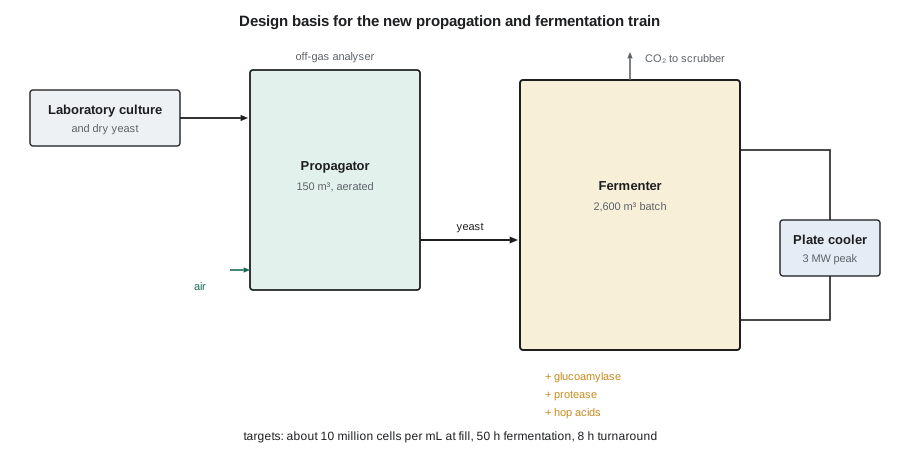
Theo's design brief is a yeast propagation and fermentation train for the new fermenter. He works through it in order.
First, the pitch. Rosa's target is about \(10^7\) live cells per milliliter at the end of fill, which needs \(2.6 \times 10^{16}\) cells for a 2,600 m³ fermenter, about 1.6 t of dry yeast at roughly 60 pg per cell. Second, the propagator. At an end concentration of 15 g/L of dry yeast, the code gives a working volume of about 104 m³; the 150 m³ tank from lesson 8 gives margin for foam and a longer fill. But lesson 8 showed that the tank's oxygen transfer supports yeast only up to about 8 to 9 g/L at full growth rate. Theo therefore specifies a fed-batch propagation in which the growth rate is held at about 0.25 h⁻¹ while the oxygen supply allows, and then the mash feed is slowed so the culture grows more slowly as it approaches 15 g/L. From 0.5 to 15 g/L at 0.25 h⁻¹ takes about 14 hours, about five doublings; with the slower final phase, about 16 to 18 hours, which fits the plant's fill schedule.
Third, the fermenter. Same size as the existing units, batch operation, a 50-hour fermentation and 8-hour turnaround using a second clean-in-place pump, as recommended in lesson 7. Cooling for a 3 MW peak through external plate exchangers sized for summer cooling water, with an extra 20 % of plate area for fouling and the option of a chiller, from lesson 10. Temperature setpoints of 34 °C early and 31 °C late, to speed early fermentation and protect the yeast later, following the model in lesson 5. Fourth, contamination control: sanitary design of the mash cooler and transfer lines, with no dead legs, clean-in-place on every cycle and routine hop acid dosing, from lesson 9. Fifth, the enzyme program: the glucoamylase dose from Dev's trials and a protease to free amino nitrogen, so less urea is needed.
The economics close: the new fermenter adds about 4 % to capacity, most of the investment pays back within a few years at mid-range margins, and the plant's carbon intensity falls slightly because the same steam and electricity serve more ethanol. Theo's report lists the uncertainties: the oxygen transfer estimate, which must be confirmed by off-gas measurements on the existing propagator; summer cooling capacity; and the credit rules, which can change.
Professional judgment
Ingrid reviews the draft with Theo and asks the questions she will ask every year he works for her. What did you assume, and how would you know if it is wrong? What happens on the worst day: the hottest week, the worst corn, a contamination? Who has to operate this, and did you ask them? Carla and the night shift have reviewed the propagator procedure. Nadia has checked the carbon dioxide confined-space hazards of the new tanks and the oxygen-enriched air option, which Theo has dropped in favor of a controlled sugar feed. Wren has confirmed that the added water and air emissions fit the plant's permits. Malik signs the design basis, and a licensed PE will seal the detailed design.
Sensitivity of the recommendation
Theo tests his recommendation against the uncertainties he can quantify. If the propagator's real \(k_La\) is 30 % lower than estimated, the end cell concentration falls to about 12 g/L in the same time, and the pitch falls by a fifth, which lengthens fermentation by about one doubling time early in the batch, roughly two hours, a small penalty that can be offset by adding some dry yeast. If summer cooling water is 4 °C warmer than design, the plate coolers' temperature difference shrinks by about half at peak, and the fermenter would rise above 35 °C for several hours without the chiller option; Theo therefore recommends buying the chiller connection now and the chiller itself only if the first summer shows it is needed. If ethanol margins fall to the bottom of their ten-year range, the payback stretches but remains positive, because the fermenter mainly adds capacity to equipment that already exists.
He also lists what he could not quantify: the effect of future changes to the carbon credit rules, the long-term performance of new yeast strains, and the corn supply. Malik reads that part twice. A design basis that admits its unknowns, he tells Theo, is easier to defend than one that pretends to certainty.
With the design basis signed, Theo hands the package to the detailed design team. His year in the fermentation area has shown him that the biology and the engineering cannot be separated: every yield, rate and constant in his calculations came from cells and enzymes that respond to the conditions the engineer provides. Rosa's last advice to him is to keep visiting the laboratory and the night shift, because the plant's best data come from both.
Common mistakes
MistakeJudging biocatalyst changes on cost alone.
InsteadYield usually matters far more; compare net value.
MistakeTreating carbon intensity values as fixed.
InsteadThey depend on models, data and rules that change; present sensitivities.
MistakeSizing a propagator on volume without checking oxygen.
InsteadCheck oxygen transfer at the target cell concentration.
MistakeDesigning without operators.
InsteadReview procedures and hazards with the people who will run the plant.
Summary and key terms
- Corn dominates cost; yield gains are worth more than biocatalyst savings.
- Carbon intensity now drives revenue under the Renewable Fuel Standard and the 45Z credit; CO₂ capture gives the largest reduction.
- Cellulosic ethanol promises lower CI but faces pretreatment, enzyme and xylose challenges.
- The new train: a 150 m³ fed-batch propagator pitching about \(10^7\) cells/mL into a 2,600 m³ batch fermenter.
- A sound design states its assumptions, its worst cases and the people who reviewed it.
- Carbon intensity
- Life-cycle greenhouse gas emissions per unit of fuel energy.
- Pitch rate
- Yeast cells added per milliliter of mash.
- Cellulosic ethanol
- Ethanol made from the cellulose and hemicellulose of plant residues.
- Pretreatment
- Processing that opens lignocellulose to enzymes.
- Co-product credit
- Emissions avoided because a co-product replaces another product.
- Design basis
- The agreed data, assumptions and criteria for a design.
Practice problems
Work each problem on paper first, then reveal the answer to check.
Why is a yield gain usually worth more than an enzyme saving?
Show answer
It multiplies the corn cost and ethanol revenue, the largest streams.
Name two ways to reduce a plant's carbon intensity.
Show answer
Heat recovery and CO₂ capture (also higher yield, corn oil, low-carbon power).
Why can ordinary yeast not use all cellulosic sugars?
Show answer
It cannot ferment xylose.
How many cells are needed to pitch 2,600 m³ at \(10^7\) per mL?
Show answer
\(2.6 \times 10^{16}\).
Why did Theo drop oxygen enrichment?
Show answer
A controlled sugar feed avoids the fire hazards of enriched oxygen.
What must be confirmed before the propagator design is final?
Show answer
Oxygen transfer, by off-gas measurement on the existing tank.
Lesson quiz · 5 questions
Score 60% or more to complete this lesson.
Create a free account to save your progress, take quizzes and earn a certificate.