
CHE-390 · Lesson 1 of 12 · 22 min
Bioprocess engineering and the ethanol plant
Every liter of fuel ethanol that leaves Kingfisher Bioenergy in Cedar Rapids was made by living cells. Yeast turned the glucose from corn starch into ethanol and carbon dioxide, and enzymes made in other people's fermenters turned the starch into glucose. Theo Laurent has spent his engineer-in-training years on the parts of the plant that chemical engineers recognize at once: the distillation columns, the molecular sieves, the new ethyl acetate line and its control and safety systems. This course follows him into the front half of the plant, the cook and fermentation area, where the reactions are catalyzed by enzymes and carried out by microorganisms. His guide is Dr. Rosa Iyer, the plant's fermentation scientist, and his mentor is still Ingrid Solheim, who now runs the process engineering group.
Biochemical engineering, or bioprocess engineering, applies the tools of chemical engineering to processes that use living cells or their enzymes. The tools are familiar: material and energy balances, reaction kinetics, reactor design, transport phenomena, separations and control. What changes is the catalyst. Enzymes are proteins that work in water near room temperature and lose their activity if they are overheated. Cells grow, consume nutrients, make by-products, respond to their environment and can be overrun by unwanted organisms. The engineer's job is to provide conditions in which the right organism does the right chemistry quickly, reliably and cheaply, at a scale of thousands of cubic meters.
Where bioprocesses are used
Industrial bioprocesses make a wide range of products. Fuel ethanol is by far the largest by volume in North America. Food and beverage fermentations make beer, wine, cheese, yogurt and bread. Industrial enzymes for starch processing, detergents, baking and animal feed are produced by aerobic fermentation of bacteria such as Bacillus and fungi such as Aspergillus and Trichoderma. Organic acids such as citric and lactic acid, amino acids such as lysine and glutamate, vitamins, and bio-based chemicals such as succinic acid and 1,3-propanediol are made by fermentation. Pharmaceutical products such as antibiotics, insulin and monoclonal antibodies are also made this way, with very different scales and regulations. This course uses the ethanol plant for most examples, because it is large, well documented and demanding, and the same principles apply to the others.
Bioprocesses are often grouped into three stages. Upstream processing prepares the raw material, the medium and the inoculum: grinding and cooking the corn, converting starch to sugars, and growing yeast. The bioreaction stage is the fermentation itself. Downstream processing recovers and purifies the product: distillation of the ethanol, separation of the stillage and drying of distillers grains. Downstream processing often costs more than the fermentation in high-value bioproducts; in ethanol, distillation and drying are the largest users of energy.
The dry-grind process
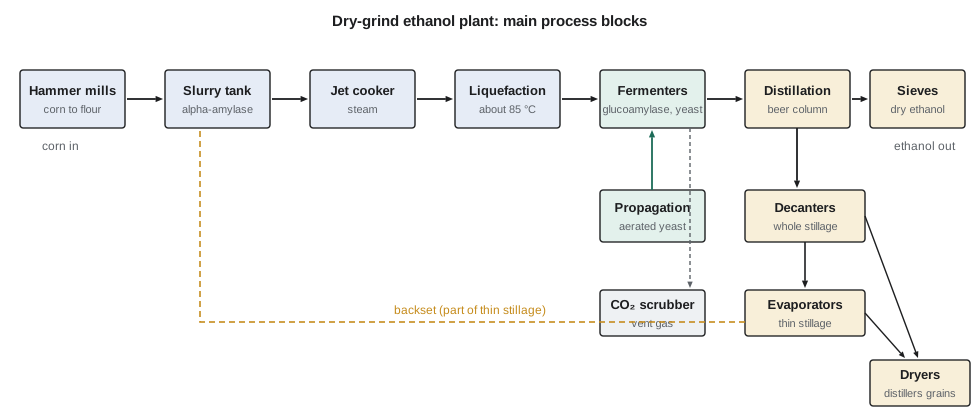
Kingfisher Bioenergy is a dry-grind plant, the most common design for corn ethanol. Whole corn is ground in hammer mills to a coarse flour. The flour is mixed with hot water and recycled process water, called backset, to make a slurry of roughly 30 to 35 % solids. A heat-stable alpha-amylase enzyme is added, and the slurry is heated, often with direct steam injection in a jet cooker, to gelatinize the starch so the enzyme can attack it. In the liquefaction tanks, held at about 85 °C for one to two hours, the alpha-amylase breaks the long starch chains into shorter dextrins and lowers the viscosity so the mash can be pumped and cooled.
The cooled mash goes to the fermenters, large tanks that each hold well over two million liters at Kingfisher Bioenergy. A second enzyme, glucoamylase, is added along with yeast grown in a smaller aerated propagation tank. The glucoamylase releases glucose from the dextrins, and the yeast converts the glucose to ethanol and carbon dioxide as fast as it appears. Because saccharification and fermentation happen together, the process is called simultaneous saccharification and fermentation, or SSF. A batch takes about two to two and a half days and finishes with roughly 13 to 16 % ethanol by volume in a liquid called beer.
The beer goes to the beer column, which strips the ethanol from the solids and water, and then to rectification and the molecular sieves, which Theo studied in CHE-350. What remains at the bottom of the beer column is whole stillage: water, unfermented corn components, yeast and dissolved solids. Decanter centrifuges separate it into wet cake and thin stillage. Part of the thin stillage returns as backset; the rest is evaporated to syrup. Cake and syrup are dried together to make dried distillers grains with solubles, DDGS, a protein-rich animal feed sold under the oversight of the FDA, which regulates animal feed ingredients, together with state feed laws. The carbon dioxide from the fermenters passes through the vent scrubber designed in CHE-314 and may be sold to a gas company for beverages or dry ice.
The plant in numbers
Ingrid asks Theo to start the way she always does: with a material balance on the whole plant. The code takes the plant's design rate, the composition of corn and the efficiency of fermentation, and works back to the corn consumed.
# Dry-grind ethanol plant: corn in, ethanol, CO2 and distillers grains out (illustrative design basis)
ethanol_L_per_yr = 200e6          # liters of anhydrous ethanol per year
hours = 8400                      # operating hours per year
rho_etoh = 0.789                  # kg/L at 20 C
moisture = 0.15                   # corn moisture as received
starch_dry = 0.72                 # starch fraction of corn dry matter
conv = 0.97                       # starch converted to fermentable glucose
y_theory = 92.1 / 180.2           # g ethanol per g glucose: 2 x 46.07 / 180.16
eff = 0.92                        # fermentation efficiency (fraction of theoretical)
etoh_kg_h = ethanol_L_per_yr * rho_etoh / hours
glucose_kg_h = etoh_kg_h / (y_theory * eff)
starch_kg_h = glucose_kg_h / 1.111          # starch + water -> glucose adds 18/162 by mass
corn_kg_h = starch_kg_h / (conv * starch_dry * (1 - moisture))
co2_kg_h = etoh_kg_h * 44.01 / 46.07        # one CO2 per ethanol in the main reaction
dm = corn_kg_h * (1 - moisture)
ddgs_kg_h = (dm - starch_kg_h * conv) * 1.0 / 0.90   # non-starch solids sold at 10 % moisture
print(f"ethanol        {etoh_kg_h/1000:7.2f} t/h   ({ethanol_L_per_yr/hours/1000:5.1f} m3/h)")
print(f"glucose needed {glucose_kg_h/1000:7.2f} t/h")
print(f"corn ground    {corn_kg_h/1000:7.2f} t/h   ({corn_kg_h*hours/1e9:5.2f} million t per year)")
print(f"CO2 from fermenters {co2_kg_h/1000:5.2f} t/h")
print(f"distillers grains (10 % moisture, before yeast and loss corrections) {ddgs_kg_h/1000:5.2f} t/h")
print(f"yield {ethanol_L_per_yr/(corn_kg_h*hours/1000):.0f} L per metric ton of corn as received")ethanol 18.79 t/h ( 23.8 m3/h) glucose needed 39.95 t/h corn ground 60.58 t/h ( 0.51 million t per year) CO2 from fermenters 17.95 t/h distillers grains (10 % moisture, before yeast and loss corrections) 18.45 t/h yield 393 L per metric ton of corn as received
The plant grinds about 60 metric tons of corn an hour, half a million metric tons a year, and makes about 393 liters of ethanol per metric ton of corn as received. That is close to the industry's typical figures of roughly 400 to 430 liters per metric ton, which is often quoted in the US as about 2.8 to 2.9 gallons per bushel. Almost as much carbon dioxide leaves the fermenters as ethanol, by mass, because the main reaction makes one molecule of each from half a glucose. About a third of the corn's mass leaves as distillers grains. Corn is the largest cost in the plant, often more than three quarters of the cost of production, so every percentage point of yield is worth a great deal.
Worked problem
Yield from starch
A metric ton of corn at 15 % moisture contains 72 % starch on a dry basis. If 97 % of the starch becomes glucose and fermentation reaches 92 % of theoretical, how many kilograms of ethanol are made?
Show solution
- Starch: \(1000 \times 0.85 \times 0.72 = 612\) kg; converted: \(612 \times 0.97 = 594\) kg.
- Glucose: \(594 \times 1.111 = 660\) kg, because hydrolysis adds one water per glucose unit.
- Ethanol: \(660 \times 0.511 \times 0.92 = 310\) kg, or about 393 L at 0.789 kg/L.
Answer: About 310 kg, or 393 L, per metric ton of corn.
What makes bioprocesses different
Rosa lists for Theo the features that make her part of the plant unlike the ester line. The catalysts are alive or were made by living things, and their activity changes with temperature, pH, inhibitors and age. Reaction rates are slow compared with most chemical reactions, so reactors are large. The medium is mostly water, and the products are dilute: beer is about 85 % water, which is why distillation and evaporation dominate energy use. The feedstock is variable: corn from a drought year differs from corn from a wet year in starch, protein and mycotoxins. And the reactors must be protected from contamination by other microorganisms that compete for the sugar; lesson 9 is devoted to this.
Biological systems are also remarkably selective and efficient. Glucoamylase cleaves only the bonds it was evolved to cleave, at 32 °C and atmospheric pressure. Yeast converts glucose to ethanol at more than 90 % of the theoretical yield. Few chemical catalysts match that selectivity under such mild conditions. Much of biochemical engineering is about keeping that efficiency at full scale.
| Feature | Ester line (CHE-345) | Fermentation area |
|---|---|---|
| Catalyst | Acidic ion-exchange resin | Enzymes and yeast cells |
| Temperature | About 75 to 85 °C | About 85 °C to cook, 30 to 34 °C to ferment |
| Reaction time | Minutes to an hour | About two days |
| Product concentration | Tens of percent ester | About 13 to 16 % ethanol by volume |
| Key disturbances | Feed composition, catalyst aging | Corn quality, contamination, temperature, nutrients |
Regulations and the market
A fuel ethanol plant works inside several regulatory systems. Its air and water emissions are permitted by the Iowa Department of Natural Resources. Its distillers grains are a feed ingredient overseen by the FDA, which regulates animal feed ingredients, together with state feed laws, which matters when antibiotics or other additives are used to control contamination. Its biological work is low risk: the yeast and the enzyme-producing organisms used in industry are well characterized organisms of low hazard, and the plant's laboratory follows good microbiological practice in line with the principles of Biosafety in Microbiological and Biomedical Laboratories (BMBL, sixth edition) published by the CDC and NIH. The market for its product is shaped by the federal Renewable Fuel Standard, which sets annual blending volumes that refiners meet with tradable credits, together with the section 45Z clean fuel production tax credit, which pays more per gallon the lower a fuel's carbon intensity. Lesson 12 returns to carbon intensity, because the plant's revenue now depends on it.
The plant's engineers also work under the same professional duties as any other: a licensed PE must seal engineering documents, and changes to the process go through management of change, as Theo learned in CHE-380. The fermentation area has its own hazards. Carbon dioxide accumulates in fermenters and tanks and has killed workers who entered without testing the atmosphere; confined space entry rules apply to every vessel. Ethanol vapors from fermenter vents are flammable. Corn dust in the grain receiving and milling area can explode, and is managed under the combustible dust practices from CHE-380.
How this course is organized
The course moves from the molecules to the plant. Lesson 2 covers the cell and its metabolism, the source of the yields engineers use. Lessons 3 and 4 cover enzymes, their kinetics and their use in liquefaction and saccharification. Lessons 5 and 6 cover microbial growth and the stoichiometry of growth and product formation. Lesson 7 compares batch, fed-batch and continuous fermentation. Lesson 8 covers aerobic bioreactors and oxygen transfer, using the yeast propagation tank. Lesson 9 covers sterilization and contamination, and lesson 10 scale-up and control. Lesson 11 covers downstream processing, and lesson 12 brings together economics, sustainability and the design of a new propagation and fermentation train for the plant's planned expansion.
Theo's assignment for the year is that expansion. Kingfisher Bioenergy intends to add a fermenter and a second propagation tank, and Malik Osei wants the design basis checked from first principles rather than copied from the existing units. Rosa will supply laboratory data; Dev, who measured the esterification kinetics, will run enzyme and growth experiments; Carla Fontaine, the panel operator, will tell Theo what the existing fermenters actually do on night shift.
Common mistakes
MistakeTreating a fermenter as an ordinary chemical reactor with a fixed rate constant.
InsteadRates change with the cells' growth, inhibition, temperature and pH; the catalyst itself grows and changes.
MistakeIgnoring the water in the balance.
InsteadThe products are dilute; water dominates the energy balance and the downstream equipment.
MistakeForgetting that hydrolysis adds water.
InsteadA kilogram of starch gives about 1.11 kg of glucose.
MistakeAssuming yield is fixed.
InsteadYield depends on enzyme performance, yeast health, contamination and the corn itself.
Summary and key terms
- Bioprocess engineering applies chemical engineering principles to processes catalyzed by enzymes or cells.
- A dry-grind plant cooks and liquefies corn starch, then ferments it by simultaneous saccharification and fermentation.
- Kingfisher Bioenergy grinds about 60 t/h of corn and makes about 393 L of ethanol per metric ton.
- Carbon dioxide is made in almost the same mass as ethanol; distillers grains carry a third of the corn mass.
- Biocatalysts are selective and efficient but sensitive to temperature, inhibitors and contamination.
- Bioprocess
- A process that uses cells or enzymes to make a product.
- Dry grind
- An ethanol process that grinds whole corn and ferments the whole mash.
- Liquefaction
- Breaking gelatinized starch into dextrins with alpha-amylase.
- Saccharification
- Converting dextrins to glucose, here with glucoamylase.
- Simultaneous saccharification and fermentation
- Releasing glucose and fermenting it in the same vessel.
- Backset
- Thin stillage returned to make up the next mash.
- Distillers grains
- The dried, protein-rich co-product sold as animal feed.
Practice problems
Work each problem on paper first, then reveal the answer to check.
Why does carbon dioxide leave the fermenters in almost the same mass as ethanol?
Show answer
Each glucose gives two ethanol and two CO₂, with molar masses 46 and 44.
Name the three stages of a bioprocess.
Show answer
Upstream processing, bioreaction and downstream processing.
If fermentation efficiency rises from 92 to 93 %, by how much does yield rise?
Show answer
By about 1.1 %, roughly 4 L per metric ton of corn.
Why are fermenters so much larger than chemical reactors of similar output?
Show answer
Biological rates are slow and the products are dilute.
What is the role of the jet cooker?
Show answer
To heat the slurry with steam and gelatinize the starch so the enzyme can act.
Why must fermenters be tested before entry?
Show answer
They can hold carbon dioxide at deadly concentrations.
Lesson quiz · 5 questions
Score 60% or more to complete this lesson.
Create a free account to save your progress, take quizzes and earn a certificate.