
CHE-280 · Lesson 7 of 12 · 22 min
Uniform and galvanic corrosion
Corrosion engineers classify damage by its form, because the form points to the cause and the cure. A widely used scheme, going back to the classic textbooks of the 1960s, lists eight forms: uniform corrosion, galvanic corrosion, crevice corrosion, pitting, intergranular corrosion, selective leaching, erosion-corrosion and environmentally assisted cracking. This lesson covers the first two, plus selective leaching, which is closely related to galvanic action. Lessons 8 to 10 cover the rest. Rafael gives Theo a box of failed parts from the plant's scrap bin and asks him to sort them by form before reading any further. Most of the parts in the box turn out to have failed by one of the forms in this lesson.
Uniform corrosion
Uniform (general) corrosion removes metal more or less evenly over the exposed surface. It is the form that destroys the most metal by weight across all industries, mainly through atmospheric rusting of steel structures, but it is also the easiest to manage, because it is predictable. Measure the rate, add a corrosion allowance, inspect periodically, and the equipment will reach the end of its design life with metal to spare. Carbon steel in cooling water, condensate, dilute acids and the atmosphere usually corrodes in a roughly uniform way, although rarely perfectly evenly; the bottom of a horizontal line, the waterline of a tank and the area downstream of a weld often corrode faster than the rest.
Atmospheric corrosion depends on how long the surface stays wet and on pollutants. Steel corrodes only when a film of moisture is present, which happens when the relative humidity is above roughly 60 to 80 percent, when dew forms or when it rains. Chloride from road salt, cooling tower drift or coastal air, and sulfur dioxide from combustion, make the moisture film more aggressive. The international standard for atmospheric corrosivity sorts environments into categories from very low (heated indoor spaces) to extreme, based on the measured first-year corrosion rate of steel and zinc coupons; a dry heated control room might lose a micrometer of steel a year, while steel next to a cooling tower in a cold climate where salt is spread in winter can lose tens of micrometers a year. Rafael's coating specifications for the plant are written for a moderately aggressive industrial category, with a more severe category near the cooling towers.
Measuring uniform corrosion with coupons
The simplest and still one of the most useful corrosion measurements is the weight-loss coupon. A small strip of the material is cleaned, measured and weighed, exposed in the process stream for a set period (often 30 to 90 days), then removed, cleaned of corrosion products by a standard chemical or mechanical method, and weighed again. Standard practices published by ASTM describe preparing, cleaning and evaluating coupons and calculating the rate. The average penetration rate is
with the mass loss \(W\) in milligrams, the area \(A\) in square centimeters, the exposure time \(t\) in hours and the density \(\rho\) in g/cm\(^3\). The same formula with a constant of 3.45 × 10\(^6\) instead of 87.6, and inches in place of millimeters, gives mils per year. The coupon surface is also examined under a microscope for pits, because a coupon can lose very little weight and still be deeply pitted. The plant runs coupons in its cooling water, condensate and process streams, and the program below converts three recent results to corrosion rates.
# Weight-loss coupon to corrosion rate (ASTM G1/G31 style)
# CR (mm/y) = 87.6 * W / (A * t * rho) with W in mg, A in cm2, t in h, rho in g/cm3
coupons = [
    ("carbon steel, cooling water", 182.0, 22.5, 2160, 7.86),
    ("carbon steel, condensate",    611.0, 22.5, 2160, 7.86),
    ("304L, beer well",               3.1, 22.5, 2160, 7.94),
]
for name, W, A, t, rho in coupons:
    cr = 87.6 * W / (A * t * rho)
    print(f"{name:28s} {cr:6.3f} mm/y = {cr * 39.37:6.2f} mpy")

# Galvanic couple: the same cathodic current is concentrated on a small or large anode
i_cath = 20e-6          # A/cm2 oxygen reduction on the cathode (illustrative)
for Ac, Aa in [(10, 1000), (1000, 1000), (1000, 10)]:
    i_anode = i_cath * Ac / Aa
    cr = 3.27e-3 * i_anode * 1e6 * 27.9 / 7.87
print(f"cathode {Ac:5d} cm2, anode {Aa:5d} cm2 -> anode attack {cr:7.3f} mm/y")carbon steel, cooling water 0.042 mm/y = 1.64 mpy carbon steel, condensate 0.140 mm/y = 5.52 mpy 304L, beer well 0.001 mm/y = 0.03 mpy cathode 10 cm2, anode 1000 cm2 -> anode attack 0.002 mm/y cathode 1000 cm2, anode 1000 cm2 -> anode attack 0.232 mm/y cathode 1000 cm2, anode 10 cm2 -> anode attack 23.185 mm/y
The cooling water coupon shows about 0.04 mm/y, which is good for carbon steel in an open recirculating system. The condensate coupon, at 0.14 mm/y, is three times higher, a sign that the condensate treatment is not keeping up; Lesson 11 follows that problem. The 304L coupon in the beer well is essentially uncorroded, as expected for a passive alloy, and Theo checks its surface under the microscope for pits before signing off.
Galvanic corrosion
When two different metals are in electrical contact and both are wetted by the same electrolyte, they form a galvanic cell. The metal with the more negative (active) corrosion potential in that environment becomes the anode and corrodes faster than it would alone; the more positive (noble) metal becomes the cathode and corrodes slower, or not at all. This is the principle behind Rafael's steel bolt, which was held against copper in cooling water: the steel became the anode and corroded rapidly near the contact. The same principle is used deliberately in sacrificial anodes and galvanizing, where zinc or magnesium is placed in contact with steel so that it corrodes instead of the steel.
Three conditions are needed for galvanic corrosion: two metals with different potentials, an electrical connection between them, and a continuous electrolyte connecting their surfaces. Break any one, and galvanic corrosion stops. The size of the potential difference matters, and the galvanic series in the relevant environment, like the seawater series shown in Lesson 4, ranks metals for this purpose. As a rough guide, potential differences under about 0.1 to 0.2 V in mild environments seldom cause problems, while larger differences in conductive water can. The galvanic series must match the environment: stainless steel is noble when passive but active if its film breaks down, and zinc, normally anodic to steel, can reverse and become cathodic to steel in hot water above about 60 °C.
The area effect
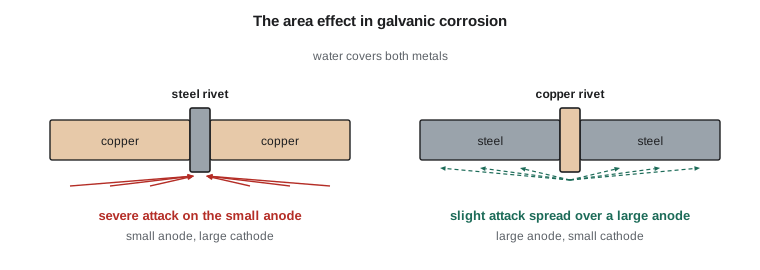
The relative areas of anode and cathode often matter more than the potential difference. In neutral water, the cathodic reaction is usually oxygen reduction, limited by how fast oxygen reaches the cathode surface. The total cathodic current is therefore roughly proportional to the cathode area. All that current must be balanced by anodic dissolution, and if the anode is small, the anodic current density, and so the penetration rate, is large. A steel rivet in a copper plate corrodes rapidly; a copper rivet in a steel plate does little harm. The program above shows how the attack on the anode changes as the area ratio swings from favorable to unfavorable; with a 100 to 1 cathode-to-anode ratio, an illustrative cathodic current density that would cause negligible attack spread over a large anode causes severe attack on a small one.
The area effect leads to a rule that surprises many students: if two metals must be joined and one of them must be coated, coat the noble one, not the active one, or coat both. Coating only the active metal leaves small holidays in its coating as tiny anodes facing the whole uncoated cathode, which is exactly the worst area ratio. A steel tank with a stainless steel nozzle should have the stainless nozzle and the surrounding steel coated together, rather than the steel alone.
Worked problem
Galvanic attack on a steel pipe at a stainless valve
A carbon steel cooling water line connects directly to a 316L stainless steel valve. The wetted stainless area is about 400 cm\(^2\), and the steel pipe within about 10 cm of the joint, where most galvanic current flows, has an area of about 600 cm\(^2\). The oxygen-limited cathodic current density on the stainless steel is about 15 µA/cm\(^2\). Estimate the extra corrosion rate on the nearby steel.
Show solution
- Total galvanic current = \(15 \times 400 = 6{,}000\) µA.
- Spread over 600 cm\(^2\) of steel: \(6{,}000/600 = 10\) µA/cm\(^2\).
- Rate = \(3.27 \times 10^{-3} \times 10 \times 27.9/7.87 = 0.116\) mm/y extra.
Answer: About 0.12 mm/y on top of the steel's normal corrosion, concentrated in the first few centimeters next to the valve. An insulating flange kit or a short stainless spool with a longer transition would reduce it.
Preventing galvanic corrosion
Prevention follows from the three conditions. Choose metals close together in the galvanic series for the environment. Electrically isolate dissimilar metals with insulating gaskets, sleeves and washers at flanges; the plant's isolation kits must be tested after installation, because a single bolt touching both flanges defeats the whole kit. Avoid unfavorable area ratios: fasteners, welds and small components should be at least as noble as the parts they join. Coat both metals, or the noble one, as described above. Keep the joint dry if possible, or reduce the conductivity of the electrolyte. Where none of these is practical, add a corrosion allowance to the active metal near the joint, design it as a replaceable spool, or install a sacrificial anode.
Welds are a special case. A weld metal slightly less noble than the parent plate can corrode preferentially, and because the weld is small and the plate large, the area ratio is unfavorable. Welding consumables for carbon steel in seawater and in some cooling waters are therefore chosen to be slightly more noble than the plate, with small additions of nickel or copper.
Selective leaching
Selective leaching (dealloying) removes one element from an alloy, leaving a porous, weak residue of the other. The classic example is dezincification of brass, mentioned in Lesson 4, in which zinc leaves and copper remains. It may happen in layers (uniform) or in localized plugs, and the part keeps its shape and may look sound while having almost no strength. Brasses with more than about 15 percent zinc are susceptible, especially in stagnant, slightly acidic or high-chloride water. Additions of tin, arsenic, antimony or phosphorus inhibit it, which is why admiralty brass contains arsenic and why naval brass contains tin. Graphitic corrosion of gray cast iron is similar: the iron corrodes away, leaving a weak network of graphite flakes and corrosion products. Old buried cast iron water mains and pump casings can look intact yet be cut with a pocket knife. Dealloying also affects aluminum bronzes (dealuminification) and some copper-nickels in particular conditions.
Sorting the scrap box
Theo's sort of Rafael's box ends with four piles. The first holds uniformly thinned pieces: a section of condensate line thinned along its bottom, a heat exchanger channel cover rusted evenly. The second holds galvanic failures: the steel bolt, a carbon steel nipple eaten away next to a brass valve, and an aluminum junction box base corroded where it sat on a stainless steel plate in the washdown area. The third holds a brass valve body that has turned reddish and crumbly in one spot, a dezincification plug. The fourth pile, deliberately left aside, holds pitted, cracked and eroded parts that belong to the next lessons. For each failure in the first three piles, Theo writes the cause and a cure: better condensate treatment for the thinned line, isolation or matched materials for the galvanic joints, and dezincification-resistant brass for the valve.
Common mistakes
MistakeCoating only the active metal in a galvanic couple.
InsteadCoat both, or the noble metal; holidays in a coated anode facing a bare cathode corrode fastest.
MistakeIgnoring the area ratio when joining dissimilar metals.
InsteadKeep fasteners and small parts at least as noble as the larger parts they join.
MistakeInstalling an insulating flange kit and never testing it.
InsteadTest isolation after installation; one bolt contact or a bridging deposit can short it.
MistakeJudging a brass valve or cast iron pipe by its appearance.
InsteadDealloyed parts can look sound but have little strength; test or section suspect parts.
Summary and key terms
- Classifying corrosion by form points to the cause and the cure; the eight classic forms are uniform, galvanic, crevice, pitting, intergranular, selective leaching, erosion-corrosion and environmentally assisted cracking.
- Uniform corrosion removes metal evenly and is managed with corrosion allowances, coatings and inspection; atmospheric corrosion depends on wetness and pollutants.
- Weight-loss coupons give average rates by CR = 87.6 W/(A t ρ) in mm/y; inspect them for pits too.
- Galvanic corrosion needs dissimilar metals, electrical contact and a shared electrolyte; the active metal corrodes faster.
- A small anode joined to a large cathode corrodes rapidly; coat the noble metal or both, never only the active one.
- Prevent galvanic corrosion by matching metals, isolation, favorable area ratios, coatings and drainage.
- Selective leaching, such as dezincification and graphitic corrosion, leaves weak residues that can look intact.
- Uniform corrosion
- Corrosion that removes metal fairly evenly over the exposed surface.
- Weight-loss coupon
- A pre-weighed metal specimen exposed to an environment and reweighed to measure the average corrosion rate.
- Galvanic corrosion
- Accelerated corrosion of the more active metal when two dissimilar metals are electrically connected in an electrolyte.
- Area effect
- The increase in galvanic attack on an anode as the ratio of cathode area to anode area rises.
- Isolation kit
- Insulating gaskets, sleeves and washers used to break the electrical path between dissimilar metal flanges.
- Selective leaching
- Removal of one element from an alloy by corrosion, leaving a porous residue.
- Graphitic corrosion
- Selective leaching of iron from gray cast iron, leaving a weak graphite network.
Practice problems
Work each problem on paper first, then reveal the answer to check.
A coupon of 22.5 cm² loses 250 mg in 2,160 h. Its density is 7.86 g/cm³. What is the corrosion rate?
Show answer
\(87.6 \times 250/(22.5 \times 2160 \times 7.86) = 0.057\) mm/y.
List the three conditions needed for galvanic corrosion.
Show answer
Two metals with different potentials, electrical contact between them and a shared electrolyte.
Why is a steel rivet in a copper plate worse than a copper rivet in a steel plate?
Show answer
The small steel anode receives all the cathodic current collected by the large copper cathode, so its corrosion rate is high.
A stainless nozzle is welded to a carbon steel tank. Which should be coated?
Show answer
Both, or at least the stainless nozzle and the steel around it; never only the steel.
Name two alloying additions that inhibit dezincification of brass.
Show answer
Arsenic, antimony, tin or phosphorus.
Why can zinc coatings stop protecting steel in hot water?
Show answer
Above about 60 °C the potentials of zinc and steel can reverse, making zinc cathodic to steel.
Lesson quiz · 5 questions
Score 60% or more to complete this lesson.
Create a free account to save your progress, take quizzes and earn a certificate.