
CHE-280 · Lesson 10 of 12 · 22 min
High-temperature corrosion, erosion-corrosion and corrosion under insulation
The last group of damage mechanisms in this course does not fit neatly with the electrochemistry of wet surfaces. Some happen in hot, dry gases with no liquid water at all. Others depend as much on fluid flow as on chemistry. And one of the costliest, corrosion under insulation, is ordinary wet corrosion hidden in a place nobody looks. At the Kingfisher Bioenergy plant, all three appear: high-temperature corrosion in the natural gas-fired distillers grains dryer and the thermal oxidizer that burns its exhaust, erosion-corrosion in slurry pumps, beer lines and steam traps, and corrosion under insulation on the plant's many kilometers of insulated steam, condensate and process piping. This lesson covers each and how the plant manages them.
High-temperature oxidation
At high temperature, metals react directly with oxygen in the gas to form an oxide scale, without any electrolyte. The rate depends on whether the scale protects the metal. If the scale is dense and adherent, further growth needs metal or oxygen ions to diffuse through it, and the scale thickens more and more slowly. The thickness then follows a parabolic law, \(x^2 = k_p t\), where \(k_p\) is a rate constant that rises steeply with temperature, roughly following an Arrhenius relationship. If the scale is porous, cracks or spalls off, oxygen reaches the metal freely and the rate can be linear or even accelerate. Thermal cycling is especially damaging because the scale and the metal expand differently, so the scale cracks and flakes off each time the equipment heats and cools.
Chromium, aluminum and silicon form slow-growing, protective oxides, which is why heat-resistant alloys rely on them. Carbon steel is usable in air up to roughly 500 to 550 °C before oxidation becomes excessive; low-alloy chromium-molybdenum steels extend this somewhat; 304 and 316 stainless steels are good to about 850 to 900 °C in continuous service; and heat-resistant grades such as 309 and 310, with more chromium and nickel, and nickel alloys such as 600 and 601 go higher. These limits come down in the presence of sulfur, chlorine, vanadium or alkali salts, and they assume the metal is strong enough at that temperature, which creep, not oxidation, often decides.
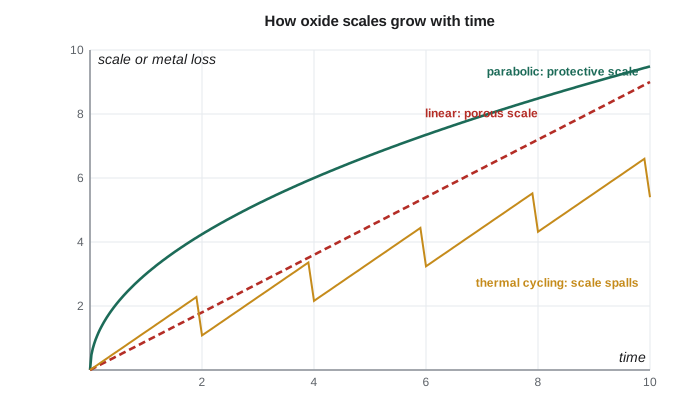
The program below applies the parabolic law to a steel component in the dryer's hot gas path, with an illustrative rate constant. Because the thickness grows with the square root of time, ten years of service consume only about three times the metal of the first year. That predictable slowing is what makes protective scales so valuable, and it is lost if the scale spalls. The second half of the program anticipates the erosion section later in this lesson.
# High temperature oxidation (parabolic law) and erosional velocity limit
import math
# Parabolic oxidation: x^2 = kp * t
kp = 2.0e-6          # mm^2 per hour at the dryer gas temperature (illustrative)
for years in (1, 5, 10):
    t = years * 8000                     # operating hours
    print(f"{years:2d} years: scale/metal loss about {math.sqrt(kp * t):.2f} mm")

# Erosional velocity guide (API RP 14E form): Ve = c / sqrt(rho_m), Ve in ft/s, rho in lb/ft3
c = 100
for name, rho_kg in [("wet steam", 15.0), ("beer slurry", 1030.0), ("thin stillage", 1020.0)]:
    rho_lb = rho_kg * 0.06243
    ve = c / math.sqrt(rho_lb)
print(f"{name:14s} density {rho_kg:6.0f} kg/m3 -> erosional velocity about {ve * 0.3048:5.1f} m/s")1 years: scale/metal loss about 0.13 mm 5 years: scale/metal loss about 0.28 mm 10 years: scale/metal loss about 0.40 mm wet steam density 15 kg/m3 -> erosional velocity about 31.5 m/s beer slurry density 1030 kg/m3 -> erosional velocity about 3.8 m/s thin stillage density 1020 kg/m3 -> erosional velocity about 3.8 m/s
Other high-temperature corrosion
Sulfidation is attack by sulfur compounds such as hydrogen sulfide at high temperature, forming metal sulfides that are less protective than oxides and melt at lower temperatures. It is a major issue in refineries, where crude oil contains sulfur, and it is predicted with empirical curves of corrosion rate against temperature and sulfur content. Carburization and metal dusting occur in hot gases rich in carbon monoxide or hydrocarbons: carbon diffuses into the alloy, forming brittle carbides, or in metal dusting the metal disintegrates into a powder of graphite and metal particles at intermediate temperatures. Hot corrosion occurs when molten salts, such as sodium sulfate or vanadium compounds from fuel ash, deposit on hot surfaces and flux away the protective oxide; it affects boilers burning poor fuels and gas turbines. Chlorine and hydrogen chloride at high temperature form volatile metal chlorides, so chloride-bearing waste incinerators need special alloys.
The plant's thermal oxidizer burns the volatile organic compounds in the dryer exhaust before it is released. Its refractory-lined combustion chamber reaches about 800 °C, and its stainless steel heat recovery section sees hot gas containing water vapor and a little sulfur from the grain. Rafael has found mild sulfidation and oxidation on the hot end of the heat recovery tubes and, more seriously, dew point corrosion at the cold end, where flue gas cools below its acid dew point and dilute sulfuric acid condenses on the tubes. Keeping metal temperatures above the acid dew point, about 120 to 150 °C for this gas, is the main defense, and the plant controls bypass dampers to do so.
Erosion-corrosion
Erosion-corrosion is accelerated attack caused by the movement of a fluid over a metal surface. It occurs when the flow removes or prevents the formation of the protective film or corrosion product layer, exposing fresh metal to corrosion; the corrosion then weakens the surface, and the flow removes it, in a cycle much faster than either process alone. It produces grooves, gullies, waves and horseshoe-shaped pits aligned with the flow, usually with a clean, bright surface free of corrosion products. It is most severe where flow is turbulent or changes direction: pump impellers and casings, elbows, tees, reducers, valve seats and trim, heat exchanger tube inlets, and downstream of orifices and control valves. Solid particles in the fluid add abrasion, and gas bubbles add impact.
Every material in a given fluid has a velocity above which erosion-corrosion begins, and Lesson 4 gave typical limits for copper alloys in water. Carbon steel in water is usually limited to a few meters per second; stainless steels and titanium, whose thin passive films reform almost instantly, tolerate much higher velocities in clean water. For two-phase gas-liquid flow, a widely used guide from oil and gas production calculates an erosional velocity \(V_e = c/\sqrt{\rho_m}\), with \(V_e\) in feet per second, the mixture density \(\rho_m\) in pounds per cubic foot and an empirical constant \(c\) usually between 100 and 150 for continuous service. The guide is approximate and does not apply well to slurries with sand, but it gives a sense of scale, as the program above showed: liquids and slurries tolerate a few meters per second, and wet steam tolerates much more because its density is low.
Flow-accelerated corrosion is a related but distinct mechanism in carbon steel exposed to flowing, deaerated, high-purity water or wet steam, typically between about 100 and 250 °C. The protective magnetite layer dissolves into the flowing water faster than it can form, and the wall thins steadily, especially at elbows, reducers and downstream of control valves. It has caused several fatal pipe ruptures in power plants, including a large feedwater line rupture at a US nuclear plant in 1986 and another in Japan in 2004. Small additions of chromium to the steel (even 1 to 2 percent) greatly reduce it, as does controlling water chemistry, especially pH and oxygen. The plant's boiler feedwater and wet steam lines are on a flow-accelerated corrosion inspection program.
Cavitation
Cavitation damage occurs when local pressure in a liquid falls below its vapor pressure, forming vapor bubbles that collapse violently when they move into a region of higher pressure. Each collapse sends a tiny high-velocity jet and a shock wave against the nearby surface, and millions of collapses pit and roughen the metal, often in a spongy pattern. Cavitation happens at pump impeller inlets when the available net positive suction head is too low, downstream of control valves with large pressure drops, and on propellers. The cure is mainly hydraulic: keep the available suction head well above the pump's requirement, size control valves to avoid flashing and cavitation, and choose harder, tougher alloys such as stainless steel or cobalt-based hard facing for parts that cannot avoid it.
Worked problem
Velocity in a beer line
The beer transfer line carries 85 m\(^3\)/h of beer slurry with suspended solids through a 100 mm (inside diameter) carbon steel pipe. The plant's guide for this slurry is a maximum of 2.5 m/s. Is the line within the guide?
Show solution
- Flow = \(85/3600 = 0.0236\) m\(^3\)/s.
- Area = \(\pi (0.100)^2/4 = 7.85 \times 10^{-3}\) m\(^2\).
- Velocity = \(0.0236/7.85 \times 10^{-3} = 3.0\) m/s.
Answer: About 3.0 m/s, above the 2.5 m/s guide. Expect erosion-corrosion at elbows and tees; increase the line size, use long-radius elbows or upgrade to stainless steel.
Corrosion under insulation
Corrosion under insulation (CUI) is the external corrosion of carbon and low-alloy steel piping and vessels beneath thermal insulation, and chloride stress corrosion cracking of austenitic stainless steel in the same situation. It is one of the most expensive and dangerous damage mechanisms in process plants because it is hidden: the insulation and its weather jacket conceal the steel, and the damage is often found only when a line leaks or an inspector removes insulation for some other reason. Industry surveys suggest CUI accounts for a large share of piping leaks in refineries and chemical plants.
CUI needs water. Rain gets past damaged jacketing, poorly sealed joints and protrusions such as supports, nozzles and instrument connections; condensation forms on cold lines and on lines that cycle between hot and cold; and insulation materials can hold water against the steel for long periods. Temperature then decides the rate. Carbon steel is most at risk between about \(-4\) and 175 °C, and especially from about 50 to 150 °C, where water is present often and the temperature speeds corrosion; above about 175 °C, the surface usually stays dry. Equipment that cycles in and out of that range, or that operates intermittently, is at greatest risk. The insulation itself can contribute chloride, which is why low-chloride insulation is specified for stainless steel. Rates under wet insulation can reach 1 mm/y or more, far higher than for bare steel in the same air, because the water stays in contact with hot metal.
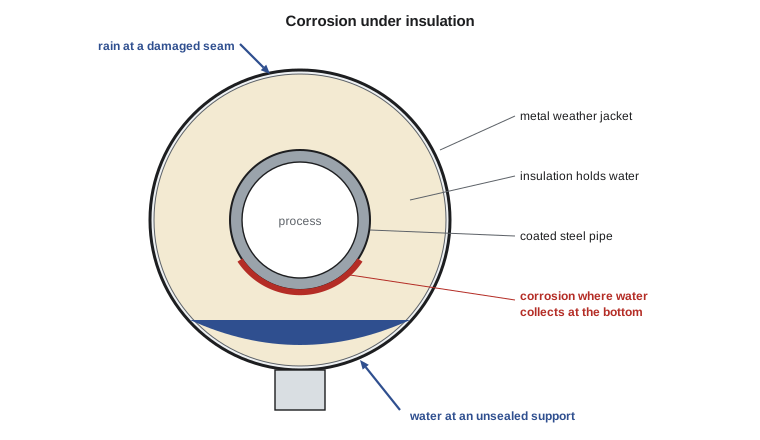
The plant's CUI program follows industry practice. New and replacement insulated carbon steel is coated before insulating with a coating suited to wet, hot service, such as thermally sprayed aluminum or high-temperature epoxy novolac; stainless steel in the risk range gets a coating too. Insulation is chosen to shed water, and jacketing is designed and maintained to keep water out, with sealed seams, caps on protrusions and drains at low points. Where insulation is not really needed, for example for personnel protection on a line that rarely runs hot, it is replaced with guards. Inspection prioritizes lines by risk: operating temperature, coating condition, insulation type, age, location (near cooling towers, steam vents or deluge systems) and consequence of failure. Inspectors use visual examination of jacketing, removal of insulation at likely spots, profile radiography through insulation, pulsed eddy current, guided-wave ultrasonics and neutron backscatter to find wet insulation.
Common mistakes
MistakeAssuming high-temperature alloys resist every hot gas.
InsteadSulfur, chlorine, molten salts and carbon-rich gases attack alloys well below their limits in clean air.
MistakeCooling flue gas below its acid dew point to recover more heat.
InsteadCondensing acid corrodes the cold end; keep metal temperatures above the dew point or use resistant materials.
MistakeIgnoring line velocity when a slurry service is redesigned for higher flow.
InsteadCheck velocities against erosion guides, especially at elbows, tees and pump casings.
MistakeAssuming insulated hot lines are safe from corrosion.
InsteadWet insulation causes severe hidden corrosion, especially between about 50 and 150 °C.
Summary and key terms
- High-temperature oxidation forms scales; protective scales grow parabolically, while porous or spalling scales allow linear growth.
- Chromium, aluminum and silicon give oxidation resistance; sulfidation, carburization, metal dusting, hot corrosion and chlorides lower the safe temperature.
- Flue gas cooled below its acid dew point condenses corrosive acid.
- Erosion-corrosion is flow-accelerated removal of protective films; it is worst at turbulence and direction changes and controlled by velocity limits and material choice.
- Flow-accelerated corrosion thins carbon steel in hot, deaerated water and wet steam; chromium additions and water chemistry reduce it.
- Cavitation is damage from collapsing vapor bubbles; it is cured mainly by hydraulic design.
- Corrosion under insulation is hidden external corrosion of insulated equipment, worst between about 50 and 150 °C; coatings, good jacketing and risk-based inspection control it.
- Parabolic rate law
- A scale growth law, x² = k_p t, for oxidation controlled by diffusion through a protective scale.
- Sulfidation
- High-temperature attack by sulfur compounds forming metal sulfides.
- Acid dew point
- The temperature below which acid vapors in a flue gas condense on surfaces.
- Erosion-corrosion
- Accelerated attack caused by fluid flow removing protective surface layers.
- Flow-accelerated corrosion
- Thinning of carbon steel by dissolution of its magnetite layer into flowing hot water or wet steam.
- Cavitation
- Formation and violent collapse of vapor bubbles in a liquid, damaging nearby surfaces.
- Corrosion under insulation
- External corrosion or cracking of equipment beneath thermal insulation, caused by trapped water.
Practice problems
Work each problem on paper first, then reveal the answer to check.
A scale is 0.10 mm thick after one year under parabolic growth. How thick after four years?
Show answer
\(x \propto \sqrt{t}\), so \(0.10 \times \sqrt{4} = 0.20\) mm.
Why does thermal cycling speed oxidation?
Show answer
Different expansion of scale and metal cracks and spalls the scale, exposing fresh metal.
Where in a piping system is erosion-corrosion most likely?
Show answer
At elbows, tees, reducers, pump casings, valve trim, tube inlets and downstream of orifices.
Name two ways to reduce flow-accelerated corrosion.
Show answer
Use steels with small chromium additions and control water chemistry, especially pH and oxygen.
In what temperature range is carbon steel most at risk from corrosion under insulation?
Show answer
Roughly 50 to 150 °C, within a wider range of about −4 to 175 °C.
Name three inspection techniques for corrosion under insulation.
Show answer
Profile radiography, pulsed eddy current, guided-wave ultrasonics, neutron backscatter or insulation removal at likely spots.
Lesson quiz · 5 questions
Score 60% or more to complete this lesson.
Create a free account to save your progress, take quizzes and earn a certificate.