
CHE-280 · Lesson 4 of 12 · 21 min
Non-ferrous metals and alloys
Steels make up most of the metal in a process plant, but a walk through the Kingfisher Bioenergy plant's utility areas turns up other metals in important places. The cooling tower's heat exchangers once had copper-nickel tubes. The control valve trim in the steam system includes cobalt-based hard facing. The instrument air lines are copper. A small heat exchanger cooling a hot brine has titanium plates. The roof sheeting on the grain storage building and many enclosures are aluminum alloy. Each was chosen for a particular combination of properties that steel could not match: thermal conductivity, resistance to biofouling, light weight, resistance to a specific chemical, or wear resistance. This lesson surveys the non-ferrous metals a process engineer is likely to meet and the services they suit. MEC-250 covers their metallurgy; here the focus is on corrosion behavior and use.
Copper and copper alloys
Copper has excellent thermal and electrical conductivity, is easy to form and join, and resists many natural waters and neutral solutions. It is used for heat exchanger tubes, water and instrument air piping, and electrical work. Copper does not depend on a passive film the way stainless steel does; it forms a protective layer of copper oxide and, in water, basic copper salts, and it corrodes slowly as long as this layer is stable. Copper ions released into water are toxic to marine organisms, which gives copper alloys a valuable resistance to biofouling in seawater and cooling water systems.
The important copper alloys in process plants include brasses (copper-zinc), admiralty brass with a little tin and arsenic to resist dezincification, aluminum bronze, and the copper-nickel alloys 90-10 and 70-30. Copper-nickels are the classic choice for seawater cooling systems and condensers because they combine good corrosion resistance, good thermal conductivity and resistance to fouling. Brasses with high zinc content can suffer dezincification, a form of selective leaching in which zinc dissolves and leaves a weak, porous copper sponge behind; Lesson 7 returns to it.
Copper alloys have three important weaknesses. First, they are attacked by ammonia, which forms soluble copper-ammonia complexes and can cause stress corrosion cracking in brasses; at an ethanol plant, where ammonia is used for pH control and as a yeast nutrient, copper alloys must be kept away from any stream or atmosphere that may contain it. Second, they are sensitive to velocity. Each copper alloy has a velocity limit above which the protective layer is stripped and erosion-corrosion begins: roughly 1 to 1.5 m/s for copper, around 2 m/s for admiralty brass, about 2.5 to 3 m/s for 90-10 copper-nickel and somewhat higher for 70-30. Third, sulfide in polluted water attacks copper alloys and prevents a protective layer from forming.
Aluminum and its alloys
Aluminum is light (about one third the density of steel), has good thermal conductivity, and forms a thin, protective aluminum oxide passive film in air and in neutral water. It resists atmospheric corrosion very well, which is why it is used for roofing, cladding, enclosures, insulation jacketing and cryogenic equipment. The aluminum-magnesium alloys of the 5000 series, such as 5083, are tough at very low temperatures and are used for cryogenic tanks and heat exchangers. Plate-fin heat exchangers in air separation and natural gas plants are brazed aluminum.
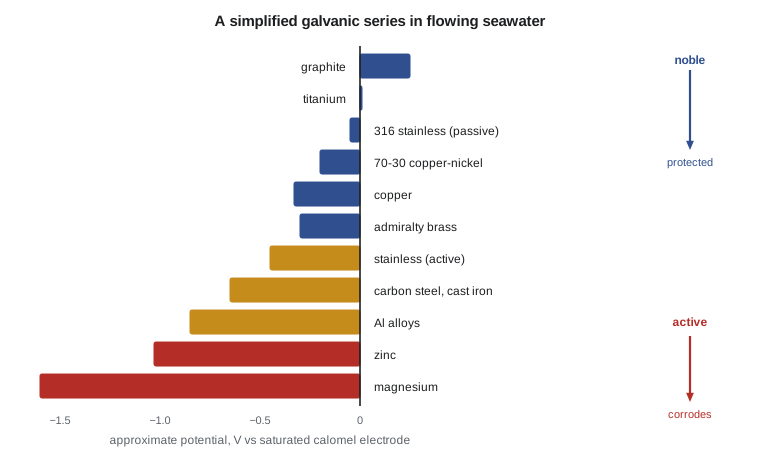
The passive film on aluminum is stable only between about pH 4 and 8.5. Outside that range, in acids or alkalis, aluminum corrodes rapidly; even concrete or alkaline cleaning solutions can attack it. Chloride causes pitting, especially in stagnant water. Aluminum is also very active in the galvanic series, so it corrodes rapidly when coupled to copper, stainless steel or carbon steel in a wet environment. Copper ions plating out of water onto aluminum surfaces can start deep pits. A notorious danger in process plants is the reaction of aluminum with mercury, found in trace amounts in some natural gas: mercury amalgamates with aluminum and can cause rapid cracking of brazed aluminum heat exchangers. At an ethanol plant, aluminum mainly appears in non-process roles, but Rafael still reviews every place where aluminum jacketing meets stainless or copper, and every place where alkaline washdown water reaches aluminum surfaces.
Titanium
Titanium owes its corrosion resistance to a very stable titanium dioxide passive film, which resists chloride better than almost any other common metal. In seawater, brackish water, wet chlorine, hypochlorite and many oxidizing chloride solutions, titanium is essentially immune to pitting and crevice corrosion up to quite high temperatures. It is light and strong, and although its price per kilogram is high, thin-walled titanium tubes and plates can make heat exchangers competitive in severe cooling water and brine service, especially when the alternative is frequent replacement of copper alloys or stainless steels. That is why the plant's small brine cooler, which handles a hot chloride solution from the water softener regeneration, has titanium plates.
Titanium has limits. It is attacked by reducing acids such as hydrochloric and sulfuric acid unless oxidizers are present, and by hydrofluoric acid and fluoride-containing solutions at almost any concentration. Dry chlorine gas can react violently with titanium, even though wet chlorine does not harm it. Crevice corrosion can occur in hot, acidic chloride solutions, so the palladium-alloyed grades (such as grade 7) or the nickel-molybdenum grade 12 are used for more severe duties. Titanium can also absorb hydrogen and become brittle if it is coupled to a more active metal or cathodically protected too strongly. Finally, titanium must be welded with careful shielding from air, because it picks up oxygen and nitrogen at welding temperatures and becomes brittle.
Other metals
Several other metals have smaller niches. Zirconium resists boiling hydrochloric acid, sulfuric acid up to moderately high concentrations, and hot organic acids, and is used in acetic acid plants and some pharmaceutical processes. Tantalum is almost completely inert to most acids except hydrofluoric acid and hot concentrated alkalis, and is used for small, critical parts such as heat exchanger tubes in hot acid service, thermowells, and repair plugs for glass-lined vessels. Lead was historically used to line sulfuric acid equipment because it forms a protective lead sulfate film; it has largely been replaced because of its toxicity and low strength. Cobalt-based alloys are used for hard facing on valve seats and pump parts where wear and corrosion combine.
| Metal | Strengths | Weaknesses | Typical process uses |
|---|---|---|---|
| Copper alloys (brass, copper-nickel) | Conductivity, fouling resistance, seawater | Ammonia, sulfide, high velocity | Condensers, cooling water exchangers, instrument air |
| Aluminum alloys | Light, atmospheric resistance, cryogenic toughness | Acids and alkalis, chloride pitting, galvanic coupling, mercury | Roofing, jacketing, cryogenic tanks, plate-fin exchangers |
| Titanium | Outstanding chloride resistance, light, strong | Reducing acids, fluorides, dry chlorine, hydrogen pickup | Brine and seawater exchangers, chlorine and hypochlorite service |
| Zirconium | Hot hydrochloric and organic acids | Fluorides, ferric and cupric chlorides | Acetic acid plants, special reactors |
| Tantalum | Nearly inert to most acids | Hydrofluoric acid, cost | Small parts in hot acid service, glass-lining repairs |
| Nickel 200/201 | Caustic soda at high temperature | Oxidizing acids, sulfur at high temperature | Caustic evaporators |
Comparing metals on mass and cost
When the corrosion resistance of several metals is acceptable, the choice often comes down to cost, and price per kilogram can mislead. A lighter metal needs less mass for the same volume, and a stronger metal can use a thinner wall. The program below compares the shell of a small vessel built in four metals for the same low-pressure duty. Because the pressure is low, a 3 mm practical minimum wall governs for carbon steel and 316L; the weaker aluminum alloy needs a thicker wall, and titanium sits between. The metal cost is only part of the total, since fabrication, welding and inspection costs differ too, but the calculation shows why titanium is used only where nothing cheaper will do and why aluminum, despite its higher price per kilogram, can be competitive when weight matters.
# Mass and material cost of a 3 m x 2 m diameter vessel shell in four metals
import math
D, H = 2.0, 3.0                 # m
area = math.pi * D * H + 2 * math.pi * (D / 2) ** 2   # shell plus two flat heads, m2
metals = {
    # name: (density kg/m3, allowable stress MPa, illustrative price per kg)
    "carbon steel": (7850, 138, 1.5),
    "316L":         (8000, 115, 6.0),
    "Al 5083":      (2660,  60, 7.0),
    "titanium Gr2": (4510,  97, 30.0),
}
P = 0.35        # internal pressure, MPa
for name, (rho, S, price) in metals.items():
    t = max(P * D * 1000 / (2 * S), 3.0)    # mm, with a 3 mm practical minimum
    mass = area * t / 1000 * rho
print(f"{name:13s} wall {t:4.1f} mm mass {mass:7.0f} kg metal cost {mass * price:9,.0f}")carbon steel wall 3.0 mm mass 592 kg metal cost 888 316L wall 3.0 mm mass 612 kg metal cost 3,672 Al 5083 wall 5.8 mm mass 390 kg metal cost 2,730 titanium Gr2 wall 3.6 mm mass 409 kg metal cost 12,270
Choosing tube metal for a cooling water exchanger
Heat exchanger tubing is where non-ferrous metals compete most directly with stainless steel, and the decision shows how the factors interact. For an open recirculating cooling water system like the plant's, the realistic candidates are admiralty brass or copper-nickel, 304L or 316L stainless steel, a superferritic or superaustenitic stainless steel, and titanium. Copper alloys resist fouling and conduct heat best, but ammonia, sulfide and high velocity rule them out in some plants. Stainless steels tolerate ammonia and higher velocities, but chloride, which rises as the tower concentrates the water, can pit them under deposits, especially at low flow. Titanium tolerates almost any cooling water chemistry and velocity, but it costs most, and its low thermal conductivity is offset only partly by thin walls. The right answer depends on the water chemistry the treatment program can guarantee, the velocities the design allows, whether ammonia or sulfide could appear, and how often the plant is willing to clean and inspect.
Rafael's rule of thumb is to decide the water chemistry limits first and choose the tube metal second. Once the plant commits to keeping chloride below a set level, maintaining minimum tube velocities and treating for microbes, 316L becomes a sound choice. If the plant cannot guarantee those limits, for example because it must use poor-quality makeup water, titanium is the safer investment. Either way, the limits go into the integrity operating windows described in Lesson 1, so operators know which numbers protect the exchangers.
Worked problem
Velocity limit for copper-nickel tubes
A cooling water exchanger has 90-10 copper-nickel tubes with an inside diameter of 22 mm. The design flow is 2.2 L/s per tube pass of 4 tubes. Is the tube velocity within the usual limit of about 2.5 m/s?
Show solution
- Flow per tube = \(2.2/4 = 0.55\) L/s = \(5.5 \times 10^{-4}\) m\(^3\)/s.
- Tube area = \(\pi (0.022)^2/4 = 3.80 \times 10^{-4}\) m\(^2\).
- Velocity = \(5.5 \times 10^{-4}/3.80 \times 10^{-4} = 1.45\) m/s.
Answer: About 1.45 m/s, comfortably below the usual limit. Watch for local high velocities at tube inlets, where erosion-corrosion often starts.
The plant's old cooling water exchanger
Rafael tells Theo the story of the plant's first fermenter cooler, which had admiralty brass tubes. Within four years the tubes at the inlet end were badly thinned, and several had cracked. Analysis found two causes. The inlet ends suffered erosion-corrosion from turbulent flow, made worse by sand from the cooling tower basin. The cracks were stress corrosion cracking from ammonia, which had leaked into the cooling water from a corroded ammonia line nearby. The exchanger was retubed with 316L stainless steel, which tolerates ammonia and higher velocities, and the cooling water treatment program was changed to control chloride so that 316L would not pit. The episode illustrates two points this course returns to often: materials must be chosen for the whole environment, including what might leak into it, and solving one problem by changing material can introduce a new one if the operating limits are not managed.
Common mistakes
MistakeUsing copper alloys anywhere ammonia might be present.
InsteadAmmonia attacks copper alloys and causes stress corrosion cracking in brass; keep them away from ammonia-containing streams and atmospheres.
MistakeAssuming aluminum is suitable for alkaline washdown.
InsteadAluminum's passive film is stable only between about pH 4 and 8.5.
MistakeTreating titanium as immune to every acid.
InsteadIt is attacked by reducing acids, fluorides and dry chlorine, and can absorb hydrogen.
MistakeComparing metals on price per kilogram alone.
InsteadAccount for density, strength, wall thickness and fabrication cost.
Summary and key terms
- Copper alloys offer conductivity and fouling resistance but are attacked by ammonia and sulfide and have velocity limits.
- Brasses with high zinc can suffer dezincification; admiralty brass and copper-nickels resist it better.
- Aluminum is light and resists the atmosphere but needs a pH of about 4 to 8.5, pits in chloride, is galvanically active and is attacked by mercury.
- Titanium resists chloride exceptionally well but not reducing acids, fluorides or dry chlorine.
- Zirconium, tantalum and nickel have specialized acid and caustic services.
- Compare metals on total cost, accounting for density, strength and fabrication, not price per kilogram alone.
- Biofouling
- The growth of organisms such as bacteria, algae and mussels on wetted surfaces.
- Dezincification
- Selective leaching of zinc from brass, leaving porous, weak copper.
- Erosion-corrosion
- Accelerated corrosion caused by fluid flow removing a protective surface layer.
- Velocity limit
- The maximum fluid velocity at which a material keeps its protective surface layer in a given service.
- Galvanic series
- A list of metals ranked by their corrosion potential in a particular environment, such as seawater.
- Liquid metal embrittlement
- Loss of ductility or cracking of a metal in contact with certain liquid metals, such as aluminum with mercury.
Practice problems
Work each problem on paper first, then reveal the answer to check.
Why are copper-nickel alloys popular for seawater condensers?
Show answer
They combine good corrosion resistance, good thermal conductivity and resistance to biofouling.
Name two environments that attack copper alloys.
Show answer
Ammonia and sulfide-polluted water, along with high-velocity flow.
Between which pH values is aluminum's passive film stable?
Show answer
About pH 4 to 8.5.
Why must titanium heat exchangers be kept out of hydrofluoric acid service?
Show answer
Fluorides destroy titanium's passive film and attack the metal rapidly.
A titanium plate exchanger is coupled to carbon steel piping in brine. Which metal is at risk, and of what?
Show answer
The carbon steel corrodes faster galvanically, and the titanium may absorb hydrogen if strongly polarized.
What two causes destroyed the admiralty brass fermenter cooler?
Show answer
Inlet erosion-corrosion from turbulent, sandy water, and ammonia stress corrosion cracking.
Lesson quiz · 5 questions
Score 60% or more to complete this lesson.
Create a free account to save your progress, take quizzes and earn a certificate.