
CHE-280 · Lesson 3 of 12 · 21 min
Stainless steels and nickel alloys
Inside the fermentation and distillation areas of the Kingfisher Bioenergy plant, almost everything that touches the process is stainless steel: the fermenters, the yeast propagation tanks, the beer well, the beer column and rectifier trays, the heat exchangers and the evaporator. Stainless steel is chosen for two reasons. It resists the warm, mildly acidic, wet streams of an ethanol plant far better than carbon steel, and it does not shed rust into the process, which matters for fermentation, for the color and purity of the ethanol and for the distillers grains sold as animal feed. This lesson explains what makes stainless steel stainless, how the families of stainless steel differ, why some grades fail where others survive, and when the plant must move up to nickel alloys.
What makes steel stainless
Stainless steels are iron alloys with at least about 10.5 percent chromium. Chromium reacts with oxygen to form an extremely thin, tightly adherent film of chromium-rich oxide, only a few nanometers thick, on the surface. This passive film separates the metal from the environment and slows corrosion to a negligible rate. Unlike rust on carbon steel, the passive film repairs itself almost instantly if it is scratched, as long as there is enough oxygen or another oxidizer in the environment. The whole behavior of stainless steel follows from this film: where it stays intact, the steel is nearly immune; where something breaks it down locally and prevents it from healing, attack can be fast and concentrated.
Chloride ions are the passive film's main enemy. They adsorb on the film at weak points, such as inclusions and scratches, and can break it down locally, starting a pit. Inside the pit, metal dissolves, the solution becomes acidic and chloride-rich, and the pit grows while the surface around it stays passive. The same process starts more easily inside crevices, under deposits and under gaskets, where the solution is stagnant and oxygen cannot reach the metal to heal the film. Heat makes all of this worse. Lesson 8 explains pitting and crevice corrosion in detail; for now, remember that the resistance of a stainless steel to chloride depends on its chromium, molybdenum and nitrogen contents, and that temperature, chloride level, acidity and crevices decide whether a given grade survives.
The families of stainless steel
Stainless steels are grouped by their crystal structure, which depends on the balance of alloying elements. MEC-250 explains the crystal structures; here is what each family means in practice.
| Family | Typical grades | Composition | Main properties and uses |
|---|---|---|---|
| Austenitic | 304L, 316L, 317L, 904L, 6Mo grades | 17 to 25 % Cr, 8 to 25 % Ni, 0 to 6 % Mo | Excellent formability and weldability, tough at low temperatures, non-magnetic; the workhorse of process plants |
| Ferritic | 409, 430, 444 | 11 to 30 % Cr, little or no Ni | Cheaper, magnetic, resistant to chloride stress corrosion cracking, but less tough and harder to weld in thick sections |
| Martensitic | 410, 420, 17-4PH (precipitation hardening) | 12 to 17 % Cr, some C | Hardenable for strength and wear: pump shafts, valve trim, blades |
| Duplex | 2205, 2507 (super duplex), lean duplex 2101 and 2304 | 21 to 26 % Cr, 1 to 7 % Ni, 0 to 4 % Mo, N | About half austenite and half ferrite; twice the strength of austenitic grades, good chloride pitting and stress corrosion cracking resistance |
Austenitic grades dominate process plants. Type 304 (18 percent chromium, 8 percent nickel) is the general-purpose grade. Type 316 adds about 2 percent molybdenum, which greatly improves resistance to pitting and crevice corrosion in chloride. The L suffix in 304L and 316L marks a low-carbon version (0.03 percent maximum), now standard for welded equipment because it avoids sensitization, explained below. Higher-alloy austenitics, such as 317L, 904L and the 6 percent molybdenum superaustenitic grades, extend chloride resistance further for brackish water, bleach plants and hot salty process streams. Duplex grades combine high strength with good chloride resistance, and their strength lets designers use thinner walls, which partly offsets their higher price per kilogram.
Measuring chloride resistance: PREN
A useful screening number for chloride pitting resistance is the pitting resistance equivalent number (PREN), calculated from the composition in weight percent. A common form is
Molybdenum counts three times as much as chromium and nitrogen sixteen times, which is why small additions of these elements make such a difference. Typical values are about 19 for 304L, 24 to 26 for 316L, 30 for 317L, 35 for 2205 duplex and 904L, and above 40 for super duplex and the 6Mo superaustenitics. PREN is only a ranking tool. Two alloys with the same PREN can behave differently, and actual performance depends on microstructure, surface finish, welding and the service conditions. Laboratory tests such as the critical pitting temperature (CPT) test, which finds the lowest temperature at which an alloy pits in a standard chloride solution, give a more direct comparison.
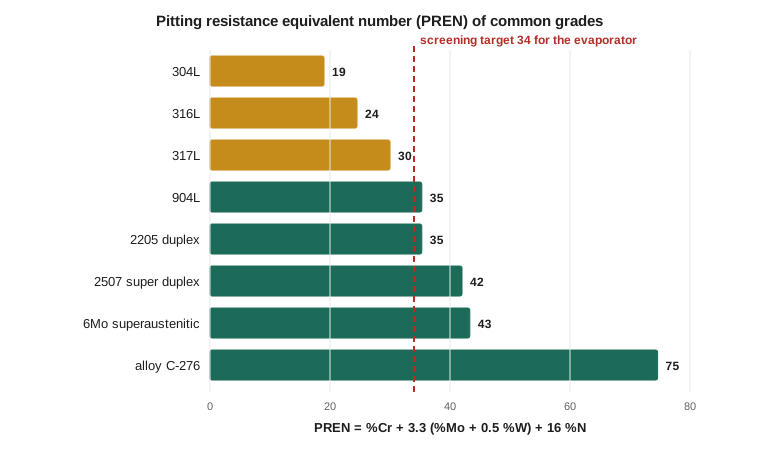
For the thin stillage evaporator, Rafael and Theo look at the conditions. The stillage runs at up to about 90 °C in the first effect, with a pH near 4, chloride levels that vary from about 300 to 1,000 mg/L depending on the corn and the recycled water, and heavy deposits on the tubes between cleanings. The 304L tubes, with a PREN near 19, pitted under deposits. Rafael sets a screening target of PREN 34 for the replacement tubes, based on published critical pitting temperature data and on experience at other ethanol plants. The program below calculates PREN for the candidates.
# Pitting resistance equivalent number (PREN) for common grades
# PREN = %Cr + 3.3 (%Mo + 0.5 %W) + 16 %N   (typical mid-range compositions)
grades = {
    "304L":        {"Cr": 18.2, "Mo": 0.0, "N": 0.05, "W": 0.0},
    "316L":        {"Cr": 16.8, "Mo": 2.1, "N": 0.05, "W": 0.0},
    "317L":        {"Cr": 18.5, "Mo": 3.2, "N": 0.06, "W": 0.0},
    "2205 duplex": {"Cr": 22.4, "Mo": 3.1, "N": 0.17, "W": 0.0},
    "904L":        {"Cr": 20.0, "Mo": 4.4, "N": 0.05, "W": 0.0},
    "2507 duplex": {"Cr": 25.0, "Mo": 3.8, "N": 0.28, "W": 0.0},
    "6Mo super":   {"Cr": 20.0, "Mo": 6.1, "N": 0.20, "W": 0.0},
    "alloy C-276": {"Cr": 15.5, "Mo": 16.0, "N": 0.0, "W": 3.8},
}
def pren(c):
    return c["Cr"] + 3.3 * (c["Mo"] + 0.5 * c["W"]) + 16 * c["N"]

need = 34   # PREN screening target chosen for the hot evaporator duty
for g, c in sorted(grades.items(), key=lambda kv: pren(kv[1])):
    p = pren(c)
    flag = "meets" if p >= need else "below"
print(f"{g:12s} PREN = {p:5.1f} {flag} target {need}")304L PREN = 19.0 below target 34 316L PREN = 24.5 below target 34 317L PREN = 30.0 below target 34 904L PREN = 35.3 meets target 34 2205 duplex PREN = 35.3 meets target 34 2507 duplex PREN = 42.0 meets target 34 6Mo super PREN = 43.3 meets target 34 alloy C-276 PREN = 74.6 meets target 34
Only 904L, 2205 duplex and the higher alloys meet the target. That seems to contradict the life-cycle analysis in Lesson 1, which favored 316L for a tank. The difference is temperature and deposits: the tank in Lesson 1 holds stillage at about 70 °C with smooth walls and regular cleaning, while the evaporator tubes are hotter, carry deposits and have hot heat-transfer surfaces where chloride concentrates as water boils off. Materials selection is always service specific. For the evaporator, Rafael's recommendation will be 2205 duplex tubes, with a chloride integrity operating window and more frequent cleaning.
Sensitization and intergranular corrosion
When austenitic stainless steel is held in the temperature range of about 450 to 850 °C, as happens in the heat-affected zone next to a weld, carbon in the steel can combine with chromium to form chromium carbides along the grain boundaries. The metal next to the carbides is depleted in chromium, sometimes below the level needed for a passive film. The steel is then sensitized, and in many acids it corrodes rapidly along the grain boundaries while the grains themselves remain intact. Grains can fall out of the surface, and the attack can penetrate a weld zone quickly. This was a common failure in the early decades of stainless steel use.
Three remedies are used. Low-carbon grades (304L, 316L) contain too little carbon to form harmful amounts of carbide during normal welding. Stabilized grades (321 with titanium, 347 with niobium) tie up the carbon in stable carbides so it cannot take chromium. And solution annealing, heating the whole item to about 1,050 °C and quenching, dissolves carbides that have formed. Lesson 8 covers intergranular corrosion again as a form of localized attack.
Stress corrosion cracking of austenitic stainless steel
Austenitic stainless steels such as 304L and 316L can crack when three conditions occur together: tensile stress (residual stress from welding and forming is enough), chloride, and a temperature above about 60 °C. The cracks are fine, branched and often transgranular, and they can go through a wall with very little visible corrosion. Classic locations are hot process lines with chloride-containing condensate, the outside of hot stainless lines under wet insulation that has leached chloride, and evaporators like the plant's. Duplex and ferritic grades and nickel-rich alloys resist chloride stress corrosion cracking much better. Lesson 9 covers it in detail.
Fabrication and surface condition
Stainless steel's corrosion resistance depends on a clean, fully passive surface. Fabrication can spoil it. Heat tint, the colored oxide left next to welds, has a chromium-depleted layer beneath it and pits easily; it should be removed by pickling or mechanical cleaning. Free iron from carbon steel tools, grinding wheels or work tables can embed in the surface and rust, starting pits. Weld spatter, scratches and rough grinding create crevices. Specifications for stainless equipment therefore call for dedicated tools, pickling or other cleaning of welds, and a final passivation treatment, usually with nitric or citric acid, to remove free iron and help the passive film form. Rafael's inspectors also check that welds in hygienic areas are smooth and fully penetrated, with no crevices for deposits or bacteria.
Nickel alloys
When stainless steels are not enough, plants turn to nickel-based alloys. Nickel itself resists caustic soda extremely well, which is why nickel 200 and 201 are used in caustic evaporators. Alloy 400 (nickel-copper) resists hydrofluoric acid, seawater and many neutral salts. Alloy 600 and 625 (nickel-chromium, with molybdenum and niobium in 625) combine high-temperature strength with good corrosion resistance. The nickel-chromium-molybdenum C-type alloys, such as C-276 and C-22, resist an exceptionally wide range of oxidizing and reducing acids and chloride solutions, including hot, acidic chloride environments that pit every stainless steel. Alloy B-2 and B-3 (nickel-molybdenum) handle hydrochloric acid, but they fail rapidly if oxidizers such as ferric ions or dissolved oxygen are present.
Nickel alloys cost several times more than stainless steel, so they are usually reserved for the parts of a system where the environment is worst: the dilution point of a sulfuric acid system, a heat exchanger in hot acid chloride service, or the weld overlay on a carbon steel vessel. Cladding, a thin layer of alloy bonded to carbon steel plate, gives the corrosion resistance of the alloy with the strength and economy of carbon steel. Clad plate and weld overlay are common in large vessels.
Worked problem
Using PREN to rank two candidates
Lean duplex 2304 typically contains about 23 % Cr, 0.3 % Mo and 0.10 % N. Grade 316L contains about 16.8 % Cr, 2.1 % Mo and 0.05 % N. Which has the higher PREN?
Show solution
- 2304: \(23 + 3.3 \times 0.3 + 16 \times 0.10 = 23 + 0.99 + 1.6 = 25.6\).
- 316L: \(16.8 + 3.3 \times 2.1 + 16 \times 0.05 = 16.8 + 6.93 + 0.8 = 24.5\).
- The values are close.
Answer: Lean duplex 2304 has a slightly higher PREN (about 25.6 against 24.5), and much higher strength. The two would be expected to have broadly similar pitting resistance, so the choice would turn on strength, availability, fabrication and stress corrosion cracking resistance.
Common mistakes
MistakeAssuming stainless steel does not corrode.
InsteadIt resists general corrosion, but chloride, deposits, crevices and heat can cause pitting, crevice corrosion and cracking.
MistakeTreating PREN as a guarantee of performance.
InsteadUse PREN to rank alloys, then confirm with test data and experience in the real service.
MistakeLeaving heat tint and free iron on new stainless welds.
InsteadRemove heat tint, clean with dedicated tools and passivate before service.
MistakeUsing 304 in hot chloride service because it passed in cold water.
InsteadTemperature strongly increases pitting and stress corrosion cracking risk; screen at the hottest condition.
Summary and key terms
- Stainless steels contain at least about 10.5 % chromium, which forms a thin, self-healing passive oxide film.
- Chloride, crevices, deposits, acidity and heat can break down the film locally, causing pitting and crevice corrosion.
- Austenitic grades (304L, 316L) are the workhorses; duplex grades add strength and chloride resistance; ferritic and martensitic grades have niche uses.
- PREN = %Cr + 3.3(%Mo + 0.5%W) + 16%N ranks chloride pitting resistance but does not replace testing.
- Sensitization near welds causes intergranular corrosion; low-carbon and stabilized grades prevent it.
- Austenitic grades can suffer chloride stress corrosion cracking above about 60 °C; duplex and nickel-rich alloys resist it better.
- Nickel alloys handle caustic, hydrofluoric acid, hot acid chlorides and reducing acids at much higher cost, often used as cladding or overlay.
- Passive film
- A very thin, adherent oxide layer that greatly slows corrosion of metals such as stainless steel, titanium and aluminum.
- PREN
- Pitting resistance equivalent number, a composition-based index used to rank stainless steels and nickel alloys for chloride pitting resistance.
- Critical pitting temperature
- The lowest temperature at which an alloy pits in a standard chloride test solution.
- Sensitization
- Precipitation of chromium carbides at grain boundaries during heating, leaving chromium-depleted zones prone to intergranular attack.
- Duplex stainless steel
- A stainless steel with a roughly equal mix of austenite and ferrite, giving high strength and good chloride resistance.
- Passivation
- A chemical treatment, usually with nitric or citric acid, that removes free iron and promotes a uniform passive film on stainless steel.
- Cladding
- A layer of corrosion-resistant alloy bonded to a cheaper structural metal such as carbon steel.
Practice problems
Work each problem on paper first, then reveal the answer to check.
Calculate the PREN of an alloy with 25 % Cr, 3.5 % Mo and 0.25 % N.
Show answer
\(25 + 3.3 \times 3.5 + 16 \times 0.25 = 25 + 11.55 + 4 = 40.6\).
Why are 304L and 316L preferred to 304 and 316 for welded equipment?
Show answer
Their low carbon content prevents sensitization in weld heat-affected zones.
Name the three conditions needed for chloride stress corrosion cracking of 304L.
Show answer
Tensile stress, chloride and a temperature above about 60 °C.
Why should heat tint be removed from stainless steel welds?
Show answer
The chromium-depleted layer beneath the colored oxide is prone to pitting.
Which nickel alloy family resists hot acid chloride solutions that pit stainless steels?
Show answer
The nickel-chromium-molybdenum C-type alloys such as C-276 and C-22.
Why might duplex tubes cost less overall than their price per kilogram suggests?
Show answer
Their higher strength allows thinner walls, reducing the mass needed.
Lesson quiz · 5 questions
Score 60% or more to complete this lesson.
Create a free account to save your progress, take quizzes and earn a certificate.