
CHE-280 · Lesson 2 of 12 · 23 min
Carbon and low-alloy steels
Walk around the Kingfisher Bioenergy plant and most of the metal you see is carbon steel: the grain bins and conveyors, the ethanol and gasoline storage tanks, the sulfuric acid tank and its piping, the steam headers, the condensate return lines, the cooling tower piping, the structural steel, the buried natural gas lateral. Carbon steel earns that place by being strong, tough, easy to weld and form, available in every shape and size, covered by every design code, and far cheaper per kilogram than any alternative. Its one great weakness is that it rusts. This lesson looks at what carbon and low-alloy steels are, how designers allow for their corrosion, and which services suit them. MEC-250 covers the metallurgy of steel, including the iron-carbon diagram and heat treatment, in depth; here the focus is on how process engineers use the material.
What carbon steel is
Carbon steel is iron with up to about 0.3 percent carbon for most pressure equipment, plus manganese (typically 0.6 to 1.2 percent) for strength and small amounts of silicon, sulfur and phosphorus. The carbon content controls strength and weldability: more carbon gives higher strength but raises the risk of hard, brittle zones forming next to welds as they cool. Process plants therefore favor low-carbon grades with a limit on the carbon equivalent, a weighted sum of carbon, manganese and other alloying elements used to judge weldability. Plates for pressure vessels are bought to material specifications such as ASME SA-516 Grade 70, a fine-grained steel with good toughness; piping is often ASME SA-106 Grade B seamless pipe or SA-53 welded pipe for utility services.
Toughness matters as much as strength. A carbon steel that is tough at room temperature can become brittle in cold weather, and a brittle vessel or line can crack catastrophically from a small defect. Codes set minimum design metal temperatures and require impact testing for materials and welds used at low temperatures. That is a real concern in Cedar Rapids, where outdoor equipment sees winter temperatures far below freezing. Rafael checks the minimum design metal temperature on every outdoor vessel's nameplate, and any line that can be cooled by flashing liquid, such as a pressure relief outlet, gets the same attention.
Why carbon steel corrodes
In water containing dissolved oxygen, carbon steel corrodes by the reaction of iron with oxygen and water to form iron oxides and hydroxides, the familiar rust. Lesson 6 explains the electrochemistry; the practical point here is that the rust carbon steel forms is porous and poorly adherent, so it does not stop further attack the way the chromium oxide film on stainless steel does. The corrosion rate depends on the supply of oxygen, the temperature, the pH, the velocity and the dissolved salts. In neutral, oxygenated water at room temperature, typical rates are 0.1 to 0.3 mm/y if nothing is done about it. In deaerated water at a pH above about 9.5, carbon steel forms a protective layer of magnetite (Fe\(_3\)O\(_4\)) and corrodes very slowly, which is why boiler water is deaerated and kept alkaline.
Acids attack carbon steel quickly. In dilute sulfuric or hydrochloric acid, iron dissolves and hydrogen gas is evolved, and rates can reach many millimeters per year. Concentrated sulfuric acid is a famous exception: above about 90 percent, carbon steel forms a film of iron sulfate that protects it as long as the acid is cold and slow moving. That is why the plant stores 93 percent sulfuric acid, used to adjust mash pH, in a carbon steel tank. If the acid absorbs water from humid air and dilutes, or if it flows too fast and strips the sulfate film, attack becomes severe. Hydrogen bubbles rising along the wall of a sulfuric acid tank can cut long grooves, called hydrogen grooving, in the steel above the nozzles. The plant limits acid velocity in carbon steel piping to well under 1 m/s and uses alloy for the pump and the dilution point, where the acid meets water and gets hot.
Corrosion allowance
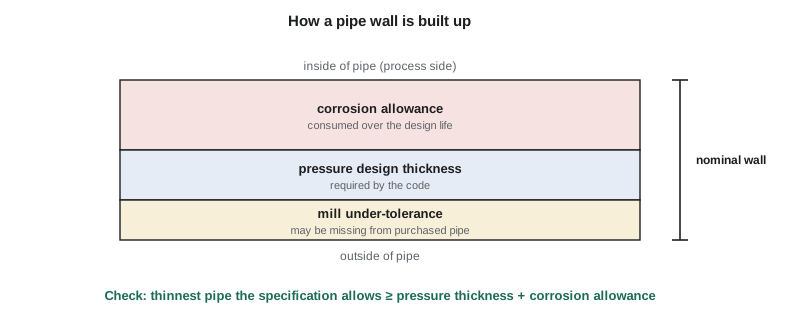
Because carbon steel's general corrosion is usually predictable, designers handle it by making the wall thicker than pressure alone requires. The extra metal is the corrosion allowance, and it is meant to be consumed over the design life. A common default for carbon steel in mildly corrosive service is 1.5 to 3 mm; for clean, dry services such as instrument air or lubricating oil, the allowance may be zero. The allowance should come from the expected corrosion rate multiplied by the design life, rounded up, and not from habit. If the expected rate times the life gives more than about 6 mm, the allowance becomes expensive and hard to justify, and a more resistant material or a lining is usually the better choice.
The pressure design thickness comes from the design code. For a thin-walled cylinder under internal pressure, the classic result from a force balance (often called Barlow's formula) is
where \(P\) is the design pressure, \(D\) the outside diameter, \(S\) the allowable stress and \(E\) the weld joint efficiency. The codes use refined versions of this equation with extra terms, but it gives the right order of magnitude. Pipe is bought in standard wall schedules, and the purchased wall may be up to 12.5 percent thinner than nominal under common pipe specifications, so the designer must check that the thinnest pipe allowed by the specification still has the pressure thickness plus the corrosion allowance.
The program below sizes a carbon steel line for dilute acid waste. The pressure thickness is tiny, less than half a millimeter, because a 1 MPa line of this diameter does not need much steel to hold pressure. The 20-year corrosion allowance of 5 mm dominates the wall, and schedule 40 pipe falls just short once its mill tolerance is counted. The program then shows the other half of the story: how the plant estimates remaining life and the next inspection date from thickness readings taken in service.
# Corrosion allowance and remaining life for a carbon steel sulfuric acid line
# Thin-wall pressure thickness (Barlow form): t = P*D / (2*S*E)
P = 1.0e6        # design pressure, Pa (1.0 MPa)
D = 0.1143       # outside diameter, m (NPS 4)
S = 138e6        # allowable stress, Pa
E = 1.0          # joint efficiency (seamless)
t_press = P * D / (2 * S * E)
print(f"pressure design thickness = {t_press * 1000:.2f} mm")

rate = 0.25      # measured corrosion rate, mm per year
life = 20        # design life, years
CA = rate * life
print(f"corrosion allowance for {life} years at {rate} mm/y = {CA:.1f} mm")
t_min = t_press * 1000 + CA
print(f"minimum thickness at installation = {t_min:.2f} mm")

# NPS 4 walls: schedule 40 = 6.02 mm, schedule 80 = 8.56 mm; allow 12.5 % mill under-tolerance
for sched, nominal in [("40", 6.02), ("80", 8.56)]:
    t_mill = nominal * 0.875
    print(f"schedule {sched} after mill tolerance = {t_mill:.2f} mm ->", "ok" if t_mill >= t_min else "too thin")

# Remaining life from two thickness readings
t_prev, t_now, years = 5.80, 5.05, 3.0
r = (t_prev - t_now) / years
t_req = 1.5      # minimum required (structural minimum governs here)
rem = (t_now - t_req) / r
print(f"short-term rate = {r:.2f} mm/y, remaining life = {rem:.1f} years")
print(f"next inspection at half the remaining life = {rem / 2:.1f} years")pressure design thickness = 0.41 mm corrosion allowance for 20 years at 0.25 mm/y = 5.0 mm minimum thickness at installation = 5.41 mm schedule 40 after mill tolerance = 5.27 mm -> too thin schedule 80 after mill tolerance = 7.49 mm -> ok short-term rate = 0.25 mm/y, remaining life = 14.2 years next inspection at half the remaining life = 7.1 years
Many lines are limited by structural minimum thickness rather than pressure thickness. A thin pipe that easily holds the pressure can still sag between supports, buckle under external loads or be damaged by a ladder leaning on it, so plants set a minimum structural thickness for each size. Rafael's inspectors compare readings with whichever is larger, the pressure minimum or the structural minimum, when they calculate remaining life.
Worked problem
Choosing a corrosion allowance
A carbon steel condensate line is expected to corrode at 0.12 mm/y. The design life is 25 years. What corrosion allowance should be specified, and is carbon steel a sensible choice?
Show solution
- Allowance = rate × life = \(0.12 \times 25 = 3.0\) mm.
- Round to a standard value: 3 mm.
- An allowance of 3 mm is within the normal range for carbon steel, and the rate is predictable.
Answer: Specify a 3 mm corrosion allowance; carbon steel is reasonable, provided the condensate treatment that produced the 0.12 mm/y estimate is maintained.
Where carbon steel struggles
Carbon steel is a poor choice wherever corrosion is localized or unpredictable, or where iron pickup would spoil the product. Ethanol is an interesting case. Pure, dry ethanol barely corrodes carbon steel, so the plant's storage tanks and the rail loading lines are carbon steel. But fuel-grade ethanol containing dissolved oxygen, a little water and some chloride has caused stress corrosion cracking in carbon steel tanks and pipelines, particularly near welds that were not stress relieved. Industry studies in the 2000s, summarized in an API recommended practice on ethanol stress corrosion cracking, led to practices such as reducing dissolved oxygen, keeping tanks free of standing water and stress relieving new welds. Lesson 9 returns to this example.
Carbonic acid in steam condensate is another classic problem. Carbon dioxide from the decomposition of bicarbonate in boiler feedwater travels with the steam and dissolves in the condensate, lowering its pH to 5 or 6. The weak acid thins carbon steel condensate lines steadily, especially at the bottom of horizontal runs and at threaded joints, where the wall is thinnest. The usual cure is chemical: neutralizing amines that raise the condensate pH, as Lesson 11 describes. Oxygen leaking into the condensate system makes things much worse, adding pitting to the general thinning.
Microbiologically influenced corrosion is a third concern, especially in firewater systems and other lines with stagnant water. Bacteria such as sulfate-reducing bacteria grow in deposits and produce acids and sulfides that pit carbon steel quickly. Water that sits for months in a dead leg of a firewater main, at a temperature bacteria enjoy, is a perfect incubator. Flushing, eliminating dead legs and treating the water reduce the risk.
Low-alloy steels
Low-alloy steels add a few percent of chromium and molybdenum, and sometimes vanadium, to carbon steel. The common grades are named by their nominal chromium and molybdenum contents: 1¼Cr-½Mo, 2¼Cr-1Mo, 5Cr-½Mo and 9Cr-1Mo. Their main advantages are strength at high temperature, resistance to creep, resistance to oxidation and sulfidation, and resistance to high-temperature hydrogen attack, in which hydrogen diffuses into hot steel and reacts with carbon to form methane bubbles that weaken the steel from inside. Refineries and petrochemical plants use them widely in furnaces, hydrotreaters and steam systems. At an ethanol plant they appear mainly in high-pressure steam piping and boiler tubes.
Low-alloy steels are harder to weld than carbon steel. Most need preheating before welding and post-weld heat treatment afterwards to temper hard zones and relieve residual stress, and the welding procedures must be qualified to the code. They are not stainless: a few percent chromium improves high-temperature oxidation resistance but does nothing useful for room-temperature corrosion in water. In wet services they corrode much like carbon steel.
| Steel | Typical use in process plants | Notes |
|---|---|---|
| Carbon steel (SA-516 Gr 70, SA-106 Gr B) | Vessels, tanks, piping, structures | Default material; needs corrosion allowance or protection |
| Killed, fine-grain carbon steel with impact testing | Low-temperature service | Toughness checked against minimum design metal temperature |
| 1¼Cr-½Mo, 2¼Cr-1Mo | High-temperature steam, hydrogen service | Creep and hydrogen attack resistance; preheat and heat treatment |
| 5Cr-½Mo, 9Cr-1Mo | Furnace tubes, sulfidation service | Better high-temperature oxidation and sulfidation resistance |
| Weathering steel | Structures, some outdoor equipment | Forms adherent rust in alternating wet and dry outdoor exposure |
Galvanizing and other coatings
Much of the outdoor carbon steel at the plant, such as grating, handrails, cable trays and small structures, is hot-dip galvanized. Galvanizing coats the steel with zinc, which corrodes slowly in the atmosphere and, where the coating is scratched, corrodes preferentially to protect the exposed steel, an example of the sacrificial protection described in Lesson 7. A typical galvanized coating lasts decades in a rural atmosphere but much less near cooling tower drift or chemical fumes. Larger equipment is painted with multi-coat systems, covered in Lesson 11, and tanks and vessels in aggressive service may be lined with polymers or glass, covered in Lesson 5.
Common mistakes
MistakeSpecifying a corrosion allowance out of habit, such as 3 mm everywhere.
InsteadBase the allowance on the expected rate multiplied by the design life, and change materials if it becomes too large.
MistakeForgetting the mill under-tolerance when checking pipe wall.
InsteadCheck that the thinnest wall the specification allows still meets the required thickness.
MistakeAssuming low-alloy steels resist wet corrosion.
InsteadA few percent chromium improves high-temperature behavior but not corrosion in water.
MistakeRunning concentrated sulfuric acid at high velocity in carbon steel.
InsteadKeep velocity low to preserve the protective sulfate film, and use alloy where flow is fast or the acid is diluted.
Summary and key terms
- Carbon steel is the default material for process plants because it is strong, tough, weldable, available and cheap.
- Its rust is porous and non-protective, so designers handle its corrosion with allowances, coatings, inhibitors and environmental control.
- Corrosion allowance should equal the expected rate times the design life; above about 6 mm, consider another material.
- Pressure thickness from the code is added to the corrosion allowance and checked against the mill under-tolerance.
- Carbon steel suits concentrated sulfuric acid at low velocity, deaerated alkaline water and dry ethanol, but not dilute acids or stagnant water prone to microbial attack.
- Low-alloy chromium-molybdenum steels serve high-temperature and hydrogen services but behave like carbon steel in wet corrosion.
- Galvanizing and coatings protect outdoor and moderately exposed carbon steel.
- Carbon equivalent
- A weighted sum of carbon and alloying element contents used to judge a steel's weldability and risk of hard weld zones.
- Minimum design metal temperature
- The lowest metal temperature at which equipment may be pressurized, set by the material's toughness.
- Hydrogen grooving
- Grooves cut in carbon steel by hydrogen bubbles disrupting the protective film in concentrated sulfuric acid.
- Mill tolerance
- The amount by which a purchased pipe or plate may differ from its nominal thickness.
- High-temperature hydrogen attack
- Damage to hot steel in which absorbed hydrogen reacts with carbon to form methane, causing fissures and loss of strength.
- Galvanizing
- Coating steel with zinc, usually by dipping in molten zinc, for atmospheric corrosion protection.
Practice problems
Work each problem on paper first, then reveal the answer to check.
Why does concentrated sulfuric acid not dissolve carbon steel rapidly?
Show answer
The steel forms a protective iron sulfate film, provided the acid stays concentrated, cool and slow moving.
A line needs 0.6 mm for pressure, has an expected rate of 0.1 mm/y and a 30-year life. What minimum wall is needed before mill tolerance?
Show answer
\(0.6 + 0.1 \times 30 = 3.6\) mm.
Nominal wall is 4.5 mm with 12.5 percent under-tolerance. What is the thinnest wall allowed?
Show answer
\(4.5 \times 0.875 = 3.94\) mm.
Why is boiler water deaerated and kept alkaline?
Show answer
Carbon steel forms a protective magnetite layer and corrodes very slowly in deaerated water above about pH 9.5.
Name two damage mechanisms that low-alloy chromium-molybdenum steels resist better than carbon steel.
Show answer
High-temperature hydrogen attack and creep, as well as high-temperature oxidation and sulfidation.
What causes carbonic acid corrosion in condensate lines?
Show answer
Carbon dioxide released from bicarbonate in the boiler water travels with the steam and dissolves in the condensate, lowering its pH.
Lesson quiz · 5 questions
Score 60% or more to complete this lesson.
Create a free account to save your progress, take quizzes and earn a certificate.