
CHE-280 · Lesson 11 of 12 · 21 min
Corrosion prevention: design, inhibitors and coatings
By now Theo can recognize most of the ways equipment corrodes. Rafael's next lesson is about stopping it. Corrosion control has five main tools, and a good plant uses all of them: choose the right material (Lessons 1 to 5); design to avoid conditions that cause corrosion; change the environment, including adding inhibitors; separate the metal from the environment with coatings and linings; and change the electrochemistry with cathodic or anodic protection. This lesson covers design, environmental control, inhibitors and coatings, using three problems at the Kingfisher Bioenergy plant as examples: the condensate system whose coupons showed 0.14 mm/y in Lesson 7, the cooling water system, and the external coating of the tank farm. Lesson 12 covers cathodic protection, inspection and the management system that ties it all together.
Designing out corrosion
Many corrosion problems are built in at the design stage and could have been avoided with a few simple rules. Avoid crevices: use welded joints instead of bolted or riveted ones where possible, make butt welds with full penetration and smooth roots, and seal or fill gaps that cannot be avoided. Make sure vessels and tanks drain completely, with sloped bottoms and drains at the lowest points, so that liquids and sludge do not collect. Avoid dead legs, branches with no flow where water stagnates and microbes grow; if a branch is needed only occasionally, keep it short or flush it regularly. Keep velocities between the lower limit needed to prevent deposits and the upper limit that causes erosion. Avoid sudden changes in direction and cross-section in high-velocity lines, using long-radius elbows. Isolate dissimilar metals or avoid joining them. Provide access for inspection and cleaning, and allow corrosion allowance and replaceable parts where corrosion cannot be prevented.
Structural steel and outdoor equipment need the same care. Water should run off, not pond: angles should face down, channels should have drain holes, and stiffeners should leave gaps for water to escape. Tank bottoms on soil should sit on a well-drained foundation, and the edge where the bottom plate meets the foundation should be sealed so water cannot get under it. Supports for insulated pipe should keep water from entering the insulation. Rafael likes to say that every piece of equipment that collects water will eventually corrode, and that a drain hole costs nothing at the design stage.
Changing the environment
Corrosion requires a cathodic reactant and an electrolyte, so removing or reducing either slows it. Deaeration removes dissolved oxygen: boiler feedwater passes through a deaerator that strips oxygen with steam to a few parts per billion, followed by a chemical oxygen scavenger to remove the remainder. Raising pH reduces attack on carbon steel in many waters; boiler water is held alkaline, and the condensate treatment below raises the pH of the condensate. Dehumidification keeps the air in enclosed spaces, such as electrical rooms and the inside of large tanks during shutdowns, dry enough that steel does not corrode. Lowering temperature slows most corrosion reactions. Removing chloride, solids or contaminants by treatment, filtration or blowdown keeps them below damaging levels. Each of these is an environmental control, and each needs monitoring so that it keeps working.
Corrosion inhibitors
A corrosion inhibitor is a chemical added in small amounts to an environment to reduce its corrosivity. Inhibitors are classified by how they work. Anodic inhibitors, such as orthophosphate, molybdate, nitrite and the older chromate (now largely banned because of toxicity), help form or maintain a passive film on the anodic areas; they are effective but can be dangerous if underdosed, because a partly covered surface may leave small anodes facing large cathodes, causing pitting. Cathodic inhibitors, such as zinc salts and polyphosphates, precipitate films on cathodic areas or slow the cathodic reaction, and they are safer if underdosed. Film-forming (adsorption) inhibitors, such as organic amines, imidazolines and azoles, adsorb on the whole surface and block both reactions; tolyltriazole and benzotriazole protect copper alloys in cooling water. Vapor-phase inhibitors protect metal in enclosed spaces during storage. Oxygen scavengers such as sulfite remove the cathodic reactant. Neutralizers raise pH.
Inhibitor efficiency is defined from corrosion rates measured with and without the inhibitor:
An efficiency of 90 percent or more is typical of a good program, but efficiency depends on the dose, temperature, flow, the metal and the other chemicals present. Inhibitors work only where they reach: a dead leg or a crevice may receive almost none. They also need constant dosing and monitoring with coupons, probes and residual analysis, because the protection disappears quickly if the feed pump stops.
The condensate system
The plant's condensate coupons showed 0.14 mm/y, and the condensate returning to the boiler house carried more iron than the guide allows. Ingrid and Rafael traced the cause. Carbon dioxide from bicarbonate in the boiler water was dissolving in the condensate, bringing its pH down to about 5.5; air was also leaking in at a few failed vacuum breakers on heat exchangers that cycled on and off. The fix combined three tools. A neutralizing amine, a volatile compound that travels with the steam and condenses with the water, raises the condensate pH to about 8.5 to 9; the plant uses a blend whose components condense at different points in the system, so that both near and distant lines are protected. The failed vacuum breakers were replaced and the condensate receivers sealed to reduce oxygen ingress. And the boiler feedwater pretreatment was adjusted to remove more alkalinity, reducing the carbon dioxide formed. The program below works out the inhibitor efficiency after three months, the amine feed rate for the plant's steam flow, and a coating life estimate used later in the lesson.
# Inhibitor efficiency, dose and coating life
cr_blank, cr_inh = 0.62, 0.05       # mm/y, coupons without and with inhibitor
eff = (cr_blank - cr_inh) / cr_blank * 100
print(f"inhibitor efficiency = {eff:.0f} %")

# Dose for a condensate system: neutralizing amine fed in proportion to steam flow
steam = 18.0          # t/h of steam
ppm = 6.0             # target amine concentration in condensate, mg/kg
kg_per_day = steam * 1000 * ppm / 1e6 * 24
print(f"amine feed = {kg_per_day:.1f} kg/day")

# Coating breakdown: holidays let a small fraction of steel corrode; life to 3 % breakdown
# Simple model: breakdown grows linearly after an initial period
initial, growth = 2.0, 0.4            # years with no breakdown, % per year afterwards
years = initial + 3 / growth
print(f"coating reaches 3 % breakdown after about {years:.1f} years")inhibitor efficiency = 92 % amine feed = 2.6 kg/day coating reaches 3 % breakdown after about 9.5 years
The average coupon rate of 0.14 mm/y hid a much worse spot: an LPR probe near the failed vacuum breakers read 0.62 mm/y. After three months of treatment that line read 0.05 mm/y, an efficiency above 90 percent. The amine feed is small, a few kilograms a day, but it must be continuous, and the plant now trends condensate pH and iron weekly. If either drifts, the operators check the feed pump first.
Cooling water treatment
The cooling water system shows how many controls work together. An open recirculating cooling tower concentrates dissolved salts as water evaporates; the cycles of concentration, the ratio of dissolved solids in the tower water to those in the makeup, are controlled by blowdown. Higher cycles save water but raise chloride and scaling tendency. The treatment program typically combines scale inhibitors (phosphonates and polymers that keep calcium carbonate and calcium phosphate from depositing), corrosion inhibitors (orthophosphate, zinc or molybdate for steel, and an azole for copper alloys), dispersants to keep solids suspended, and biocides (an oxidizing biocide such as chlorine or bromine, sometimes with a non-oxidizing biocide) to control bacteria and algae. The water is monitored for pH, conductivity, inhibitor residuals, chloride, microbiological counts and corrosion rates on coupons and LPR probes. When Rafael upgraded the fermenter cooler from brass to 316L, he also set a chloride limit in the cooling water, enforced through the cycles of concentration, so the stainless tubes would not pit.
Protective coatings
Coatings are the most widely used form of corrosion protection by area. A paint coating protects steel by forming a barrier that slows the passage of water, oxygen and ions; some primers also inhibit corrosion chemically or protect sacrificially. Zinc-rich primers contain so much zinc dust that the particles touch each other and the steel, so the zinc corrodes in preference to any exposed steel at scratches, like galvanizing. A typical high-performance system for industrial steel has three layers: a zinc-rich primer (inorganic or organic), an epoxy intermediate coat for barrier thickness, and a polyurethane or polysiloxane topcoat for resistance to sunlight and weathering. Total dry film thickness is typically 250 to 350 µm for a moderately aggressive industrial atmosphere.
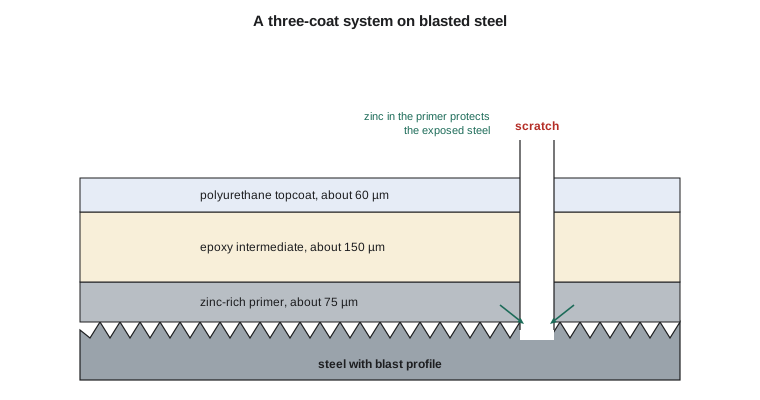
A coating's performance depends more on surface preparation and application than on the paint itself. Industry surveys repeatedly attribute most premature coating failures to poor surface preparation. Steel must be cleaned of oil and salts and abrasive blasted to a specified cleanliness, commonly a near-white metal grade from the joint standards of AMPP and the international standards organization, with a surface profile (roughness) of typically 50 to 75 µm to anchor the coating. Soluble salts, especially chloride, left on the steel draw water through the coating by osmosis and cause blistering, so salt levels are tested and limited. Each coat must be applied within the right temperature and humidity window, with the surface at least 3 °C above the dew point, to the specified thickness, and allowed to cure before the next. Inspectors measure dry film thickness with magnetic gauges, check for holidays, and test adhesion.
Coatings eventually degrade. Ultraviolet light chalks and erodes topcoats; water and ions permeate slowly; mechanical damage breaks the film; and corrosion spreads under the coating from defects, undercutting it. Maintenance painting is planned using the degree of rusting, rated against standard pictorial scales: touch-up is cheapest when breakdown is still a few percent of the area, while waiting until rust is widespread forces a full blast and recoat. The program above uses a simple model, in which breakdown starts after a delay and then grows steadily, to estimate when the tank farm coating will reach 3 percent breakdown, the plant's trigger for spot repair. Rafael's maintenance budget is built on that kind of estimate, checked against annual coating surveys.
Worked problem
Inhibitor efficiency from LPR readings
An LPR probe in a cooling water line reads 0.35 mm/y before a new inhibitor is added and 0.03 mm/y after it stabilizes. What is the inhibitor efficiency?
Show solution
- \(\eta = (0.35 - 0.03)/0.35 \times 100\%\).
- \(\eta = 0.32/0.35 \times 100\% = 91\%\).
Answer: About 91 percent. The program should still be checked with coupons, which also reveal pitting that LPR averages out.
Linings, wraps and metallic coatings
Lesson 5 covered polymer and glass linings for vessel interiors. Other protective layers include hot-dip galvanizing for structural steel and small parts, thermally sprayed aluminum or zinc for corrosion under insulation and for marine structures, metallic cladding and weld overlay for vessel interiors, fusion-bonded epoxy and multilayer polyethylene or polypropylene for buried pipelines, and petrolatum or wax tapes and heat-shrink sleeves for buried joints and irregular shapes. Every one of them has the same weakness: a defect leaves the steel exposed. Buried pipelines therefore combine coatings with cathodic protection, the subject of the next lesson.
Common mistakes
MistakeChoosing the paint system and neglecting surface preparation.
InsteadSpecify and inspect blast cleanliness, profile and soluble salts; most coating failures start there.
MistakeUnderdosing an anodic inhibitor to save cost.
InsteadPartial coverage can leave small anodes and cause pitting; keep anodic inhibitors above their minimum effective dose.
MistakeAssuming inhibitors protect stagnant branches and crevices.
InsteadInhibitors work only where they reach; flush or eliminate dead legs.
MistakePainting when the steel is near the dew point.
InsteadKeep the surface at least 3 °C above the dew point during application and curing.
Summary and key terms
- The five corrosion control tools are material selection, design, environmental control, coatings and electrochemical protection.
- Good design avoids crevices and dead legs, ensures drainage, controls velocity, isolates dissimilar metals and allows inspection.
- Environmental controls include deaeration, pH adjustment, dehumidification and limiting chloride and solids.
- Inhibitors are anodic, cathodic, film-forming, vapor-phase, scavengers or neutralizers; efficiency compares rates with and without inhibitor.
- Neutralizing amines, reduced oxygen ingress and better feedwater treatment controlled the plant's condensate corrosion.
- Coating systems typically combine a zinc-rich primer, an epoxy intermediate and a weathering topcoat; surface preparation decides their life.
- Plan maintenance painting from coating surveys before breakdown becomes widespread.
- Dead leg
- A section of piping with no flow, where water stagnates and corrosion or microbial growth is likely.
- Corrosion inhibitor
- A chemical added in small amounts to reduce the corrosivity of an environment.
- Inhibitor efficiency
- The percentage reduction in corrosion rate produced by an inhibitor.
- Neutralizing amine
- A volatile amine added to steam systems that condenses with the condensate and raises its pH.
- Cycles of concentration
- The ratio of dissolved solids in recirculating cooling water to those in the makeup water.
- Zinc-rich primer
- A primer with enough zinc dust to protect steel sacrificially at small breaks in the coating.
- Dry film thickness
- The thickness of a cured coating, usually measured in micrometers.
Practice problems
Work each problem on paper first, then reveal the answer to check.
List five design rules that reduce corrosion.
Show answer
For example: avoid crevices, ensure complete drainage, avoid dead legs, control velocity, isolate dissimilar metals and provide inspection access.
Why can underdosing an anodic inhibitor cause pitting?
Show answer
Partial film coverage leaves small anodic areas facing a large cathodic area.
Coupons show 0.48 mm/y without inhibitor and 0.06 mm/y with it. What is the efficiency?
Show answer
\((0.48 - 0.06)/0.48 \times 100\% = 87.5\%\).
How does a neutralizing amine protect condensate lines?
Show answer
It travels with the steam, condenses with the water and raises the condensate pH, reducing carbonic acid attack.
What are the three layers of a typical industrial coating system and their roles?
Show answer
A zinc-rich primer for sacrificial protection, an epoxy intermediate for barrier thickness and a polyurethane or polysiloxane topcoat for weathering resistance.
Why are soluble salts on blasted steel tested before coating?
Show answer
Salts draw water through the coating by osmosis and cause blistering.
Lesson quiz · 5 questions
Score 60% or more to complete this lesson.
Create a free account to save your progress, take quizzes and earn a certificate.