
CHE-260 · Lesson 6 of 12 · 24 min
UV-visible spectroscopy and the Beer-Lambert law
The cooling water at Kingfisher Bioenergy runs through miles of carbon steel pipe and heat exchangers. If corrosion speeds up, dissolved iron in the water rises before any leak appears, so the operators want an iron result every day. Phosphorus in the plant's effluent is limited by its permit, and the treatment operators need daily numbers to adjust chemical dosing. Both measurements use the same tool: a spectrophotometer that measures how much light a colored solution absorbs. Spectrophotometry is quick, cheap and sensitive, and it is the gateway to all the spectroscopic methods in the following lessons.
Light and absorption
Light is electromagnetic radiation, described by its wavelength \(\lambda\), frequency \(\nu\) and the energy of each photon, \(E = h\nu = hc/\lambda\), where h is Planck's constant and c the speed of light. Short wavelengths carry more energy. Ultraviolet light from about 190 to 400 nm and visible light from 400 to about 750 nm carry enough energy to promote electrons in molecules from lower to higher energy levels. Infrared light, at longer wavelengths, excites molecular vibrations instead, which Lesson 7 covers.
A molecule absorbs only photons whose energy matches the gap between two of its energy levels. Molecules with conjugated double bonds, aromatic rings or metal ions bound to suitable ligands absorb in the ultraviolet or visible region. The color we see is the complement of what is absorbed: a solution that absorbs blue-green light near 510 nm, like the red-orange iron complex used at the plant, looks orange-red. Most analytes are not colored, so many methods first convert the analyte into a colored product with a reagent that reacts selectively.
Transmittance and absorbance
When light of power \(P_0\) passes through a sample, some is absorbed and the transmitted power P is lower. The transmittance is \(T = P/P_0\), often quoted as a percentage, and the absorbance is:
An absorbance of 1 means 10 percent of the light gets through, an absorbance of 2 means 1 percent. Absorbance is preferred to transmittance because, under the right conditions, it is directly proportional to concentration.
The Beer-Lambert law
The Beer-Lambert law states that absorbance is proportional to the path length b through the sample and the concentration c of the absorbing species:
The proportionality constant \(\varepsilon\) is the molar absorptivity, in L/(mol cm) when b is in centimeters and c in mol/L. It depends on the substance, the wavelength and to some extent the solvent and temperature. A large \(\varepsilon\) means a sensitive method. The iron complex with 1,10-phenanthroline has \(\varepsilon\) of about 11,000 L/(mol cm) at 510 nm, which allows iron to be measured at a fraction of a milligram per liter in a standard 1 cm cell.
The law can be pictured simply. Each thin slice of solution absorbs the same fraction of the light reaching it, so the power falls exponentially with distance, and the logarithm of the ratio, the absorbance, grows linearly with path length. Doubling the concentration doubles the number of absorbing molecules in each slice, which also doubles the absorbance.
Worked problem
Molar absorptivity and an unknown
A 1.00 mg/L iron standard, developed with phenanthroline, has an absorbance of 0.199 in a 1.00 cm cell at 510 nm. Find the molar absorptivity, and the iron concentration of a solution with A = 0.316.
Show solution
- Convert the standard to mol/L: \(1.00 \times 10^{-3}\ \text{g/L}/55.845\ \text{g/mol} = 1.791 \times 10^{-5}\) mol/L.
- Molar absorptivity: \(\varepsilon = A/(bc) = 0.199/(1.00 \times 1.791 \times 10^{-5}) = 1.11 \times 10^4\) L/(mol cm).
- Unknown: concentration is proportional to absorbance, so \(1.00 \times 0.316/0.199 = 1.59\) mg/L.
Answer: The molar absorptivity is about \(1.1 \times 10^4\) L/(mol cm), and the unknown solution contains 1.59 mg/L iron. In practice the lab uses a multi-point calibration rather than a single standard.
Instruments
A spectrophotometer has five main parts. A source provides broad-band light: a deuterium lamp for the ultraviolet and a tungsten-halogen lamp for the visible. A monochromator, built around a diffraction grating and slits, selects a narrow band of wavelengths. The sample sits in a cuvette of known path length, usually 1.00 cm. A detector, a photodiode or photomultiplier, converts the transmitted light into a current. The electronics compare it with the blank to give absorbance.
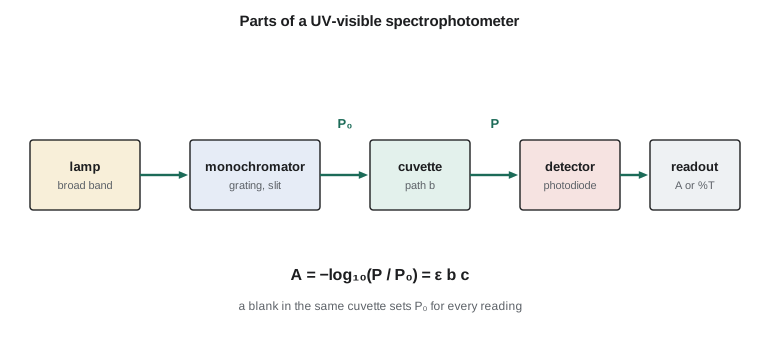
The blank, a cuvette filled with the solvent and reagents but no analyte, is measured to set \(P_0\). That cancels absorption by the solvent, the reagents and the cuvette walls, and reflection losses at the windows. Glass and plastic cuvettes suit the visible region but absorb ultraviolet light below about 320 nm, so ultraviolet work needs quartz cuvettes. Cuvettes are handled by their frosted sides and wiped clean, because a fingerprint on the light path adds absorbance.
Single-beam instruments measure the blank and sample one after the other. Double-beam instruments split the light and measure both at once, which cancels drift in the lamp. Diode-array instruments pass all wavelengths through the sample and spread them onto an array of detectors, recording a full spectrum in a fraction of a second. Simple filter photometers, which use a colored filter or light-emitting diode instead of a monochromator, are common in field kits and online analyzers for water treatment.
Choosing conditions and sources of error
Measurements are usually made at the wavelength of maximum absorbance, \(\lambda_{max}\), where sensitivity is highest and small errors in wavelength setting matter least, because the absorbance curve is flat at its peak. Absorbances between about 0.1 and 1.0 give the best precision. Below that, small differences between large signals are hard to measure. Above it, very little light reaches the detector and noise and stray light dominate.
The Beer-Lambert law is a limiting law and fails under some conditions. Chemical deviations occur when the absorbing species takes part in an equilibrium that shifts with concentration, such as an indicator whose two forms absorb differently or a complex that dissociates on dilution. Instrumental deviations arise from polychromatic light, because the law holds exactly only for a single wavelength, and from stray light, light of other wavelengths that reaches the detector without passing through the sample. Stray light makes high absorbances read low, bending the calibration curve toward the concentration axis. At high concentrations, above roughly 0.01 mol/L, interactions between absorbing molecules also change \(\varepsilon\).
Colorimetric methods at the plant
| Analyte | Reagent and product | Wavelength |
|---|---|---|
| Iron | 1,10-phenanthroline after reducing iron(III) to iron(II); orange-red complex | 510 nm |
| Phosphate | Molybdate and a reducing agent; molybdenum blue | About 880 nm |
| Ammonia | Salicylate and hypochlorite; blue-green indophenol dye | About 650 nm |
| Reducing sugars | Dinitrosalicylic acid on heating; red-brown product | 540 nm |
| Protein in enzyme assays | Dye-binding reagent; blue complex | 595 nm |
Each method reacts the analyte with a reagent to form a strongly absorbing product, using conditions that favor the reaction and suppress interferences. For iron, hydroxylamine first reduces any iron(III) to iron(II), which forms a stable complex with three phenanthroline molecules. For phosphate, the molybdenum blue method is so sensitive that it reaches micrograms per liter, which is why it is the standard for effluent phosphorus. Enzyme activity, important when the plant evaluates new amylase products, is often measured by following the change in absorbance as a reaction proceeds, a kinetic method that applies the rate laws from CHE-250.
Worked problem
Phosphorus in treated effluent
A calibration for phosphate-phosphorus by the molybdenum blue method has slope 0.415 absorbance units per mg/L P and intercept 0.006 in a 1.00 cm cell. A treated effluent sample, diluted 25.0 mL to 50.0 mL before the reagent is added, gives an absorbance of 0.218. A reagent blank carried through the procedure reads 0.012. What is the phosphorus in the effluent?
Show solution
- Correct for the reagent blank: \(0.218 - 0.012 = 0.206\). The calibration standards were also blank-corrected, so use the slope without the intercept: \(0.206/0.415 = 0.496\) mg/L in the diluted solution.
- Apply the dilution: \(0.496 \times 50.0/25.0 = 0.99\) mg/L P.
- Compare with the plant's monthly average permit limit, which for this example is 1.0 mg/L.
Answer: The effluent contains about 0.99 mg/L phosphorus, right at the example limit. The operators increase the dose of the chemical that precipitates phosphorus, and the lab runs a duplicate and a spiked sample to confirm the result before it goes on the monthly report.
Interferences are the main weakness of color-forming methods. Silicate forms a molybdenum blue of its own and can raise phosphate results; arsenate does the same. Strongly colored or turbid samples absorb or scatter light whatever their analyte content. Standard methods deal with these by controlling acidity and reaction time, by filtering or by measuring a sample blank without the color reagent and subtracting it. When a new kind of sample comes into the lab, such as water from a new well or a process stream after a change of chemistry, the analyst checks for interferences with a spike recovery before trusting routine results.
The program below calibrates the iron method from Theo's transmittance readings, calculates the molar absorptivity, reads a diluted cooling-water sample, and shows how half a percent of stray light distorts high absorbances.
# Beer-Lambert calibration for iron in cooling water (phenanthroline complex, 510 nm)
import math

std = [0.0, 0.5, 1.0, 2.0, 3.0, 4.0]                   # Fe, mg/L
T_pct = [100.0, 79.5, 63.3, 40.1, 25.3, 16.1]          # percent transmittance, 1.00 cm cell
A = [-math.log10(t / 100) + 0.0 for t in T_pct]
for c, a in zip(std, A):
    print(f"{c:4.1f} mg/L  A = {a:.3f}")
n = len(std); xm = sum(std) / n; ym = sum(A) / n
b = sum((x - xm) * (y - ym) for x, y in zip(std, A)) / sum((x - xm) ** 2 for x in std)
a0 = ym - b * xm
print(f"slope = {b:.4f} L/mg (path 1.00 cm), intercept = {a0:.4f}")
eps = b * 55.845 * 1000              # molar absorptivity, L/(mol cm)
print(f"molar absorptivity = {eps:,.0f} L/(mol cm)")

# Unknown cooling-water sample, diluted 10.00 mL to 25.00 mL before the complex is formed
A_unk = 0.316
c_cell = (A_unk - a0) / b
print(f"in the cell: {c_cell:.2f} mg/L; in the sample: {c_cell * 25 / 10:.2f} mg/L")

# Stray light makes high absorbances read low: 0.5 percent stray light
s = 0.005
for true_A in (0.5, 1.0, 2.0, 3.0):
    T = 10 ** -true_A
    meas = -math.log10((T + s) / (1 + s))
print(f"true A {true_A:.1f} reads as {meas:.2f}")0.0 mg/L A = 0.000 0.5 mg/L A = 0.100 1.0 mg/L A = 0.199 2.0 mg/L A = 0.397 3.0 mg/L A = 0.597 4.0 mg/L A = 0.793 slope = 0.1984 L/mg (path 1.00 cm), intercept = 0.0003 molar absorptivity = 11,082 L/(mol cm) in the cell: 1.59 mg/L; in the sample: 3.98 mg/L true A 0.5 reads as 0.50 true A 1.0 reads as 0.98 true A 2.0 reads as 1.83 true A 3.0 reads as 2.22
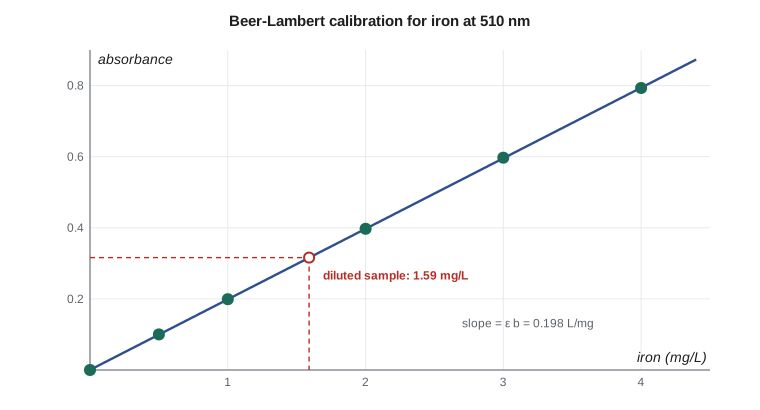
The diluted sample reads 1.59 mg/L, so the cooling water itself contains about 4.0 mg/L iron after allowing for the 10 to 25 mL dilution. That is high for this system, and the operators check the corrosion inhibitor dosing. The stray-light model shows why the lab dilutes samples that read above about 1.0: a true absorbance of 2.0 would read as 1.83, an error of 8 percent that no calibration within the normal range would reveal.
Beyond simple absorption
If two absorbing species are present, their absorbances add. Measuring at two wavelengths where their absorptivities differ gives two equations that can be solved for both concentrations, and modern software extends this to many components using the full spectrum. Fluorescence spectroscopy measures light emitted when excited molecules return to the ground state. Because it measures a small signal against a dark background, it can be a thousand times more sensitive than absorption, and it is used for trace organics and in many biological assays. Turbidity, the cloudiness of water caused by suspended particles, is measured by the light they scatter, and it is one of the simplest online measurements in water treatment.
Common mistakes
MistakeUsing a plastic cuvette for measurements below 320 nm.
InsteadUse quartz in the ultraviolet; glass and plastic absorb there.
MistakeReporting a sample with absorbance 2.5 from a calibration that ends at 0.8.
InsteadDilute into the calibrated range; stray light makes high absorbances read low.
MistakeSetting the wavelength on the steep side of an absorption band.
InsteadWork at the band maximum, where small wavelength errors change the absorbance least.
MistakeForgetting the dilution factor when reporting.
InsteadMultiply the result in the cell by the total dilution, and record the factor in the notebook.
Summary and key terms
- UV-visible light promotes electrons; molecules absorb photons whose energy matches an energy gap.
- Absorbance \(A = -\log T\) is proportional to path length and concentration: \(A = \varepsilon b c\).
- A spectrophotometer has a source, monochromator, cuvette, detector and readout; a blank sets the reference.
- Measure at the absorption maximum with absorbances between about 0.1 and 1.0.
- Chemical equilibria, polychromatic light, stray light and high concentrations cause deviations from the law.
- Color-forming reagents make iron, phosphate, ammonia and sugars measurable at low levels.
- Absorbance
- The logarithm of the ratio of incident to transmitted light power.
- Transmittance
- The fraction of incident light power that passes through a sample.
- Beer-Lambert law
- The relation A = εbc between absorbance, path length and concentration.
- Molar absorptivity
- The absorbance of a 1 mol/L solution in a 1 cm path at a given wavelength.
- Monochromator
- A device, usually a grating with slits, that selects a narrow band of wavelengths.
- Blank
- A solution containing everything except the analyte, used to set the zero of absorbance.
- Stray light
- Light reaching the detector that has not passed through the sample at the selected wavelength.
- Colorimetric method
- A method in which the analyte is converted to a colored product whose absorbance is measured.
Practice problems
Work each problem on paper first, then reveal the answer to check.
A solution transmits 25 percent of the light. What is its absorbance?
Show answer
\(-\log 0.25 = 0.602\).
What transmittance corresponds to A = 0.30?
Show answer
\(10^{-0.30} = 0.50\), or 50 percent.
A compound has ε = 8,400 L/(mol cm). What absorbance does a 5.0 × 10⁻⁵ mol/L solution give in a 1.00 cm cell?
Show answer
\(8400 \times 1.00 \times 5.0 \times 10^{-5} = 0.42\).
Why must a blank be measured?
Show answer
To cancel absorption and reflection by the solvent, reagents and cuvette so that only the analyte's absorbance is measured.
A cooling-water sample diluted 2.0 mL to 50.0 mL reads 0.80 mg/L iron. What is the iron in the original water?
Show answer
\(0.80 \times 50.0/2.0 = 20\) mg/L.
Why does stray light make high absorbances read low?
Show answer
Stray light adds to the small transmitted signal, so the detector sees more light than the sample really transmits.
Lesson quiz · 5 questions
Score 60% or more to complete this lesson.
Create a free account to save your progress, take quizzes and earn a certificate.