
CHE-250 · Lesson 8 of 12 · 24 min
Electrochemistry and corrosion
Corrosion costs Kingfisher Bioenergy more than any other materials problem. Thin stillage is warm, acidic and full of dissolved salts and organic acids; the fermenters see lactic and acetic acid whenever bacteria get ahead of the yeast; and the cooling towers concentrate dissolved oxygen and chloride. Carbon steel that would last decades in dry service can lose millimeters a year in those streams, which is why the stillage piping, evaporators and fermenters are built from stainless steel. Corrosion is an electrochemical process, and so are batteries, fuel cells, electroplating and the pH probes in the lab. This lesson connects the Gibbs energy of Lesson 3 to electrical potential.
Theo's questions come from the maintenance department. A section of carbon steel pipe in the condensate return system has thinned noticeably, and the inspector's ultrasonic readings suggest a corrosion rate of about a tenth of a millimeter a year. Ingrid wants Theo to understand the driving force behind that rate, why lowering the pH or adding oxygen makes it worse, and how corrosion engineers convert a measured current into a thickness loss.
Redox reactions and electrochemical cells
Every electrochemical process is a redox reaction split into two half-reactions. Oxidation, the loss of electrons, happens at the anode; reduction, the gain of electrons, happens at the cathode. In a galvanic cell the two half-reactions take place in separate compartments, electrons flow through an external wire from anode to cathode, and ions move through a salt bridge or membrane to keep each compartment electrically neutral. The cell converts the Gibbs energy of the reaction directly into electrical work.
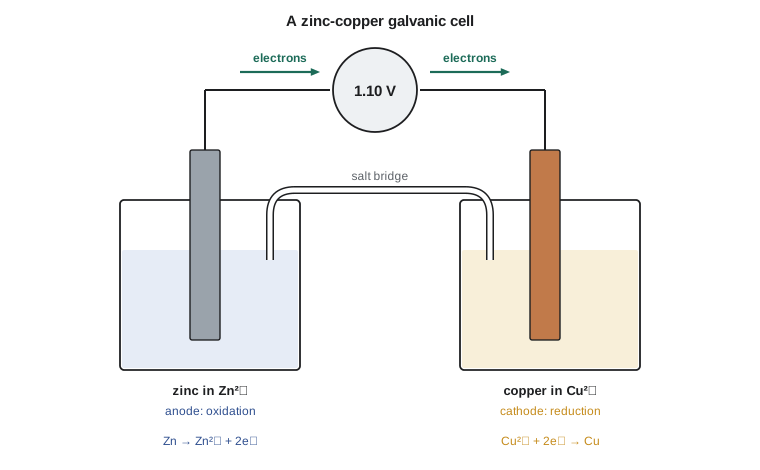
The classic example is the zinc-copper cell. Zinc metal is oxidized at the anode, \(\text{Zn} \to \text{Zn}^{2+} + 2e^-\), and copper ions are reduced at the cathode, \(\text{Cu}^{2+} + 2e^- \to \text{Cu}\). Under standard conditions the cell produces 1.10 V. Corrosion is the same process without the separate compartments: on a corroding steel surface, tiny anodic regions where iron dissolves sit next to cathodic regions where oxygen or hydrogen ions are reduced, and the metal itself carries the electrons between them.
Cell potential and Gibbs energy
The maximum electrical work a cell can do equals the decrease in its Gibbs energy, as Lesson 3 explained. Electrical work is charge times voltage, and \(n\) moles of electrons carry a charge of \(nF\), where the Faraday constant \(F = 96{,}485\) C/mol is the charge on one mole of electrons. Therefore:
A positive cell potential corresponds to a negative \(\Delta_r G\), a spontaneous reaction. For the zinc-copper cell, \(\Delta_r G^\circ = -2(96{,}485)(1.10) = -212\) kJ/mol. Combining this with \(\Delta_r G^\circ = -RT\ln K\) from Lesson 4 gives \(E^\circ = (RT/nF)\ln K\), so a standard cell potential is just another way of expressing an equilibrium constant. A potential of 1.10 V for a two-electron reaction corresponds to \(K \approx 10^{37}\): the reaction goes essentially to completion.
Standard electrode potentials
It is impossible to measure the potential of a single electrode, only the difference between two. By convention the standard hydrogen electrode, hydrogen gas at 1 bar bubbling over platinum in an acid of unit hydrogen-ion activity, is assigned a potential of exactly zero. Every other half-reaction is written as a reduction and assigned a standard reduction potential relative to it. The standard cell potential is then the cathode potential minus the anode potential: \(E^\circ_{cell} = E^\circ_{cathode} - E^\circ_{anode}\).
| Half-reaction (as reduction) | E° (V, approximate) |
|---|---|
| O₂ + 4H⁺ + 4e⁻ → 2H₂O | +1.23 |
| Cu²⁺ + 2e⁻ → Cu | +0.34 |
| 2H⁺ + 2e⁻ → H₂ | 0.00 (by definition) |
| Fe²⁺ + 2e⁻ → Fe | −0.44 |
| Zn²⁺ + 2e⁻ → Zn | −0.76 |
| Al³⁺ + 3e⁻ → Al | −1.66 |
The table ranks oxidizing and reducing strength. Species at the top, such as oxygen, are strong oxidizing agents; metals at the bottom, such as zinc and aluminum, are easily oxidized. Any reduction half-reaction can drive the oxidation of a metal below it. Oxygen in water can oxidize iron, which is why steel rusts. Zinc lies below iron, so zinc corrodes preferentially when the two are in contact; that is how galvanizing protects steel and how sacrificial zinc or magnesium anodes protect buried pipelines and ship hulls.
The Nernst equation
Real cells rarely operate at standard conditions. Substituting \(\Delta_r G = -nFE\) into \(\Delta_r G = \Delta_r G^\circ + RT\ln Q\) gives the Nernst equation:
Each factor of ten in \(Q\) changes the potential by 59.2 mV divided by the number of electrons. When a cell reaches equilibrium, \(Q = K\) and \(E = 0\): the battery is flat. The Nernst equation also explains how a pH meter works. The glass electrode's potential depends on the hydrogen-ion activity, changing by 59.2 mV per pH unit at 25 °C, and the meter converts the measured voltage into pH. That is why pH electrodes are calibrated with buffers and why their reading drifts with temperature unless the meter compensates.
Worked problem
Effect of concentration on a cell potential
For the zinc-copper cell at 25 °C, find the potential when the copper ion concentration falls to 0.010 mol/L while the zinc ion concentration stays at 1.0 mol/L.
Show solution
- The reaction is \(\text{Zn} + \text{Cu}^{2+} \to \text{Zn}^{2+} + \text{Cu}\), with \(n = 2\) and \(Q = [\text{Zn}^{2+}]/[\text{Cu}^{2+}] = 1.0/0.010 = 100\).
- \(E = 1.10 - (0.0592/2)\log_{10}100 = 1.10 - 0.0296 \times 2 = 1.041\) V.
Answer: About 1.04 V. The potential falls only slowly as the cell discharges, a logarithmic dependence that makes many batteries hold a fairly steady voltage for most of their life.
How pH controls corrosion
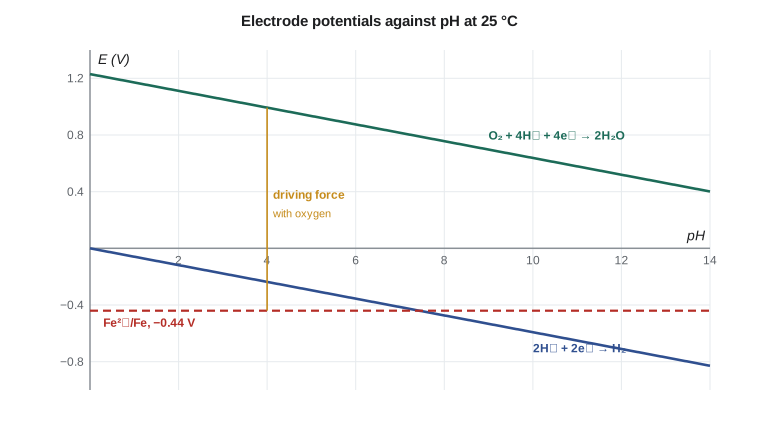
In acid, the main cathodic reaction on corroding steel is hydrogen evolution, \(2\text{H}^+ + 2e^- \to \text{H}_2\). Its potential depends on pH through the Nernst equation, \(E = -0.0592\,\text{pH}\) V at 25 °C with hydrogen at 1 bar, so lower pH raises the cathode potential and increases the driving force for iron dissolution. When dissolved oxygen is present, the reduction \(\text{O}_2 + 4\text{H}^+ + 4e^- \to 2\text{H}_2\text{O}\) provides an even larger driving force, with \(E = 1.23 - 0.0592\,\text{pH}\) V. In neutral, aerated water, oxygen reduction usually dominates, and the corrosion rate is limited by how fast oxygen diffuses to the steel surface.
These two reactions explain the plant's corrosion map. The condensate return line is warm, slightly acidic from dissolved carbon dioxide, which forms carbonic acid, and periodically aerated, so it corrodes carbon steel steadily. Boiler feedwater is treated to remove oxygen and raise pH to protect the boiler. The fermenters and stillage system combine low pH, chloride and organic acids, conditions under which only stainless steels and other resistant alloys form a protective oxide film that survives.
Corrosion rates and Faraday's law
Thermodynamics tells us whether a metal can corrode; it does not tell us how fast. The rate is measured as a corrosion current density, \(i_{corr}\), the anodic current per unit area, which corrosion engineers measure with electrochemical probes or infer from coupon weight loss. Faraday's law converts that current into a mass loss: each mole of iron dissolved as \(\text{Fe}^{2+}\) releases 2 mol of electrons. The thickness lost per unit time is:
where \(M\) is the molar mass and \(\rho\) the density of the metal. For iron, a corrosion current density of 1 µA/cm² corresponds to about 0.012 mm per year, and 10 µA/cm² to about 0.12 mm per year.
Worked problem
Converting a corrosion current to a thickness loss
A corrosion probe in the condensate return line reads \(i_{corr} = 10\) µA/cm² on carbon steel. Estimate the corrosion rate in mm per year, taking \(M = 55.85\) g/mol, \(n = 2\) and \(\rho = 7.87\) g/cm³.
Show solution
- Rate \(= (10 \times 10^{-6})(55.85)/(2 \times 96{,}485 \times 7.87) = 3.68 \times 10^{-10}\) cm/s.
- One year is \(3.156 \times 10^7\) s, so the rate is \(1.16 \times 10^{-2}\) cm/yr, or 0.116 mm/yr.
Answer: About 0.12 mm per year. A pipe with a 3 mm corrosion allowance would last about 25 years at that rate, but a local acidic upset that raised the current tenfold would consume the same allowance in two or three years, which is why the plant monitors corrosion continuously.
Fuel cells and the limits of electrochemical energy
A fuel cell runs a combustion reaction electrochemically, so it is not limited by the Carnot efficiency of a heat engine. The reversible voltage follows from \(\Delta_r G^\circ = -nFE^\circ\). For hydrogen and oxygen forming liquid water, \(E^\circ = 1.23\) V. For ethanol, oxidized completely to carbon dioxide and water in a reaction that transfers 12 electrons per molecule, \(E^\circ = 1{,}325{,}000/(12 \times 96{,}485) = 1.14\) V. Direct ethanol fuel cells remain a research topic, because breaking the carbon-carbon bond at a low-temperature electrode is slow, and practical cells produce far less than the reversible voltage. Lessons 9 to 11 explain why slow reactions waste so much of the available Gibbs energy.
Calculating potentials and corrosion rates
The program below calculates the zinc-copper cell potential under several concentrations, the hydrogen and oxygen electrode potentials at different pH values, the driving force for iron corrosion by oxygen, the corrosion rate of carbon steel for several current densities, and the reversible voltage of an ideal ethanol fuel cell.
# Cell potentials, the Nernst equation and corrosion rates (standard potentials approximate)
import math
R, F = 8.314, 96485.0
T = 298.15
E0 = {'Zn2+/Zn': -0.76, 'Fe2+/Fe': -0.44, '2H+/H2': 0.00, 'Cu2+/Cu': 0.34, 'O2/H2O': 1.23}

# 1) Daniell-type cell Zn | Zn2+ || Cu2+ | Cu
Ecell0 = E0['Cu2+/Cu'] - E0['Zn2+/Zn']
print(f"Zn-Cu standard cell potential = {Ecell0:.2f} V, dG = {-2 * F * Ecell0 / 1000:.0f} kJ/mol")
for cu, zn in ((1.0, 1.0), (0.01, 1.0), (1.0, 0.01)):
    E = Ecell0 - R * T / (2 * F) * math.log(zn / cu)
    print(f"  [Cu2+] = {cu}, [Zn2+] = {zn}: E = {E:.3f} V")

# 2) hydrogen and oxygen electrode potentials against pH (25 C, gases at 1 bar)
for pH in (2, 4, 7):
    EH = -0.0592 * pH
    EO = 1.23 - 0.0592 * pH
    print(f"pH {pH}: E(H+/H2) = {EH:+.3f} V   E(O2/H2O) = {EO:+.3f} V")

# 3) driving force for iron corrosion by oxygen at pH 4, with [Fe2+] = 1e-6 M
EFe = E0['Fe2+/Fe'] + R * T / (2 * F) * math.log(1e-6)
print(f"\nE(Fe2+/Fe) at 1e-6 M = {EFe:.3f} V; driving force with O2 at pH 4 = {(1.23 - 0.0592 * 4) - EFe:.2f} V")

# 4) corrosion rate of carbon steel from a corrosion current density (Faraday's law)
M_Fe, rho = 55.85, 7.87   # g/mol, g/cm3
for i_uA in (1, 10, 100):
    i = i_uA * 1e-6                         # A/cm2
    rate_cm_s = i * M_Fe / (2 * F * rho)    # cm/s
    print(f"i = {i_uA:3d} uA/cm2 -> corrosion rate = {rate_cm_s * 3.156e7 * 10:.3f} mm/yr")

# 5) ideal ethanol fuel cell: C2H5OH + 3 O2 -> 2 CO2 + 3 H2O(l), 12 electrons
dG = -1325.3e3
print(f"\nethanol fuel cell reversible voltage = {-dG / (12 * F):.3f} V")Zn-Cu standard cell potential = 1.10 V, dG = -212 kJ/mol [Cu2+] = 1.0, [Zn2+] = 1.0: E = 1.100 V [Cu2+] = 0.01, [Zn2+] = 1.0: E = 1.041 V [Cu2+] = 1.0, [Zn2+] = 0.01: E = 1.159 V pH 2: E(H+/H2) = -0.118 V E(O2/H2O) = +1.112 V pH 4: E(H+/H2) = -0.237 V E(O2/H2O) = +0.993 V pH 7: E(H+/H2) = -0.414 V E(O2/H2O) = +0.816 V E(Fe2+/Fe) at 1e-6 M = -0.617 V; driving force with O2 at pH 4 = 1.61 V i = 1 uA/cm2 -> corrosion rate = 0.012 mm/yr i = 10 uA/cm2 -> corrosion rate = 0.116 mm/yr i = 100 uA/cm2 -> corrosion rate = 1.161 mm/yr ethanol fuel cell reversible voltage = 1.145 V
The driving force for iron corrosion by oxygen in acidic water is about 1.6 V, enormous by chemical standards. Steel survives at all only because corrosion is slow: protective oxide films, limited oxygen supply and the sluggish kinetics of the electrode reactions hold the current to microamps per square centimeter. Corrosion control works by attacking those rates, through coatings, inhibitors, oxygen removal, pH control, cathodic protection or more resistant alloys.
Common mistakes
MistakeMultiplying standard potentials by stoichiometric coefficients.
InsteadPotentials are intensive; only ΔG scales with the amount of reaction.
MistakeSubtracting potentials the wrong way round.
InsteadE°cell = E°cathode − E°anode, with both written as reduction potentials.
MistakeAssuming a large positive cell potential means fast corrosion.
InsteadIt means a large driving force; the rate depends on kinetics, films and mass transfer.
MistakeUsing 0.0592 V in the Nernst equation at temperatures other than 25 °C.
InsteadUse RT/F at the actual temperature; the slope rises with temperature.
Summary and key terms
- Electrochemical cells split redox reactions into oxidation at the anode and reduction at the cathode.
- ΔG = −nFE links cell potential to Gibbs energy, and E° = (RT/nF) ln K links it to the equilibrium constant.
- Standard reduction potentials are measured against the standard hydrogen electrode and rank oxidizing strength.
- The Nernst equation, E = E° − (RT/nF) ln Q, gives potentials at real concentrations; E = 0 at equilibrium.
- Lower pH and dissolved oxygen raise the driving force for steel corrosion.
- Faraday's law converts a corrosion current density into a thickness loss: about 0.012 mm/yr per µA/cm² for iron.
- Anode
- The electrode at which oxidation occurs.
- Cathode
- The electrode at which reduction occurs.
- Faraday constant
- The charge on one mole of electrons, 96,485 C/mol.
- Standard hydrogen electrode
- The reference electrode assigned a potential of exactly zero.
- Standard reduction potential
- The potential of a half-reaction, written as a reduction, under standard conditions relative to the hydrogen electrode.
- Nernst equation
- E = E° − (RT/nF) ln Q, the potential of a cell or electrode at actual concentrations.
- Corrosion current density
- The anodic current per unit area of a corroding metal, a direct measure of corrosion rate.
- Sacrificial anode
- A more easily oxidized metal connected to a structure so that it corrodes instead.
Practice problems
Work each problem on paper first, then reveal the answer to check.
Find E°cell for a cell with an iron anode and a copper cathode.
Show answer
\(0.34 - (-0.44) = 0.78\) V.
What is ΔG° for that cell reaction, Fe + Cu²⁺ → Fe²⁺ + Cu?
Show answer
\(-2(96{,}485)(0.78) = -151\) kJ/mol.
By how much does the hydrogen electrode potential change between pH 3 and pH 6 at 25 °C?
Show answer
It falls by \(3 \times 0.0592 = 0.178\) V.
Why does zinc coating protect steel even where the coating is scratched?
Show answer
Zinc has a lower reduction potential, so it is oxidized in preference to iron and acts as a sacrificial anode.
What corrosion current density on carbon steel gives 0.5 mm per year?
Show answer
About \(0.5/0.0116 = 43\) µA/cm².
What is the cell potential of any galvanic cell at equilibrium?
Show answer
Zero, because Q = K and ΔG = 0.
Lesson quiz · 5 questions
Score 60% or more to complete this lesson.
Create a free account to save your progress, take quizzes and earn a certificate.