
CHE-250 · Lesson 12 of 12 · 24 min
Surfaces, adsorption and colloids
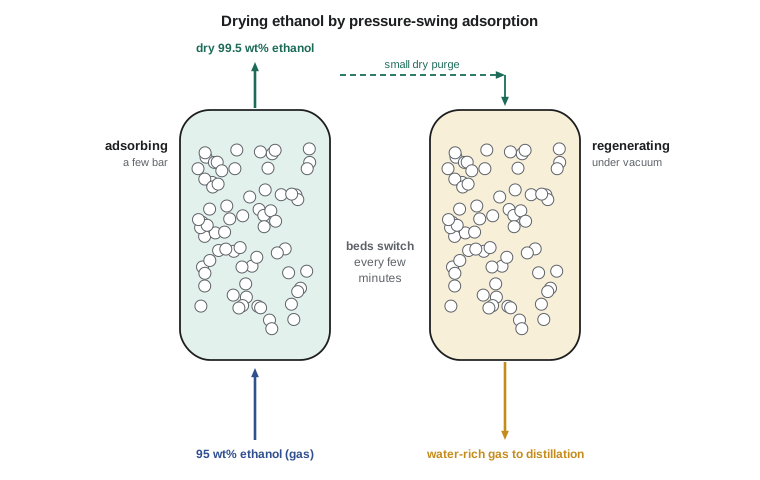
Lesson 7 left Theo with an unsolved problem: distillation cannot take ethanol past the azeotrope at about 95.6 percent by mass, yet fuel ethanol must contain less than about 1 percent water. At Kingfisher Bioenergy, the last step happens in tall vessels packed with beads of 3A molecular sieve, a synthetic zeolite whose pores are just wide enough to admit water molecules and too narrow for ethanol. Water vapor sticks to the internal surface of the beads and dry ethanol vapor passes through. When one bed fills, it is switched offline and regenerated under vacuum while another takes over. This is adsorption, the attachment of molecules to a surface, and it is the final topic of the course because it brings together molecular size, intermolecular forces, equilibrium and kinetics.
Surfaces matter elsewhere in the plant too. Activated carbon removes odor compounds from the carbon dioxide sold next door; foam in the fermenters has to be controlled with antifoam; yeast cells and fine grain particles form colloidal suspensions that settle or refuse to settle depending on their surface charge; and corn oil recovered from the stillage separates from water only because of the forces at the oil-water interface. Ingrid asks Theo to analyze the plant's molecular sieve data and to understand why the beds have to cycle as often as they do.
Why surfaces are special
Molecules at a surface are different from those in the bulk. A molecule inside a liquid is pulled equally in all directions by its neighbors; one at the surface has neighbors only on one side, so it is pulled inward and has higher energy. The extra energy per unit area is the surface tension, \(\gamma\), measured in J/m² or N/m. Water's surface tension, about 0.072 N/m at 25 °C, is high because of its hydrogen bonds; ethanol's is about 0.022 N/m. Adding ethanol to water lowers the surface tension sharply, which is why beer foams differently from water and why ethanol-water mixtures wet surfaces so readily.
Surface tension explains why droplets are spherical, why liquids rise in narrow tubes and why small droplets have a higher vapor pressure than large ones. The pressure inside a curved surface exceeds the pressure outside by \(2\gamma/r\), the Laplace pressure, so a small gas bubble or droplet is under substantial internal pressure. Foam bubbles in a fermenter therefore drain and burst as liquid flows away from their thin walls, unless proteins and other surface-active molecules from the grain stabilize them; antifoams work by spreading at the surface and creating weak spots in those films.
Physisorption and chemisorption
Adsorption is the accumulation of molecules, the adsorbate, on the surface of a solid, the adsorbent. Two kinds are distinguished by the strength of the bond. In physisorption, molecules are held by the same van der Waals and electrostatic forces described in Lesson 2; enthalpies of adsorption are typically 20 to 50 kJ/mol, similar to enthalpies of condensation, the process is fully reversible, and several layers of molecules can build up. In chemisorption, molecules form chemical bonds with surface atoms; enthalpies are typically 80 to 400 kJ/mol, only a single layer forms, and the adsorbed molecule may be broken apart. Chemisorption is the first step in most heterogeneous catalysis, while separation processes such as the molecular sieves rely on physisorption, because the adsorbate must be released again easily.
| Feature | Physisorption | Chemisorption |
|---|---|---|
| Forces | van der Waals, electrostatic | Chemical bonds |
| Typical enthalpy | 20–50 kJ/mol | 80–400 kJ/mol |
| Layers | Can be many | One (monolayer) |
| Reversibility | Easily reversed by heating or lowering pressure | Often hard to reverse |
| Uses | Drying, gas separation, surface area measurement | Catalysis, corrosion inhibition |
Molecular sieves
Zeolites are crystalline aluminosilicates whose frameworks contain cages and channels of precisely uniform size. The type 3A sieve used for ethanol drying has pore openings of about 0.3 nm, set by potassium ions sitting in the windows of the framework. A water molecule, with an effective diameter of about 0.28 nm, can enter; an ethanol molecule, about 0.44 nm, cannot. Inside the pores, water is held strongly by the electric fields around the framework's cations, so the sieve can dry ethanol vapor to well below 1 percent water. The separation works by size exclusion and by the strong attraction of polar water to the charged framework, which is why it succeeds where distillation fails at the azeotrope.
The Langmuir isotherm
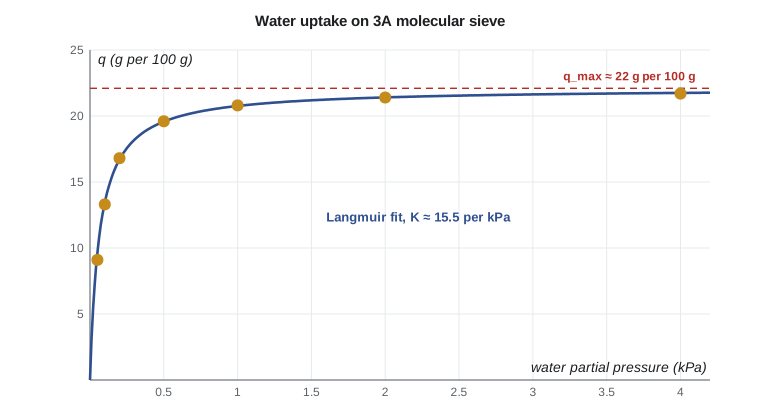
An adsorption isotherm describes how much adsorbate a solid holds at equilibrium as a function of pressure or concentration at constant temperature. Irving Langmuir derived the simplest useful model in 1916 by assuming that the surface has a fixed number of identical sites, each holding at most one molecule, and that adsorbed molecules do not interact. At equilibrium, the rate of adsorption onto empty sites, proportional to the pressure \(p\) and to the fraction of empty sites \(1 - \theta\), equals the rate of desorption from occupied sites, proportional to \(\theta\). That balance gives the fractional coverage:
where \(q\) is the amount adsorbed, \(q_{max}\) the monolayer capacity and \(K\) the adsorption equilibrium constant, which falls with temperature because adsorption is exothermic. At low pressure the isotherm is linear, \(\theta \approx Kp\), like Henry's law; at high pressure it saturates as \(\theta\) approaches 1. The form is identical to the Michaelis-Menten equation of Lesson 11, and for the same reason: a fixed number of sites must be occupied. Rearranging gives a straight-line form for fitting data, \(p/q = p/q_{max} + 1/(Kq_{max})\).
Worked problem
Coverage of the molecular sieve
A Langmuir fit to water uptake on the plant's 3A sieve gives \(q_{max} = 22.1\) g per 100 g and \(K = 15.5\) kPa⁻¹ at the operating temperature. Find the coverage and uptake at a water partial pressure of 0.3 kPa, and at 0.05 kPa, typical of the bed under vacuum regeneration.
Show solution
- At 0.3 kPa: \(\theta = 15.5(0.3)/(1 + 15.5 \times 0.3) = 4.65/5.65 = 0.823\); uptake \(= 0.823 \times 22.1 = 18.2\) g per 100 g.
- At 0.05 kPa: \(\theta = 0.775/1.775 = 0.437\); uptake \(= 9.7\) g per 100 g.
- The sieve still holds almost half its capacity even under deep vacuum.
Answer: That residual water limits the working capacity, the difference between the loading during adsorption and after regeneration. It is why the plant cannot use the whole capacity of the sieve and why heat or a purge of dry product is needed to regenerate the beds more completely.
Pressure-swing adsorption
Because \(\theta\) rises with partial pressure, adsorbed water can be released by lowering the pressure instead of heating the bed. Ethanol plants use pressure-swing adsorption with two or three beds: a bed adsorbs water from superheated ethanol vapor at a few bar, then switches to regeneration under vacuum while a small stream of dry product sweeps the released water out. The cycle repeats every few minutes. A short cycle keeps the heat released by adsorption, about 50 kJ per mole of water, in the bed, where it helps drive desorption in the next half-cycle; a long cycle would let the bed heat up during adsorption and cool down during regeneration, wasting energy and reducing capacity. Only the front part of each bed is loaded heavily in each cycle, so the theoretical loading time calculated from the isotherm is an upper bound, not the actual switching time.
Multilayer adsorption and the BET method
The Langmuir model allows only one layer. For physisorption near the condensation pressure, molecules stack in several layers, and Stephen Brunauer, Paul Emmett and Edward Teller extended the model in 1938 by treating each layer above the first as condensing like a liquid. The BET equation, in linear form, is:
where \(x = P/P_0\) is the pressure relative to the saturation pressure, \(v\) the volume adsorbed, \(v_m\) the volume of a complete monolayer and \(C\) a constant related to the difference between the first-layer enthalpy and the enthalpy of condensation. Plotting the left side against \(x\) for relative pressures from about 0.05 to 0.3 gives \(v_m\) from the slope and intercept. Multiplying the number of molecules in the monolayer by the area each one occupies, 0.162 nm² for nitrogen at 77 K, gives the surface area. The BET surface area, measured by nitrogen adsorption at liquid nitrogen temperature, is the standard specification for adsorbents and catalysts worldwide.
The numbers are remarkable. Activated carbons often have BET areas of 800 to 1,500 m² per gram, so a teaspoon of carbon has the surface area of a few tennis courts or more. That vast internal area, mostly in pores a few nanometers wide, is what lets a modest carbon bed remove traces of sulfur compounds, aldehydes and odors from the plant's carbon dioxide stream before it is sold for beverage use.
Colloids
Colloids are dispersions of particles between about 1 nm and 1 µm across in a continuous medium: yeast cells and fine fiber in beer, oil droplets in stillage, protein films in foam. Their particles are so small that gravity settles them slowly, and their behavior is controlled by their huge surface area and surface charge. Most particles in water carry a charge, from ionized surface groups or adsorbed ions, surrounded by a diffuse cloud of oppositely charged ions. When two particles approach, the overlapping clouds repel them, while van der Waals forces attract them. The balance, described by DLVO theory, decides whether a suspension stays dispersed or aggregates.
Adding salt compresses the ion clouds and weakens the repulsion, so particles can approach close enough for attraction to win; that is how salt and polymer flocculants make fine solids settle in water treatment. Yeast flocculation in brewing follows the same physics, and the plant's centrifuges separating wet cake from thin stillage work better when the operating pH and salt content favor aggregation. The zeta potential, the electrical potential at the edge of the bound ion layer, is measured routinely as a guide: suspensions with zeta potentials beyond about ±30 mV tend to stay dispersed, while those near zero tend to aggregate.
Calculating adsorption parameters
The program below fits illustrative water uptake data for the molecular sieve to the Langmuir isotherm, calculates the BET surface area of an activated carbon from illustrative nitrogen data and estimates the working capacity of a sieve bed and the longest time one bed could adsorb before needing regeneration.
# Langmuir fit for water on 3A molecular sieve, BET surface area, and a sieve bed capacity estimate
import math

def fit(x, y):
    n = len(x); mx = sum(x) / n; my = sum(y) / n
    m = sum((a - mx) * (b - my) for a, b in zip(x, y)) / sum((a - mx) ** 2 for a in x)
    return m, my - m * mx

# illustrative water uptake q (g water per 100 g sieve) against water partial pressure p (kPa)
p = [0.05, 0.1, 0.2, 0.5, 1.0, 2.0, 4.0]
q = [9.1, 13.3, 16.8, 19.6, 20.8, 21.4, 21.7]
# linear Langmuir form: p/q = p/qmax + 1/(K qmax)
m, c = fit(p, [a / b for a, b in zip(p, q)])
qmax, K = 1 / m, m / c
print(f"Langmuir: qmax = {qmax:.1f} g/100 g, K = {K:.1f} per kPa")
for pp in (0.3, 3.0):
    print(f"  coverage at {pp} kPa = {K * pp / (1 + K * pp):.3f}")

# BET analysis of illustrative nitrogen data at 77 K for an activated carbon (P/P0, cm3 STP per g)
x = [0.05, 0.10, 0.15, 0.20, 0.25, 0.30]
v = [214.9, 241.1, 260.7, 280.0, 300.7, 323.5]
yb = [a / (b * (1 - a)) for a, b in zip(x, v)]
s, i = fit(x, yb)
vm = 1 / (s + i); Cb = 1 + s / i
area = vm / 22414 * 6.02214e23 * 0.162e-18          # m2/g, N2 cross-section 0.162 nm2
print(f"BET: monolayer volume = {vm:.0f} cm3/g, C = {Cb:.0f}, surface area = {area:.0f} m2/g")

# sieve bed: theoretical time for one bed to load before switching (an upper bound)
bed_kg = 20000.0                                      # sieve in one bed
theta = lambda pp: K * pp / (1 + K * pp)
working = qmax / 100 * (theta(40.0) - theta(0.05))     # kg water per kg sieve, feed at 40 kPa water, regeneration at 0.05 kPa
feed = 50000.0                                         # kg/h of 95 wt% ethanol in the gas phase
product = feed * 0.95 / 0.995                          # kg/h of 99.5 wt% ethanol
water_rem = feed * 0.05 - product * 0.005
print(f"working capacity = {100 * working:.1f} g/100 g; water removed = {water_rem:.0f} kg/h")
print(f"one bed could load for at most {bed_kg * working / water_rem * 60:.0f} min")Langmuir: qmax = 22.1 g/100 g, K = 15.5 per kPa coverage at 0.3 kPa = 0.823 coverage at 3.0 kPa = 0.979 BET: monolayer volume = 230 cm3/g, C = 150, surface area = 1001 m2/g working capacity = 12.4 g/100 g; water removed = 2261 kg/h one bed could load for at most 66 min
A 20-metric ton bed has a theoretical loading time of about an hour at the plant's feed rate, yet real beds switch every few minutes. The difference is mass transfer: water is adsorbed in a front that moves through the bed, and only a fraction of the bed reaches equilibrium before water begins to break through at the outlet. Designing beds and cycles to manage that front belongs to CHE-314 Mass Transfer and CHE-350 Separation Processes, which build directly on the equilibrium ideas of this lesson.
The course in one plant
Theo's year at Kingfisher Bioenergy has followed one plant through the main ideas of physical chemistry. Kinetic theory explained the carbon dioxide at the fermenter vent and how it leaks. Intermolecular forces explained why carbon dioxide liquefies and why ethanol and water behave so unlike an ideal mixture. Gibbs energy and chemical potential set the direction of every process, from the dehydration of ethanol to its equilibrium with its vapor. Colligative properties sized the reverse osmosis unit, vapor-liquid equilibrium explained the azeotrope, and electrochemistry explained the corrosion of the condensate lines. Kinetics, temperature and catalysis governed the enzymes and the fermenters, and adsorption finished the job that distillation could not. The same tools reappear throughout the rest of the chemical engineering program, wherever molecules move, mix, react or stick to surfaces.
Common mistakes
MistakeAssuming adsorption capacity is unlimited.
InsteadSites are finite; the Langmuir isotherm saturates at q_max.
MistakeConfusing physisorption with chemisorption.
InsteadPhysisorption is weak and reversible; chemisorption forms bonds and usually stops at a monolayer.
MistakeFitting BET data over the whole pressure range.
InsteadUse relative pressures of roughly 0.05 to 0.3, where the BET assumptions hold.
MistakeTreating the isotherm loading time as the bed's cycle time.
InsteadMass transfer fronts mean only part of a bed is used; real cycles are much shorter.
Summary and key terms
- Surface molecules have extra energy, measured by surface tension; ethanol lowers water's surface tension sharply.
- Physisorption is weak and reversible; chemisorption forms bonds and starts most heterogeneous catalysis.
- 3A molecular sieves admit water (0.28 nm) but exclude ethanol (0.44 nm), drying ethanol past the azeotrope.
- The Langmuir isotherm, θ = Kp/(1 + Kp), is linear at low pressure and saturates at high pressure.
- Pressure-swing adsorption regenerates sieves by lowering the pressure; working capacity is the loading difference between steps.
- The BET method measures surface area from multilayer nitrogen adsorption; colloid stability depends on surface charge.
- Surface tension
- The extra energy per unit area of a surface, caused by unbalanced attraction of surface molecules.
- Adsorption
- The accumulation of molecules on the surface of a solid or liquid.
- Physisorption
- Adsorption by weak van der Waals and electrostatic forces.
- Chemisorption
- Adsorption by formation of chemical bonds with surface atoms.
- Adsorption isotherm
- The equilibrium amount adsorbed as a function of pressure or concentration at constant temperature.
- Langmuir isotherm
- θ = Kp/(1 + Kp), for monolayer adsorption on identical, independent sites.
- BET surface area
- The surface area of a solid calculated from multilayer nitrogen adsorption using the BET equation.
- Zeta potential
- The electrical potential at the edge of the bound ion layer around a colloidal particle.
Practice problems
Work each problem on paper first, then reveal the answer to check.
For a Langmuir isotherm with K = 2.0 kPa⁻¹, what pressure gives half coverage?
Show answer
θ = 0.5 when Kp = 1, so p = 0.5 kPa.
Why can 3A sieves dry ethanol but not separate ethanol from methanol?
Show answer
Methanol, about 0.38 nm, is also too large for 3A pores, so neither alcohol enters; the sieve separates only water from alcohols.
A BET analysis gives a nitrogen monolayer volume of 100 cm³ (STP) per gram. What is the surface area?
Show answer
\((100/22{,}414) \times 6.022 \times 10^{23} \times 0.162 \times 10^{-18} = 435\) m²/g.
Why does lowering the pressure regenerate a molecular sieve?
Show answer
The equilibrium coverage falls with water partial pressure, so water desorbs.
What is the Laplace pressure inside a 1 µm diameter water droplet?
Show answer
\(2(0.072)/(0.5 \times 10^{-6}) = 2.9 \times 10^5\) Pa, about 2.9 bar.
Why does adding salt help fine particles settle?
Show answer
It compresses the ion clouds around the particles, weakening repulsion so van der Waals attraction causes aggregation.
Lesson quiz · 5 questions
Score 60% or more to complete this lesson.
Create a free account to save your progress, take quizzes and earn a certificate.