
CHE-250 · Lesson 3 of 12 · 25 min
Gibbs energy and chemical potential
The first two lessons described gases molecule by molecule. The rest of the course needs a tool that works for any system, gas, liquid, solid or mixture, and tells us which way a change will go: whether ethanol will evaporate, whether a reaction will proceed, whether carbon dioxide will dissolve in the beer or bubble out of it. That tool is the Gibbs energy. You met the first and second laws of thermodynamics in CHE-220, where the focus was on energy balances, entropy and power cycles. This lesson takes the same laws in the direction physical chemists use most: the Gibbs energy as the criterion for spontaneous change at constant temperature and pressure, and the chemical potential as the quantity that governs every phase and chemical equilibrium in the lessons that follow.
Ingrid gives Theo a question from a proposal on her desk. A chemical company has asked whether Kingfisher Bioenergy could dehydrate some of its ethanol to make bio-based ethylene, the building block of polyethylene. Before anyone designs a reactor, Theo must answer a thermodynamic question: under what conditions does the reaction go at all?
Spontaneity and the second law
The second law says that in any spontaneous process the total entropy of the system and its surroundings increases. That criterion is correct but awkward, because it requires tracking the surroundings. For a process at constant temperature \(T\) and pressure \(P\), the surroundings receive heat \(-\Delta H\) from the system, so their entropy changes by \(-\Delta H/T\). The total entropy change is then \(\Delta S - \Delta H/T\), and requiring it to be positive is the same as requiring:
where \(G = H - TS\) is the Gibbs energy. At constant temperature and pressure, a process is spontaneous if it lowers the Gibbs energy of the system, and the system is at equilibrium when \(G\) is at a minimum and \(\Delta G = 0\) for any small change. This one statement, expressed entirely in terms of the system, is the basis of phase equilibrium, chemical equilibrium and electrochemistry.
The Gibbs energy also has a practical meaning. The decrease in \(G\) is the maximum amount of non-expansion work, such as electrical work, that a process can deliver at constant \(T\) and \(P\). A fuel cell running on ethanol could, at best, convert the full \(-\Delta G\) of the combustion reaction into electricity, while a heat engine burning the same ethanol is limited by the Carnot efficiency you studied in CHE-220. Lesson 8 returns to this link between Gibbs energy and cell voltage.
Enthalpy and entropy in competition
The equation \(\Delta G = \Delta H - T\Delta S\) shows two driving forces. A negative \(\Delta H\) (releasing heat to the surroundings) favors a process, and so does a positive \(\Delta S\) (increasing disorder). When both point the same way, the process is spontaneous at all temperatures, or at none. When they conflict, temperature decides: the entropy term \(T\Delta S\) grows in importance as temperature rises.
| ΔH | ΔS | Spontaneous? | Example |
|---|---|---|---|
| Negative | Positive | At all temperatures | Combustion of ethanol |
| Positive | Negative | At no temperature | Reverse of combustion |
| Negative | Negative | Below a crossover temperature | Condensation of steam |
| Positive | Positive | Above a crossover temperature | Evaporation; ethanol dehydration |
Evaporation is the classic case of the last row. Turning liquid ethanol into vapor absorbs heat (\(\Delta H > 0\)) but greatly increases disorder (\(\Delta S > 0\)). At low temperature the enthalpy term wins and the liquid is stable; at high temperature the entropy term wins and the vapor is stable. The crossover, \(T = \Delta H/\Delta S\), is the boiling point. Using standard values (\(\Delta H^\circ = 42.9\) kJ/mol and \(\Delta S^\circ = 120.9\) J/(mol K)) gives 355 K, within a few kelvins of ethanol's normal boiling point of 351 K. The small difference arises because \(\Delta H\) and \(\Delta S\) vary slightly with temperature and because the standard state is 1 bar rather than 1 atm.
Standard Gibbs energies of reaction
For a chemical reaction we use standard values, written with the symbol °, which refer to each substance in its standard state: the pure substance at 1 bar for gases, liquids and solids, and 1 mol/L or 1 mol/kg for solutes. The standard enthalpy of reaction is calculated from standard enthalpies of formation, as in CHE-200, and the standard entropy of reaction from absolute standard entropies, which the third law makes possible by fixing the entropy of a perfect crystal at 0 K as zero:
Here \(\nu_i\) is the stoichiometric coefficient, positive for products and negative for reactants. Alternatively, \(\Delta_r G^\circ\) can be calculated directly from standard Gibbs energies of formation. Either way, \(\Delta_r G^\circ\) tells us about the reaction when every species is in its standard state; Lesson 4 shows how to extend this to the actual mixture in a reactor.
Worked problem
Can ethanol be dehydrated to ethylene?
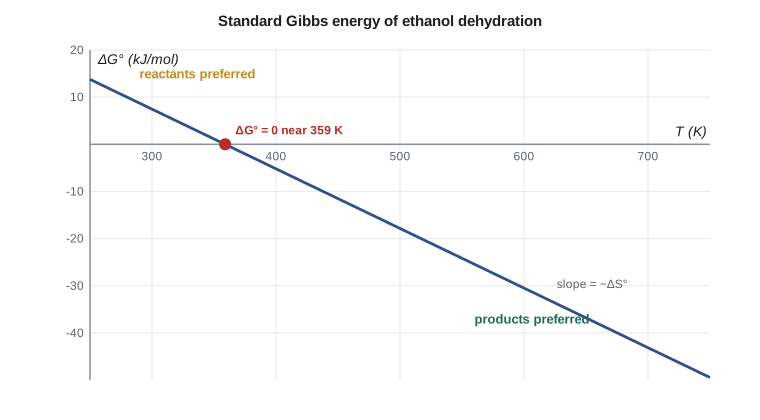
For the gas-phase reaction \(\text{C}_2\text{H}_5\text{OH(g)} \to \text{C}_2\text{H}_4\text{(g)} + \text{H}_2\text{O(g)}\), use approximate standard data at 298 K (enthalpies of formation −234.8, 52.4 and −241.8 kJ/mol; entropies 281.6, 219.3 and 188.8 J/(mol K)) to find \(\Delta_r G^\circ\) at 298 K and the temperature above which it becomes negative.
Show solution
- \(\Delta_r H^\circ = 52.4 + (-241.8) - (-234.8) = 45.4\) kJ/mol, so the reaction is endothermic.
- \(\Delta_r S^\circ = 219.3 + 188.8 - 281.6 = 126.5\) J/(mol K), positive because one gas molecule becomes two.
- At 298 K: \(\Delta_r G^\circ = 45.4 - 298.15(0.1265) = 7.7\) kJ/mol, positive.
- Crossover: \(T = 45{,}400/126.5 = 359\) K, about 86 °C.
Answer: The reaction is unfavorable at room temperature but becomes favorable above roughly 360 K. Industrial plants run it at 300 to 450 °C, well above the crossover, both to drive equilibrium toward ethylene and to make the reaction fast enough over a solid acid catalyst.
The result shows a general principle: reactions that break one molecule into several, increasing the number of gas molecules, are favored by high temperature. The reverse reaction, hydration of ethylene to ethanol, is how most synthetic ethanol was made for most of the twentieth century; it is run at lower temperature and high pressure, for the opposite reasons.
How G depends on temperature and pressure
Combining the first and second laws gives the fundamental equation for the Gibbs energy of a closed system of fixed composition, \(dG = V\,dP - S\,dT\). It shows that \(G\) falls as temperature rises, at a rate equal to the entropy, and rises with pressure, at a rate equal to the volume. Because gases have large molar volumes, their Gibbs energy depends strongly on pressure; liquids and solids, with small volumes, are almost insensitive to it.
For an ideal gas, \(V_m = RT/P\), and integrating from the standard pressure \(P^\circ = 1\) bar gives:
Halving the pressure of a gas lowers its molar Gibbs energy by \(RT\ln 2\), about 1.7 kJ/mol at room temperature. This logarithmic dependence is the origin of every logarithm you will meet in equilibrium constants, the Nernst equation and Raoult's law.
The temperature dependence is expressed most usefully by the Gibbs-Helmholtz equation, \(\partial(G/T)/\partial T = -H/T^2\). It says that how a Gibbs energy changes with temperature is governed by the enthalpy. In Lesson 4 it becomes the van 't Hoff equation, which tells Theo how an equilibrium constant shifts when the reactor is heated.
Chemical potential
For a mixture, the Gibbs energy depends on the amounts of every component as well as on \(T\) and \(P\). The chemical potential of component \(i\) is the partial molar Gibbs energy:
It is the increase in the Gibbs energy of a large mixture when one mole of \(i\) is added at constant temperature, pressure and amounts of everything else. For a pure substance the chemical potential is just the molar Gibbs energy. For an ideal gas in a mixture it depends on the partial pressure: \(\mu_i = \mu_i^\circ + RT\ln(p_i/P^\circ)\).
Chemical potential plays the same role for matter that temperature plays for heat. Heat flows spontaneously from high temperature to low; matter moves spontaneously from high chemical potential to low, whether that means evaporating, dissolving, diffusing through a membrane or reacting. Equilibrium is reached when the chemical potential of each component is the same everywhere it can go. That single condition is the foundation of Lessons 4 to 8:
| Equilibrium | Condition | Lesson |
|---|---|---|
| Chemical reaction | \(\sum \nu_i \mu_i = 0\) | 4 |
| Pure substance in two phases | \(\mu^{liquid} = \mu^{vapor}\) | 5 |
| Solvent across a membrane | \(\mu_{solvent}\) equal on both sides | 6 |
| Component in liquid and vapor mixtures | \(\mu_i^{liquid} = \mu_i^{vapor}\) | 7 |
| Electrochemical cell | Electrochemical potential equal for each species | 8 |
Worked problem
Chemical potential of ethanol vapor
Ethanol vapor sits above liquid ethanol in a closed tank at 25 °C. The standard Gibbs energy of vaporization is about 6.9 kJ/mol. Use the condition \(\mu^{vapor} = \mu^{liquid}\) to estimate the equilibrium vapor pressure.
Show solution
- For the pure liquid, \(\mu^{liquid} \approx G_m^{\circ, liquid}\), since pressure barely affects a liquid.
- For the vapor, \(\mu^{vapor} = G_m^{\circ, vapor} + RT\ln(P/P^\circ)\).
- Setting them equal: \(RT\ln(P/P^\circ) = -(G_m^{\circ, vapor} - G_m^{\circ, liquid}) = -\Delta_{vap}G^\circ = -6.9\) kJ/mol.
- \(P = \exp(-6900/(8.314 \times 298.15)) = 0.062\) bar.
Answer: About 0.06 bar, or 6 kPa. The measured vapor pressure of ethanol at 25 °C is about 7.9 kPa; the difference reflects the approximate data. The method, though, is exactly how vapor pressures follow from thermodynamics, and Lesson 5 develops it into the Clausius-Clapeyron equation.
Calculating Gibbs energies with a program
The program below computes standard enthalpy, entropy and Gibbs energy changes for three processes at the plant: vaporizing ethanol, dehydrating it to ethylene and burning it. It finds the crossover temperatures where the signs of \(\Delta H\) and \(\Delta S\) conflict, tabulates the dehydration Gibbs energy and equilibrium constant at higher temperatures, and shows how the chemical potential of ethanol vapor changes with pressure.
# Standard Gibbs energy changes from tabulated data (approximate values at 298 K)
import math
R = 8.314
# species: (dHf kJ/mol, S J/(mol K))
D = {'EtOH(l)': (-277.7, 160.7), 'EtOH(g)': (-234.8, 281.6), 'C2H4(g)': (52.4, 219.3),
     'H2O(g)': (-241.8, 188.8), 'H2O(l)': (-285.8, 70.0), 'CO2(g)': (-393.5, 213.8), 'O2(g)': (0.0, 205.2)}

def rxn(nu):
    dH = sum(n * D[s][0] for s, n in nu.items())
    dS = sum(n * D[s][1] for s, n in nu.items())
    return dH, dS

cases = {
    'vaporization of ethanol': {'EtOH(l)': -1, 'EtOH(g)': 1},
    'dehydration to ethylene': {'EtOH(g)': -1, 'C2H4(g)': 1, 'H2O(g)': 1},
    'combustion of ethanol':   {'EtOH(l)': -1, 'O2(g)': -3, 'CO2(g)': 2, 'H2O(l)': 3},
}
for name, nu in cases.items():
    dH, dS = rxn(nu)
    dG = dH - 298.15 * dS / 1000
    line = f"{name:25s} dH = {dH:8.1f} kJ  dS = {dS:7.1f} J/K  dG(298) = {dG:8.1f} kJ"
    if dH > 0 and dS > 0:
        line += f"  dG = 0 near {1000 * dH / dS:.0f} K"
    print(line)

# dehydration: dG and K at several temperatures (constant dH and dS approximation)
dH, dS = rxn(cases['dehydration to ethylene'])
for T in (298.15, 400, 500, 600, 700):
    dG = dH - T * dS / 1000
    print(f"T = {T:6.1f} K  dG = {dG:6.1f} kJ/mol  K = {math.exp(-dG * 1000 / (R * T)):.3g}")

# chemical potential of ethanol gas relative to 1 bar, at 25 C
for P in (0.01, 0.0787, 0.5, 1.0):
print(f"P = {P:6.4f} bar mu - mu0 = {R * 298.15 * math.log(P) / 1000:6.2f} kJ/mol")vaporization of ethanol dH = 42.9 kJ dS = 120.9 J/K dG(298) = 6.9 kJ dG = 0 near 355 K dehydration to ethylene dH = 45.4 kJ dS = 126.5 J/K dG(298) = 7.7 kJ dG = 0 near 359 K combustion of ethanol dH = -1366.7 kJ dS = -138.7 J/K dG(298) = -1325.3 kJ T = 298.1 K dG = 7.7 kJ/mol K = 0.0451 T = 400.0 K dG = -5.2 kJ/mol K = 4.78 T = 500.0 K dG = -17.9 kJ/mol K = 73.3 T = 600.0 K dG = -30.5 kJ/mol K = 452 T = 700.0 K dG = -43.1 kJ/mol K = 1.66e+03 P = 0.0100 bar mu - mu0 = -11.42 kJ/mol P = 0.0787 bar mu - mu0 = -6.30 kJ/mol P = 0.5000 bar mu - mu0 = -1.72 kJ/mol P = 1.0000 bar mu - mu0 = 0.00 kJ/mol
The combustion of ethanol releases about 1,367 kJ/mol of heat and has a Gibbs energy change of about −1,325 kJ/mol. The difference, about 40 kJ/mol at 25 °C, is the \(T\Delta S\) term; it is negative here because gas molecules are consumed and liquid water is formed. That is the energy no fuel cell could ever turn into electricity at room temperature, however good its design.
Common mistakes
MistakeConcluding that a reaction with positive ΔG° cannot happen at all.
InsteadΔG° refers to standard states; a reaction can still proceed in a real mixture, and Lesson 4 shows how far.
MistakeMixing kJ and J when combining ΔH and TΔS.
InsteadEntropies are usually tabulated in J/(mol K); convert before subtracting.
MistakeThinking a negative ΔG means a fast reaction.
InsteadThermodynamics says whether a change can occur, not how fast; rates are the subject of Lessons 9 to 11.
MistakeApplying the ideal-gas pressure term to liquids.
InsteadThe Gibbs energy of a liquid or solid barely changes with pressure because its molar volume is small.
Summary and key terms
- At constant T and P, a process is spontaneous if ΔG = ΔH − TΔS is negative, and equilibrium corresponds to minimum G.
- −ΔG is the maximum non-expansion work, such as electrical work, a process can deliver.
- When ΔH and ΔS have the same sign, temperature decides, with crossover at T = ΔH/ΔS.
- For an ideal gas, \(G_m = G_m^\circ + RT\ln(P/P^\circ)\); liquids and solids barely depend on pressure.
- The chemical potential is the partial molar Gibbs energy; matter moves from high to low chemical potential.
- Every equilibrium in the course is an equality of chemical potentials.
- Gibbs energy
- G = H − TS, the state function whose decrease measures spontaneity at constant temperature and pressure.
- Standard state
- The reference condition for a substance, usually the pure substance at 1 bar.
- Crossover temperature
- The temperature ΔH/ΔS at which ΔG changes sign.
- Third law
- The entropy of a perfect crystal is zero at absolute zero, which allows absolute entropies to be tabulated.
- Gibbs-Helmholtz equation
- The relation ∂(G/T)/∂T = −H/T², linking the temperature dependence of G to H.
- Chemical potential
- The partial molar Gibbs energy of a component, μᵢ = (∂G/∂nᵢ) at constant T, P and other amounts.
- Partial molar quantity
- The change in an extensive property when one mole of a component is added to a large mixture.
Practice problems
Work each problem on paper first, then reveal the answer to check.
For a process with ΔH = −20 kJ/mol and ΔS = −50 J/(mol K), below what temperature is it spontaneous?
Show answer
\(T < 20{,}000/50 = 400\) K.
By how much does the molar Gibbs energy of an ideal gas change when its pressure rises from 1 bar to 10 bar at 300 K?
Show answer
\(RT\ln 10 = 8.314(300)(2.303) = 5.74\) kJ/mol higher.
Why are reactions that increase the number of gas molecules favored at high temperature?
Show answer
They have positive ΔS, so the −TΔS term becomes more negative as T rises.
What is the chemical potential condition for a substance in equilibrium between two phases?
Show answer
Its chemical potential is equal in both phases.
For ethanol combustion, ΔH° = −1,367 kJ/mol and ΔG° = −1,325 kJ/mol at 298 K. What is ΔS°?
Show answer
\(\Delta S^\circ = (\Delta H^\circ - \Delta G^\circ)/T = (-42{,}000)/298 = -141\) J/(mol K), close to the program's −139.
Does a large negative ΔG° guarantee that a reaction will be observed in a day?
Show answer
No; the reaction may be very slow without a catalyst, as with ethanol and oxygen at room temperature.
Lesson quiz · 5 questions
Score 60% or more to complete this lesson.
Create a free account to save your progress, take quizzes and earn a certificate.