
CHE-250 · Lesson 7 of 12 · 24 min
Phase equilibrium in mixtures: Raoult's and Henry's laws
Distillation is the heart of Kingfisher Bioenergy. The beer leaving the fermenters is about 12 percent ethanol by mass; the beer column strips nearly all of it into a vapor of about 50 percent ethanol, and the rectifier concentrates that to about 95 percent. Then progress stops. However many trays the rectifier has, it cannot push the ethanol much past about 95.6 percent by mass, and the last few percent of water must be removed by molecular sieves, the subject of Lesson 12. That limit, the ethanol-water azeotrope, is the most expensive fact of physical chemistry in the whole plant. This lesson explains it, starting from the chemical potentials of Lessons 3 and 6.
Theo also has a gas-liquid problem. The fermentation beer is saturated with carbon dioxide, which comes out of solution in the beer well and the beer column and has to be vented and scrubbed. Ingrid asks him how much carbon dioxide stays dissolved at fermentation temperature and why chilling the beer would make it hold more. That question needs Henry's law, the partner of Raoult's law for dilute solutes.
Raoult's law
For a liquid mixture in equilibrium with its vapor, each component's chemical potential is the same in both phases. If the liquid is an ideal solution and the vapor an ideal gas, equating \(\mu_i = \mu_i^* + RT\ln x_i\) in the liquid with \(\mu_i = \mu_i^\circ + RT\ln(p_i/P^\circ)\) in the vapor gives Raoult's law:
The partial pressure of each component above the liquid equals its liquid mole fraction times its pure-component vapor pressure. The total pressure is the sum of the partial pressures, and the vapor mole fraction is \(y_i = p_i/P\). Because the more volatile component has the larger vapor pressure, it is enriched in the vapor: \(y_i > x_i\). That enrichment is what makes distillation work, and the ratio \(K_i = y_i/x_i\), the vapor-liquid equilibrium ratio, is the quantity distillation designers use for every component.
Raoult's law describes mixtures of chemically similar molecules well: benzene and toluene, or hexane and heptane. Their molecules interact with each other almost exactly as with themselves, so the mixture is close to ideal. Ethanol and water are not similar at all, and treating them as ideal gives badly wrong answers, as the program at the end of this lesson shows.
Bubble points, dew points and phase diagrams
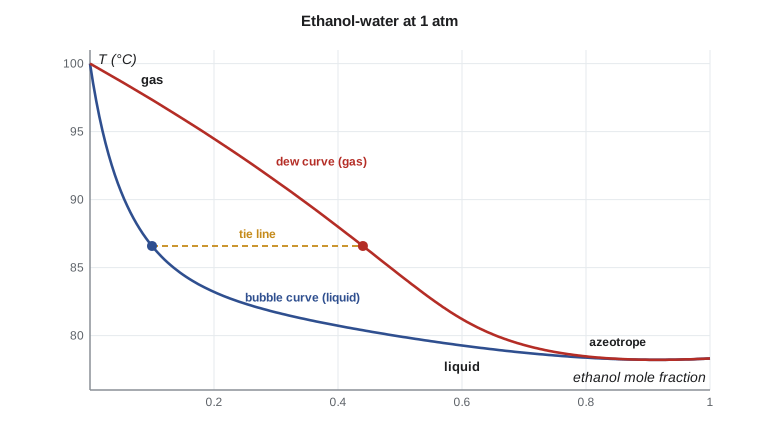
At fixed pressure, a liquid mixture begins to boil at its bubble point temperature, where the sum of the partial pressures first equals the total pressure. A vapor mixture begins to condense at its dew point. For a pure substance the two coincide at the boiling point; for a mixture they differ, and the mixture boils over a range of temperatures. The phase rule from Lesson 5 explains why: with two components and two phases, \(F = 2 - 2 + 2 = 2\), so fixing the pressure still leaves the temperature free to vary with composition.
Plotting bubble and dew temperatures against composition gives a T-x-y diagram, the map distillation engineers use to count equilibrium stages. The bubble curve is the lower line and the dew curve the upper line. Between them lies a two-phase region in which a liquid of composition \(x\) coexists with a vapor of composition \(y\), joined by a horizontal tie line. Each step from liquid to vapor along a tie line is one ideal stage of separation.
Real mixtures and activity coefficients
For nonideal liquids, the chemical potential is written with an activity coefficient \(\gamma_i\) that corrects the mole fraction: \(\mu_i = \mu_i^* + RT\ln(\gamma_i x_i)\). Raoult's law becomes the modified Raoult's law:
If \(\gamma_i > 1\), the component's partial pressure is higher than Raoult's law predicts: a positive deviation. That happens when unlike molecules attract each other less than like molecules, so each component escapes the mixture more easily than it would escape its own pure liquid. If \(\gamma_i < 1\), unlike molecules attract more strongly and the deviation is negative. Activity coefficients approach 1 as a component becomes pure and are largest when it is most dilute, where its value is called the infinite-dilution activity coefficient.
Ethanol and water show strong positive deviations. That may seem surprising, since both hydrogen bond, but water's hydrogen-bonded network is disrupted by ethanol's nonpolar ethyl group, and ethanol's own associations are broken by dilution in water. At high dilution in water, ethanol's activity coefficient is about 5, so a small amount of ethanol in water evaporates five times more readily than Raoult's law predicts. That is good news for the beer column: it is why a 12 percent beer gives a vapor of about 50 percent ethanol after a single stage of boiling.
Several models express activity coefficients as functions of composition. The simplest useful ones, the Margules and van Laar equations, have two adjustable parameters fitted to experimental data. The van Laar form used in this lesson is:
For ethanol (1) and water (2), approximate parameters are \(A_{12} = 1.68\) and \(A_{21} = 0.92\). More sophisticated models, such as Wilson, NRTL and UNIQUAC, are built into process simulators and handle multicomponent mixtures better; CHE-350 Separation Processes uses them in distillation design. All of them rest on the same thermodynamic foundation.
Azeotropes
When the deviations from Raoult's law are large enough, the bubble and dew curves touch at a composition called an azeotrope, where the vapor has exactly the same composition as the liquid. At that point \(y = x\), boiling produces no enrichment, and ordinary distillation cannot cross it. Strong positive deviations give a minimum-boiling azeotrope, which boils lower than either pure component. Ethanol and water form one at about 89.4 mole percent ethanol, or 95.6 percent by mass, boiling at 78.15 °C at 1 atm, just below pure ethanol's 78.3 °C. Negative deviations can give maximum-boiling azeotropes, such as hydrochloric acid and water.
Worked problem
Why the rectifier stops at about 95 percent
Use the modified Raoult's law to show that a liquid of 0.95 mole fraction ethanol at its bubble point produces a vapor poorer in ethanol than the liquid. The approximate model gives \(\gamma_1 = 1.00\) and \(\gamma_2 = 2.39\) at that composition, and a bubble temperature of 78.24 °C, where the vapor pressures are about 758 mmHg for ethanol and 330 mmHg for water.
Show solution
- Ethanol partial pressure: \(0.95 \times 1.00 \times 758 = 720\) mmHg.
- Water partial pressure: \(0.05 \times 2.39 \times 330 = 39\) mmHg.
- Total \(\approx 759\) mmHg, close to 760, confirming the bubble point.
- \(y_1 = 720/759 = 0.948\), slightly less than \(x_1 = 0.95\).
Answer: Above the azeotrope, the vapor is poorer in ethanol than the liquid, so boiling and condensing moves the composition back toward the azeotrope from either side. The rectifier can approach about 0.89 mole fraction but cannot pass it at atmospheric pressure.
Industry breaks azeotropes in three main ways. Pressure-swing distillation exploits the fact that azeotrope composition shifts with pressure; for ethanol and water the shift is small, and the azeotrope only disappears below about 0.1 bar, so this is costly. Azeotropic or extractive distillation adds a third component that changes the activity coefficients; benzene, then cyclohexane, was once used for ethanol. Most modern fuel ethanol plants, including Kingfisher Bioenergy, use adsorption on 3A molecular sieves, which take up water but exclude the larger ethanol molecule, as Lesson 12 explains.
Henry's law for dilute solutes
Raoult's law works best for the component in excess, the solvent. For a dilute solute, especially a gas such as carbon dioxide or oxygen dissolved in water, a different limiting law holds. At low concentration, each solute molecule is surrounded entirely by solvent, so its escaping tendency is proportional to its concentration but with a proportionality constant that has nothing to do with the pure solute's vapor pressure. This is Henry's law, often written for gas solubility as:
where \(c_i\) is the dissolved concentration, \(p_i\) the partial pressure of the gas above the liquid and \(k_H\) the Henry's law constant, which depends on the gas, the solvent and the temperature. Several conventions exist, some inverting the constant or using mole fractions, so always check the units of a tabulated value. For carbon dioxide in water at 25 °C, \(k_H \approx 0.034\) mol/(L atm). Raoult's and Henry's laws are consistent: in a binary mixture that follows Henry's law for the solute at low concentration, the solvent follows Raoult's law over the same range.
Gas solubility usually falls as temperature rises, because dissolving a gas releases heat and Le Chatelier's principle pushes the equilibrium back toward the gas when the liquid is warmed. Carbon dioxide is about twice as soluble at 10 °C as at 32 °C. That is why chilled beer stays carbonated, why a warm soft drink goes flat, and why fish suffer in warm, oxygen-poor water in late summer.
Worked problem
Dissolved carbon dioxide in the beer well
Fermentation finishes at about 32 °C under a carbon dioxide atmosphere at roughly 1 atm. Taking \(k_H = 0.028\) mol/(L atm) at 32 °C and treating the beer as water, estimate the dissolved carbon dioxide, and the effect of holding the beer under 2 atm of carbon dioxide instead.
Show solution
- At 1 atm: \(c = 0.028 \times 1 = 0.028\) mol/L, or \(0.028 \times 44.01 = 1.23\) g/L.
- At 2 atm: \(c = 0.028 \times 2 = 0.056\) mol/L, or 2.46 g/L.
- A 12 percent beer flowing at 300 m³/h at 1 atm therefore carries about \(1.23 \times 300 = 370\) kg/h of dissolved carbon dioxide.
Answer: About 1.2 g/L, roughly 370 kg/h at that flow. Almost all of it comes out of solution when the beer is heated in the beer column, which is why the column overhead must vent carbon dioxide continuously and why that vent stream is scrubbed to recover the ethanol vapor it carries.
Calculating vapor-liquid equilibrium
The program below calculates bubble temperatures and vapor compositions for ethanol-water at 1 atm, first with ideal Raoult's law and then with van Laar activity coefficients. It locates the azeotrope by bisection on \(y_1 - x_1\) and uses Henry's law to estimate dissolved carbon dioxide at several temperatures.
# Bubble points of ethanol-water at 1 atm: ideal Raoult's law against modified Raoult's law
# with van Laar activity coefficients (Antoine and van Laar constants approximate)
import math

def psat(A, B, C, T):                     # mmHg, T in C
    return 10 ** (A - B / (C + T))
ETH = (8.20417, 1642.89, 230.300)
WAT = (8.07131, 1730.63, 233.426)
A12, A21 = 1.6798, 0.9227                 # van Laar, ethanol (1) - water (2)

def gammas(x1):
    x2 = 1 - x1
    if x1 in (0, 1):
        return (math.exp(A12), 1.0) if x1 == 0 else (1.0, math.exp(A21))
    d = A12 * x1 + A21 * x2
    return math.exp(A12 * (A21 * x2 / d) ** 2), math.exp(A21 * (A12 * x1 / d) ** 2)

def bubble(x1, P=760.0, ideal=False):
    g1, g2 = (1.0, 1.0) if ideal else gammas(x1)
    lo, hi = 50.0, 110.0
    for _ in range(60):
        T = (lo + hi) / 2
        Ptot = x1 * g1 * psat(*ETH, T) + (1 - x1) * g2 * psat(*WAT, T)
        if Ptot > P: hi = T
        else: lo = T
    y1 = x1 * g1 * psat(*ETH, T) / P
    return T, y1

print("  x1     ideal T   ideal y1   real T   real y1")
for x1 in (0.02, 0.05, 0.10, 0.30, 0.50, 0.70, 0.85, 0.95):
    Ti, yi = bubble(x1, ideal=True); Tr, yr = bubble(x1)
    print(f"{x1:5.2f}   {Ti:7.2f}   {yi:7.3f}   {Tr:7.2f}   {yr:7.3f}")

# azeotrope: find x1 where y1 = x1
lo, hi = 0.6, 0.99
for _ in range(60):
    mid = (lo + hi) / 2
    if bubble(mid)[1] - mid > 0: lo = mid
    else: hi = mid
T_az, _ = bubble(mid)
print(f"azeotrope near x1 = {mid:.3f} ({100 * mid * 46.07 / (mid * 46.07 + (1 - mid) * 18.02):.1f} wt% ethanol) at {T_az:.2f} C")

# Henry's law: carbon dioxide dissolved in beer (treated as water), kH approximate
kH = {10: 0.0536, 25: 0.0336, 32: 0.0280}   # mol/(L atm)
for T, k in kH.items():
    print(f"{T} C: dissolved CO2 at 1 atm = {k:.4f} mol/L = {k * 44.01:.2f} g/L")
print(f"at 32 C and 2 atm CO2: {2 * kH[32] * 44.01:.2f} g/L")x1 ideal T ideal y1 real T real y1 0.02 99.32 0.044 95.09 0.179 0.05 98.33 0.105 90.59 0.324 0.10 96.76 0.200 86.59 0.440 0.30 91.29 0.492 81.71 0.582 0.50 86.81 0.694 79.94 0.658 0.70 83.04 0.842 78.74 0.757 0.85 80.56 0.928 78.27 0.860 0.95 79.04 0.978 78.24 0.948 azeotrope near x1 = 0.915 (96.5 wt% ethanol) at 78.22 C 10 C: dissolved CO2 at 1 atm = 0.0536 mol/L = 2.36 g/L 25 C: dissolved CO2 at 1 atm = 0.0336 mol/L = 1.48 g/L 32 C: dissolved CO2 at 1 atm = 0.0280 mol/L = 1.23 g/L at 32 C and 2 atm CO2: 2.46 g/L
The ideal model predicts that a 10 mole percent ethanol liquid boils at about 97 °C with a vapor of 20 percent ethanol. The activity-coefficient model predicts 86.6 °C and 44 percent, close to measured values. The approximate van Laar constants place the azeotrope near 0.915 mole fraction, a little above the measured 0.894; a better-fitted model or NRTL would match it more closely. The lesson for design is clear: an ideal-solution model for ethanol and water would size the beer column completely wrongly.
Common mistakes
MistakeApplying Raoult's law to ethanol-water.
InsteadUse the modified Raoult's law with activity coefficients; deviations are large.
MistakeExpecting distillation to purify ethanol beyond the azeotrope.
InsteadAt the azeotrope y = x, so further stages give no enrichment; another method is needed.
MistakeMixing up Henry's law constant conventions.
InsteadCheck whether the constant is c/p, p/c or p/x, and its units, before using it.
MistakeAssuming gases dissolve better in warm water.
InsteadMost gases are less soluble at higher temperature because dissolving them is exothermic.
Summary and key terms
- Raoult's law: yᵢP = xᵢPᵢˢᵃᵗ for ideal mixtures; the more volatile component is enriched in the vapor.
- A binary mixture boils between its bubble and dew temperatures; T-x-y diagrams map the two-phase region.
- Activity coefficients correct for nonideality: yᵢP = γᵢxᵢPᵢˢᵃᵗ; γ > 1 is a positive deviation.
- Ethanol-water has strong positive deviations and a minimum-boiling azeotrope at about 95.6 wt% ethanol.
- Henry's law, c = k_H p, describes dilute dissolved gases; their solubility falls as temperature rises.
- Azeotropes are broken by pressure swing, entrainers or adsorption, such as molecular sieves.
- Raoult's law
- The partial pressure of a component equals its liquid mole fraction times its pure vapor pressure.
- Bubble point
- The temperature at which a liquid mixture begins to boil at a given pressure.
- Dew point
- The temperature at which a vapor mixture begins to condense at a given pressure.
- Activity coefficient
- A factor γᵢ that corrects a mole fraction for nonideal behavior.
- Azeotrope
- A mixture whose vapor has the same composition as the liquid, so distillation cannot separate it further.
- Henry's law
- The concentration of a dilute dissolved gas is proportional to its partial pressure.
- Tie line
- A line on a phase diagram joining the compositions of two phases in equilibrium.
- Relative volatility
- The ratio of the K values of two components, a measure of how easily distillation separates them.
Practice problems
Work each problem on paper first, then reveal the answer to check.
Benzene (P* = 95 kPa) and toluene (P* = 29 kPa) form an ideal solution at 80 °C. Find the total pressure above a liquid with x_benzene = 0.4.
Show answer
\(0.4(95) + 0.6(29) = 38 + 17.4 = 55.4\) kPa.
For the same liquid, what is the vapor mole fraction of benzene?
Show answer
\(38/55.4 = 0.69\).
What does an activity coefficient greater than 1 indicate?
Show answer
Unlike molecules attract each other less than like ones; the component escapes more easily than Raoult's law predicts.
Why does a minimum-boiling azeotrope limit distillation?
Show answer
At the azeotrope the vapor and liquid have the same composition, so each stage gives no further separation.
Using k_H = 0.0536 mol/(L atm) at 10 °C, how much carbon dioxide dissolves in water under 1 atm of carbon dioxide?
Show answer
0.0536 mol/L, or about 2.4 g/L.
How many degrees of freedom does a two-phase binary mixture have?
Show answer
Two: \(F = 2 - 2 + 2 = 2\); fixing pressure leaves temperature or composition free.
Lesson quiz · 5 questions
Score 60% or more to complete this lesson.
Create a free account to save your progress, take quizzes and earn a certificate.