
CHE-243 · Lesson 9 of 12 · 21 min
Amines and nitrogen compounds
Nitrogen is the fourth element of organic chemistry after carbon, hydrogen and oxygen, and it is essential to life: every amino acid, protein, nucleic acid and many vitamins contain it. At Kingfisher Bioenergy nitrogen compounds show up in several places. Yeast need a nitrogen source to grow, so the plant doses urea or aqueous ammonia into the fermenters, and ammonia also serves to adjust the pH of the mash. The distillers grains sold as animal feed are valued mainly for their protein. And the carbon dioxide that Lakeshore Gas recovers from the fermenters is close to pure, but in many other industries carbon dioxide must be separated from flue gas or natural gas, usually by scrubbing with a solution of an amine. This lesson covers the structure and basicity of amines, their reactions, other nitrogen functional groups, and the industrial roles of nitrogen compounds.
Structure and classification of amines
Amines are organic derivatives of ammonia in which one or more hydrogens are replaced by carbon groups. Like alcohols, they are classified by substitution, but the classification counts the carbons on the nitrogen, not on the carbon. A primary amine has one carbon group on nitrogen (R–NH₂, such as methylamine); a secondary amine has two (R₂NH, such as diethylamine); and a tertiary amine has three (R₃N, such as triethylamine). A nitrogen with four carbon groups carries a positive charge and is called a quaternary ammonium ion. Quaternary ammonium salts are widely used as disinfectants and sanitizers, including in food and fermentation plants.
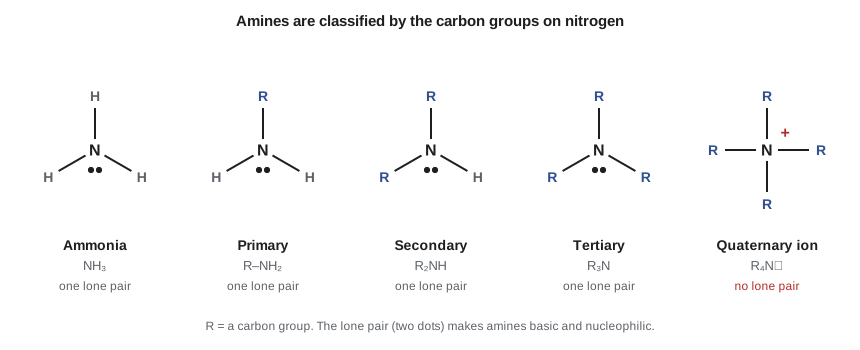
The nitrogen of an amine is sp³ hybridized, with three bonds and a lone pair arranged roughly tetrahedrally, giving a pyramidal shape. The lone pair is the key to amine chemistry. It makes amines basic, because it can accept a proton, and nucleophilic, because it can attack an electron-poor carbon. Amines with three different groups on nitrogen are chiral in principle, but the nitrogen inverts rapidly through a flat transition state, like an umbrella flipping, so the two enantiomers interconvert and cannot normally be separated.
Physical properties
Primary and secondary amines can hydrogen bond through their N–H bonds, though less strongly than alcohols because nitrogen is less electronegative than oxygen. Their boiling points therefore lie between those of alkanes and alcohols of similar size. Tertiary amines have no N–H and boil lower. Small amines are soluble in water, which can hydrogen bond to the lone pair. Low-molecular-weight amines have strong, unpleasant fishy or ammonia-like odors, and some of the smells of decay come from diamines such as putrescine and cadaverine, formed when bacteria break down amino acids, which is one reason odor complaints from spoiled stillage or wet grains point to bacterial activity.
Basicity of amines
An amine accepts a proton from water to form an ammonium ion and hydroxide, so amine solutions are basic. Chemists usually describe amine basicity through the pKa of the conjugate acid, the ammonium ion: the higher the pKa of R–NH₃⁺, the stronger the base. Simple alkylamines have conjugate-acid pKa values near 10 to 11, a little higher than ammonia at 9.25, because alkyl groups donate electron density to the nitrogen. Aromatic amines such as aniline are much weaker bases, with a pKa near 4.6, because the lone pair is shared with the benzene ring by resonance and is less available to a proton. Amides are not basic at all, for the same reason: the lone pair is delocalized into the carbonyl.
Because amines are bases, they react with acids to form ammonium salts, which are ionic, water-soluble and usually odorless solids. Many drugs that contain amine groups are sold as hydrochloride salts for that reason. The ratio of protonated to free amine at any pH follows the Henderson-Hasselbalch equation, which the program below applies to several amines.
# Fraction of an amine that is protonated at a given pH (Henderson-Hasselbalch)
# pKa refers to the conjugate acid R-NH3+ (approximate values at 25 C).
amines = {'monoethanolamine (MEA)': 9.5, 'diethanolamine (DEA)': 8.9,
          'methyldiethanolamine (MDEA)': 8.6, 'ammonia': 9.25, 'aniline': 4.6}

def frac_protonated(pKa, pH):
    return 1 / (1 + 10 ** (pH - pKa))

print("amine                         pKa   % protonated at pH 7   pH 9   pH 11")
for name, pKa in amines.items():
    vals = [100 * frac_protonated(pKa, pH) for pH in (7, 9, 11)]
print(f"{name:28s} {pKa:5.2f} {vals[0]:8.1f} {vals[1]:5.1f} {vals[2]:5.1f}")amine pKa % protonated at pH 7 pH 9 pH 11 monoethanolamine (MEA) 9.50 99.7 76.0 3.1 diethanolamine (DEA) 8.90 98.8 44.3 0.8 methyldiethanolamine (MDEA) 8.60 97.5 28.5 0.4 ammonia 9.25 99.4 64.0 1.7 aniline 4.60 0.4 0.0 0.0
At pH 7 almost every alkylamine is protonated, while aniline is almost entirely free. At pH 11 the alkylamines are mostly unprotonated. That pH switch is the basis of amine extraction: an amine can be pulled from an organic solvent into acidic water as its salt, then recovered by making the water basic. It is also the basis of acid gas scrubbing, as the next section explains.
Amine scrubbing of carbon dioxide
Aqueous solutions of alkanolamines, amines that also carry hydroxyl groups, absorb carbon dioxide and hydrogen sulfide from gas streams. The most common are monoethanolamine (MEA), a primary amine; diethanolamine (DEA), secondary; and methyldiethanolamine (MDEA), tertiary. In the absorber, the gas flows up against the amine solution at around 40 to 50 °C, and carbon dioxide reacts with the amine. Primary and secondary amines form carbamates, in which carbon dioxide bonds directly to nitrogen; tertiary amines cannot form carbamates and instead catalyze the formation of bicarbonate. The rich solution is then heated to around 110 to 120 °C in a stripper, which reverses the reaction, releases nearly pure carbon dioxide and regenerates the amine.
The choice of amine is a trade-off. MEA reacts fast and absorbs carbon dioxide strongly, but regenerating it takes a lot of heat, and it degrades and corrodes equipment. MDEA reacts more slowly but needs less energy to regenerate and can absorb more carbon dioxide per mole of amine, so blends of MDEA with a faster amine are common. Amine scrubbing is used in natural gas processing, in hydrogen and ammonia plants, and in most current carbon capture projects at power and industrial plants.
For Kingfisher Bioenergy, carbon dioxide from fermentation is already about 99 percent pure on a dry basis, so Lakeshore Gas needs only to remove water, ethanol and trace sulfur and organic compounds before compression. That purity is why fermentation carbon dioxide is among the cheapest sources for food-grade carbon dioxide and for carbon capture and storage projects, several of which have been proposed to collect carbon dioxide from Midwest ethanol plants by pipeline.
Reactions of amines
As nucleophiles, amines react with alkyl halides by SN2 substitution, but the reaction is hard to stop at one step: the product amine is itself nucleophilic and reacts again, giving mixtures of secondary, tertiary and quaternary products. Industry makes simple amines more cleanly by reacting ammonia with alcohols over a catalyst, or by reductive amination, in which an aldehyde or ketone reacts with ammonia or an amine and the product is hydrogenated. Ethanolamines are made by reacting ammonia with ethylene oxide.
Amines react with acid chlorides and anhydrides to form amides, a reaction used to make many pharmaceuticals and the nylons covered in lesson 11. Primary aromatic amines such as aniline react with nitrous acid at low temperature to form diazonium salts, which are intermediates for dyes; dry diazonium salts can decompose violently, so they are made and used in solution in cold conditions. Secondary amines react with nitrites or nitrogen oxides to form N-nitrosamines, a group of probable carcinogens. Nitrosamine formation is a concern in amine scrubbing plants and has led regulators to recall several medicines found to contain nitrosamine impurities since 2018.
Worked problem
Selecting a pH for extracting an amine
A process stream contains a basic product, an alkylamine whose conjugate acid has pKa 10.6, dissolved in toluene with neutral impurities. The plan is to extract the amine into water and leave the impurities behind. What pH should the water have to capture at least 99 percent of the amine as its salt?
Show solution
- The salt is water-soluble; the free amine stays in toluene. We need at least 99 percent protonated.
- Fraction protonated \(= 1/(1 + 10^{\,\text{pH} - 10.6}) \ge 0.99\), so \(10^{\,\text{pH} - 10.6} \le 0.0101\).
- \(\text{pH} - 10.6 \le -2.0\), so \(\text{pH} \le 8.6\).
- In practice a pH of 2 to 4, set with dilute acid, protonates essentially all the amine and leaves a wide margin.
Answer: Any pH at or below about 8.6 captures 99 percent; dilute acid at pH 2 to 4 captures virtually all of it. Raising the pH of the aqueous layer above 12.6 later frees the amine for recovery.
Other nitrogen functional groups
Several other nitrogen groups are common in industry. Nitriles, R–C≡N, contain a carbon-nitrogen triple bond; acrylonitrile, CH₂=CHCN, is a monomer for acrylic fibers and ABS plastic, and adiponitrile is an intermediate for nylon. Nitriles hydrolyze to carboxylic acids or amides and can be hydrogenated to amines. Nitro compounds, R–NO₂, include nitrobenzene, which is hydrogenated to aniline for polyurethane chemicals. Many nitro compounds are thermally unstable, and they are handled under strict temperature limits. Imines, R₂C=NR, form from aldehydes or ketones and amines and are intermediates in reductive amination and in many biological reactions.
Urea, H₂NCONH₂, deserves special mention. It is a diamide of carbonic acid and the most widely used nitrogen fertilizer in the world, made from ammonia and carbon dioxide at high pressure. Ammonia plants and urea plants are often built together because the ammonia process produces the carbon dioxide that urea needs. Fermentation plants use feed-grade urea as a cheap nitrogen source for yeast; yeast enzymes break it down to ammonia, which the cells use to build amino acids. The plant also uses urea in some air pollution control systems, where urea solution injected into hot flue gas reduces nitrogen oxides to nitrogen.
Amino acids and proteins
Amino acids contain both an amine group and a carboxylic acid group on the same carbon. In water near neutral pH, the acid group is ionized and the amine group protonated, so an amino acid exists as a zwitterion, with both a positive and a negative charge. The pH at which the net charge is zero is the isoelectric point. Twenty amino acids, differing in their side chains, link through amide bonds, called peptide bonds, to form proteins. Except for glycine, all the amino acids in proteins are chiral, and nature uses the L forms almost exclusively.
Proteins matter to the ethanol plant in three ways. Enzymes, the protein catalysts that break starch into glucose, are added to the mash, and their activity depends on temperature and pH because both affect the protein's folded shape. Yeast need amino acids and ammonia to grow, and when nitrogen runs short the yeast make more fusel alcohols by breaking down amino acids, so the nitrogen supply influences the impurity profile Theo met in lesson 2. And the protein content of the distillers grains, typically around 30 percent on a dry basis for dried distillers grains with solubles, sets much of their value as animal feed.
Common mistakes
MistakeClassifying amines by the carbon that carries the nitrogen, as for alcohols.
InsteadCount the carbon groups bonded directly to nitrogen: one, two or three.
MistakeAssuming aniline is as basic as an alkylamine.
InsteadResonance with the ring ties up aniline's lone pair; its conjugate acid pKa is about 4.6, not 10.
MistakeCalling amides basic because they contain nitrogen.
InsteadThe amide nitrogen's lone pair is delocalized into the carbonyl, so amides are essentially neutral.
MistakeAlkylating an amine with an alkyl halide and expecting a single product.
InsteadThe product amines keep reacting; expect a mixture unless the conditions are controlled.
Summary and key terms
- Amines are primary, secondary or tertiary by the number of carbon groups on nitrogen; quaternary ammonium ions carry a positive charge.
- The nitrogen lone pair makes amines basic and nucleophilic; alkylamines have conjugate-acid pKa near 10 to 11.
- Aromatic amines and especially amides are much weaker bases because the lone pair is delocalized.
- Henderson-Hasselbalch sets the protonated fraction at each pH, the basis of extraction and acid gas scrubbing.
- Alkanolamines such as MEA, DEA and MDEA absorb CO₂ and release it on heating.
- Urea, nitriles, nitro compounds and amino acids are major nitrogen compounds in industry and biology.
- Amine
- An organic derivative of ammonia with one or more carbon groups on nitrogen.
- Quaternary ammonium ion
- A positively charged nitrogen bonded to four carbon groups.
- Conjugate acid
- The species formed when a base accepts a proton, such as R–NH₃⁺ from R–NH₂.
- Alkanolamine
- An amine that also carries one or more hydroxyl groups, used in gas scrubbing.
- Carbamate
- The product formed when carbon dioxide bonds to the nitrogen of a primary or secondary amine.
- Zwitterion
- A molecule carrying both positive and negative charges but neutral overall.
- Peptide bond
- The amide bond linking amino acids in a protein.
Practice problems
Work each problem on paper first, then reveal the answer to check.
Classify (CH₃)₂NCH₂CH₃.
Show answer
A tertiary amine: nitrogen carries three carbon groups.
Which is the stronger base, methylamine or aniline?
Show answer
Methylamine; aniline's lone pair is delocalized into the ring.
Using the program, what fraction of MEA is protonated at pH 9?
Show answer
About 76 percent.
Why does heating the rich amine solution release carbon dioxide?
Show answer
Absorption is exothermic and reversible, so higher temperature shifts the equilibrium back toward free CO₂ and amine.
What is the isoelectric point of an amino acid?
Show answer
The pH at which the zwitterion's net charge is zero.
Why might a nitrogen-starved fermentation produce more fusel alcohols?
Show answer
Yeast break down amino acids for nitrogen, and the carbon skeletons are converted into higher alcohols.
Lesson quiz · 5 questions
Score 60% or more to complete this lesson.
Create a free account to save your progress, take quizzes and earn a certificate.