
CHE-243 · Lesson 4 of 12 · 23 min
Alkenes, alkynes and addition reactions
Ethylene is the largest-volume organic chemical in the world, with global production well above 150 million metric tons a year. Almost all of it comes from steam cracking ethane, propane or naphtha, but a small and growing share is made by dehydrating ethanol, producing what is sold as bio-based ethylene for polyethylene. That connection is why Ingrid asked Theo to look at alkenes: one option Kingfisher Bioenergy keeps reviewing is selling ethanol into chemical markets rather than fuel. Alkenes also matter to the plant in a quieter way. The corn oil it recovers is rich in carbon-carbon double bonds, and those double bonds control how the oil behaves in storage, how it can be processed, and what it is worth.
Structure of alkenes and alkynes
Alkenes contain at least one carbon-carbon double bond, and open-chain alkenes with one double bond have the formula CₙH₂ₙ. Alkynes contain a carbon-carbon triple bond and have the formula CₙH₂ₙ₋₂. As lesson 1 explained, the carbons of a double bond are sp² hybridized and flat, with 120° bond angles, and the pi bond lies above and below the plane of the molecule. Alkyne carbons are sp hybridized and linear, with two pi bonds at right angles to each other forming a cylinder of electron density around the bond axis.
The pi bond has two important consequences. First, it holds the two carbons and their four substituents in one plane and prevents rotation, so alkenes can exist as geometric isomers. Second, its electrons are loosely held and exposed above and below the plane, making alkenes nucleophilic: they are attracted to electron-poor species called electrophiles. Almost all alkene chemistry follows from that second point.
Geometric isomers: cis, trans, E and Z
When each carbon of a double bond carries two different groups, two isomers are possible. In cis-2-butene the two methyl groups are on the same side of the double bond; in trans-2-butene they are on opposite sides. These are different compounds with different boiling points and stabilities, and they do not interconvert at room temperature because that would require breaking the pi bond. Trans alkenes are usually slightly more stable than cis because the large groups do not crowd each other.
The cis and trans labels become ambiguous when a double bond carries three or four different groups, so IUPAC uses the E,Z system. For each carbon, rank the two attached groups by the Cahn-Ingold-Prelog priority rules, which start with atomic number: the atom of higher atomic number has higher priority, and ties are broken by looking at the next atoms out. If the two higher-priority groups are on the same side, the isomer is Z (from German zusammen, together); if they are on opposite sides, it is E (entgegen, opposite). For simple cases like 2-butene, cis corresponds to Z and trans to E.
Geometric isomerism has real consequences in fats and oils. Natural unsaturated fatty acids such as oleic and linoleic acid have cis double bonds, which put a kink in the chain and keep the oils liquid. Partial hydrogenation of vegetable oils, once common in food processing, converted some cis bonds to trans, producing trans fats whose straighter chains pack like saturated fats. Health concerns led both Canada and the United States to remove partially hydrogenated oils from the food supply, with bans taking effect in 2018.
Stability and the heat of hydrogenation
Adding hydrogen across a double bond, with a metal catalyst such as nickel, palladium or platinum, converts an alkene into an alkane and releases heat. The heat of hydrogenation is a convenient measure of alkene stability: the more stable the alkene, the less heat it releases. Measurements show that more highly substituted alkenes, with more alkyl groups on the double-bond carbons, are more stable, and that trans isomers are more stable than cis. Hydrogenating 1-butene releases about 127 kJ/mol, cis-2-butene about 120 kJ/mol, and trans-2-butene about 116 kJ/mol.
Catalytic hydrogenation is one of the most important industrial reactions. It saturates vegetable oils for margarine and shortening, upgrades cracked petroleum fractions, and is used throughout fine chemical manufacturing. The reaction is highly exothermic and uses flammable hydrogen under pressure, so hydrogenation reactors are designed with careful attention to heat removal and hydrogen handling.
Measuring unsaturation in oils: the iodine value
The oil and biodiesel industries describe unsaturation with the iodine value, the mass of iodine in grams that adds across the double bonds of 100 g of oil. A saturated fat has an iodine value near zero; corn oil, rich in linoleic acid, is typically around 120 to 130. The iodine value predicts how easily an oil oxidizes in storage, since double bonds, especially those separated by a single CH₂ as in linoleic acid, are attacked by oxygen. It also sets how much hydrogen would be needed to saturate the oil. The program below estimates the iodine value of corn oil from an illustrative fatty acid profile.
# Iodine value of a vegetable oil from its fatty acid profile (illustrative corn oil composition)
# Iodine value = grams of I2 that add across the C=C bonds of 100 g of oil.
I2 = 253.81
# fatty acid: (mass fraction of acids, C=C bonds per chain, molar mass of the acid in g/mol)
profile = {'palmitic (16:0)': (0.11, 0, 256.4), 'stearic (18:0)': (0.02, 0, 284.5),
           'oleic (18:1)': (0.28, 1, 282.5), 'linoleic (18:2)': (0.58, 2, 280.4), 'linolenic (18:3)': (0.01, 3, 278.4)}

GLYCEROL_FACTOR = 0.957   # approximate mass of acids per gram of triglyceride oil
iv = 0.0
for name, (w, db, M) in profile.items():
    mol_acid = w * 100 * GLYCEROL_FACTOR / M        # mol of this acid chain in 100 g of oil
    iv += mol_acid * db * I2
    print(f"{name:18s} {w * 100:4.0f}%  C=C per chain {db}")
print(f"Estimated iodine value: {iv:.0f} g I2 per 100 g oil")
print("Hydrogen to saturate 1 t of oil:", round(iv * 10 / I2 * 2.016, 1), "kg H2")palmitic (16:0) 11% C=C per chain 0 stearic (18:0) 2% C=C per chain 0 oleic (18:1) 28% C=C per chain 1 linoleic (18:2) 58% C=C per chain 2 linolenic (18:3) 1% C=C per chain 3 Estimated iodine value: 127 g I2 per 100 g oil Hydrogen to saturate 1 t of oil: 10.1 kg H2
The estimate of about 127 g of iodine per 100 g of oil sits in the typical range for corn oil, and it implies that fully saturating a metric ton of oil would take about 10 kg of hydrogen. For the plant, the more useful conclusion is about storage: an oil with this much polyunsaturation must be protected from air, heat and metals such as copper, which catalyze oxidation, if it is to keep its value as a biodiesel or renewable diesel feedstock.
Electrophilic addition to alkenes
The characteristic reaction of alkenes is addition: a reagent X–Y breaks apart and X and Y attach to the two carbons of the double bond, which becomes a single bond. Many common reagents add this way, including hydrogen halides (HCl, HBr), water (with an acid catalyst), halogens (Cl₂, Br₂) and hydrogen (with a metal catalyst). The reactions are generally favorable because a weak pi bond and the X–Y bond are replaced by two stronger sigma bonds.
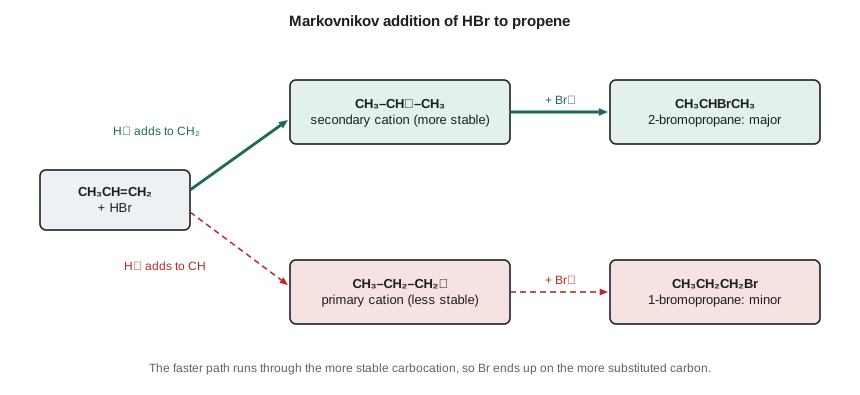
The mechanism of hydrogen halide addition shows how alkenes react. In the first step, the pi electrons attack the hydrogen of H–Br, forming a new C–H bond and leaving a positive charge on the other carbon: a carbocation, a carbon with only three bonds and an empty p orbital. In the second step, the bromide ion, a nucleophile, attacks the carbocation and forms the C–Br bond. The first step is slower and controls the rate. Lesson 10 develops the language of mechanisms, but this two-step picture is enough to predict the outcome of many additions.
Markovnikov's rule and carbocation stability
When an unsymmetrical reagent such as HBr adds to an unsymmetrical alkene such as propene, two products are possible: 1-bromopropane or 2-bromopropane. In practice 2-bromopropane dominates. The Russian chemist Vladimir Markovnikov summarized such results in 1869: the hydrogen adds to the carbon that already has more hydrogens, and the halogen to the carbon with fewer. The modern explanation is carbocation stability. Adding H to the end carbon of propene gives a secondary carbocation, with the positive carbon bonded to two other carbons; adding H to the middle carbon gives a primary carbocation, bonded to only one. Alkyl groups donate electron density and stabilize the positive charge, so the order of stability is tertiary > secondary > primary > methyl. The faster pathway goes through the more stable cation.
Carbocations can also rearrange: a hydrogen or methyl group on a neighboring carbon can shift, with its bonding pair, to the positive carbon if that produces a more stable cation. Rearrangements explain some unexpected products in acid-catalyzed reactions and are deliberately used in refinery isomerization and alkylation units to make highly branched, high-octane hydrocarbons.
Worked problem
Predicting the product of acid-catalyzed hydration
2-Methylpropene, (CH₃)₂C=CH₂, reacts with water in the presence of dilute sulfuric acid. Predict the main product.
Show solution
- The acid protonates the double bond. Adding H⁺ to the CH₂ end gives (CH₃)₃C⁺, a tertiary carbocation; adding it to the other carbon would give a primary cation.
- The tertiary cation forms much faster.
- Water attacks the cation, and loss of a proton from the resulting oxonium ion gives the alcohol.
- Product: (CH₃)₃COH, 2-methyl-2-propanol (tert-butyl alcohol).
Answer: Markovnikov hydration gives tert-butyl alcohol. Industrial direct hydration of ethylene over an acid catalyst, which makes synthetic ethanol, follows the same mechanism, although with ethylene there is only one possible product.
Hydration, dehydration and ethanol
Hydration of ethylene and dehydration of ethanol are the same reaction run in opposite directions.
Hydration is exothermic and favored by low temperature and high pressure, since two molecules of gas become one. Dehydration is endothermic and favored by high temperature. Synthetic ethanol producers hydrate ethylene from petroleum over a phosphoric acid catalyst at around 250 to 300 °C and 60 to 70 bar. Bio-ethylene producers do the reverse, passing ethanol vapor over an alumina or zeolite catalyst at roughly 300 to 450 °C. Le Chatelier's principle, which you used in CHE-220, explains why each process runs where it does. A by-product of dehydration at lower temperature is diethyl ether, formed when an ethanol molecule attacks a protonated ethanol, a substitution reaction covered in lesson 7.
Halogen addition and oxidation
Bromine adds rapidly to alkenes at room temperature, and the red-brown color of bromine disappears as it reacts, a classic test for unsaturation. The addition goes through a bridged bromonium ion, and the bromide ion attacks from the opposite face, so the two bromine atoms end up on opposite sides (anti addition). Chlorine adds to ethylene the same way, and that reaction, making 1,2-dichloroethane, is the first step in producing vinyl chloride for PVC.
Alkenes are also oxidized more readily than alkanes. Mild oxidants convert them to diols (1,2-ethanediol, or ethylene glycol, is made industrially by hydrating ethylene oxide). Silver catalysts with oxygen convert ethylene to ethylene oxide, a key intermediate. Strong oxidants and ozone cleave the double bond completely, giving aldehydes, ketones or carboxylic acids. Uncontrolled oxidation by air is what makes polyunsaturated oils go rancid, and in extreme cases oily rags heat up by oxidation until they ignite, which is why rags soaked with drying oils must be stored in closed metal containers.
Alkynes
Alkynes undergo many of the same addition reactions as alkenes, often twice, because the triple bond contains two pi bonds. Hydrogenation over a normal catalyst goes all the way to the alkane, but a deliberately weakened catalyst stops at the cis alkene, a selectivity trick used in fine chemical synthesis and in removing traces of acetylene from ethylene streams in crackers. Terminal alkynes, with a C–H on the triple bond, are weakly acidic (pKa about 25) because the sp carbon holds the electron pair of its conjugate base close to the nucleus.
Acetylene, HC≡CH, deserves a safety note. It is unstable at high pressure and can decompose explosively without oxygen, which is why it is stored dissolved in acetone in cylinders packed with a porous filler, and why its pressure in hoses and regulators is limited. It also forms shock-sensitive compounds with copper and silver, so acetylene equipment avoids high-copper alloys. Welders in every plant handle acetylene, and these properties follow directly from its high-energy triple bond.
Common mistakes
MistakeAssuming cis and trans alkenes interconvert like conformations.
InsteadConverting them requires breaking the pi bond; they are distinct compounds.
MistakePlacing the halogen on the carbon with more hydrogens in HX addition.
InsteadThe reaction goes through the more stable carbocation, so X ends up on the more substituted carbon.
MistakeTreating the iodine value as a measure of oil quality in general.
InsteadIt measures unsaturation only; acidity, moisture and contaminants are separate specifications.
MistakeRunning ethanol dehydration at the conditions used for ethylene hydration.
InsteadThe reactions are reverses of each other; temperature and pressure decide which direction is favored.
Summary and key terms
- Alkenes (CₙH₂ₙ) contain a C=C with a reactive pi bond; alkynes (CₙH₂ₙ₋₂) contain a C≡C.
- Restricted rotation gives cis/trans (E/Z) isomers; natural fatty acids are cis, and trans fats come from partial hydrogenation.
- Heats of hydrogenation show that more substituted and trans alkenes are more stable.
- Alkenes undergo electrophilic addition through carbocations; Markovnikov products come from the more stable cation.
- Hydration of ethylene and dehydration of ethanol are reverse reactions governed by temperature and pressure.
- The iodine value measures unsaturation in oils and predicts oxidation tendency and hydrogen demand.
- Alkene
- A hydrocarbon containing a carbon-carbon double bond.
- Electrophile
- An electron-poor species that accepts an electron pair from a nucleophile.
- Carbocation
- A positively charged carbon with three bonds and an empty p orbital.
- Markovnikov’s rule
- In additions of HX to alkenes, H goes to the carbon with more hydrogens and X to the more substituted carbon.
- E/Z notation
- A system for naming geometric isomers using Cahn-Ingold-Prelog priorities.
- Iodine value
- Grams of iodine absorbed by 100 g of a fat or oil; a measure of unsaturation.
- Hydrogenation
- Addition of hydrogen across a multiple bond, usually with a metal catalyst.
Practice problems
Work each problem on paper first, then reveal the answer to check.
Draw or describe the two geometric isomers of 2-pentene.
Show answer
cis-2-Pentene with CH₃ and CH₂CH₃ on the same side, and trans-2-pentene with them on opposite sides.
What is the major product of HCl adding to 2-methyl-2-butene?
Show answer
2-Chloro-2-methylbutane, from the tertiary carbocation.
Which releases more heat on hydrogenation, cis- or trans-2-butene?
Show answer
cis-2-Butene (about 120 against 116 kJ/mol), because it is the less stable isomer.
Why does bromine water lose its color when shaken with an alkene?
Show answer
Bromine adds across the double bond to form a colorless dibromide.
Is high or low temperature better for making ethylene from ethanol?
Show answer
High temperature, because dehydration is endothermic and also makes two gas molecules from one.
Using the program, how would the iodine value change if the oil were 70 percent linoleic acid instead of 58 percent?
Show answer
It would rise, because linoleic chains carry two double bonds each; rerun the program with the new fraction to find the value.
Lesson quiz · 5 questions
Score 60% or more to complete this lesson.
Create a free account to save your progress, take quizzes and earn a certificate.