
CHE-243 · Lesson 5 of 12 · 22 min
Aromatic compounds
In the nineteenth century, chemists noticed that a group of compounds extracted from balsams, coal tar and spices had pleasant smells and unusual chemistry, and they called them aromatic. The smell turned out to be a poor guide, but the chemistry was real: these compounds all contain a benzene ring or a related ring, and they resist the addition reactions that alkenes undergo so easily. Aromatic compounds are now central to industry. Benzene, toluene and the xylenes, known together as BTX, are made in tens of millions of metric tons a year and feed the production of plastics, fibers, resins, solvents and pharmaceuticals. They also appear in gasoline, where they raise the octane rating, and that is where they touch the Kingfisher Bioenergy plant: the denaturant specification limits aromatics, and Theo wants to understand why.
The structure of benzene
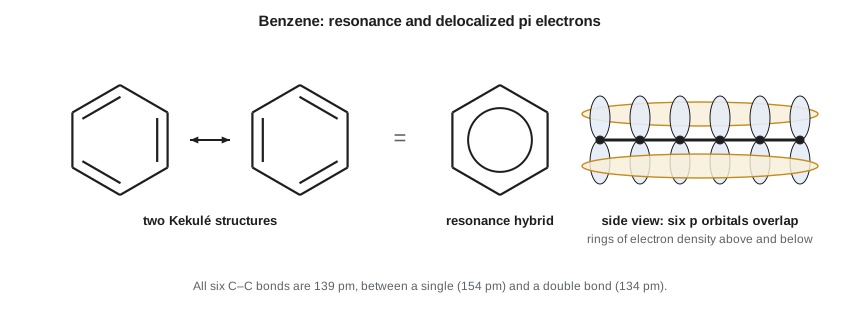
Benzene, C₆H₆, has four degrees of unsaturation, so an early guess was a six-membered ring with three alternating double bonds, the structure proposed by August Kekulé in 1865. That structure predicts two kinds of carbon-carbon bond, short double bonds and long single bonds, and predicts that benzene should add bromine as alkenes do. Neither prediction holds. All six C–C bonds in benzene are identical, 139 pm long, between the single (154 pm) and double (134 pm) values, and benzene does not decolorize bromine water.
The modern picture explains both facts. Each carbon in benzene is sp² hybridized, bonded to two carbons and one hydrogen in a flat hexagon, with 120° angles. Each carbon has one remaining p orbital perpendicular to the ring, and the six p orbitals overlap all the way around, forming a continuous ring of pi electron density above and below the plane. The six pi electrons are not confined to three double bonds but are shared equally by all six carbons. In resonance language, benzene is a hybrid of the two Kekulé structures, and chemists often draw it as a hexagon with a circle inside.
Aromatic stability
Benzene is much more stable than a hypothetical cyclohexatriene with three isolated double bonds. The evidence comes from heats of hydrogenation. Hydrogenating cyclohexene, with one double bond, releases about 120 kJ/mol. Three isolated double bonds would therefore release about 360 kJ/mol, yet hydrogenating benzene to cyclohexane releases only about 208 kJ/mol. The difference, about 150 kJ/mol, is benzene's resonance or aromatic stabilization energy. Breaking the aromatic ring costs that stabilization, which is why benzene undergoes substitution, which keeps the ring intact, rather than addition, which would destroy it.
Hückel's rule
Not every ring with alternating double bonds is aromatic. In 1931 Erich Hückel found that a compound is aromatic only if it is cyclic, planar, fully conjugated (with a p orbital on every ring atom) and has 4n + 2 pi electrons, where n is zero or a positive integer: 2, 6, 10, 14 and so on. Rings that meet the first three conditions but have 4n pi electrons, such as square cyclobutadiene with four, are antiaromatic and unusually unstable. Rings that are not planar or not fully conjugated are simply nonaromatic. Cyclooctatetraene, with eight pi electrons, avoids antiaromaticity by folding into a tub shape and behaves like an ordinary alkene.
# Aromaticity check (Huckel 4n + 2) and the resonance energy of benzene from hydrogenation heats
def huckel(pi_electrons, cyclic=True, planar=True, conjugated=True):
    if not (cyclic and planar and conjugated):
        return 'not aromatic (fails ring, planarity or conjugation test)'
    if pi_electrons % 4 == 2:
        return 'aromatic'
    if pi_electrons % 4 == 0:
        return 'antiaromatic if planar'
    return 'odd count: check charges'

for name, pe, kw in [('benzene', 6, {}), ('cyclobutadiene', 4, {}), ('cyclooctatetraene (tub-shaped)', 8, {'planar': False}),
                     ('pyridine', 6, {}), ('naphthalene', 10, {}), ('1,3-cyclohexadiene', 4, {'cyclic': True, 'conjugated': False})]:
    print(f"{name:32s} {pe:2d} pi electrons -> {huckel(pe, **kw)}")

h_cyclohexene = 120     # kJ/mol released hydrogenating one isolated C=C (approximate)
h_benzene = 208         # kJ/mol released hydrogenating benzene to cyclohexane (approximate)
print(f"Expected for three isolated C=C: {3 * h_cyclohexene} kJ/mol; measured {h_benzene} kJ/mol")
print(f"Resonance (aromatic) stabilization of benzene: about {3 * h_cyclohexene - h_benzene} kJ/mol")benzene 6 pi electrons -> aromatic cyclobutadiene 4 pi electrons -> antiaromatic if planar cyclooctatetraene (tub-shaped) 8 pi electrons -> not aromatic (fails ring, planarity or conjugation test) pyridine 6 pi electrons -> aromatic naphthalene 10 pi electrons -> aromatic 1,3-cyclohexadiene 4 pi electrons -> not aromatic (fails ring, planarity or conjugation test) Expected for three isolated C=C: 360 kJ/mol; measured 208 kJ/mol Resonance (aromatic) stabilization of benzene: about 152 kJ/mol
Hückel's rule extends aromaticity well beyond benzene. Fused rings such as naphthalene (10 pi electrons) are aromatic, as are heterocyclic rings that contain nitrogen, oxygen or sulfur. Pyridine, C₅H₅N, has a nitrogen in place of one CH and six pi electrons; its nitrogen lone pair lies in the plane of the ring and is not part of the aromatic system, so it is available to accept a proton, making pyridine a weak base. In pyrrole and furan, by contrast, a lone pair on nitrogen or oxygen is part of the aromatic sextet. These heterocycles are building blocks for many drugs, dyes and agricultural chemicals, and the DNA bases are aromatic heterocycles.
Naming aromatic compounds
Monosubstituted benzenes are named by adding the substituent as a prefix: chlorobenzene, nitrobenzene, ethylbenzene. Many have accepted common names that are used more often than the systematic ones: toluene (methylbenzene), phenol (hydroxybenzene), aniline (aminobenzene), styrene (vinylbenzene), benzoic acid and benzaldehyde. When a benzene ring is itself a substituent it is called a phenyl group, C₆H₅–, abbreviated Ph.
For disubstituted benzenes, three positional isomers are possible. They are labeled ortho (o-) for neighboring positions 1,2; meta (m-) for 1,3; and para (p-) for 1,4. The three xylenes are o-, m- and p-dimethylbenzene. p-Xylene is by far the most valuable, because oxidizing both methyl groups gives terephthalic acid, the main raw material for polyethylene terephthalate, the PET of drink bottles and polyester fiber. With three or more substituents, numbers are used, as in 2,4,6-trimethylphenol.
| Compound | Structure | Boiling point (°C) | Main use |
|---|---|---|---|
| Benzene | C₆H₆ | 80 | Ethylbenzene, cumene and cyclohexane production |
| Toluene | C₆H₅CH₃ | 111 | Solvent, gasoline blending, benzene and xylene production |
| p-Xylene | C₆H₄(CH₃)₂, 1,4 | 138 | Terephthalic acid for PET |
| Ethylbenzene | C₆H₅CH₂CH₃ | 136 | Dehydrogenated to styrene |
| Styrene | C₆H₅CH=CH₂ | 145 | Polystyrene and synthetic rubbers |
| Phenol | C₆H₅OH | 182 | Resins, bisphenol A, nylon intermediates |
Electrophilic aromatic substitution
Benzene reacts with strong electrophiles, but it substitutes a hydrogen rather than adding across a bond. The mechanism has two steps. First, the pi electrons attack the electrophile, forming a new C–E bond and a positively charged ring intermediate called an arenium ion, in which the aromatic stabilization is temporarily lost. Second, a base removes the hydrogen from the carbon bearing the electrophile, and the electrons return to restore the aromatic ring. The first step is slow because it costs the aromatic stability; the second is fast because it restores it.
Five classic substitutions follow this pattern. Halogenation uses chlorine or bromine with an iron(III) halide catalyst. Nitration uses a mixture of concentrated nitric and sulfuric acids, which generates the nitronium ion, NO₂⁺. Sulfonation uses fuming sulfuric acid. Friedel-Crafts alkylation attaches an alkyl group using an alkyl halide or an alkene with an acid catalyst, and Friedel-Crafts acylation attaches an acyl group, R–C=O. Industry relies heavily on alkylation: benzene and ethylene over a zeolite catalyst give ethylbenzene, and benzene and propylene give cumene, which is oxidized to phenol and acetone.
Nitration and some other aromatic reactions are strongly exothermic, and the nitrated products can be energetic materials. Industrial nitration plants are designed with very careful temperature control, mixing and emergency systems, and nitrated aromatic compounds are handled under strict procedures. The point for an engineer is general: when a reaction is fast and exothermic and its products store energy, process safety design comes first, a theme lesson 12 develops.
Substituent effects
A substituent already on the ring changes both the rate of further substitution and where the new group goes. Electron-donating groups, such as –OH, –NH₂, –OCH₃ and alkyl groups, push electron density into the ring, making it more reactive than benzene; they are called activating groups and direct new substituents to the ortho and para positions. Electron-withdrawing groups, such as –NO₂, –COOH, –CHO, –CN and –SO₃H, pull electron density out of the ring, making it less reactive; they are deactivating and direct to the meta position. Halogens are an exception: they deactivate the ring slightly but direct ortho and para.
Worked problem
Predicting the products of nitrating toluene
Toluene is nitrated with a mixture of nitric and sulfuric acids. Predict the main products and whether the reaction is faster or slower than for benzene.
Show solution
- The methyl group is an electron-donating alkyl group: activating, ortho/para directing.
- The reaction is therefore faster than with benzene, and the nitro group goes mainly to the positions next to (ortho) and opposite (para) the methyl group.
- There are two ortho positions and one para position, but the para position is less crowded, so both products form in substantial amounts.
- Main products: 2-nitrotoluene and 4-nitrotoluene, with little 3-nitrotoluene.
Answer: Nitration of toluene gives mainly ortho and para nitrotoluenes, faster than benzene. These are intermediates for dyes and for toluene diisocyanate, used in polyurethane foams.
Reactions of side chains
The aromatic ring is stable enough that reactions can often be carried out on a side chain while leaving the ring untouched. Strong oxidation converts an alkyl side chain to a carboxylic acid group, which is how p-xylene becomes terephthalic acid and toluene becomes benzoic acid. The carbon next to the ring, called the benzylic position, is especially reactive toward radicals and oxidation, because a radical or cation there is stabilized by resonance with the ring. Ethylbenzene is dehydrogenated at this position, over an iron oxide catalyst at about 600 °C with steam, to make styrene.
Aromatic rings from biomass
Aromatic rings are not only a petrochemical story. Plants make them too. Lignin, the glue that binds cellulose fibers in corn stover and wood, is a cross-linked polymer of aromatic units with methoxy and hydroxyl groups, and it makes up roughly a fifth to a third of dry plant cell walls. Corn bran contains ferulic acid, an aromatic acid that links lignin to the cell-wall sugars. Three of the twenty amino acids in proteins, phenylalanine, tyrosine and tryptophan, contain aromatic rings, and the yeast at the plant converts some of them into aromatic flavor compounds such as 2-phenylethanol, which has a rose-like smell and appears at low levels in the fusel oil.
Lignin is a large, mostly unused source of renewable aromatics. Pulp mills burn most of theirs for energy, and cellulosic ethanol plants would produce lignin as a residue. Converting lignin into benzene, toluene, xylenes or phenols is an active research area, but its irregular, cross-linked structure makes clean, selective conversion hard. For now, almost all industrial aromatics still come from catalytic reforming of naphtha and from steam cracker by-products.
Health effects and regulation of aromatics
Benzene is a known human carcinogen: long-term exposure can cause leukemia, and occupational exposure limits for benzene are among the lowest for any common solvent. That is the main reason the denaturant specification for fuel ethanol limits benzene, and why gasoline specifications in both countries cap it. Toluene and xylenes are much less hazardous than benzene but still toxic at high exposure, affecting the nervous system, and they are regulated as hazardous air pollutants. Polycyclic aromatic hydrocarbons, formed in incomplete combustion, include several carcinogens, which is another reason burner tuning and emissions control matter.
The US EPA's gasoline benzene program caps the average benzene content of gasoline at 0.62 percent by volume, and OSHA's benzene standard sets a permissible exposure limit of 1 ppm as an eight-hour average, with an action level of 0.5 ppm. The plant's denaturant must meet the limits written into the fuel ethanol standard it sells against.
Theo's conclusion for Ingrid is short. Aromatics are valuable chemicals and good octane boosters, but benzene in particular is toxic enough that every specification in the fuel chain restricts it, and the plant's purchasing of denaturant must check the supplier's certificate of analysis against those limits.
Common mistakes
MistakeDrawing benzene as cyclohexatriene and predicting alkene-style addition.
InsteadBenzene's delocalized sextet is stabilized by about 150 kJ/mol, so it substitutes rather than adds.
MistakeCounting any ring with alternating double bonds as aromatic.
InsteadCheck Hückel's conditions: cyclic, planar, fully conjugated and 4n + 2 pi electrons.
MistakeAssuming every substituent speeds up substitution.
InsteadElectron donors activate and direct ortho/para; electron withdrawers deactivate and direct meta.
MistakeTreating all aromatic solvents as equally hazardous.
InsteadBenzene is a carcinogen with very low exposure limits; toluene and xylenes are far less hazardous but still controlled.
Summary and key terms
- Benzene is a flat ring of sp² carbons with six delocalized pi electrons and equal C–C bonds.
- Aromatic stabilization of about 150 kJ/mol makes benzene substitute rather than add.
- Hückel's rule: cyclic, planar, fully conjugated rings with 4n + 2 pi electrons are aromatic.
- Electrophilic aromatic substitution goes through an arenium ion and restores the ring.
- Activating groups direct ortho/para; deactivating groups direct meta; halogens deactivate but direct ortho/para.
- BTX aromatics are major feedstocks; benzene is a carcinogen and is tightly limited in fuels and workplaces.
- Aromatic compound
- A cyclic, planar, fully conjugated compound with 4n + 2 pi electrons and extra stability.
- Hückel’s rule
- The 4n + 2 pi electron condition for aromaticity.
- Arenium ion
- The positively charged intermediate formed when an electrophile attacks an aromatic ring.
- Ortho, meta, para
- Positional labels for 1,2-, 1,3- and 1,4-disubstituted benzenes.
- Activating group
- A substituent that donates electron density and speeds up electrophilic aromatic substitution.
- BTX
- Benzene, toluene and xylenes, the main aromatic petrochemical feedstocks.
- Heterocycle
- A ring that contains at least one atom other than carbon, such as nitrogen, oxygen or sulfur.
Practice problems
Work each problem on paper first, then reveal the answer to check.
Is cyclopentadienyl anion, C₅H₅⁻, with six pi electrons in a planar ring, aromatic?
Show answer
Yes: cyclic, planar, fully conjugated and 4n + 2 = 6 with n = 1.
Name C₆H₄Cl₂ with the chlorines on carbons 1 and 4.
Show answer
1,4-Dichlorobenzene, or p-dichlorobenzene.
Where does bromine go when nitrobenzene is brominated?
Show answer
Mainly the meta position; the nitro group deactivates and directs meta.
Which reagent converts benzene to ethylbenzene industrially?
Show answer
Ethylene, with a zeolite acid catalyst (Friedel-Crafts alkylation).
Using the hydrogenation data in the program, what would three isolated C=C bonds release?
Show answer
About 360 kJ/mol, against 208 kJ/mol measured for benzene.
Why does pyridine act as a base while pyrrole does not?
Show answer
Pyridine's nitrogen lone pair is outside the aromatic system and free to take a proton; pyrrole's is part of the aromatic sextet.
Lesson quiz · 5 questions
Score 60% or more to complete this lesson.
Create a free account to save your progress, take quizzes and earn a certificate.