
CHE-243 · Lesson 12 of 12 · 23 min
Industrial organic chemistry, green chemistry and process safety
The final lesson brings the course together at the scale where chemical engineers work. Industrial organic chemistry turns a handful of raw materials, mainly natural gas, crude oil fractions and increasingly biomass, into a few dozen base chemicals, and those into the thousands of products of the modern economy. Doing that profitably, with little waste and without harming people, depends on the chemistry of the earlier lessons. Ingrid ends Theo's term with a capstone question: if Kingfisher Bioenergy wanted to make a chemical from part of its ethanol, which route should it consider first, and what would it need to get right on chemistry, waste and safety?
From raw materials to base chemicals
Most of the organic chemicals industry rests on a few building blocks. Steam crackers convert ethane, propane or naphtha into ethylene, propylene and butadiene, the olefins, with hydrogen and some aromatics as co-products. Catalytic reformers in refineries produce benzene, toluene and xylenes. Natural gas is converted into synthesis gas, a mixture of carbon monoxide and hydrogen, which feeds methanol and ammonia production. From these base chemicals, a relatively small number of large-scale reactions produce the intermediates: ethylene oxide and glycol, vinyl chloride, styrene, cumene, phenol and acetone, acetic acid, terephthalic acid and many others.
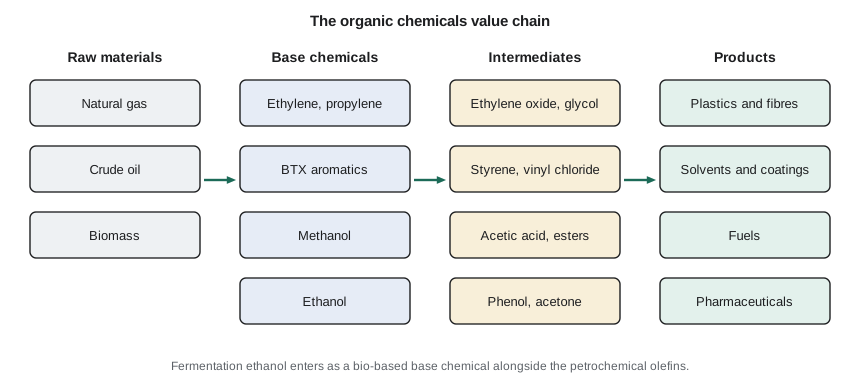
Ethanol enters this picture in two ways. As a fuel, it competes with gasoline. As a chemical, it can be converted into ethylene by dehydration (lesson 4), into acetaldehyde by oxidation or dehydrogenation, into ethyl acetate by esterification or dehydrogenation (lesson 8), into diethyl ether, and into butanol and longer alcohols by catalytic condensation. In most markets fermentation ethanol costs more per metric ton of product than the petrochemical routes it would replace, so bio-based chemicals usually depend on customers willing to pay for lower carbon intensity, on policy incentives, or on products where the bio route has a technical advantage.
| Base chemical | Main fossil route | Bio-based route | Major uses |
|---|---|---|---|
| Ethylene | Steam cracking of ethane or naphtha | Dehydration of ethanol | Polyethylene, ethylene oxide, PVC |
| Methanol | Synthesis gas from natural gas | Gasification of biomass; biogas reforming | Formaldehyde, acetic acid, fuels |
| Acetic acid | Methanol carbonylation | Ethanol oxidation; fermentation | Vinyl acetate, solvents, PET |
| Ethyl acetate | Esterification with petrochemical ethanol | Esterification or dehydrogenation of fermentation ethanol | Coatings, inks, adhesives |
| Lactic acid | Rarely made from petrochemicals | Fermentation of sugars | Polylactic acid, food acidulant |
The twelve principles of green chemistry
In 1998 Paul Anastas and John Warner published twelve principles of green chemistry, a framework for designing chemical products and processes that reduce or eliminate hazardous substances. The principles include preventing waste rather than treating it; maximizing atom economy; using less hazardous syntheses and safer chemicals; using safer solvents or none; designing for energy efficiency, with reactions near ambient temperature and pressure; using renewable feedstocks; reducing unnecessary steps such as protecting groups; preferring catalytic over stoichiometric reagents; designing products that break down after use; monitoring processes in real time to prevent pollution; and choosing substances and forms that minimize the potential for accidents. Several of these principles connect directly to the chemistry in this course.
Measuring greenness: yield, atom economy and E-factor
Three numbers summarize how efficiently a reaction uses its materials. Percent yield compares the product actually obtained with the theoretical maximum. Atom economy, introduced by Barry Trost, compares the molar mass of the desired product with the total molar mass of all reactants in the balanced equation, so it measures how many reactant atoms end up in the product even at 100 percent yield. Addition reactions, such as hydrogenation or the hydration of ethylene, have 100 percent atom economy; substitutions and eliminations always lose atoms to by-products. The E-factor, introduced by Roger Sheldon, is the total mass of waste per mass of product, including solvents, by-products and process aids. Bulk chemical plants typically have E-factors below 1, fine chemicals 5 to 50, and pharmaceuticals often 25 to 100 or more.
# Atom economy, yield and E-factor for two routes to ethyl acetate, and the adiabatic temperature rise of a batch
M = {'ethanol': 46.07, 'acetic acid': 60.05, 'ethyl acetate': 88.11, 'water': 18.02, 'hydrogen': 2.016}

routes = {
    'esterification (ethanol + acetic acid)': (['ethanol', 'acetic acid'], 'ethyl acetate'),
    'dehydrogenation (2 ethanol)':            (['ethanol', 'ethanol'], 'ethyl acetate'),
}
for name, (reactants, product) in routes.items():
    ae = 100 * M[product] / sum(M[r] for r in reactants)
    print(f"{name:40s} atom economy = {ae:5.1f}%")

# E-factor: kg waste per kg product for a batch (illustrative numbers)
inputs_kg, product_kg = 1450.0, 1000.0
print(f"E-factor = {(inputs_kg - product_kg) / product_kg:.2f} kg waste per kg product")
print(f"Isolated yield when theory allows 1180 kg: {100 * product_kg / 1180:.1f}%")

# Adiabatic temperature rise if cooling fails: dT = (-dH) x moles reacted / (mass x cp)
dH = -60e3                     # J/mol, exothermic (illustrative)
mol, mass, cp = 8000.0, 2500.0, 2.2e3   # mol reacting, kg of batch, J/(kg K)
print(f"Adiabatic temperature rise = {-dH * mol / (mass * cp):.0f} K")esterification (ethanol + acetic acid) atom economy = 83.0% dehydrogenation (2 ethanol) atom economy = 95.6% E-factor = 0.45 kg waste per kg product Isolated yield when theory allows 1180 kg: 84.7% Adiabatic temperature rise = 87 K
The program compares the two routes to ethyl acetate that Theo identified. Esterification of ethanol with acetic acid has an atom economy of about 83 percent, losing one water per ester. Dehydrogenation, in which two ethanol molecules combine over a copper catalyst to form ethyl acetate and two molecules of hydrogen, has an atom economy of about 96 percent, and the hydrogen by-product is itself valuable as a fuel or chemical. Dehydrogenation also avoids buying acetic acid, which suits a plant whose cheapest raw material is its own ethanol. Several commercial plants in other countries already make ethyl acetate this way.
Solvents and separation
Solvents often make up most of the mass in a chemical process and most of its waste, so solvent choice is one of the biggest levers in green chemistry. Companies and industry groups publish solvent selection guides that rank common solvents by health, safety and environmental criteria. Water, ethanol, ethyl acetate and acetone usually rank well; chlorinated solvents, benzene, diethyl ether and some polar aprotic solvents rank poorly. Ethanol and ethyl acetate rank among the preferred solvents, which is part of the market case for making them from renewable feedstocks.
Separation usually accounts for the largest share of energy use in a chemical plant. Reactive distillation, mentioned in lesson 8 for ethyl acetate, combines reaction and separation in one column, which can raise conversion beyond the equilibrium limit and cut energy use. Membranes, adsorption on molecular sieves and extraction are alternatives to distillation in particular cases. The ethanol plant itself uses molecular sieves to break the ethanol-water azeotrope, a clear example of choosing a separation technology to save energy.
Process safety: hazards of organic chemistry at scale
Organic chemicals bring three major groups of hazards into a plant. Flammability: most organic liquids and gases burn, many have flash points below room temperature, and their vapors can form explosive mixtures with air. Toxicity: some compounds, such as benzene, methanol, acrolein, hydrogen cyanide and the isocyanates, are acutely or chronically toxic at low concentrations. Reactivity: some substances decompose, polymerize or react with water or air, releasing heat and gas. Lessons 3, 5, 7 and 11 highlighted examples of each. Process safety is the engineering discipline that manages these hazards so that they do not lead to fires, explosions or toxic releases.
History shows the stakes. In 1984 at Bhopal, India, water entered a tank of methyl isocyanate, starting a runaway reaction that released a toxic cloud and killed thousands of people. In 2007 at T2 Laboratories in Jacksonville, Florida, loss of cooling during a batch reaction to make a fuel additive led to a runaway and explosion that killed four people. In 2013 at Lac-Mégantic, Quebec, a runaway train carrying crude oil derailed and exploded, killing 47 people and destroying much of the town center. Investigations of incidents like these, notably by the US Chemical Safety Board, consistently find that the hazard was knowable in advance from the chemistry and that safeguards were missing or failed.
Thermal runaway
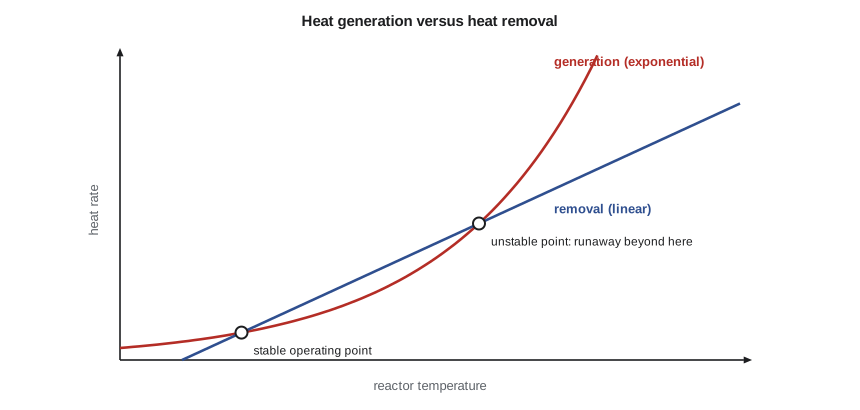
A runaway reaction happens when an exothermic reaction generates heat faster than the equipment can remove it. Lesson 10 explained why: the reaction rate, and so the rate of heat generation, rises exponentially with temperature, while heat removal through a cooling jacket rises only linearly with the temperature difference. Above a critical temperature, generation outruns removal, the temperature climbs, the rate rises further, and the process accelerates until reactants are exhausted, a relief device opens or the vessel fails. Secondary decomposition reactions that start at higher temperatures can add more heat and gas.
A first screening measure is the adiabatic temperature rise: the temperature increase if the whole reaction heat stayed in the batch with no cooling at all. It equals the heat of reaction times the amount reacting, divided by the batch mass times its heat capacity. If the batch temperature plus this rise would exceed the solvent's boiling point, the decomposition onset temperature of any component, or the design limits of the vessel, then losing cooling is a credible route to an incident. The program estimates an 87 K rise for an illustrative batch, enough to boil many solvents from a normal operating temperature.
Engineers test reactive hazards with calorimetry, which measures heats of reaction, decomposition onset temperatures and gas generation rates, and they then design safeguards in layers. Inherently safer design comes first: use less hazardous chemicals, smaller inventories, milder conditions and semi-batch addition so that unreacted material never accumulates. Engineered controls follow: adequate cooling with backup, high-temperature interlocks that stop feeds, emergency relief systems sized for the runaway case, and quench or dump systems. Procedures, training and management of change complete the layers.
In the United States, OSHA's Process Safety Management standard (29 CFR 1910.119) applies to processes holding more than threshold quantities of listed highly hazardous chemicals or 10,000 pounds of flammable liquids or gases, and EPA's Risk Management Program rule requires hazard assessments and emergency planning for listed substances. In Iowa, the plant's ethanol, denaturant and ammonia inventories bring several of these requirements into play.
Chemical compatibility on site
A simple but essential application of organic chemistry is checking which chemicals must never meet. Oxidizers, such as concentrated nitric acid, hydrogen peroxide or hypochlorite sanitizers, can react violently with organic materials and fuels. Strong acids mixed with hypochlorite release chlorine gas, and ammonia mixed with hypochlorite forms toxic chloramines, a hazard in cleaning operations where acids, caustic and sanitizers are used in sequence. Acid chlorides and anhydrides react with water. Peroxide formers age. Compatibility charts, segregated storage, dedicated hoses and clear labeling turn this chemistry into daily practice.
Worked problem
Screening a proposed batch for runaway potential
A proposed semi-batch esterification at 70 °C would hold up to 8000 mol of unreacted acid chloride if feed control failed, in a 2500 kg batch with heat capacity 2.2 kJ/(kg·K). The reaction releases about 60 kJ/mol. The solvent boils at 110 °C. Is loss of cooling a concern?
Show solution
- Adiabatic rise: \(\Delta T = 60{,}000 \times 8000 / (2500 \times 2200) = 87\ \text{K}\).
- Maximum temperature if all accumulated material reacted with no cooling: \(70 + 87 = 157\ \text{°C}\).
- That exceeds the solvent's 110 °C boiling point, so the batch would boil and pressurize the vessel.
- Safeguards: limit accumulation by interlocking the feed rate to the measured temperature and confirming reaction before feeding more; size the relief for two-phase venting; or use a less reactive acylating agent.
Answer: Yes. The credible worst case boils the solvent, so the design must limit accumulation and provide relief. The same screening calculation applies to any exothermic step a plant considers adding.
Theo's recommendation
Theo's capstone memo recommends that Kingfisher Bioenergy study catalytic dehydrogenation of ethanol to ethyl acetate first. The route uses the plant's own product, has high atom economy, co-produces hydrogen, and makes a solvent that ranks well in selection guides. The chemistry is mild compared with nitration or chlorination, but the memo flags the hazards: ethanol, ethyl acetate and hydrogen are all flammable, hydrogen needs special attention to leaks and ignition sources, the copper catalyst must be protected from sulfur and from overheating, and the market for ethyl acetate is far smaller than the fuel market. Ingrid agrees that it is the right first study, which is the point of the course: organic chemistry gives an engineer the vocabulary to read a process, the judgment to compare routes, and the respect for hazards that keeps plants and people safe.
Common mistakes
MistakeJudging a route by percent yield alone.
InsteadAlso check atom economy and E-factor; a high-yield route can still waste most of its mass.
MistakeAssuming bio-based chemicals are automatically greener.
InsteadCompare whole life cycles, including feedstock production, energy and waste.
MistakeRelying on cooling alone to control a strongly exothermic batch.
InsteadLimit accumulation, test with calorimetry, and provide interlocks and relief sized for the runaway case.
MistakeTreating cleaning chemicals as low risk.
InsteadAcids, hypochlorite and ammonia can generate toxic gases when mixed; segregate and label them.
Summary and key terms
- A few base chemicals from oil, gas and biomass feed the organic chemicals value chain; ethanol is a bio-based base chemical.
- Green chemistry's twelve principles favor waste prevention, atom economy, catalysis, safer solvents and renewable feedstocks.
- Atom economy and E-factor measure material efficiency alongside percent yield.
- Dehydrogenation of ethanol to ethyl acetate has higher atom economy than esterification and co-produces hydrogen.
- Thermal runaway occurs when heat generation outpaces removal; the adiabatic temperature rise screens for it.
- Inherently safer design, engineered safeguards and compatibility checks manage the hazards of organic chemicals.
- Base chemical
- A large-volume chemical made from raw materials and used to make many other chemicals.
- Atom economy
- The percentage of reactant mass that ends up in the desired product, from the balanced equation.
- E-factor
- Mass of waste produced per mass of product.
- Green chemistry
- Design of chemical products and processes that reduce or eliminate hazardous substances.
- Thermal runaway
- An uncontrolled acceleration of an exothermic reaction when heat generation exceeds removal.
- Adiabatic temperature rise
- The temperature increase if all reaction heat stays in the mixture with no cooling.
- Inherently safer design
- Reducing hazards at the source by changing chemicals, quantities or conditions.
Practice problems
Work each problem on paper first, then reveal the answer to check.
What is the atom economy of hydrating ethylene to ethanol?
Show answer
100 percent: every reactant atom ends up in the product.
A process uses 5000 kg of materials to make 1000 kg of product. What is its E-factor?
Show answer
(5000 − 1000)/1000 = 4.
Using the program's molar masses, why does dehydrogenation beat esterification on atom economy?
Show answer
It loses only hydrogen (4.0 g per 92.1 g of reactants) instead of water (18.0 g per 106.1 g).
Why is semi-batch addition safer than charging all reactants at once?
Show answer
It limits the amount of unreacted material that could react if cooling fails.
Name two chemicals that must not be mixed with sodium hypochlorite.
Show answer
Acids (release chlorine) and ammonia (forms chloramines).
What does the upper crossing point on a heat generation and removal plot represent?
Show answer
An unstable operating point; above it, heat generation exceeds removal and the temperature runs away.
Lesson quiz · 5 questions
Score 60% or more to complete this lesson.
Create a free account to save your progress, take quizzes and earn a certificate.