
CHE-230 · Lesson 1 of 12 · 25 min
Fluids and their properties
Platte Bluffs Water supplies drinking water to Omaha. Its Northside pumping station is the kind of place where fluid mechanics is visible everywhere. Treated water collects in a concrete clearwell. Three large centrifugal pumps lift it through a 500 mm discharge main to an elevated reservoir on a ridge 48 m higher, and from there gravity feeds the north end of the city. A venturi meter on the incoming main measures the flow. A pressure-reducing station downstream contains a small in-line turbine that recovers energy the reducing valve used to waste. A backwash tank, chemical feed lines, air-release valves and a maintenance pontoon on the intake complete the picture. Utility engineer Hana Lindqvist, senior operator Ray Mendoza and co-op student Jun Park will work through this course with us, because every one of those components is a lesson in fluid mechanics.
Fluid mechanics is the study of fluids at rest and in motion and of the forces they exert. It explains why the clearwell wall must be thicker at the bottom, how a meter can measure flow without moving parts, why a pipe bend needs a concrete anchor block, and how much power a pump needs to lift a given flow. Its tools are a handful of conservation laws (mass, momentum and energy) applied to carefully chosen regions of a flow, together with a few fluid properties. This lesson defines those properties and shows where each one matters in practice.
What makes a fluid a fluid
A solid resists a shear stress by deforming a fixed amount and then stopping, like a steel bar twisted slightly in a vise. A fluid cannot do that. Apply even a tiny shear stress, and a fluid deforms continuously for as long as the stress acts. Water in the clearwell is at rest only because no shear acts on it; tilt the surface by a gust of wind and the water starts moving. This definition covers both liquids and gases. Liquids have closely packed molecules, keep a nearly fixed volume and form a free surface in a container. Gases have widely spaced molecules, expand to fill whatever container holds them and are easily compressed.
Some materials sit between the two. Toothpaste, wet concrete and the sludge that settles in a clarifier behave like solids at low stress and flow above a threshold, the yield stress. Polymer solutions used as coagulant aids thin out as they are sheared faster. These non-Newtonian fluids have their own branch of the subject, called rheology. In this course we deal with Newtonian fluids such as water, air and light oils, for which a simple linear law relates shear stress to the rate of deformation.
Engineers also treat a fluid as a continuum: a smooth material whose properties, such as density and velocity, have a definite value at every point. Real fluids are made of molecules, and at a small enough scale density fluctuates from one tiny volume to the next. But a cubic millimeter of water holds about 3 × 10¹⁹ molecules, so the continuum model works extremely well for pipes, tanks and pumps. It fails only in very rarefied gases and in channels a few molecules wide, where the mean free path of the molecules is comparable to the size of the flow passage.
Density, specific weight and specific gravity
Density \(\rho\) is mass per unit volume, in kg/m³. Specific weight \(\gamma = \rho g\) is weight per unit volume, in N/m³, and is the natural quantity in hydrostatics because it multiplies a depth to give a pressure. Specific gravity \(SG\) compares a liquid's density with that of water at 4 °C, 1000 kg/m³. Mercury has \(SG \approx 13.6\), a light turbine oil about 0.85, and the 12 percent sodium hypochlorite solution in the chemical room about 1.2.
Liquids are nearly incompressible. Water's density changes by less than half a percent between 0 °C and 30 °C, and raising its pressure by 1 MPa compresses it by only about 0.05 percent. For almost all liquid flows we can take density as constant, which simplifies every equation in the course. Gases are different. Their density follows the ideal-gas law, \(\rho = P/(RT)\), so it changes with both pressure and temperature. Air at the station's elevation and 20 °C has a density of about 1.13 kg/m³, compared with 1.20 kg/m³ at sea level.
| Fluid at 20 °C | Density (kg/m³) | Dynamic viscosity (Pa·s) | Kinematic viscosity (m²/s) |
|---|---|---|---|
| Water | 998 | 1.00 × 10⁻³ | 1.00 × 10⁻⁶ |
| Seawater | 1025 | 1.08 × 10⁻³ | 1.05 × 10⁻⁶ |
| Air (101.3 kPa) | 1.20 | 1.81 × 10⁻⁵ | 1.51 × 10⁻⁵ |
| Light turbine oil | 870 | 0.06 | 6.9 × 10⁻⁵ |
| Glycerin | 1260 | 1.41 | 1.12 × 10⁻³ |
| Mercury | 13 550 | 1.53 × 10⁻³ | 1.13 × 10⁻⁷ |
Viscosity: the property of internal friction
Viscosity measures a fluid's resistance to being sheared. Picture water between two large parallel plates a small distance \(h\) apart. The bottom plate is fixed and the top plate is pulled at a steady speed \(U\). The fluid sticks to both plates, a fact called the no-slip condition, so the layer touching the top plate moves at \(U\) and the layer touching the bottom plate stays still. In between, the velocity varies linearly with height. Keeping the top plate moving takes a force, and the shear stress \(\tau\) on the plate is proportional to the velocity gradient. The constant of proportionality is the dynamic viscosity \(\mu\).
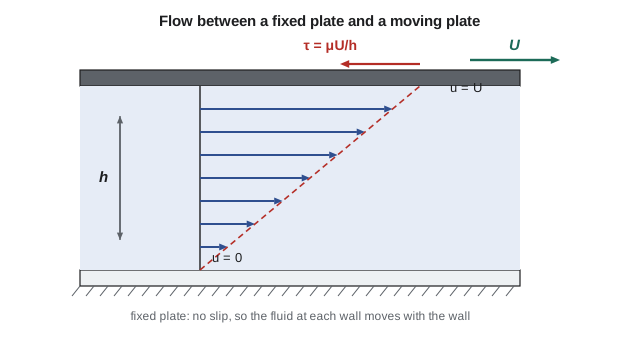
Dynamic viscosity has units of Pa·s, equivalently N·s/m² or kg/(m·s). Older literature uses the poise, where 1 P = 0.1 Pa·s; water at 20 °C has a viscosity of almost exactly one centipoise. Dividing by density gives the kinematic viscosity \(\nu = \mu/\rho\), in m²/s, which appears naturally whenever inertia and viscosity compete, as they do in the Reynolds number we meet in Lesson 11. Air has a much lower dynamic viscosity than water, but because it is so light, its kinematic viscosity is about fifteen times higher.
Temperature changes viscosity strongly and in opposite directions for liquids and gases. In a liquid, viscosity comes mainly from cohesive forces between molecules; heating loosens those bonds, so viscosity falls. Water at 1 °C is about 70 percent more viscous than water at 20 °C, which matters for Platte Bluffs Water: in February the raw water arrives near freezing, head losses in the intake rise, and filters need more pressure to pass the same flow. In a gas, viscosity comes from molecules carrying momentum between layers as they move, and faster molecules carry more, so heating a gas raises its viscosity. The program in this lesson tabulates both trends.
Worked problem
Viscous loss in a pump sleeve bearing
An auxiliary pump shaft of diameter 80 mm (3.15 in) turns at 1780 rpm in a sleeve bearing 100 mm (3.94 in) long. The radial clearance is 0.10 mm (0.004 in) and is filled with oil of viscosity 0.040 Pa·s (8.35 × 10⁻⁴ lbf·s/ft²). Assuming a linear velocity profile in the thin film, find the shear stress on the shaft, the friction torque and the power lost.
Show solution
- Surface speed: \(U = \pi D N/60 = \pi(0.080)(1780)/60 = 7.46\ \text{m/s}\).
- Shear stress, linear profile across the gap: \(\tau = \mu U/h = 0.040(7.46)/(0.10 \times 10^{-3}) = 2980\ \text{Pa}\).
- Force on the shaft surface: \(F = \tau \pi D L = 2980\,\pi(0.080)(0.100) = 74.9\ \text{N}\).
- Torque \(T = F D/2 = 74.9(0.040) = 3.0\ \text{N·m}\); power \(P = FU = 74.9(7.46) = 559\ \text{W}\).
Answer: About 0.56 kW (0.75 hp) is turned into heat in the oil film. That is why the bearing has an oil cooler, and why the oil grade matters: a lubricant twice as viscous would double the loss but carry more load before metal touches metal.
# Fluid properties at Northside pumping station
import math

# Water viscosity (Pa*s) from a standard correlation, T in kelvin
def mu_water(T):
    return 2.414e-5 * 10 ** (247.8 / (T - 140))

# Air viscosity from Sutherland's law
def mu_air(T):
    return 1.716e-5 * (T / 273.15) ** 1.5 * (273.15 + 110.4) / (T + 110.4)

print("Water and air viscosity")
print(" T (C)   mu_water (mPa*s)   mu_air (uPa*s)")
for tc in (1, 10, 20, 40, 60, 80):
    T = tc + 273.15
    print(f"{tc:5d}   {mu_water(T)*1e3:14.3f}   {mu_air(T)*1e6:14.2f}")

# Shear stress in the oil film of a pump shaft sleeve bearing
mu_oil = 0.040          # Pa*s, light turbine oil at operating temperature
D, L, gap = 0.080, 0.100, 0.10e-3   # m: shaft diameter, sleeve length, radial clearance
rpm = 1780
U = math.pi * D * rpm / 60          # surface speed, m/s
tau = mu_oil * U / gap              # linear profile in the thin film
F = tau * math.pi * D * L           # friction force on the shaft surface
P = F * U                           # power lost to viscous friction
print()
print(f"Sleeve bearing: U = {U:.2f} m/s, shear stress = {tau/1000:.1f} kPa")
print(f"Friction force = {F:.0f} N, power lost = {P:.0f} W")

# Capillary rise in a clean glass sight tube
sigma, rho, g = 0.0728, 998.0, 9.81
for d_mm in (2, 5, 10):
    h = 4 * sigma * math.cos(0) / (rho * g * d_mm / 1000)
print(f"Capillary rise in a {d_mm:2d} mm tube: {h*1000:5.1f} mm")Water and air viscosity
T (C) mu_water (mPa*s) mu_air (uPa*s)
1 1.698 17.21
10 1.300 17.65
20 1.002 18.13
40 0.651 19.07
60 0.463 19.99
80 0.351 20.87
Sleeve bearing: U = 7.46 m/s, shear stress = 3.0 kPa
Friction force = 75 N, power lost = 559 W
Capillary rise in a 2 mm tube: 14.9 mm
Capillary rise in a 5 mm tube: 5.9 mm
Capillary rise in a 10 mm tube: 3.0 mmCompressibility and the speed of sound
How much does a fluid's volume change when it is squeezed? The bulk modulus \(E_v\) answers that: it is the pressure change needed to produce a given fractional change in volume, \(E_v = -dP/(dV/V) = dP/(d\rho/\rho)\). Water has \(E_v \approx 2.2\ \text{GPa}\), so raising its pressure by 2.2 MPa shrinks it by only 0.1 percent. Steel is about a hundred times stiffer still, which is why pipes filled with water feel completely rigid.
Compressibility sets the speed at which a pressure disturbance travels through a fluid, the speed of sound \(c = \sqrt{E_v/\rho}\). In water it is about 1480 m/s; in air at 20 °C it is about 343 m/s. The elastic pipe wall lowers the wave speed in a real water main to roughly 1000 to 1300 m/s. When a valve closes suddenly or a pump trips, a pressure wave races along the main at this speed and can raise the pressure by several megapascals. This water hammer is why Platte Bluffs Water uses slow-closing valves and surge tanks; the analysis is covered in a later course, but its root is the property defined here.
For gas flows, the ratio of flow speed to sound speed, the Mach number, tells us whether compressibility matters. Below a Mach number of about 0.3, density changes by less than 5 percent and the flow can be treated as incompressible. The air in the station's ventilation ducts moves at 5 to 10 m/s, far below that limit, so even air flows in buildings are usually treated as incompressible.
Surface tension and capillarity
At a free surface, molecules are pulled inward by their neighbors below and not balanced from above, so the surface behaves like a stretched membrane. The force per unit length along a line in the surface is the surface tension \(\sigma\); for clean water against air at 20 °C, \(\sigma \approx 0.073\ \text{N/m}\). Surface tension explains why small droplets are spherical, why insects can stand on still water, and why bubbles in a pump suction line can resist being swept along.
Where a liquid meets a solid wall, the balance between cohesion within the liquid and adhesion to the wall sets the contact angle \(\theta\). Water wets clean glass, with a contact angle near zero, so it climbs up a narrow glass tube. Mercury does not wet glass, with a contact angle near 140°, so it is depressed. Balancing the upward surface-tension force around the tube's circumference against the weight of the raised column gives the capillary rise.
Capillarity matters for measurement. A water level read in a 5 mm glass sight tube on a chemical tank sits about 6 mm above the true level in the tank; in a 2 mm tube the error is about 15 mm. Instrument makers use sight tubes at least 10 mm in diameter, or apply a correction, to keep this error small. Surface tension also limits how small a droplet a spray nozzle can make, and it drives the wicking of moisture into concrete and soil.
Vapor pressure and cavitation
Every liquid tends to evaporate. In a sealed container, molecules leave the liquid until the vapor above it reaches a pressure at which as many molecules return as leave. That pressure is the vapor pressure \(p_v\), and it depends strongly on temperature: about 0.6 kPa for water at 0 °C, 2.34 kPa at 20 °C, 7.4 kPa at 40 °C and 101.3 kPa at 100 °C. Boiling happens when the liquid's pressure falls to its vapor pressure, whether that is because we heat it at constant pressure or lower its pressure at constant temperature.
In flowing liquids, pressure can drop locally, for instance at the eye of a pump impeller, the throat of a venturi or the crest of a siphon. If it falls to the vapor pressure, small vapor bubbles form. When they are carried into a region of higher pressure, they collapse violently, sending out shock waves and microjets that pit metal surfaces, make a noise like gravel in the pipe and reduce pump performance. This is cavitation. Its prevention runs through the course: we check it at a siphon crest in Lesson 7, at a meter throat in Lesson 8 and at a pump inlet in Lesson 12.
Atmospheric pressure sets the margin. At the Northside station, about 330 m (1080 ft) above sea level, the barometer averages about 97.4 kPa (14.1 psia). The water in the clearwell is at 20 °C (68 °F) in summer, so its pressure can fall by about 95 kPa (13.8 psi) below atmospheric before it boils. That margin shrinks at higher elevations and higher temperatures, which is why pumping hot water is harder than pumping cold water.
Units and dimensional consistency
Every equation in fluid mechanics must be dimensionally consistent: each term must have the same dimensions of mass M, length L and time T. Pressure has dimensions M L⁻¹ T⁻², velocity L T⁻¹, viscosity M L⁻¹ T⁻¹. Checking dimensions catches many algebra errors, and it underlies the dimensionless groups such as the Reynolds number that organize the rest of the subject. In SI, the unit check is equally useful: Pa·s divided by kg/m³ gives m²/s, confirming that kinematic viscosity has the units of area per time.
Many utilities in the United States still size pumps and pipes in US customary units: flow in gallons per minute (gpm) or million gallons per day (MGD), head in feet, pressure in psi, density in slugs per cubic foot or pound-mass per cubic foot, and viscosity in lbf·s/ft². Water at 68 °F has a density of 1.94 slug/ft³ (62.3 lbm/ft³), a specific weight of 62.3 lbf/ft³ and a kinematic viscosity of 1.08 × 10⁻⁵ ft²/s. One US gallon is 3.785 L, one foot is 0.3048 m and one psi is 6.895 kPa, so a 4800 gpm pump moves about 0.30 m³/s, and a head of 180 ft is about 55 m. This course works in SI first and repeats key results in customary units.
Common mistakes
MistakeTreating kinematic and dynamic viscosity as the same quantity.
InsteadDynamic viscosity μ is in Pa·s; kinematic viscosity ν = μ/ρ is in m²/s. Check which one a formula needs.
MistakeAssuming viscosity rises with temperature for every fluid.
InsteadLiquids become less viscous as they warm; gases become more viscous.
MistakeTreating water as compressible in ordinary pipe flow, or air as incompressible at high speed.
InsteadLiquids are effectively incompressible; gases can be treated as incompressible below a Mach number of about 0.3.
MistakeIgnoring the no-slip condition.
InsteadA real fluid in contact with a wall moves with the wall; velocity gradients near walls create shear.
MistakeReading levels in narrow tubes without allowing for capillary rise.
InsteadUse tubes of 10 mm or more, or correct with h = 4σcosθ/(ρgd).
Summary and key terms
- A fluid deforms continuously under any shear stress; liquids keep their volume, gases fill their container.
- Density ρ, specific weight γ = ρg and specific gravity SG describe how much a fluid weighs; liquids are nearly incompressible.
- Newton's law of viscosity, τ = μ du/dy, relates shear stress to the velocity gradient; ν = μ/ρ.
- Liquid viscosity falls with temperature; gas viscosity rises.
- The bulk modulus sets the speed of sound, which governs how fast pressure waves travel in pipes.
- Surface tension causes capillary rise h = 4σcosθ/(ρgd), an error source in narrow level tubes.
- A liquid boils when its pressure falls to its vapor pressure; local boiling in a flow is cavitation.
- Fluid
- A substance that deforms continuously under any shear stress, however small.
- Continuum
- A model treating a fluid as continuous matter with definite properties at every point.
- Density
- Mass per unit volume, ρ, in kg/m³.
- Specific weight
- Weight per unit volume, γ = ρg, in N/m³.
- Specific gravity
- The ratio of a liquid's density to that of water at 4 °C.
- No-slip condition
- A real fluid in contact with a solid surface moves at the same velocity as the surface.
- Dynamic viscosity
- The constant μ in τ = μ du/dy; units Pa·s.
- Kinematic viscosity
- Dynamic viscosity divided by density, ν = μ/ρ; units m²/s.
- Newtonian fluid
- A fluid whose shear stress is proportional to its rate of deformation.
- Bulk modulus
- The pressure change per fractional change in volume, a measure of compressibility.
- Surface tension
- The force per unit length acting in a liquid surface, σ, in N/m.
- Vapor pressure
- The pressure at which a liquid boils at a given temperature.
- Cavitation
- The formation and collapse of vapor bubbles where local pressure falls to the vapor pressure.
Practice problems
Work each problem on paper first, then reveal the answer to check.
A 2.0 L sample of hypochlorite solution has a mass of 2.42 kg. Find its density, specific weight and specific gravity.
Show answer
ρ = 1210 kg/m³, γ = 11.9 kN/m³, SG = 1.21.
Oil of viscosity 0.30 Pa·s fills a 1.5 mm gap between a fixed plate and a plate moving at 0.8 m/s. Find the shear stress.
Show answer
τ = μU/h = 0.30(0.8)/0.0015 = 160 Pa.
Water at 20 °C has μ = 1.00 × 10⁻³ Pa·s and ρ = 998 kg/m³. Find ν.
Show answer
ν = 1.00 × 10⁻⁶ m²/s.
By how much does 1 m³ of water shrink when its pressure rises by 5 MPa (E_v = 2.2 GPa)?
Show answer
ΔV ≈ −V ΔP/E_v = −0.0023 m³, about 2.3 L.
Find the capillary rise of 20 °C water in a clean 3 mm glass tube.
Show answer
h = 4(0.073)/(998 × 9.81 × 0.003) ≈ 9.9 mm.
In the program, change the oil viscosity to 0.080 Pa·s. What happens to the power lost?
Show answer
It doubles to about 1.1 kW, because shear stress and force are proportional to μ.
Lesson quiz · 5 questions
Score 60% or more to complete this lesson.
Create a free account to save your progress, take quizzes and earn a certificate.