
CHE-200 · Lesson 9 of 12 · 27 min
Multiphase systems: phase equilibrium, Raoult's law and humidity
The grain dryers at Kingfisher Bioenergy discharge a hot, humid exhaust. Before it reaches the stack it passes through the thermal oxidizer, and the plant is studying a heat recovery unit that would cool the exhaust to recover energy. The question Ingrid gives Theo is whether water will condense in the recovery unit, and if so at what temperature; condensate in the wrong place corrodes ducts and fouls heat exchangers. The same week, the tank farm asks at what temperature the natural gasoline used to denature the fuel ethanol starts to boil. Both questions are about equilibrium between phases, the subject of this lesson.
Phases and phase diagrams
A phase is a region of uniform composition and properties: a gas, a liquid, or a solid. Many process steps exist precisely to move material between phases: distillation, evaporation, condensation, absorption, drying and crystallization. Balances on these steps need one more piece of information beyond the conservation law, namely how the components distribute between phases at equilibrium.
For a pure substance, a phase diagram of pressure against temperature shows where it is solid, liquid or vapor. The line between liquid and vapor is the vapor pressure curve, which runs from the triple point to the critical point. At any temperature on that line, liquid and vapor coexist, and the pressure is the vapor pressure \(p^*\). A liquid boils when its vapor pressure equals the surrounding pressure; the normal boiling point is the temperature at which \(p^* = 1\ \text{atm}\). Above the critical temperature, no amount of pressure produces a separate liquid phase.
Vapor pressure correlations
Vapor pressure rises steeply with temperature. The Clausius-Clapeyron equation, derived from thermodynamics with a few approximations, predicts that \(\ln p^*\) is nearly a straight line against \(1/T\), with a slope set by the heat of vaporization. The empirical Antoine equation adds a third constant and fits data closely over a stated range. Antoine constants are tied to particular units, often mm Hg and degrees Celsius, so always check the units given with them.
| Substance | A | B | C | Normal boiling point |
|---|---|---|---|---|
| Water | 8.07131 | 1730.63 | 233.426 | 100.0 °C |
| Ethanol | 8.11220 | 1592.864 | 226.184 | 78.3 °C |
| n-Hexane | 6.88555 | 1175.817 | 224.867 | 68.7 °C |
| n-Heptane | 6.90253 | 1267.828 | 216.823 | 98.4 °C |
The Gibbs phase rule
How many variables must be fixed to define a system at equilibrium? The Gibbs phase rule answers it for intensive variables, those that do not depend on the size of the system, such as temperature, pressure and composition. With \(c\) components and \(\pi\) phases and no reactions, the number of degrees of freedom is \(F = 2 + c - \pi\). Pure water with liquid and vapor present has \(F = 1\): fixing the temperature fixes the pressure. A two-component liquid in equilibrium with its vapor has \(F = 2\): fixing temperature and pressure fixes both phase compositions. This is a different count from the degree-of-freedom analysis of Lesson 3, which counts extensive variables such as flows as well.
Gas and liquid with one condensable component
Many process gases contain one component that can condense, typically water, mixed with others that cannot under the conditions of interest, such as air, nitrogen or carbon dioxide. If the gas is in contact with the liquid long enough to reach equilibrium, the gas is saturated and the partial pressure of the condensable component equals its vapor pressure at the system temperature. That is Raoult's law in its simplest form, for a liquid phase that is pure.
If a gas has a partial pressure of the condensable below its vapor pressure, it is superheated, and it can be cooled at constant pressure until the partial pressure equals the vapor pressure. That temperature is the dew point, where the first drop of liquid forms. The degrees of superheat are the difference between the actual temperature and the dew point. Several related measures describe how close a gas is to saturation.
| Measure | Definition | Common name for water in air |
|---|---|---|
| Relative saturation | p_i/p_i*(T), as a percentage | Relative humidity |
| Molal saturation | moles of vapor per mole of vapor-free gas, y/(1 − y) | Molal humidity |
| Absolute saturation | mass of vapor per mass of vapor-free gas | Absolute humidity or humidity ratio |
| Percentage saturation | actual molal saturation divided by the value at saturation, × 100 | Percentage humidity |
Worked problem
Will the dryer exhaust condense?
The dryer exhaust is at 95 °C (203 °F) and 101.3 kPa (14.7 psia) and contains 18 mol% water vapor; the rest is air with some carbon dioxide. Find the relative humidity, the molal humidity and the dew point. The heat recovery unit would cool the gas to 65 °C (149 °F). Does water condense?
Show solution
- Partial pressure of water \(= 0.18 \times 101.3 = 18.2\ \text{kPa}\).
- Vapor pressure at 95 °C from the Antoine equation: \(\log_{10} p^* = 8.07131 - 1730.63/(95 + 233.426) = 2.8018\), so \(p^* = 633.7\ \text{mm Hg} = 84.5\ \text{kPa}\).
- Relative humidity \(= 18.2/84.5 = 21.6\ \text{percent}\); molal humidity \(= 0.18/0.82 = 0.220\ \text{mol water per mol dry gas}\).
- Dew point: solve \(p^*(T) = 18.2\ \text{kPa} = 136.8\ \text{mm Hg}\), giving \(T = 1730.63/(8.07131 - \log_{10}136.8) - 233.426 = 58.2\ °\text{C}\).
- At 65 °C the gas is still about 7 °C above its dew point, so no water condenses in the bulk gas.
Answer: Cooling to 65 °C is safe in the bulk gas, but the tube walls in a heat exchanger are colder than the gas. If the wall temperature falls below about 58 °C, water will condense there even though the gas leaving is above its dew point. Designers therefore keep a margin, and exhausts that contain acid gases need a larger one because acid dew points are higher than the water dew point.
Condensation and humidification balances
When a saturated gas is cooled or compressed, some vapor condenses. The balance is straightforward if the dry gas is used as a tie component: the dry gas flow is unchanged, the vapor leaving equals the dry gas times the molal saturation at the new conditions, and the condensate is the difference. Compression raises the partial pressure of the vapor, so compressing a saturated gas at constant temperature always condenses some liquid. This is why the carbon dioxide compressors have knockout drums after each intercooler.
Worked problem
Water removed by compression
Carbon dioxide leaves the scrubber saturated with water at 30 °C and 1.05 bar, at 815.3 kmol/h of dry carbon dioxide. After the first two compressor stages and cooling back to 30 °C, it is at 6.0 bar and still saturated. How much water condenses in the knockout drums? The vapor pressure of water at 30 °C is 4.24 kPa.
Show solution
- Molal saturation at the suction \(= 4.24/(105 - 4.24) = 0.0421\); water entering \(= 0.0421 \times 815.3 = 34.3\ \text{kmol/h}\).
- Molal saturation at 6.0 bar \(= 4.24/(600 - 4.24) = 0.00712\); water still in the gas \(= 5.8\ \text{kmol/h}\).
- Water condensed \(= 34.3 - 5.8 = 28.5\ \text{kmol/h} = 513\ \text{kg/h}\).
Answer: Over half a metric ton of water per hour drops out after the first stages simply because the pressure rises. The rest is removed by a dehydration unit before liquefaction, since any water left would freeze and block equipment at the low liquefaction temperatures.
Multicomponent vapor-liquid equilibrium: Raoult's and Henry's laws
When the liquid is a mixture, each component's partial pressure in the vapor depends on how much of it is in the liquid. For ideal solutions of similar molecules, such as hexane and heptane or benzene and toluene, Raoult's law states that the partial pressure equals the liquid mole fraction times the pure-component vapor pressure. For a gas dissolved in a liquid at low concentration, such as carbon dioxide or oxygen in water, Henry's law is used instead, with a Henry's constant from tables.
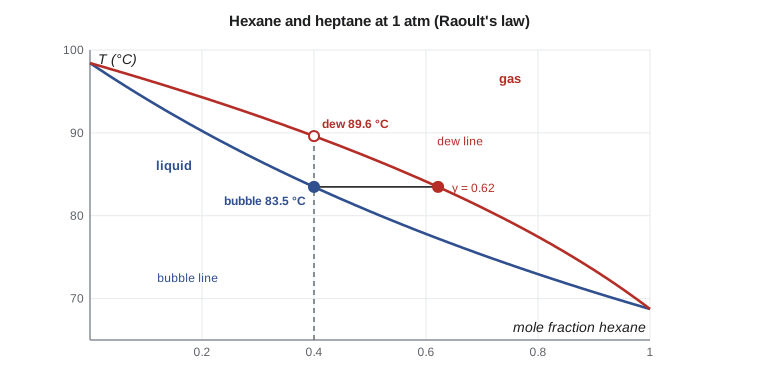
Raoult's law gives two standard calculations. At the bubble point, a liquid of known composition starts to boil: the sum of \(x_i p_i^*\) equals the total pressure, and the first bubble has \(y_i = x_i p_i^*/P\). At the dew point, a vapor of known composition starts to condense: the sum of \(y_i P/p_i^*\) equals one. Both need a trial-and-error search for the temperature, or for the pressure if the temperature is fixed. Between the bubble and dew points, a mixture is partly vapor and partly liquid, and a flash calculation finds how it splits.
Worked problem
Bubble point of the denaturant
Model the natural gasoline used as denaturant as a liquid of 40 mol% n-hexane and 60 mol% n-heptane. Find its bubble point at 1 atm and the composition of the first vapor, assuming Raoult's law.
Show solution
- Guess 80 °C: \(p^*_{\text{hex}} = 142.4\ \text{kPa}\), \(p^*_{\text{hep}} = 57.0\ \text{kPa}\); \(\sum x_i p_i^* = 0.4(142.4) + 0.6(57.0) = 91.2\ \text{kPa}\), below 101.3, so the temperature is too low.
- Guess 85 °C: \(p^*_{\text{hex}} = 164.4\), \(p^*_{\text{hep}} = 67.1\); sum \(= 106.0\ \text{kPa}\), above 101.3, so the temperature is too high.
- Interpolate: \(T \approx 80 + 5(101.3 - 91.2)/(106.0 - 91.2) = 83.4\ °\text{C}\). Check at 83.5 °C: \(p^*_{\text{hex}} = 157.5\), \(p^*_{\text{hep}} = 64.0\), sum \(= 101.4\ \text{kPa}\). The bubble point is 83.5 °C.
- First vapor: \(y_{\text{hex}} = 0.40 \times 157.5/101.3 = 0.62\); \(y_{\text{hep}} = 0.38\).
Answer: The vapor is richer in the lighter hexane than the liquid, which is the basis of separation by distillation. Real natural gasoline contains pentanes and lighter components too, so its bubble point is much lower, which is why the denaturant tank is designed with vapor controls.
# Vapor pressure, humidity and bubble/dew points with the Antoine equation
# Antoine constants (approximate): log10(p* / mmHg) = A - B / (T + C), with T in degrees C
ANT = {'water': (8.07131, 1730.63, 233.426),
       'n-hexane': (6.88555, 1175.817, 224.867),
       'n-heptane': (6.90253, 1267.828, 216.823)}
MMHG = 0.133322                      # kPa per mmHg

def psat(sp, T):                     # T in C, result in kPa
    A, B, C = ANT[sp]
    return 10 ** (A - B / (T + C)) * MMHG

def tsat(sp, p):                     # inverse: temperature (C) where psat = p (kPa)
    A, B, C = ANT[sp]
    from math import log10
    return B / (A - log10(p / MMHG)) - C

print(f"Water vapor pressure at 25 C {psat('water', 25):.2f} kPa, at 100 C {psat('water', 100):.1f} kPa")

# Dryer exhaust: 1.0 atm, 95 C, contains 18 mol% water vapor
P, T, y = 101.325, 95.0, 0.18
pw = y * P
print(f"\nDryer exhaust: p_water = {pw:.1f} kPa, saturation at {T:.0f} C = {psat('water', T):.1f} kPa")
print(f"Relative saturation {100 * pw / psat('water', T):.1f} %, dew point {tsat('water', pw):.1f} C")
print(f"Molal humidity {y / (1 - y):.3f} mol water per mol dry gas")

# Raoult's law bubble and dew points for a hexane/heptane liquid at 1 atm
def bubble_T(x, P):
    lo, hi = 0.0, 150.0
    for _ in range(80):
        T = (lo + hi) / 2
        s = sum(xi * psat(sp, T) for sp, xi in x.items()) / P
        lo, hi = (T, hi) if s < 1 else (lo, T)
    return T

def dew_T(y, P):
    lo, hi = 0.0, 150.0
    for _ in range(80):
        T = (lo + hi) / 2
        s = sum(yi * P / psat(sp, T) for sp, yi in y.items())
        lo, hi = (lo, T) if s < 1 else (T, hi)
    return T

z = {'n-hexane': 0.40, 'n-heptane': 0.60}
Tb, Td = bubble_T(z, P), dew_T(z, P)
yb = {sp: z[sp] * psat(sp, Tb) / P for sp in z}
print(f"\nBubble point of 40/60 hexane/heptane at 1 atm: {Tb:.1f} C, first vapor {yb['n-hexane']:.3f} hexane")
print(f"Dew point of the same mixture as a vapor: {Td:.1f} C")
for sp in z:
print(f"Normal boiling point of {sp}: {tsat(sp, P):.1f} C")Water vapor pressure at 25 C 3.16 kPa, at 100 C 101.3 kPa Dryer exhaust: p_water = 18.2 kPa, saturation at 95 C = 84.5 kPa Relative saturation 21.6 %, dew point 58.2 C Molal humidity 0.220 mol water per mol dry gas Bubble point of 40/60 hexane/heptane at 1 atm: 83.5 C, first vapor 0.622 hexane Dew point of the same mixture as a vapor: 89.6 C Normal boiling point of n-hexane: 68.7 C Normal boiling point of n-heptane: 98.4 C
When Raoult's law fails
Ethanol and water are a famous exception. Their molecules attract each other differently from how each attracts its own kind, so the mixture's partial pressures depart strongly from Raoult's law, and the mixture forms an azeotrope near 95.6 percent ethanol by mass. Such systems need activity coefficients, which multiply the mole fraction in Raoult's law and are calculated from models such as Wilson, NRTL or UNIQUAC. Those models are the subject of thermodynamics courses; in this course, use Raoult's law only for mixtures of chemically similar molecules.
Common mistakes
MistakeUsing Raoult's law for ethanol and water.
InsteadEthanol and water are strongly nonideal; use measured data or an activity coefficient model.
MistakeForgetting that Antoine constants carry specific units.
InsteadCheck the pressure and temperature units of every set of constants.
MistakeAssuming a gas below its dew point in the bulk cannot condense on surfaces.
InsteadCold surfaces below the dew point condense vapor even if the bulk gas is warmer.
MistakeTreating relative humidity and molal humidity as the same.
InsteadRelative humidity is p/p*; molal humidity is moles of vapor per mole of dry gas.
MistakeNot using dry gas as a tie component in condensation problems.
InsteadThe dry gas flow is unchanged and links inlet and outlet.
Summary and key terms
- Vapor pressure rises steeply with temperature; Antoine and Clausius-Clapeyron equations correlate it.
- The phase rule F = 2 + c − π counts intensive degrees of freedom at equilibrium.
- A saturated gas has p_i = p_i*(T); the dew point is where a superheated gas starts to condense.
- Humidity can be expressed as relative, molal, absolute or percentage saturation.
- Raoult's law y_i P = x_i p_i* applies to ideal solutions; Henry's law to dilute dissolved gases.
- Bubble and dew points need a trial-and-error search for temperature or pressure.
- Vapor pressure
- The pressure at which a pure liquid and its vapor coexist at a given temperature.
- Normal boiling point
- The temperature at which the vapor pressure equals 1 atm.
- Dew point
- The temperature at which a vapor mixture begins to condense on cooling.
- Bubble point
- The temperature at which a liquid mixture begins to boil on heating.
- Relative humidity
- The partial pressure of water vapor divided by its vapor pressure, as a percentage.
- Raoult's law
- For ideal solutions, the partial pressure of a component equals its liquid mole fraction times its vapor pressure.
- Henry's law
- For dilute dissolved gases, the partial pressure equals the liquid mole fraction times a Henry's constant.
- Gibbs phase rule
- F = 2 + c − π, the number of intensive variables that can be set independently at equilibrium.
Practice problems
Work each problem on paper first, then reveal the answer to check.
Air at 30 °C and 101.3 kPa has a relative humidity of 60 %. The vapor pressure of water at 30 °C is 4.24 kPa. Find the water mole fraction.
Show answer
p = 0.6 × 4.24 = 2.54 kPa; y = 2.54/101.3 = 0.0251.
What is the dew point of that air?
Show answer
The temperature where p* = 2.54 kPa, about 21.4 °C.
How many degrees of freedom does pure water at its triple point have?
Show answer
F = 2 + 1 − 3 = 0; the triple point is fixed.
A liquid of 50 mol% hexane and 50 mol% heptane is at 85 °C. Is it above or below its bubble point at 1 atm?
Show answer
Σ x p* = 0.5(164.4) + 0.5(67.1) = 115.8 kPa > 101.3, so it is above its bubble point and is partly vaporized.
In the program, change the denaturant to 60 mol% hexane. What happens to the bubble point?
Show answer
It falls to about 78 °C, because there is more of the lighter component.
Why do carbon dioxide compressors need knockout drums?
Show answer
Compressing a saturated gas raises the water partial pressure above its vapor pressure, so water condenses and must be removed.
Lesson quiz · 5 questions
Score 60% or more to complete this lesson.
Create a free account to save your progress, take quizzes and earn a certificate.