
CHE-200 · Lesson 10 of 12 · 27 min
Energy and the first law for process systems
With the material balances in hand, Theo turns to energy. The plant's boiler raises about 95 t/h of steam at 10 bar, and the steam heats the beer column reboilers, the evaporators, the cook process and the molecular sieve superheaters. The energy manager wants to know how much natural gas the boiler needs, how much power the feed pump draws, and how much water the desuperheater must inject. All three answers come from the energy balance, the second great conservation law in this course. This lesson sets up the energy balance for closed and open systems and shows how to use tabulated property data; Lessons 11 and 12 apply it to heating, phase change and reaction.
Forms of energy
A system can hold energy in three forms that matter for process balances. Kinetic energy is due to the motion of the system as a whole, \(E_k = \tfrac{1}{2}mv^2\). Potential energy is due to its position in a gravitational field, \(E_p = mgz\). Internal energy \(U\) is everything else: the motion and interactions of the molecules, and the energy stored in chemical bonds. Internal energy cannot be measured absolutely, only relative to a chosen reference state, but changes in it can be calculated precisely.
Energy crosses a system boundary in two ways. Heat \(Q\) is energy that flows because of a temperature difference. Work \(W\) is energy that flows because of any other driving force, such as a rotating shaft, a moving piston or an electric current. Heat and work exist only in transit; a system contains internal energy, not heat. In this course \(Q\) is positive when heat flows into the system, and \(W\) is positive when the system does work on its surroundings, the usual chemical engineering convention.
The closed-system energy balance
For a closed system, one with no mass crossing its boundary such as a batch fermenter between filling and emptying, the general balance of Lesson 1 becomes the first law of thermodynamics. Energy is neither generated nor consumed, so the change in the system's energy equals the net energy transferred in as heat minus the net energy transferred out as work.
Several simplifications are common. If the system's temperature, phase and composition do not change, \(\Delta U \approx 0\). If it does not accelerate, \(\Delta E_k = 0\). If it does not rise or fall, \(\Delta E_p = 0\). If it is perfectly insulated, the process is adiabatic and \(Q = 0\). If no moving parts or currents cross the boundary, \(W = 0\). Applying these carefully to a well-chosen system is most of the work.
Open systems: flow work and enthalpy
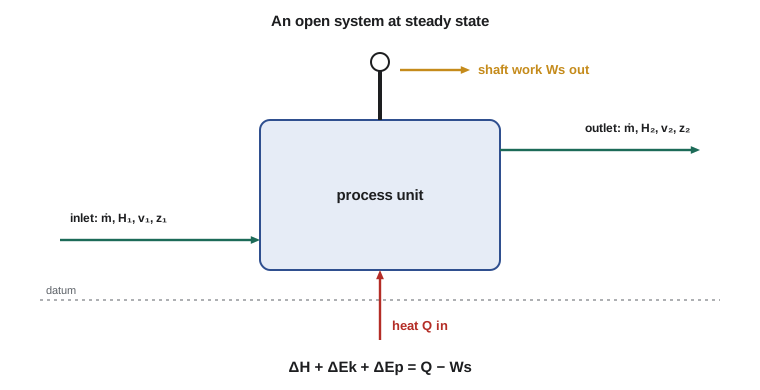
Most process units are open systems with streams flowing in and out. Pushing a stream into a system takes work, because the fluid ahead must be displaced; pushing one out does work on the surroundings. This flow work equals \(PV\) for each mass of fluid crossing the boundary. The remaining work, done through rotating shafts or other moving parts, is called shaft work \(W_s\). Pumps and compressors receive shaft work (\(W_s < 0\)); turbines deliver it (\(W_s > 0\)).
Because internal energy and flow work always travel together with a stream, it is convenient to combine them into a single property, the enthalpy, \(H = U + PV\). On a mass basis, specific enthalpy \(\hat{H} = \hat{U} + P\hat{V}\). With enthalpy, the energy balance for an open system at steady state takes its most useful form.
Each \(\Delta\) term is the total for all outlet streams minus the total for all inlet streams. For a unit with one inlet and one outlet and a mass flow \(\dot{m}\), the balance per unit mass is \(\Delta\hat{H} + \Delta v^2/2 + g\Delta z = \hat{Q} - \hat{W}_s\). In most chemical process units the kinetic and potential energy terms are tiny compared with the enthalpy change, and the balance reduces to \(\Delta\dot{H} = \dot{Q} - \dot{W}_s\). The program at the end of the lesson checks this for the boiler.
State properties and reference states
Internal energy and enthalpy are state properties: their values depend only on the state of the substance, fixed by its temperature, pressure, phase and composition, not on how it reached that state. That means a change in enthalpy can be calculated along any convenient path between the two states, a fact used heavily in Lessons 11 and 12. Heat and work are not state properties; they depend on the path.
Because only changes in enthalpy matter, tables list values relative to a chosen reference state where \(\hat{H}\) or \(\hat{U}\) is set to zero. The steam tables used worldwide set the internal energy of liquid water at its triple point, 0.01 °C and 0.611 kPa, to zero. Any reference works, as long as you use the same one for every stream of a given substance in one balance. Mixing values from tables with different references is a common and costly mistake.
Steam tables
Water and steam are so widely used that their properties are tabulated in great detail. Saturated steam tables give, at each temperature or pressure on the boiling curve, the specific volume, internal energy and enthalpy of saturated liquid and saturated vapor, and their difference, the latent heat of vaporization. Superheated steam tables give properties of vapor at temperatures above saturation for a range of pressures. Liquid water well below its boiling point is nearly incompressible, and its enthalpy is close to that of saturated liquid at the same temperature.
| State | Pressure | Temperature | Specific enthalpy (kJ/kg) |
|---|---|---|---|
| Liquid water | any moderate | 25 °C | 104.8 |
| Liquid water (feedwater) | about 1.2 bar | 105 °C | 440.2 |
| Saturated liquid | 10 bar | 179.9 °C | 762.6 |
| Saturated vapor | 10 bar | 179.9 °C | 2777.7 |
| Superheated vapor | 10 bar | 250 °C | 2943.0 |
| Saturated vapor | 3.5 bar | 138.9 °C | 2732.0 |
A steam quality \(x\) describes a wet mixture of saturated liquid and vapor: the fraction of the mass that is vapor. Its enthalpy is \(\hat{H} = (1 - x)\hat{H}_L + x\hat{H}_V\). Steam leaving a turbine or a long, poorly insulated line often has a quality below one, and the liquid fraction carries much less energy than the vapor.
Worked problem
Boiler duty and gas consumption
The boiler takes feedwater at 105 °C (221 °F) and produces 95 000 kg/h (209 000 lbm/h) of saturated steam at 10 bar (145 psia). The steam drum is 15 m above the feed pump discharge, and the steam leaves at 30 m/s against 2 m/s in the feedwater line. Find the heat input to the water and steam, check the size of the kinetic and potential energy terms, and estimate the natural gas used if the boiler is 84 percent efficient on the gas's higher heating value of 39.0 MJ/Nm³ (about 990 Btu per standard cubic foot at 60 °F).
Show solution
- Enthalpy change \(= 2777.7 - 440.2 = 2337.5\ \text{kJ/kg}\).
- Kinetic energy change \(= (30^2 - 2^2)/2 = 448\ \text{J/kg} = 0.448\ \text{kJ/kg}\); potential energy change \(= 9.81 \times 15 = 147\ \text{J/kg} = 0.147\ \text{kJ/kg}\). Together they are 0.03 percent of the enthalpy change.
- No shaft work crosses the boiler boundary, so \(\dot{Q} = \dot{m}\,\Delta\hat{H} = (95\,000/3600) \times 2338 = 61\,700\ \text{kW} = 61.7\ \text{MW}\).
- Fuel energy \(= 61.7/0.84 = 73.4\ \text{MW} = 264\ \text{GJ/h}\), or about 250 million Btu/h; gas \(= 264\,000/39.0 = 6780\ \text{Nm}^3/\text{h}\), about 253 000 scf/h at 60 °F.
Answer: The boiler burns about 163 000 Nm³ of gas a day. The kinetic and potential energy terms are negligible, as they almost always are for heating and cooling equipment. The 16 percent of the fuel energy that does not reach the steam leaves mainly in the hot flue gas, which is why the stack temperature and the excess air from Lesson 7 matter so much.
The mechanical energy balance
For pumps, pipes and other equipment where liquids flow with little heating, a different form of the energy balance is more useful. For an incompressible fluid at nearly constant temperature, the enthalpy change can be split into the pressure term \(\Delta P/\rho\) and a friction loss \(\hat{F}\), the mechanical energy converted to internal energy by friction. The result is the mechanical energy balance, which becomes the Bernoulli equation when there is no friction and no shaft work.
Worked problem
Power for the boiler feed pump
The feed pump takes 95 000 kg/h of water at 105 °C (density 955 kg/m³) from the deaerator at 120 kPa absolute and delivers it to the steam drum at 1250 kPa, 15 m higher. Friction in the piping and control valve dissipates 25 J/kg; velocity changes are negligible. Find the shaft work, the power delivered to the water and the motor power if the pump is 70 percent efficient.
Show solution
- Pressure term \(= (1250 - 120) \times 1000/955 = 1183\ \text{J/kg}\); potential energy term \(= 9.81 \times 15 = 147\ \text{J/kg}\).
- \(-\hat{W}_s = 1183 + 147 + 25 = 1355\ \text{J/kg}\), so the pump delivers 1.36 kJ/kg to the water.
- Fluid power \(= 26.39\ \text{kg/s} \times 1.355\ \text{kJ/kg} = 35.8\ \text{kW}\); motor input \(= 35.8/0.70 = 51.1\ \text{kW}\).
Answer: Compare 1.36 kJ/kg of pump work with the 2338 kJ/kg added in the boiler: pumping a liquid takes very little energy, while compressing a gas to the same pressure would take hundreds of times more. That is why boilers pump water as a liquid and then boil it, rather than compressing steam.
# Steady-flow energy balances on the plant steam system
# Approximate steam-table enthalpies (kJ/kg), reference: liquid water at the triple point
h = {'water 25 C': 104.8, 'water 105 C (feedwater)': 440.2,
     'sat. liquid 10 bar': 762.6, 'sat. vapor 10 bar': 2777.7,
     'superheated 10 bar, 250 C': 2943.0, 'sat. vapor 3.5 bar': 2732.0}

# 1. How big are kinetic and potential energy changes compared with enthalpy changes?
v1, v2 = 2.0, 30.0              # m/s: feedwater pipe and steam header velocities
dz = 15.0                       # m rise from boiler feed pump to steam drum
dEk = (v2 ** 2 - v1 ** 2) / 2 / 1000     # kJ/kg
dEp = 9.81 * dz / 1000                   # kJ/kg
dH = h['sat. vapor 10 bar'] - h['water 105 C (feedwater)']
print(f"Per kg of steam: dH = {dH:.0f} kJ/kg, dEk = {dEk:.3f} kJ/kg, dEp = {dEp:.3f} kJ/kg")

# 2. Boiler duty and fuel use
steam = 95_000.0                # kg/h of saturated steam at 10 bar
Q = steam * (dH + dEk + dEp) / 3600      # kW
print(f"Boiler duty {Q / 1000:.1f} MW")
eff = 0.84                      # boiler efficiency (fraction of fuel HHV reaching the steam)
hhv = 39.0                      # MJ per normal cubic meter of natural gas, approximate
gas = Q / 1000 / eff / hhv * 3600        # Nm3/h
print(f"Natural gas at {eff:.0%} efficiency: {gas:.0f} Nm3/h ({gas * 24 / 1000:.0f} thousand Nm3/day)")

# 3. Boiler feed pump: mechanical energy balance for an incompressible liquid
rho = 955.0                     # kg/m3 at 105 C
P_in, P_out = 120.0, 1250.0     # kPa absolute
friction = 25.0                 # J/kg lost to friction in the piping
w = (P_out - P_in) * 1000 / rho + 9.81 * dz + friction   # J/kg
m = steam / 3600                # kg/s
eta = 0.70
print(f"Pump: shaft work {w / 1000:.2f} kJ/kg, fluid power {m * w / 1000:.1f} kW, motor input at {eta:.0%}: {m * w / 1000 / eta:.1f} kW")

# 4. Desuperheating: how much 105 C water turns 250 C steam into saturated steam at 10 bar?
hs, hw, hsat = h['superheated 10 bar, 250 C'], h['water 105 C (feedwater)'], h['sat. vapor 10 bar']
ratio = (hs - hsat) / (hsat - hw)        # kg water per kg superheated steam
print(f"Desuperheater: {ratio:.4f} kg water per kg of superheated steam")Per kg of steam: dH = 2338 kJ/kg, dEk = 0.448 kJ/kg, dEp = 0.147 kJ/kg Boiler duty 61.7 MW Natural gas at 84% efficiency: 6780 Nm3/h (163 thousand Nm3/day) Pump: shaft work 1.36 kJ/kg, fluid power 35.8 kW, motor input at 70%: 51.1 kW Desuperheater: 0.0707 kg water per kg of superheated steam
Mixing streams: a desuperheater
Energy balances on adiabatic mixing are especially simple: with no heat, no shaft work and negligible kinetic and potential energy changes, the total enthalpy of the streams entering equals the total enthalpy leaving. Desuperheaters use this. Superheated steam from a turbine or a boiler superheater is sprayed with water, which evaporates and cools the steam to saturation, because process heaters transfer heat far better from condensing saturated steam than from superheated vapor.
Worked problem
Water for the desuperheater
The molecular sieve section receives steam at 10 bar and 250 °C, but its heat exchangers need saturated steam at 10 bar. Feedwater at 105 °C is sprayed in. How much water is needed per kilogram of superheated steam, and how much saturated steam results?
Show solution
- Energy balance on the adiabatic mixer, per kg of superheated steam with \(m_w\) kg of water: \(2943.0 + 440.2\,m_w = 2777.7(1 + m_w)\).
- Solving: \(m_w = (2943.0 - 2777.7)/(2777.7 - 440.2) = 0.0707\ \text{kg}\).
- Saturated steam produced \(= 1.0707\ \text{kg}\) per kg of superheated steam.
Answer: About 7 percent more steam leaves than enters, because the water joins it. Material and energy balances had to be solved together here: the mass balance gave the outlet flow in terms of \(m_w\), and the energy balance fixed \(m_w\).
Common mistakes
MistakeWriting heat as something a system contains.
InsteadSystems contain internal energy; heat and work are energy in transit across the boundary.
MistakeUsing internal energy instead of enthalpy for flowing streams.
InsteadOpen-system balances use enthalpy, which includes the flow work PV.
MistakeMixing enthalpy values from tables with different reference states.
InsteadUse one reference state for each substance throughout a balance.
MistakeKeeping large kinetic and potential terms in heat exchanger balances.
InsteadCheck their size; they are usually negligible compared with enthalpy changes.
MistakeForgetting the sign convention for work.
InsteadWith Q − W, work done by the system is positive; pumps and compressors have negative W_s.
Summary and key terms
- Energy appears as kinetic, potential and internal energy; heat and work cross boundaries.
- Closed systems: ΔU + ΔE_k + ΔE_p = Q − W.
- Open systems at steady state: ΔH + ΔE_k + ΔE_p = Q − W_s, with H = U + PV.
- Enthalpy and internal energy are state properties, tabulated relative to a reference state.
- Steam tables give enthalpies of liquid water, saturated steam and superheated steam.
- The mechanical energy balance handles pumps and piping; adiabatic mixing conserves enthalpy.
- Internal energy
- The energy of a system due to molecular motion and interactions, relative to a reference.
- Enthalpy
- H = U + PV, the property that combines internal energy and flow work.
- Shaft work
- Work transferred through rotating shafts or other moving parts.
- Flow work
- Work needed to push fluid into or out of an open system, equal to PV.
- Adiabatic
- Describing a process with no heat transfer across the boundary.
- State property
- A property whose value depends only on the state, not on the path taken.
- Steam quality
- The mass fraction of vapor in a wet steam mixture.
- Higher heating value
- The heat released by complete combustion with the product water condensed to liquid.
Practice problems
Work each problem on paper first, then reveal the answer to check.
Water flows at 10 kg/s and rises 20 m. What power goes into potential energy?
Show answer
10 × 9.81 × 20 = 1962 W, about 2 kW.
A turbine expands steam from 2943.0 to 2732.0 kJ/kg adiabatically at 10 kg/s. Find the shaft power.
Show answer
W_s = 10 × (2943.0 − 2732.0) = 2110 kW.
Find the enthalpy of wet steam at 10 bar with quality 0.95.
Show answer
0.05(762.6) + 0.95(2777.7) = 2677 kJ/kg.
Why can the kinetic energy term usually be dropped in a heat exchanger balance?
Show answer
Velocity changes of a few meters per second give fractions of a kJ/kg, against enthalpy changes of hundreds or thousands.
In the program, what boiler efficiency would cut gas use to 6500 Nm³/h?
Show answer
Efficiency = 61.7/(6500 × 39.0/3600) = 0.876, about 88 percent.
Set up the energy balance for mixing 2 kg/s of water at 25 °C with 1 kg/s at 105 °C adiabatically.
Show answer
2(104.8) + 1(440.2) = 3 h, so h = 216.6 kJ/kg, about 51.7 °C.
Lesson quiz · 5 questions
Score 60% or more to complete this lesson.
Create a free account to save your progress, take quizzes and earn a certificate.