
CHE-200 · Lesson 2 of 12 · 24 min
Units, dimensions and process variables
Theo's first task at the plant sounds simple. The laboratory reports the beer leaving the fermenters as 13.5 percent ethanol by mass, the flowmeter reads in kilograms per hour, the distillation simulator wants molar flows in kilomoles per hour, and the pressure gauge on the beer column feed line reads 240 kPa. Ingrid asks him to put all of these on a common footing so that the beer column can be checked. Doing that correctly is the subject of this lesson: units, dimensions, and the process variables that describe every stream, namely flow rate, composition, pressure and temperature.
Dimensions and units
A dimension is a kind of physical quantity, such as length, mass, time or temperature. A unit is a particular amount of that quantity used for measuring it, such as a meter, a kilogram, a second or a kelvin. Quantities are always a number times a unit, and the unit is part of the value. Writing 240 instead of 240 kPa is not a shorthand; it is an incomplete answer.
The International System of Units, SI, uses seven base units, of which five matter most in this course: the meter, kilogram, second, kelvin and mole. Derived units are built from them: the newton (\(\text{kg·m/s}^2\)) for force, the pascal (\(\text{N/m}^2\)) for pressure, the joule (\(\text{N·m}\)) for energy and the watt (\(\text{J/s}\)) for power. Prefixes such as kilo, mega and milli scale them. Chemical engineers in the United States use SI for most scientific and much design work, while many plants, equipment catalogs and codes still use US customary units, so engineers must handle both.
US customary units, sometimes called American engineering units, use the foot, the pound-mass (lbm), the second and the degree Rankine, together with the pound-force (lbf) and the British thermal unit (Btu). Many US plants keep their records and instruments in these units, and engineers routinely move between them and SI. Examples in this course show both where US practice uses customary units.
Converting units
To convert a quantity, multiply it by conversion factors written as ratios equal to one, arranged so that unwanted units cancel. For example, to convert a flow of 47 600 L/h into cubic meters per second, multiply by \((1\ \text{m}^3/1000\ \text{L})\) and \((1\ \text{h}/3600\ \text{s})\) to get 0.0132 m³/s. Writing the units on every factor makes errors visible: if the units do not cancel to what you want, a factor is upside down.
The pound-mass and pound-force deserve care. By definition, a force of 1 lbf accelerates 1 lbm at the standard acceleration of gravity, 32.174 ft/s². Newton's law in these units needs a conversion factor \(g_c = 32.174\ \text{lbm·ft/(lbf·s}^2)\). In SI the corresponding factor is \(1\ \text{kg·m/(N·s}^2)\), which is why it is rarely written. The weight of 1 lbm at sea level is 1 lbf, but the two are different quantities, just as the mass of 1 kg and its weight of 9.81 N are different.
| Quantity | SI unit | Useful conversions |
|---|---|---|
| Length | m | 1 ft = 0.3048 m; 1 in = 25.4 mm |
| Mass | kg | 1 lbm = 0.4536 kg; 1 t = 1000 kg |
| Volume | m³ | 1 m³ = 1000 L; 1 US gal = 3.785 L; 1 ft³ = 28.32 L |
| Force | N | 1 lbf = 4.448 N |
| Pressure | Pa | 1 atm = 101.325 kPa = 14.696 psi = 760 mm Hg; 1 bar = 100 kPa |
| Energy | J | 1 Btu = 1.055 kJ; 1 kWh = 3.6 MJ; 1 cal = 4.184 J |
| Power | W | 1 hp = 745.7 W; 1 Btu/h = 0.2931 W |
Dimensional homogeneity
Every valid equation is dimensionally homogeneous: each term added or subtracted has the same dimensions, and both sides match. This gives a quick check on any formula you derive or copy. It also explains why some empirical correlations carry hidden units. A correlation such as the Antoine equation for vapor pressure, \(\log_{10} p^* = A - B/(T + C)\), works only with the pressure and temperature units used to fit the constants, because the argument of a logarithm must be dimensionless. When you use a published correlation, always confirm its units.
Dimensionless groups, such as the Reynolds number or a mole fraction, have no units and the same value in any consistent system. They are valuable precisely because of that, and they appear throughout fluid mechanics, heat transfer and reactor design.
Mass, volume and flow rate
Density is mass per unit volume, \(\rho = m/V\). Liquids and solids are nearly incompressible, so their densities change little with pressure, though they do change with temperature: water is 997 kg/m³ at 25 °C and 958 kg/m³ at 100 °C. Specific gravity is the ratio of a substance's density to that of a reference, usually water at 4 °C (1000 kg/m³). Specific volume is the inverse of density. Gas densities depend strongly on pressure and temperature and are covered in Lesson 8.
Process streams are described by flow rates. The mass flow rate \(\dot{m}\) is mass per time, the volumetric flow rate \(\dot{V}\) is volume per time, and the molar flow rate \(\dot{n}\) is moles per time. They are linked by the density and the molar mass.
Flowmeters measure one of these directly. Coriolis meters, common in the ethanol plant's product loading, measure mass flow. Magnetic and turbine meters measure volumetric flow, so the density is needed to get mass. Because liquid density changes with temperature, fuel ethanol is sold on a temperature-corrected volume, usually at 15 °C in Canada and at 60 °F in the United States.
Moles, molar mass and composition
A mole is the amount of substance containing as many entities as there are atoms in 12 g of carbon-12, about \(6.022 \times 10^{23}\). A gram-mole of ethanol has a mass of 46.07 g; a kilogram-mole has a mass of 46.07 kg; and a pound-mole has a mass of 46.07 lbm. The molar mass \(M\) converts between mass and moles in whichever system you use, so 1 kmol/h of ethanol is 46.07 kg/h. Reactions are written in moles, so balances on reacting systems usually work in moles, while balances on mixing and separation are often easier in mass.
The composition of a mixture is given by fractions. The mass fraction of species A is \(w_A = m_A/m\); the mole fraction is \(x_A = n_A/n\). Each set sums to one. Liquids and solids are usually described by mass fractions, and gases by mole fractions, which for ideal gases equal volume fractions. The average molar mass of a mixture follows from either set.
Concentrations express amount per volume: mass concentration in kg/m³ or g/L, and molar concentration, or molarity, in mol/L. Trace amounts are often given in parts per million, ppm, which means mass fraction times \(10^6\) for liquids and solids but mole fraction times \(10^6\) for gases. Always check which is meant: 10 ppm sulfur in a liquid fuel is a mass basis, while 10 ppm of carbon monoxide in a flue gas is a mole basis.
Worked problem
Converting the beer composition
The clarified beer flow is 280 000 kg/h with mass fractions 0.135 ethanol, 0.855 water, 0.002 carbon dioxide and 0.008 glycerol. Molar masses are 46.07, 18.02, 44.01 and 92.09 g/mol. Find the molar flow of each component, the mole fractions and the average molar mass.
Show solution
- Ethanol: \(280\,000 \times 0.135/46.07 = 820.5\ \text{kmol/h}\).
- Water: \(280\,000 \times 0.855/18.02 = 13\,285\ \text{kmol/h}\); carbon dioxide: 12.7 kmol/h; glycerol: 24.3 kmol/h.
- Total molar flow \(= 14\,143\ \text{kmol/h}\); ethanol mole fraction \(= 820.5/14\,143 = 0.0580\).
- Average molar mass \(= 280\,000/14\,143 = 19.80\ \text{kg/kmol}\).
Answer: Although ethanol is 13.5 percent of the beer by mass, it is only 5.8 percent by moles, because a water molecule is so much lighter than an ethanol molecule. The distillation simulator needs the molar figure; the sales team cares about the mass and volume. Mixing up the two is one of the most common errors in balance work.
Pressure
Pressure is force per unit area. Absolute pressure is measured relative to a perfect vacuum. Most process gauges read gauge pressure, the difference between the absolute pressure and the local atmospheric pressure. The relation is simple, but forgetting it causes large errors in gas calculations, where absolute pressure is always required.
A vacuum gauge reads how far below atmospheric pressure a system is. The ethanol plant's evaporators run under vacuum, so a reading of 60 kPa vacuum means an absolute pressure of about 41 kPa. Pressure units add to the confusion: kPa, bar, atm, psi, inches of water and millimeters of mercury all appear on real instruments. In US practice, psig and psia distinguish gauge and absolute pounds per square inch.
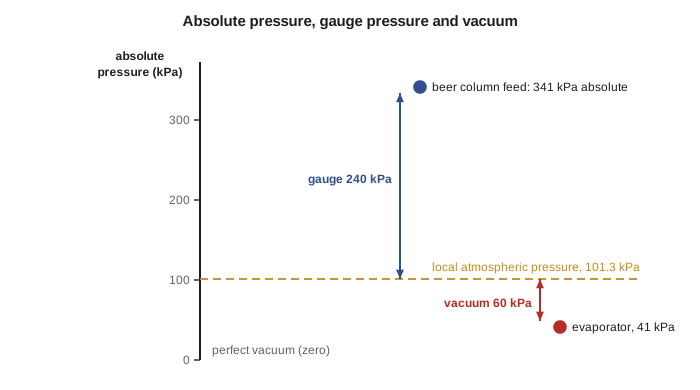
A column of fluid exerts a hydrostatic pressure at its base equal to \(\rho g h\). This is why liquid levels can be measured with pressure transmitters, and why a pressure can be expressed as a head, such as meters of water. A manometer balances an unknown pressure against a column of liquid of known density.
Worked problem
Pressure at the base of a fermenter
A fermenter is filled with mash of density 1060 kg/m³ to a depth of 14.0 m (45.9 ft). The headspace is vented to the carbon dioxide scrubber at 3 kPa gauge, and the atmospheric pressure is 100.8 kPa. Find the gauge and absolute pressure at the bottom, and express the gauge pressure in psig.
Show solution
- Hydrostatic pressure \(= \rho g h = 1060 \times 9.81 \times 14.0 = 145\,600\ \text{Pa} = 145.6\ \text{kPa}\).
- Gauge pressure at the bottom \(= 3 + 145.6 = 148.6\ \text{kPa}\).
- Absolute pressure \(= 148.6 + 100.8 = 249.4\ \text{kPa}\); in US units the gauge pressure is \(148.6 \times 14.696/101.325 = 21.6\ \text{psig}\).
Answer: The bottom of a tall fermenter sees about one and a half atmospheres above ambient. Tank walls and bottom outlet valves must be designed for this, and a level transmitter at the base can infer the depth from the pressure if the density is known.
Temperature
Temperature measures how hot something is. The Celsius scale sets 0 °C at the freezing point of water and 100 °C at its normal boiling point; the kelvin scale has the same size of degree but starts at absolute zero, so \(T(\text{K}) = T(°\text{C}) + 273.15\). In US practice the Fahrenheit and Rankine scales are used, with \(T(°\text{F}) = 1.8\,T(°\text{C}) + 32\) and \(T(°\text{R}) = T(°\text{F}) + 459.67 = 1.8\,T(\text{K})\). Gas laws and many correlations need absolute temperature in kelvins or degrees Rankine.
A temperature difference is not the same as a temperature. A difference of 1 K equals a difference of 1 °C, and a difference of 1 °R equals 1 °F, but 1 °C of difference equals 1.8 °F of difference. This matters when converting heat capacities: 4.18 kJ/(kg·°C) equals 4.18 kJ/(kg·K), but in US units it becomes 1.0 Btu/(lbm·°F).
# Process variables for the beer stream leaving the fermenters
# Composition given in mass fractions; convert to mole fractions and molar flow.
M = {'ethanol': 46.07, 'water': 18.02, 'carbon dioxide': 44.01, 'glycerol': 92.09}
w = {'ethanol': 0.135, 'water': 0.855, 'carbon dioxide': 0.002, 'glycerol': 0.008}
mass_flow = 280_000.0          # kg/h of clarified beer (solids removed for this example)

assert abs(sum(w.values()) - 1) < 1e-9
moles = {k: mass_flow * w[k] / M[k] for k in w}     # kmol/h
n_total = sum(moles.values())
print(f"{'component':16s}{'mass frac':>10s}{'kmol/h':>10s}{'mole frac':>11s}")
for k in w:
    print(f"{k:16s}{w[k]:10.3f}{moles[k]:10.1f}{moles[k] / n_total:11.4f}")
Mavg = mass_flow / n_total
print(f"Total {n_total:.1f} kmol/h, average molar mass {Mavg:.2f} kg/kmol")

# Volumetric flow from a mixture density
rho = 975.0                     # kg/m3, approximate for this beer at 32 C
print(f"Volumetric flow {mass_flow / rho:.1f} m3/h")

# Pressure: gauge reading at the beer column feed
p_atm = 101.325                 # kPa
p_gauge = 240.0                 # kPa gauge
print(f"Absolute pressure {p_gauge + p_atm:.1f} kPa = {(p_gauge + p_atm) / 100:.3f} bar")

# Temperature conversions used on the control room screens
for T_c in (32.0, 78.4, 100.0):
print(f"{T_c:6.1f} C = {T_c + 273.15:7.2f} K = {T_c * 9 / 5 + 32:6.1f} F = {(T_c + 273.15) * 1.8:7.2f} R")component mass frac kmol/h mole frac ethanol 0.135 820.5 0.0580 water 0.855 13285.2 0.9394 carbon dioxide 0.002 12.7 0.0009 glycerol 0.008 24.3 0.0017 Total 14142.8 kmol/h, average molar mass 19.80 kg/kmol Volumetric flow 287.2 m3/h Absolute pressure 341.3 kPa = 3.413 bar 32.0 C = 305.15 K = 89.6 F = 549.27 R 78.4 C = 351.55 K = 173.1 F = 632.79 R 100.0 C = 373.15 K = 212.0 F = 671.67 R
Significant figures and data quality
Report answers with a sensible number of significant figures. Plant flowmeters are rarely better than one percent, and laboratory compositions often have similar uncertainty, so reporting a flow to seven figures implies a precision that does not exist. Carry extra digits through the calculation to avoid rounding drift, then round the final answer. Three significant figures is usually appropriate for process balances.
Common mistakes
MistakeUsing gauge pressure in the ideal gas law.
InsteadGas laws need absolute pressure; add the local atmospheric pressure to the gauge reading.
MistakeConverting a temperature difference with the full Fahrenheit formula.
InsteadA difference of 1 °C equals 1.8 °F; the 32 offset applies only to temperatures, not differences.
MistakeTreating mass fractions as mole fractions.
InsteadConvert with molar masses; the two can differ greatly, as for ethanol in beer.
MistakeTreating lbm and lbf as interchangeable in an equation.
InsteadUse g_c = 32.174 lbm·ft/(lbf·s²) when force appears with mass and acceleration.
MistakeUsing a correlation with the wrong units.
InsteadEmpirical constants, such as Antoine constants, are tied to specific units of pressure and temperature.
Summary and key terms
- Every quantity is a number with a unit; conversion factors are ratios equal to one.
- Equations must be dimensionally homogeneous; empirical correlations carry fixed units.
- Mass, volumetric and molar flows are linked by density and molar mass.
- Mass and mole fractions each sum to one and convert through molar masses.
- Absolute pressure equals gauge plus atmospheric; hydrostatic pressure is ρgh.
- Absolute temperature is needed in gas laws; temperature differences convert without offsets.
- Dimension
- A kind of physical quantity, such as length, mass or time.
- Dimensional homogeneity
- The property that every term in an equation has the same dimensions.
- Specific gravity
- The ratio of a substance's density to that of a reference, usually water.
- Molar mass
- The mass of one mole of a substance.
- Mass fraction
- The mass of one component divided by the total mass of a mixture.
- Mole fraction
- The moles of one component divided by the total moles of a mixture.
- Gauge pressure
- Pressure measured relative to the local atmospheric pressure.
- Absolute temperature
- Temperature measured from absolute zero, in kelvins or degrees Rankine.
Practice problems
Work each problem on paper first, then reveal the answer to check.
Convert 12 600 US gal/h to m³/s.
Show answer
12 600 × 3.785 L = 47 690 L/h; ÷ 1000 ÷ 3600 = 0.0132 m³/s.
A gas is 80 mol% methane and 20 mol% ethane. Find its average molar mass.
Show answer
0.8(16.04) + 0.2(30.07) = 18.85 kg/kmol.
A gauge reads 35 psig at sea level. What is the absolute pressure in kPa?
Show answer
35 + 14.70 = 49.7 psia = 342.6 kPa.
What depth of water gives 50 kPa of hydrostatic pressure?
Show answer
h = 50 000/(1000 × 9.81) = 5.10 m.
Convert 78.4 °C to °F and K.
Show answer
173.1 °F and 351.55 K.
In the program, change the ethanol mass fraction to 0.15 and water to 0.84. What is the new ethanol mole fraction?
Show answer
About 0.0648; the average molar mass rises slightly to about 20.0 kg/kmol.
Lesson quiz · 5 questions
Score 60% or more to complete this lesson.
Create a free account to save your progress, take quizzes and earn a certificate.