
CHE-200 · Lesson 11 of 12 · 24 min
Energy balances on nonreactive processes
Most of the steam at Kingfisher Bioenergy is used without any chemical reaction: to heat the beer, to boil the bottoms of the columns, to evaporate water from the thin stillage, and to vaporize and superheat ethanol for the molecular sieves. The plant also recovers heat by passing hot stillage against cold beer in a preheater. Ingrid asks Theo to calculate the duty of the sieve vaporizer and to check the preheater. Both need enthalpy changes for heating, cooling and changing phase when steam tables are not available, which is the subject of this lesson.
Hypothetical process paths
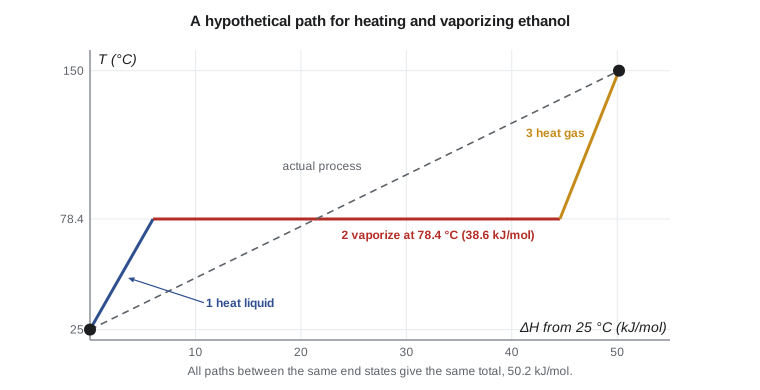
Enthalpy is a state property, so the change between two states does not depend on how the change actually happens. That lets us replace any real process with a convenient imaginary path made of simple steps whose enthalpy changes are known: heating or cooling at constant pressure, changing phase at a temperature where the latent heat is known, changing pressure, and mixing. The real process might heat a liquid while it boils along a tube; the hypothetical path heats the liquid to its normal boiling point, vaporizes it there, and then heats the vapor. Both give the same total \(\Delta\hat{H}\).
Choosing the path is a matter of where data are available. Heats of vaporization are usually tabulated at the normal boiling point, so paths are built to change phase there. Heat capacities are known for each phase, so the sensible heating steps use them. For an ideal gas, enthalpy does not depend on pressure at all, and for liquids and solids the effect of pressure is small, \(\Delta\hat{H} \approx \hat{V}\Delta P\), which is often negligible.
Sensible heat and heat capacity
Heat that changes a substance's temperature without changing its phase is called sensible heat. The constant-pressure heat capacity \(C_p\) is the rate at which enthalpy changes with temperature, \(C_p = (\partial\hat{H}/\partial T)_P\). For ideal gases, and to a good approximation for liquids and solids, the enthalpy change for heating from \(T_1\) to \(T_2\) is the integral of \(C_p\) over that range.
Heat capacities of gases rise with temperature, so tables give polynomial fits with constants valid over a stated range. Liquids and solids vary less, and a mean value is often good enough. Water's liquid heat capacity is about 4.18 kJ/(kg·K), much higher than that of most other liquids; organic liquids are typically 1.8 to 2.6 kJ/(kg·K). For gas mixtures and ideal liquid mixtures, the mixture heat capacity is the mole-fraction or mass-fraction weighted sum of the component values.
| Substance | Phase | Mean or polynomial C_p | Notes |
|---|---|---|---|
| Water | liquid | 75.4 J/(mol·K), 4.18 kJ/(kg·K) | Nearly constant 0 to 100 °C |
| Water | vapor | 33.46 + 0.00688T + 7.604 × 10⁻⁶T² − 3.593 × 10⁻⁹T³ J/(mol·K) | T in °C |
| Ethanol | liquid | about 112 J/(mol·K), 2.43 kJ/(kg·K) | Mean value 20 to 80 °C |
| Ethanol | vapor | 61.34 + 0.1572T − 8.749 × 10⁻⁵T² + 1.983 × 10⁻⁸T³ J/(mol·K) | T in °C |
| Air | gas | about 29.2 J/(mol·K) near room temperature | Rises slowly with T |
Ideal gas heat capacities at constant volume and constant pressure differ by the gas constant, \(C_p = C_v + R\). For liquids and solids the two are nearly equal. Heat capacity data in US units are often in Btu/(lbm·°F); because a degree Fahrenheit is smaller than a kelvin by a factor of 1.8 and a Btu per pound-mass is 2.326 kJ/kg, the number in Btu/(lbm·°F) equals the number in cal/(g·°C), so water is 1.0 in both systems.
Phase changes and latent heats
Changing phase at constant temperature and pressure takes or releases latent heat. The heat of vaporization \(\Delta\hat{H}_v\) is the enthalpy change for turning a liquid into vapor at its boiling point; the heat of fusion \(\Delta\hat{H}_m\) is for melting a solid. Condensation and freezing release the same amounts. Latent heats are large: vaporizing water takes 40.66 kJ/mol at 100 °C, the same as heating liquid water through more than 500 K if it stayed liquid.
When a measured value is not available, estimates help. Trouton's rule says that for many nonpolar liquids the heat of vaporization at the normal boiling point is about 88 J/(mol·K) times the boiling point in kelvins. Water and alcohols, with hydrogen bonding, are higher: about 109 J/(mol·K) times \(T_b\). Watson's correlation converts a known heat of vaporization at one temperature to another, falling to zero at the critical point.
The Watson form uses absolute temperatures, and the exponent 0.38 fits a wide range of liquids. For ethanol, with a heat of vaporization of 38.58 kJ/mol at its normal boiling point of 78.4 °C and a critical temperature of 513.9 K, Watson's correlation gives about 43.0 kJ/mol at 25 °C, close to the measured value of about 42.3 kJ/mol.
Worked problem
Duty of the sieve vaporizer
A start-up vaporizer takes 10 000 kg/h (22 050 lbm/h) of liquid 92.5 wt% ethanol (the rest water) at 25 °C (77 °F) and produces vapor at 150 °C (302 °F) for the molecular sieve. Treating the components as an ideal mixture and ignoring pressure effects, find the heat duty using the data in the table and heats of vaporization of 38.58 kJ/mol (ethanol, 78.4 °C) and 40.66 kJ/mol (water, 100 °C).
Show solution
- Molar flows: ethanol \(= 9250/46.07 = 200.8\ \text{kmol/h}\); water \(= 750/18.02 = 41.6\ \text{kmol/h}\).
- Ethanol path: liquid \(0.112(78.4 - 25) = 5.98\); vaporize 38.58; vapor \(\int_{78.4}^{150} C_p\,dT = 5.60\ \text{kJ/mol}\); total 50.16 kJ/mol.
- Water path: liquid \(0.0754(100 - 25) = 5.65\); vaporize 40.66; vapor \(\int_{100}^{150} C_p\,dT = 1.72\ \text{kJ/mol}\); total 48.04 kJ/mol.
- Duty \(= 200.8 \times 50.16 + 41.6 \times 48.04 = 10\,070 + 2000 = 12\,070\ \text{MJ/h} = 3.35\ \text{MW}\).
Answer: More than three quarters of the duty is latent heat; 3.35 MW is about 11.4 million Btu/h. At 10 bar, condensing steam supplies about \(2777.7 - 762.6 = 2015\ \text{kJ/kg}\), so the vaporizer needs about 6000 kg/h of steam. In normal operation the sieve takes vapor straight from the rectifier, and this vaporizer is used only at start-up, which is why plants integrate the sieve with the distillation columns.
# Heating and vaporizing 92.5 wt% ethanol: a hypothetical-path enthalpy calculation
# Heat capacity polynomials for the vapors, kJ/(mol C) with T in C (approximate)
CP = {'ethanol': (61.34e-3, 15.72e-5, -8.749e-8, 19.83e-12),
      'water':   (33.46e-3, 0.6880e-5, 0.7604e-8, -3.593e-12)}
CP_LIQ = {'ethanol': 0.112, 'water': 0.0754}       # kJ/(mol C), mean liquid values
TB = {'ethanol': 78.4, 'water': 100.0}               # normal boiling points, C
HV = {'ethanol': 38.58, 'water': 40.66}              # kJ/mol at the normal boiling point
TC = {'ethanol': 513.9, 'water': 647.1}              # critical temperatures, K
M = {'ethanol': 46.07, 'water': 18.02}

def int_cp(sp, T1, T2):
    a, b, c, d = CP[sp]
    f = lambda T: a * T + b * T ** 2 / 2 + c * T ** 3 / 3 + d * T ** 4 / 4
    return f(T2) - f(T1)

def watson(sp, T):
    """Heat of vaporization at T (C) from the value at the normal boiling point."""
    Tr1, Tr2 = (TB[sp] + 273.15) / TC[sp], (T + 273.15) / TC[sp]
    return HV[sp] * ((1 - Tr2) / (1 - Tr1)) ** 0.38

feed = 10_000.0                                       # kg/h of 92.5 wt% ethanol
n = {'ethanol': feed * 0.925 / M['ethanol'], 'water': feed * 0.075 / M['water']}  # kmol/h
T_in, T_out = 25.0, 150.0
total = 0.0                                           # MJ/h (kmol/h times kJ/mol)
for sp in n:
    h1 = CP_LIQ[sp] * (TB[sp] - T_in)               # heat liquid to its boiling point
    h2 = HV[sp]                                     # vaporize
    h3 = int_cp(sp, TB[sp], T_out)                  # heat vapor to the outlet
    dh = h1 + h2 + h3
    total += n[sp] * dh
    print(f"{sp:8s} {n[sp]:7.1f} kmol/h: liquid {h1:6.2f} + vaporize {h2:6.2f} + vapor {h3:6.2f} = {dh:6.2f} kJ/mol")
print(f"Vaporizer and superheater duty {total / 3600:.2f} MW ({total:.0f} MJ/h)")

print("\nHeat of vaporization of ethanol by Watson's correlation")
for T in (25, 50, 78.4, 120, 150):
print(f"{T:6.1f} C {watson('ethanol', T):6.2f} kJ/mol")ethanol 200.8 kmol/h: liquid 5.98 + vaporize 38.58 + vapor 5.60 = 50.16 kJ/mol water 41.6 kmol/h: liquid 5.65 + vaporize 40.66 + vapor 1.72 = 48.04 kJ/mol Vaporizer and superheater duty 3.35 MW (12070 MJ/h) Heat of vaporization of ethanol by Watson's correlation 25.0 C 42.98 kJ/mol 50.0 C 41.02 kJ/mol 78.4 C 38.58 kJ/mol 120.0 C 34.48 kJ/mol 150.0 C 30.93 kJ/mol
Heat exchangers
A heat exchanger transfers heat from a hot stream to a cold one without mixing them. For the whole exchanger with negligible heat loss, the heat lost by the hot stream equals the heat gained by the cold stream. Each stream's enthalpy change comes from its heat capacity, or from latent heat if it condenses or boils. The energy balance fixes the outlet temperatures, but not the area of the exchanger, which depends on heat transfer rates and is the subject of a heat transfer course.
Worked problem
The beer preheater
Beer at 280 000 kg/h (617 000 lbm/h) is heated from 32 °C to 65 °C (89.6 to 149 °F) in a preheater by whole stillage from the beer column bottoms, which enters at 108 °C at 215 000 kg/h. Mean heat capacities are 4.05 kJ/(kg·K) for the beer and 3.95 kJ/(kg·K) for the stillage. Find the heat transferred and the stillage outlet temperature.
Show solution
- Heat gained by the beer \(= 280\,000 \times 4.05 \times (65 - 32) = 37.42\ \text{GJ/h} = 10.4\ \text{MW}\).
- Stillage temperature drop \(= 37.42 \times 10^6/(215\,000 \times 3.95) = 44.1\ \text{K}\).
- Stillage outlet \(= 108 - 44.1 = 63.9\ °\text{C}\).
Answer: The preheater recovers 10.4 MW that would otherwise need about 18.6 t/h of steam at 10 bar in the beer column. The beer leaves at 65 °C while the stillage leaves at 63.9 °C, which is possible only with countercurrent flow, where the streams pass in opposite directions. Pinch analysis, taught in process design courses, finds the most heat that can be recovered across a whole plant this way.
Reusing latent heat: multiple-effect evaporation
The evaporator in the stillage train shows how much latent heat matters to plant economics. Lesson 4 found that it removes about 77 t/h of water. In a single-effect evaporator, every kilogram of water boiled off needs roughly a kilogram of steam, because the latent heat of the condensing steam is about equal to the latent heat of the boiling water. The plant's evaporator has four effects in series, each running at a lower pressure than the one before. Vapor boiled off in the first effect condenses in the second effect's heating tubes, where the lower pressure means the liquid boils at a lower temperature; the second effect's vapor heats the third, and so on. Only the first effect needs fresh steam.
An energy balance on each effect, condensing vapor in and boiling vapor out with small sensible-heat corrections, shows that four effects remove about 3.5 kg of water per kilogram of steam rather than one. That saving, around 55 t/h of steam at this plant, is far larger than any other single heat recovery measure. Many plants go further and drive one stage with vapor from the distillation columns, or compress the evaporator vapor mechanically so that electricity rather than steam supplies the latent heat. All of these are designed from the same energy balance you have just learned.
Mixing and solutions
Mixing two liquids or dissolving a solid can release or absorb heat, the heat of mixing or heat of solution. For ideal mixtures it is zero, and the enthalpy of a mixture is the sum of the component enthalpies. For some systems it is large: diluting concentrated sulfuric acid releases enough heat to boil water, which is why acid is always added to water and never the reverse. Ethanol and water have a small exothermic heat of mixing, a few hundred joules per mole at most, which is usually neglected in plant balances but appears in accurate simulator models. Heats of solution are tabulated for common salts, acids and bases, and enthalpy-concentration charts combine all the effects for systems such as sulfuric acid and water or ammonia and water.
Humidification and the psychrometric chart
Air-water systems, such as the grain dryers and the cooling towers, combine sensible heat and latent heat. The psychrometric chart plots humidity against temperature at atmospheric pressure with lines of relative humidity, specific volume, enthalpy and wet-bulb temperature. Adiabatic humidification, in which air passes over water and evaporates some of it without any external heat, follows a line of nearly constant wet-bulb temperature: the air cools as it picks up moisture. Cooling towers use this to reject the heat from the condensers, and evaporative coolers use it for comfort cooling in dry climates.
Common mistakes
MistakeUsing a heat of vaporization at the wrong temperature.
InsteadBuild the path to change phase where the latent heat is known, or correct it with Watson's correlation.
MistakeTreating C_p as constant over a wide range for a gas.
InsteadIntegrate the polynomial; gas heat capacities rise noticeably with temperature.
MistakeUsing degrees Fahrenheit differences with kJ/(kg·K) data.
InsteadConvert the temperature difference, or convert C_p to Btu/(lbm·°F).
MistakeAssuming any outlet temperatures are possible in a heat exchanger.
InsteadThe hot outlet must stay above the cold inlet and vice versa; check feasibility.
MistakeIgnoring heats of mixing for acids and bases.
InsteadStrongly nonideal solutions need heats of solution or enthalpy-concentration charts.
Summary and key terms
- Enthalpy changes can be calculated along any convenient hypothetical path.
- Sensible heat: ΔH = ∫C_p dT, with polynomial C_p for gases and mean values for liquids.
- Latent heats are large; Trouton's rule estimates them and Watson's correlation shifts them in temperature.
- In a heat exchanger, the hot stream's enthalpy loss equals the cold stream's gain.
- Mixing and solution heats are zero for ideal mixtures but large for acids and bases in water.
- Air-water systems combine sensible and latent heat and are analyzed with psychrometric charts.
- Sensible heat
- Heat that changes temperature without changing phase.
- Latent heat
- The enthalpy change accompanying a phase change at constant temperature.
- Heat capacity
- The rate of change of enthalpy (C_p) or internal energy (C_v) with temperature.
- Hypothetical process path
- An imaginary sequence of simple steps used to calculate a state property change.
- Trouton's rule
- An estimate of the heat of vaporization as about 88 J/(mol·K) times the normal boiling point.
- Heat of solution
- The enthalpy change when a substance dissolves in a solvent.
- Countercurrent flow
- Heat exchanger flow in which the two streams move in opposite directions.
- Wet-bulb temperature
- The temperature reached by water evaporating into air under adiabatic conditions.
Practice problems
Work each problem on paper first, then reveal the answer to check.
How much heat raises 1000 kg of water from 20 to 80 °C?
Show answer
1000 × 4.18 × 60 = 250 800 kJ, about 251 MJ.
Estimate the heat of vaporization of n-hexane (T_b = 341.9 K) by Trouton's rule.
Show answer
88 × 341.9 = 30 100 J/mol, about 30.1 kJ/mol (measured about 28.9).
Using the program's Watson output, what is ethanol's heat of vaporization at 120 °C?
Show answer
About 34.5 kJ/mol.
In the preheater example, what stillage outlet temperature results if the beer is heated to 70 °C?
Show answer
Q = 280 000 × 4.05 × 38 = 43.09 GJ/h; ΔT = 50.7 K; outlet 57.3 °C.
Convert 2.43 kJ/(kg·K) to Btu/(lbm·°F).
Show answer
2.43/4.187 = 0.580 Btu/(lbm·°F).
Why is the latent heat step the largest part of the vaporizer duty?
Show answer
Vaporization breaks intermolecular attractions, which takes far more energy than raising the temperature of either phase by tens of degrees.
Lesson quiz · 5 questions
Score 60% or more to complete this lesson.
Create a free account to save your progress, take quizzes and earn a certificate.