
BUS-130 · Lesson 7 of 12 · 31 min
Groups and teams
Most work today is done in groups. Products are designed by cross-functional teams, patients are treated by care teams, construction projects are coordinated by site teams, and software is built by squads that may span several countries. Teams can achieve things no individual could, but they can also waste time, suppress good ideas and frustrate their members. This lesson explains how groups develop, what shapes their behavior, why bigger is not always better and what the evidence says about building effective teams. Running meetings and team communication are covered in BUS-120; here the focus is on how groups and teams work as social systems.
Groups and teams
A group is two or more individuals who interact and depend on each other to achieve particular objectives. Formal groups are defined by the organization's structure, such as a department or project team. Informal groups form naturally in response to social needs, such as colleagues who lunch together; they can strongly shape norms and information flow. A team is a special kind of group whose members work intensely together toward a common goal, with mutual accountability and complementary skills, so that the collective result is greater than the sum of individual inputs. A work group shares information to help each member perform individually; a team produces a joint product.
| Feature | Work group | Team |
|---|---|---|
| Goal | Share information | Collective performance |
| Synergy | Neutral, sometimes negative | Positive |
| Accountability | Individual | Individual and mutual |
| Skills | Random or varied | Complementary |
| Example | Regional sales managers meeting monthly | A product launch team with marketing, engineering and finance |
Organizations use several types of team. Problem-solving teams of employees from the same department meet to improve quality, efficiency or the work environment. Self-managed teams take on many supervisory responsibilities, such as scheduling, assigning tasks and choosing methods. Cross-functional teams bring together people from different areas to complete a task such as launching a product. Virtual teams use technology to connect members in different locations. Multiteam systems are networks of teams, such as the police, fire, paramedic and hospital teams responding to a highway crash, whose goals depend on each other.
How groups develop
Bruce Tuckman's five-stage model, proposed in 1965 and extended in 1977, remains the most widely used description of group development. In forming, members are polite and uncertain, testing what behavior is acceptable and looking to a leader for direction. In storming, conflict emerges over goals, roles and leadership as members assert their views. In norming, the group develops close relationships, shared expectations and a sense of identity. In performing, the structure is accepted and energy goes into the task. In adjourning, temporary groups wrap up and disband, which can bring both satisfaction and a sense of loss.
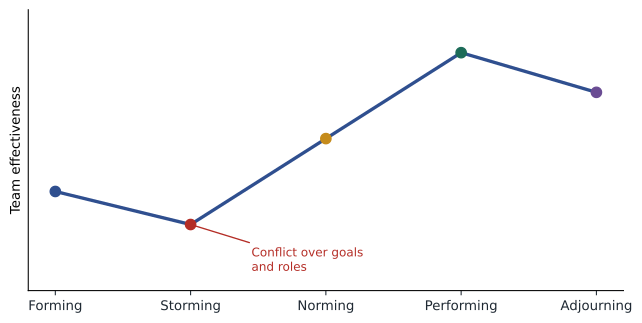
Real groups do not always follow the stages neatly; they may return to storming when a new member joins or the goal changes. Connie Gersick's research on project teams with deadlines found a different pattern, called punctuated equilibrium. Teams set a direction in their first meeting and stick with it through a first phase of relative inertia. At about the midpoint of their allotted time, they experience a transition, a burst of change in which they drop old patterns and adopt new perspectives, followed by a second phase of execution and a final burst of activity before the deadline. The practical lesson is that the midpoint of a project is a natural moment to step back and reassess.
Worked problem
Diagnosing a team's stage
Six weeks into a 16-week project to replace a hospital's scheduling system, a team of nurses, IT specialists and administrators shows these signs: meetings run long because the IT lead and the nursing manager disagree about whether to customize the software; two members have stopped attending; people complain privately that roles are unclear; and no one has agreed on how decisions will be made. Identify the stage and suggest actions.
Show solution
- The open disagreement about direction, unclear roles and conflict over influence are classic signs of storming.
- Withdrawal by two members suggests the conflict is becoming personal or that people feel unheard.
- Action 1: hold a session to agree a team charter covering the goal, roles, decision rules and how disagreements will be handled.
- Action 2: separate the substantive issue (customization) and gather evidence, such as clinical workflow needs and vendor upgrade costs, rather than arguing positions.
- Action 3: use the week-8 midpoint, predicted by punctuated equilibrium, as a formal review of direction.
Answer: The team is storming. A charter, clear decision rules and an evidence-based approach to the customization question can move it to norming before the midpoint review.
Roles, norms and status
A role is a set of expected behaviors attributed to someone occupying a given position. Team members play task roles, which move the work forward (initiating, information seeking, summarizing), maintenance roles, which keep relationships healthy (encouraging, harmonizing, gatekeeping so quieter members can speak), and sometimes self-oriented roles that hurt the group (dominating, blocking, seeking recognition). Role ambiguity, uncertainty about what is expected, and role conflict, incompatible expectations, are sources of stress. Tools such as Belbin's team roles are popular for discussion, though like other typologies their predictive evidence is limited.
Norms are acceptable standards of behavior shared by group members. They cover performance (how hard to work, how fast to respond to messages), appearance, social arrangements and resource allocation. The Hawthorne studies at Western Electric in the 1920s and 1930s, though flawed by modern standards, drew attention to how informal group norms regulate output: workers in the bank wiring room kept production at a level the group agreed was fair and pressured "rate-busters" to slow down. Solomon Asch's experiments in the 1950s showed the power of conformity: when a group of confederates unanimously gave an obviously wrong answer about line lengths, about three-quarters of participants conformed at least once. A single dissenter sharply reduced conformity, which shows the value of encouraging even one person to speak up.
Status is a socially defined position or rank given to groups or group members. High-status members often talk more, are interrupted less and have more influence over decisions, whether or not they have the most relevant knowledge. Teams perform better when influence follows expertise rather than status, which leaders can encourage by asking for input from junior members first and explicitly inviting dissent.
Group size and social loafing
Bigger groups bring more resources, skills and perspectives, but they are harder to coordinate. Communication channels grow much faster than group size. In a group of \(n\) members, the number of possible one-to-one channels is:
# Possible one-to-one communication channels as a team grows
for n in [3, 5, 7, 9, 12, 15, 20]:
    channels = n * (n - 1) // 2
print(f"team of {n:2d}: {channels:3d} channels")team of 3: 3 channels team of 5: 10 channels team of 7: 21 channels team of 9: 36 channels team of 12: 66 channels team of 15: 105 channels team of 20: 190 channels
A team of 5 has 10 channels; a team of 15 has 105. This is one reason many organizations keep teams small. Amazon popularized the "two-pizza team", a team small enough to be fed by two pizzas, and research on team effectiveness generally suggests that teams of about five to nine people balance resources and coordination well for most tasks.
Social loafing is the tendency for individuals to put in less effort when working collectively than when working alone. In the 1880s, the French agricultural engineer Max Ringelmann found that people pulling on a rope in groups exerted less force per person as group size increased. Later research separated two causes: coordination losses (people do not pull at the same moment) and motivation losses (people reduce effort when their individual contribution cannot be identified). Social loafing is stronger in individualistic cultures, on boring tasks and when people believe others are slacking.
Worked problem
Estimating social loafing and coordination costs
A data-entry pilot measured output: one person working alone processes 120 records an hour. Teams of 4 sharing a queue with no individual tracking process 400 records an hour in total; teams of 8 process 720. Compute output per person and the percentage loss relative to working alone, and suggest a remedy.
Show solution
- Team of 4: 400 ÷ 4 = 100 records per person, a loss of (120 − 100) ÷ 120 ≈ 16.7 %.
- Team of 8: 720 ÷ 8 = 90 records per person, a loss of (120 − 90) ÷ 120 = 25 %.
- Channels: a team of 4 has 6; a team of 8 has 28, so coordination costs rise too.
- Remedies: make individual contributions identifiable (individual dashboards alongside team totals), keep teams smaller, set specific team goals and make the work more meaningful.
Answer: Per-person output falls as the team grows. Making contributions visible and keeping teams small should recover much of the loss without abandoning teamwork.
Cohesiveness
Cohesiveness is the degree to which members are attracted to each other and motivated to stay in the group. Cohesive groups communicate more, cooperate more and are more satisfying to belong to. But cohesiveness amplifies norms rather than guaranteeing performance. A cohesive group with high performance norms is very productive; a cohesive group with low performance norms is very good at restricting output. Cohesiveness also increases the risk of groupthink, discussed in lesson 8. Cohesion grows with time together, shared success, smaller size, clear goals and, often, a shared external challenge.
What makes teams effective
Research on team effectiveness points to three clusters of factors. Context includes adequate resources, effective leadership and structure, a climate of trust and a performance evaluation and reward system that recognizes team contributions, not only individual ones. Composition includes members' abilities and personalities, the allocation of roles, diversity, size and members' preference for teamwork. Process includes a common purpose, specific team goals, team efficacy (members' confidence that the team can succeed), a shared mental model of how the work gets done, a manageable level of conflict (lesson 11) and low social loafing.
| Cluster | Factor | Question to ask |
|---|---|---|
| Context | Resources and support | Does the team have the time, tools, information and budget it needs? |
| Context | Rewards | Are team results recognized, not just individual performance? |
| Composition | Skills and roles | Does the team have the technical, problem-solving and interpersonal skills the task requires? |
| Composition | Size | Is the team as small as the task allows? |
| Process | Purpose and goals | Can every member state the team's purpose and its specific goals? |
| Process | Psychological safety | Do members feel safe to admit mistakes, ask questions and disagree? |
Psychological safety, a concept developed by Amy Edmondson, is a shared belief that the team is safe for interpersonal risk-taking: that members will not be embarrassed, rejected or punished for speaking up with ideas, questions, concerns or mistakes. Edmondson's early research in hospitals found, surprisingly, that better-led nursing units reported more errors, because people felt safe reporting them, not because they made more. Google's Project Aristotle, reported in 2015, studied about 180 internal teams and concluded that psychological safety was the most important factor distinguishing effective teams, followed by dependability, structure and clarity, meaning and impact. HSE-109 covers psychological safety as part of psychological health and safety; at the team level, leaders build it by framing work as learning, acknowledging their own fallibility and responding to bad news with appreciation rather than blame.
Diversity in teams
Diverse teams can make better decisions because members bring different information, perspectives and networks, but diversity can also increase conflict and reduce cohesion, especially early on. Research distinguishes informational diversity, differences in knowledge and expertise, which tends to help complex, non-routine tasks, from demographic differences that create faultlines, hypothetical dividing lines that split a group into subgroups, such as when all the engineers are young men in one office and all the marketers are older women in another. Strong faultlines can produce us-versus-them dynamics. Leaders reduce these risks by emphasizing a shared goal and identity, mixing subgroups in tasks and creating an inclusive climate where every perspective is sought.
Virtual and hybrid teams
Virtual and hybrid teams face distinctive challenges: fewer informal interactions, slower trust-building, time-zone coordination, misread tone in written messages and the risk that remote members are left out of decisions made by those in the office, sometimes called proximity bias. Effective virtual teams establish clear norms for responsiveness and channels, overlap hours deliberately, document decisions, rotate meeting times fairly across time zones, invest in occasional in-person time for relationship-building and make sure contributions are judged by output rather than visibility. Trust in virtual teams often starts as swift trust, a presumption of reliability that must then be confirmed by early, visible follow-through.
Worked problem
Drafting a team charter
A hybrid team of seven, with members in Halifax, Toronto, Denver and Vancouver, is launching a customer-portal project. Draft the key elements of a team charter.
Show solution
- Purpose: launch a self-service customer portal by March 31 that reduces call volume by 15 %.
- Roles: product owner (decisions on scope), technical lead, UX designer, two developers, a customer-service representative and a project coordinator.
- Decision rules: consensus on design principles; product owner decides scope trade-offs after consultation; technical lead decides architecture.
- Communication norms: core overlap 1 p.m.–3 p.m. Eastern; chat replies within four working hours; decisions recorded in the shared log; cameras optional.
- Conflict: raise disagreements directly within two days; escalate to the sponsor only after one facilitated discussion.
- Review: a retrospective every two weeks and a formal midpoint review.
Answer: A charter turns implicit norms into explicit agreements, which is especially valuable when members rarely meet in person.
Common mistakes
MistakeCalling every group a team.
InsteadReserve teamwork for tasks that need joint effort and mutual accountability; use work groups for information sharing.
MistakeAssuming bigger teams are always better.
InsteadKeep teams as small as the task allows; communication channels grow as n(n − 1) ÷ 2.
MistakeRewarding only individual performance in team-based work.
InsteadInclude team goals and recognition so members invest in collective results.
MistakeTreating cohesion as automatically good.
InsteadCheck performance norms; cohesion amplifies whatever norms the group holds.
MistakePunishing people who report mistakes.
InsteadRespond to bad news with appreciation and a focus on learning to build psychological safety.
Summary and key terms
- A team works intensely toward a common goal with mutual accountability and complementary skills; a work group mainly shares information.
- Groups often move through forming, storming, norming, performing and adjourning; project teams often shift at their midpoint (punctuated equilibrium).
- Roles, norms and status shape behavior; conformity pressure is strong but one dissenter can break it.
- Communication channels grow as n(n − 1) ÷ 2, and social loafing increases with size when contributions are not identifiable.
- Cohesiveness amplifies performance norms.
- Team effectiveness depends on context, composition and process; psychological safety is a key process factor.
- Diversity helps complex tasks when it is informational and well led; faultlines can split teams.
- Virtual and hybrid teams need explicit norms, documented decisions and fair inclusion of remote members.
- Group
- Two or more interdependent individuals who interact to achieve particular objectives.
- Team
- A group whose members work intensely together toward a common goal with mutual accountability.
- Punctuated equilibrium
- A pattern in which project teams change direction in a burst around the midpoint of their time.
- Norms
- Acceptable standards of behavior shared by group members.
- Conformity
- Adjusting one's behavior to align with group norms.
- Social loafing
- Reduced individual effort when working collectively.
- Cohesiveness
- The degree to which members are attracted to and motivated to stay in a group.
- Psychological safety
- A shared belief that a team is safe for interpersonal risk-taking.
- Faultline
- A dividing line that splits a group into subgroups based on aligned characteristics.
- Team charter
- A written agreement on a team's purpose, roles, decision rules and norms.
Practice problems
Work each problem on paper first, then reveal the answer to check.
Name Tuckman's five stages.
Show answer
Forming, storming, norming, performing and adjourning.
How many one-to-one channels exist in a team of 10?
Show answer
10 × 9 ÷ 2 = 45.
What happens at the midpoint in the punctuated equilibrium model?
Show answer
A transition: the team drops old patterns and adopts new perspectives.
What did Asch find when one confederate dissented?
Show answer
Conformity dropped sharply.
Give two causes of reduced per-person output in larger groups.
Show answer
Coordination losses and motivation losses (social loafing).
A cohesive team has low performance norms. What do you predict?
Show answer
Low productivity, because cohesion reinforces the low norms.
What did Google's Project Aristotle identify as the most important team factor?
Show answer
Psychological safety.
What is a faultline?
Show answer
An alignment of characteristics that splits a group into subgroups.
Give three norms useful for a hybrid team.
Show answer
Core overlap hours, response-time expectations, documented decisions, fair meeting rotation.
Portfolio task: identify the stage of a team you belong to and one action to help it progress.
Show answer
Answers vary; a good answer cites observed behaviors and a matching action.
Lesson quiz · 5 questions
Score 60% or more to complete this lesson.
Create a free account to save your progress, take quizzes and earn a certificate.