
BUS-130 · Lesson 5 of 12 · 29 min
Theories of motivation
Motivation is the set of processes that account for an individual's intensity, direction and persistence of effort toward a goal. Intensity is how hard a person tries. Direction is where the effort goes, which matters because hard work aimed at the wrong goal is wasted. Persistence is how long the effort lasts in the face of obstacles. Motivation is not a fixed personality trait. The same person can be highly motivated in one job and unmotivated in another, which means managers have real influence over it.
This lesson surveys the major theories of motivation, from early needs theories that remain popular to contemporary theories with stronger evidence. Lesson 6 then applies them to job design, rewards, pay and recognition. As you read, notice that the theories are complementary more than competing: each highlights a different part of the motivational process.
Early needs theories
Abraham Maslow's hierarchy of needs proposes five levels: physiological, safety, social (belonging), esteem and self-actualization. Lower needs must be substantially satisfied before higher needs become motivating. The hierarchy is intuitive and widely taught, but research has found little support for its strict ordering. People pursue several needs at once, and the order varies by person and culture. Its lasting value is the reminder that people have a range of needs and that unmet basic needs, such as safety or a reliable income, will dominate attention.
Frederick Herzberg's two-factor theory distinguishes hygiene factors from motivators. Hygiene factors, such as pay, company policies, supervision, working conditions and job security, cause dissatisfaction when inadequate, but improving them only removes dissatisfaction; it does not create motivation. Motivators, such as achievement, recognition, responsibility, the work itself and growth, are what create satisfaction and motivation. The theory has been criticized because it relied on people's stories about good and bad experiences, which may reflect self-serving bias (people credit themselves for good experiences and blame the environment for bad ones). Still, it influenced the movement toward job enrichment discussed in lesson 6.
David McClelland's theory of needs focuses on three learned needs. The need for achievement is the drive to excel and succeed against a standard; high achievers prefer moderately difficult tasks with personal responsibility and fast feedback. The need for power is the desire to influence and control others. The need for affiliation is the desire for friendly, close relationships. McClelland found that the best managers in large organizations tend to be high in the need for power, directed at the organization's goals rather than personal gain, and relatively low in the need for affiliation, because they must sometimes make unpopular decisions.
| Theory | Core idea | Evidence | Practical use |
|---|---|---|---|
| Maslow's hierarchy | Five needs in a fixed order | Weak for strict ordering | Check that basic needs such as safety and income security are met |
| Herzberg's two-factor | Hygiene factors prevent dissatisfaction; motivators create motivation | Mixed; method criticized | Do not expect pay and perks alone to create motivation; enrich the work |
| McClelland's needs | Achievement, power and affiliation are learned needs | Moderate, especially for achievement | Give high achievers challenging goals and feedback; select managers with socialized power motives |
Self-determination theory
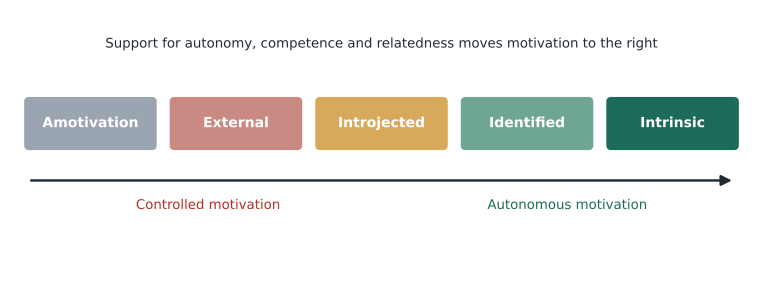
Self-determination theory, developed by Edward Deci and Richard Ryan, is one of the best-supported modern theories. It holds that people have three basic psychological needs: autonomy (a sense of choice and control over one's actions), competence (a sense of mastery and effectiveness) and relatedness (a sense of connection with others). When work satisfies these needs, people experience more autonomous forms of motivation: they act because the work is interesting (intrinsic motivation) or because they personally value its purpose (identified motivation). When work thwarts these needs, motivation becomes controlled, driven by pressure, guilt or rewards and punishments, and it tends to be less persistent and less creative.
A famous and debated implication is that extrinsic rewards can sometimes crowd out intrinsic motivation. Experiments have found that paying people for an activity they already enjoy can reduce their interest once the payment stops, especially when the reward feels controlling ("You will get this only if you do exactly what I say"). When rewards are informational, signaling competence and appreciation, they are much less likely to undermine motivation. The practical message is not to avoid rewards, but to design them so they feel like recognition rather than control, and to keep attention on the meaning of the work.
Goal-setting theory
Edwin Locke and Gary Latham's goal-setting theory is supported by hundreds of studies. Its central finding is that specific, difficult goals lead to higher performance than easy goals, vague goals or the instruction to "do your best". Specific goals direct attention, difficult goals increase effort and persistence, and both encourage people to find better strategies. Four conditions strengthen the effect: commitment to the goal, which participation, public commitment and confidence all support; feedback on progress; task complexity that is not so high that people must first learn the task; and adequate ability and resources.
Goals can also backfire. Very narrow goals can cause people to ignore important aspects of performance that are not measured, such as quality, safety or teamwork. Stretch goals with large rewards can encourage cheating and risk-taking: investigations into Wells Fargo's sales practices, revealed from 2016, found that aggressive cross-selling targets contributed to employees opening millions of accounts without customers' consent. For complex tasks that people are still learning, learning goals ("identify three new ways to reduce scrap") work better than performance goals ("cut scrap by 20 %"). The SMART acronym, specific, measurable, achievable, relevant and time-bound, is a useful checklist, though the evidence suggests goals should be challenging rather than merely achievable.
| Goal feature | Effect | Watch out for |
|---|---|---|
| Specific | Directs attention to what matters | Ignoring unmeasured aspects of the job |
| Difficult but attainable | Increases effort and persistence | Cheating or excessive risk when goals are impossible or rewards huge |
| Committed to | Sustains effort | Imposed goals with no explanation reduce commitment |
| With feedback | Allows adjustment of effort and strategy | Feedback that only arrives at year end |
| Learning goal for new, complex tasks | Encourages discovery of strategies | Pushing hard performance targets before people know how to do the task |
Objectives and key results (OKRs), popularized by Intel and later Google, are a goal-setting system that pairs an inspiring objective with three to five measurable key results, set quarterly and often shared openly. Many organizations use OKRs to align teams; their success depends on the same principles: specific, challenging goals, commitment, feedback and care not to tie them so tightly to pay that people set easy targets.
Self-efficacy
Self-efficacy, a concept developed by Albert Bandura, is a person's belief that they can successfully perform a specific task. It is task-specific: someone can have high self-efficacy for writing reports and low self-efficacy for public speaking. People with high self-efficacy set higher goals, try harder, persist longer and recover faster from setbacks. Bandura identified four sources of self-efficacy, in order of strength: enactive mastery (succeeding at the task oneself), vicarious modeling (seeing someone similar succeed), verbal persuasion (being told you can do it) and physiological and emotional states (interpreting arousal as energy rather than anxiety). Good training builds self-efficacy by breaking tasks into steps that allow early success.
Reinforcement theory
Reinforcement theory, rooted in B. F. Skinner's research on operant conditioning, focuses on the consequences of behavior rather than internal states. Behavior followed by positive consequences tends to be repeated; behavior followed by negative consequences or no consequences tends to fade. Positive reinforcement adds something desirable (praise, a bonus); negative reinforcement removes something undesirable (ending close supervision once quality improves); punishment adds an undesirable consequence or removes a desirable one; extinction removes the reinforcement that maintained a behavior.
The timing of reinforcement matters. Continuous reinforcement, rewarding every occurrence, produces fast learning but fast extinction when rewards stop. Intermittent schedules produce slower learning but more persistent behavior. Fixed-interval schedules, such as pay deposited every two weeks, produce steady but not exceptional effort; variable-ratio schedules, such as commissions on unpredictable sales or the payouts of a slot machine, produce high, persistent response rates. Reinforcement theory explains much workplace behavior, including why safety rules are ignored when shortcuts are rewarded with time savings and violations are rarely noticed.
Expectancy theory
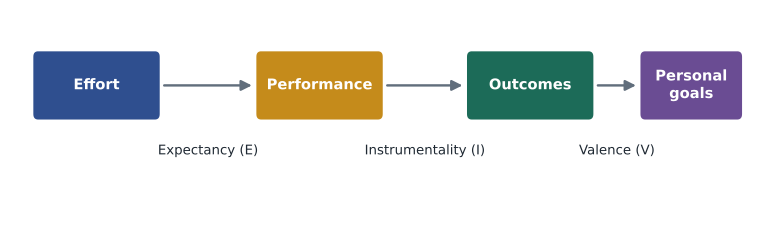
Victor Vroom's expectancy theory explains motivation as a rational calculation. People are motivated to exert effort when they believe three things. Expectancy (E) is the belief that effort will lead to performance ("If I try hard, can I hit the target?"). Instrumentality (I) is the belief that performance will lead to outcomes ("If I hit the target, will I actually get the reward?"). Valence (V) is the value the person places on the outcomes ("Do I want the reward?"). Motivational force is the product of the three, so if any is zero, motivation is zero.
Worked problem
Calculating motivational force
A sales representative, Lena, is considering whether to pursue a difficult new territory target. She estimates a 0.6 probability that extra effort would let her hit the target (E = 0.6). If she hits it, she believes there is a 0.9 probability of a $5,000 bonus, which she values at +8 on a scale from −10 to +10, a 0.5 probability of being considered for promotion, valued at +6, and a 0.8 probability of working many more weekends, valued at −5. Compute her motivational force, then recompute if her manager provides lead support that raises E to 0.8 and arranges help so the weekend probability falls to 0.4.
Show solution
- Sum of instrumentality × valence = (0.9 × 8) + (0.5 × 6) + (0.8 × −5) = 7.2 + 3.0 − 4.0 = 6.2.
- MF = 0.6 × 6.2 = 3.72.
- After changes: sum = (0.9 × 8) + (0.5 × 6) + (0.4 × −5) = 7.2 + 3.0 − 2.0 = 8.2.
- New MF = 0.8 × 8.2 = 6.56.
- Motivational force rises by about 76 % (from 3.72 to 6.56), without increasing the bonus.
Answer: Raising expectancy through support and reducing a negative outcome nearly doubles motivation. Managers can often motivate more effectively by removing obstacles and clarifying rewards than by offering bigger bonuses.
Expectancy theory gives managers a diagnostic checklist. If people believe the target is impossible, improve expectancy with training, resources or more realistic goals. If they doubt that performance will actually be rewarded, improve instrumentality by making rewards transparent and consistently applied. If they do not value the rewards on offer, improve valence by learning what people care about, which may be flexibility, development or recognition rather than money.
Equity theory and organizational justice
J. Stacy Adams's equity theory holds that people compare the ratio of their outcomes (pay, recognition, opportunities) to their inputs (effort, experience, education, skill) with the ratio of a referent other. When the ratios are equal, people perceive equity. When their own ratio is lower, they feel under-rewarded, which produces anger; when it is higher, they may feel over-rewarded, which produces guilt, though people are much more tolerant of over-reward than under-reward.
Worked problem
Comparing equity ratios
Amir and Beth are analysts at the same firm. Amir has 6 years of experience and earns $78,000. Beth has 4 years and earns $76,000. A new pay-transparency rule means Amir now sees Beth's salary range. Using years of experience as a simple proxy for inputs, compare their ratios and predict Amir's reaction.
Show solution
- Amir's ratio = $78,000 ÷ 6 = $13,000 per year of experience.
- Beth's ratio = $76,000 ÷ 4 = $19,000 per year of experience.
- Amir's ratio is lower, so he is likely to perceive under-reward inequity.
- He might reduce inputs (less effort), seek more outcomes (ask for a raise), distort perceptions (decide Beth has rarer skills), change his referent, or leave.
- The employer should be able to explain the difference using legitimate factors such as performance, skills or market rates for a specialty, and correct it if it cannot.
Answer: Amir perceives inequity. Clear, defensible pay criteria matter more than ever when pay information becomes visible.
People respond to perceived inequity in six main ways: change their inputs, change their outcomes, distort perceptions of themselves, distort perceptions of others, choose a different referent, or leave the situation. Equity theory broadened into the study of organizational justice, which has three main forms. Distributive justice is the perceived fairness of outcomes. Procedural justice is the perceived fairness of the process used to determine outcomes, judged by consistency, lack of bias, accurate information, a chance to be heard and the ability to appeal. Interactional justice is the perceived quality of interpersonal treatment, including respect and honest explanations. Research shows that fair procedures and respectful treatment can make even disappointing outcomes acceptable, which is why how a decision is made and communicated matters as much as the decision itself.
| Justice type | Question employees ask | How managers support it |
|---|---|---|
| Distributive | Is my outcome fair given my contribution? | Base rewards on clear, job-related criteria |
| Procedural | Was the process fair? | Apply rules consistently, use accurate data, allow input and appeals |
| Interactional | Was I treated with dignity and given honest reasons? | Explain decisions respectfully and in good time |
Bringing the theories together
An integrated view combines the theories. Opportunity and ability enable performance. Goals direct effort, self-efficacy and expectancy determine whether effort seems worthwhile, rewards and their instrumentality and valence determine what effort earns, equity and justice determine whether rewards feel fair, and need satisfaction, especially autonomy, competence and relatedness, determines whether motivation is autonomous and lasting. When motivation problems appear, work through the chain to find the weakest link rather than reaching straight for a bonus scheme.
Common mistakes
MistakeAssuming money is the only motivator.
InsteadUse expectancy and self-determination theory to find what people value, including autonomy, growth and recognition.
MistakeSetting impossible stretch goals with large rewards.
InsteadSet challenging but attainable goals, monitor unmeasured aspects such as quality and ethics, and use learning goals for complex new tasks.
MistakeTelling people to "do their best".
InsteadAgree on specific, difficult goals with feedback on progress.
MistakeOffering rewards that feel controlling.
InsteadFrame rewards as recognition of competence and keep attention on meaningful work.
MistakeFocusing only on outcomes when making pay or promotion decisions.
InsteadUse fair procedures and explain decisions respectfully; procedural and interactional justice shape acceptance.
Summary and key terms
- Motivation involves intensity, direction and persistence of effort.
- Maslow, Herzberg and McClelland offer useful ideas but mixed evidence.
- Self-determination theory emphasizes autonomy, competence and relatedness; controlling rewards can crowd out intrinsic motivation.
- Specific, difficult goals with commitment and feedback raise performance; poorly designed goals can encourage unethical behavior.
- Self-efficacy grows mainly through mastery experiences.
- Reinforcement schedules shape the speed and persistence of learned behavior.
- Expectancy theory: motivation = expectancy × instrumentality × valence.
- Equity theory and organizational justice show that perceived fairness of outcomes, processes and treatment shapes motivation.
- Motivation
- The processes that account for the intensity, direction and persistence of effort toward a goal.
- Hygiene factors
- Job conditions that prevent dissatisfaction when adequate but do not themselves motivate.
- Intrinsic motivation
- Doing an activity because it is interesting or enjoyable in itself.
- Self-determination theory
- A theory that autonomous motivation arises when needs for autonomy, competence and relatedness are met.
- Goal-setting theory
- The finding that specific, difficult goals with feedback lead to higher performance.
- Self-efficacy
- A person's belief in their ability to perform a specific task.
- Expectancy
- The perceived probability that effort will lead to performance.
- Instrumentality
- The perceived probability that performance will lead to an outcome.
- Valence
- The value a person places on an outcome.
- Procedural justice
- The perceived fairness of the process used to determine outcomes.
Practice problems
Work each problem on paper first, then reveal the answer to check.
Name the three elements of motivation.
Show answer
Intensity, direction and persistence.
In Herzberg's theory, is pay a hygiene factor or a motivator?
Show answer
A hygiene factor.
List the three basic needs in self-determination theory.
Show answer
Autonomy, competence and relatedness.
Why might a "do your best" instruction produce less effort than a specific goal?
Show answer
It gives no clear target, so attention, effort and persistence are less focused.
What is the strongest source of self-efficacy?
Show answer
Enactive mastery: succeeding at the task oneself.
E = 0.5, and outcomes have I × V of 0.8 × 6 and 0.5 × −2. What is MF?
Show answer
0.5 × (4.8 − 1.0) = 1.9.
Which reinforcement schedule produces the most persistent behavior?
Show answer
Variable ratio.
Give three responses to perceived under-reward inequity.
Show answer
Reduce effort, ask for more pay, distort perceptions, change referent or leave.
Define procedural justice.
Show answer
The perceived fairness of the process used to determine outcomes.
Portfolio task: use expectancy theory to diagnose a time when you lacked motivation at work or school.
Show answer
Answers vary; a good answer identifies which link, E, I or V, was weakest.
Lesson quiz · 5 questions
Score 60% or more to complete this lesson.
Create a free account to save your progress, take quizzes and earn a certificate.